Software Development for Non-profits and Charities

Charities run on goodwill, small teams and donor data that has to be handled with care. We build donation platforms, supporter CRMs, receipting and Gift Aid tools, volunteer and case-management apps and AI assistants for non-profits in the US, UK, Canada and Australia, with consent, card-payment and reporting rules designed in from the first release.

Teams agent resolving 30–50% of staff requests · Personalisation that lifted an online store's orders 18% · Clinic website we supported for six years

THE NON-PROFIT SECTOR

What the non-profit sector is, and how it is funded

The non-profit sector is every organisation that exists for a purpose rather than for profit: charities that deliver services, foundations that give grants, membership bodies, faith groups and community organisations. It is large in every market we serve. Canada had 85,348 registered charities in 2025, and Australian charities reported $239 billion in revenue in the ACNC's latest report.

How a charity is funded shapes its software. Individual donors are the largest source of US giving: $394.2 billion of the $617.20 billion given in 2025. Grants from foundations and governments arrive with reporting conditions, service contracts with outcome targets, and membership fees and trading income with their own records. Each income line needs receipts, claims or reports to a regulator.

Under most charities sits a small stack: a supporter CRM, an online donation page, email, accounting and, for service charities, case or volunteer records. Custom non-profit software development fills the gaps between them, where staff still export spreadsheets, re-key gifts and send receipts by hand.

1,596,231organisations recognised under section 501(c)(3) in fiscal year 2025IRS Data Book
171,885registered charities in England and Wales, with £109.1 billion in annual income (September 2026)Charity Commission
$617.20 billiongiven to US charities in 2025, the first year above $600 billionGiving USA

Service charities

Health, housing, food, family and social care

  • Case management
  • Volunteer rotas
  • Outcome reports

Fundraising-led charities

Appeals, events and regular giving

  • Donation pages
  • Supporter CRM
  • Receipts and Gift Aid

Foundations and grant-makers

Private, community and corporate foundations

  • Applications
  • Reviews
  • Grant payments

Membership bodies

Associations, societies and clubs

  • Renewals
  • Events
  • Member portals

Faith and community groups

Congregations and local organisations

  • Giving
  • Rotas
  • Newsletters

CHALLENGES

The challenges non-profits and charities face

Six pressures that small and mid-sized charities raise again and again, and where software makes a real difference.

01

Small teams, heavy admin

What it looks like

Gifts are re-keyed from the donation page into the CRM and the accounts, and receipts and reports are assembled by hand.

Where software helps

Gifts recorded once and flowing to receipts, accounts and reports automatically.

02

Keeping donors giving

What it looks like

Income depends on donors who give again, and a generic thank-you weeks later does not keep them.

Where software helps

Thank-yous sent the same day, regular-giving journeys and a flag when a supporter lapses.

03

Consent and preferences

What it looks like

Rules differ by country and by channel, and supporters can opt out through you or through services such as the UK's Fundraising Preference Service.

Where software helps

One consent record per person, per channel and per purpose, checked before every send.

04

Cyber attacks and vendor breaches

What it looks like

About 28% of UK charities reported a cyber breach or attack in the last 12 months, and a breach at a vendor becomes your problem to explain to donors.

Where software helps

Multi-factor sign-in, access by role, less data kept, and a review of every vendor that touches donor data.

05

Funder reporting

What it looks like

Every funder wants different outputs, so staff rebuild the same figures in a new shape for each report.

Where software helps

Outcomes captured once at the point of service and reported in the shape each funder asks for.

06

Stretched and donated systems

What it looks like

Free tiers, donated licences and spreadsheets grow past what they were built for, and data ends up in five places.

Where software helps

Integrate the CRM, payments, email and accounting first, and replace only what still gets in the way.

AI FOR NON-PROFITS

How AI can help non-profits, and where it needs a person

AI helps most where staff time is short and a mistake is easy to catch before it reaches anyone. It needs the most care with beneficiary data and with decisions about people.

UseWhat it doesWho stays in chargeRisk
Supporter question assistantAnswers questions about giving, events, Gift Aid and how to update details, from your own content.Supporter care takes over complaints, bereavements and anything sensitive.Low
Thank-you and appeal draftsDrafts thank-you letters, appeal emails and social posts in your voice for staff to edit.A person approves every message and checks every impact figure against your records.Low
Duplicate and data clean-upFinds duplicate supporter records and suggests merges and address fixes.A person approves each merge, and consent history survives it.Low
Grant application draftsPulls outcomes, budgets and past answers into a first draft for each funder's form.The grant lead checks every claim and figure before it goes out.Medium
Donor scoring and researchRanks supporters by likelihood to give again or give more.Fundraisers decide who to contact; donors are told in your privacy notice, and under the GDPR can object to direct marketing at any time (GDPR Art. 21).High
Case note summariesSummarises case notes for staff who support beneficiaries.Caseworkers review every summary; nothing decides eligibility or support on its own.High

Before any AI touches donor or client data

  • A data processing agreement with every AI model provider, with no training on your data
  • Only the data the task needs in each prompt
  • Beneficiary and health data kept out unless the task cannot work without it
  • A person approves anything that goes to a donor, a funder or a client
  • Every AI output logged with who approved it
  • Testing with synthetic data, never real supporter or client records

REGULATION AND COMPLIANCE

Non-profit regulation and compliance: what software has to respect

Three sets of rules shape almost every charity system: what you must report and receipt, what you may do with supporters' data, and how you take card donations. US rules first, then all four markets side by side.

IRS

Receipts and annual returns

Donors need a written acknowledgment to deduct any single gift of $250 or more, and you must give a written disclosure when a payment over $75 is partly for goods or services, with a penalty of $10 per contribution, up to $5,000 per event or mailing (IRS Publication 1771). Form 990 and 990-PF have been filed electronically for tax years beginning after July 1, 2019 (IRS).

What it means for software

  • Receipts generated from the gift record, with the required wording
  • The value of event benefits recorded per ticket
  • Public copies of returns without donor names (IRS)
State and EU law

Donor data and marketing consent

California's CCPA does not generally apply to non-profits (CPPA), but Colorado's privacy law does above its thresholds, Oregon's has covered non-profits since July 1, 2025, and Delaware's applies to for-profit and non-profit organisations alike. For EU donors, the GDPR allows consent or legitimate interests, but email marketing to individuals generally needs prior consent under the ePrivacy Directive.

What it means for software

  • A dated consent record per person, channel and purpose
  • One opt-out that stops marketing everywhere
  • Access and deletion requests handled from one place
Mandatory since 31 March 2025

Card donations: PCI DSS v4

PCI DSS v4.0.1 is the only active version of the card security standard. Version 3.2.1 was retired on 31 March 2024, and the 51 future-dated requirements in version 4 became mandatory on 31 March 2025 (PCI Security Standards Council).

What it means for software

  • A hosted payment page or provider fields, so card numbers never touch your servers
  • Only a token and the last four digits stored for regular gifts
  • Scripts on the donation page reviewed and controlled

OTHER MARKETS

Charity rules in the US, UK, Canada and Australia, side by side

Each market has its own regulator and its own forms, but they ask software for the same things: record each gift once, receipt it correctly, respect what each supporter agreed to, and report on time.

Requirement USUnited StatesUKUnited Kingdom CACanadaAUAustralia
Main regulators IRS, plus state attorneys general and charity offices Charity Commission (England and Wales), Fundraising Regulator, HMRC, ICO CRA Charities Directorate, Office of the Privacy Commissioner ACNC, OAIC, ACMA and state fundraising regulators
Annual reporting Form 990 series, filed electronically; public for three years Annual return within 10 months of year end if income is over £10,000 (Charity Commission); accounts and trustees' report over £25,000 (GOV.UK) T3010 return within six months of the fiscal year end (CRA) Annual Information Statement within six months of the reporting period, published on the public register (ACNC)
Receipts and registration Written acknowledgment for gifts of $250+; disclosure for payments over $75 that include a benefit (IRS) A Gift Aid declaration for every donor you claim on, with records kept (HMRC); claims through Charities Online (GOV.UK) Official receipts with your registration number, a unique serial number and the CRA's name and website (CRA) Registered charities must keep meeting the ACNC Governance Standards to stay registered (ACNC)
Fundraising rules Many states require registration before soliciting; New York, for example (NY Attorney General) Code of Fundraising Practice in effect from 1 November 2025 (Fundraising Regulator); the Fundraising Preference Service lets people stop contact from up to 10 charities at once (FPS) Fundraising emails from registered charities are exempt from CASL's consent and content rules (CASL Regulations) State by state: in NSW an authority is needed above $15,000 a year (NSW Government), or a deemed authority through the ACNC (NSW); national principles agreed in 2023 (Treasury)
Donor data CCPA generally not; Colorado, Oregon and Delaware laws do apply to non-profits UK GDPR and PECR; charitable-purpose soft opt-in since 5 February 2026 for new contacts only (ICO) PIPEDA usually does not apply, but selling, bartering or leasing donor lists brings it in (OPC) Privacy Act applies above $3 million turnover, or at any size for a health service or trading in personal data (OAIC)
Marketing messages Follow the state privacy law that applies and every opt-out you receive Consent, or the charitable-purpose soft opt-in (ICO) Fundraising messages exempt, as above; other commercial messages need consent under CASL Registered charities can send messages about their own goods or services without consent, but must identify themselves (Spam Act 2003, ACMA)
Card donationsThe same everywhere: PCI DSS v4.0.1 (PCI SSC)

A vendor's breach is yours to explain

Blackbaud, a software vendor used by many non-profits, paid $3 million in 2023 to settle SEC charges over misleading disclosures about a 2020 ransomware attack that hit more than 13,000 customers (SEC). The FTC's 2024 order requires it to delete data it no longer needs (FTC). Keep less, and check your vendors.

Small mistakes reach the regulator

The ICO fined the Central YMCA £7,500 after an email to people on an HIV support programme used CC instead of BCC (ICO), and fined Birthlink £18,000 after it destroyed about 4,800 records (ICO). Trustees must report a significant data breach as a serious incident (Charity Commission).

Fundraising in the EU

Under the GDPR, you must be able to show a donor consented when consent is your basis, and a donor can object to direct marketing at any time. Plan for both before the first EU appeal goes out.

A summary for planning, not legal advice. Confirm the details for your organisation with your adviser or regulator.

That is the sector. Here is where Metwaves fits: charities and non-profits that need software built around their supporters and the people they serve, with these rules in from day one.

WHAT WE BUILD

Nonprofit software development services

Six kinds of system, each linked to the service page that explains how we build it.

Giving

Donation pages and regular giving

Fast, accessible donation pages with one-off and monthly gifts, Gift Aid or receipt options and a hosted card page, tied to your CRM.

  • Monthly gifts
  • Hosted payments
  • Gift Aid capture
  • Appeal tracking

Web application development >

Supporters

Supporter CRM and integrations

Your CRM connected to payments, email, events and accounting, so every gift and preference is recorded once.

  • Payment sync
  • Email platform sync
  • Consent log
  • Accounting export

Software integration >

Admin

Receipting, Gift Aid and returns

Receipts with the right wording, batch Gift Aid claims, year-end statements and the figures for your annual return.

  • Receipts
  • Gift Aid batches
  • Annual statements
  • Return figures

Custom software development >

Services

Volunteer and case-management apps

Rotas, sign-ups, check-ins and case notes for staff and volunteers on their phones, with access limited by role.

  • Volunteer rotas
  • Case notes
  • Role-based access
  • Outcome capture

Mobile app development >

Grants

Grant and funder portals

Applications, reviews, payments and reports for foundations, or one place to track every grant you receive.

  • Applications
  • Reviewer scoring
  • Payments
  • Funder reports

Web application development >

AI

AI assistants for supporters and staff

Assistants that answer supporter and staff questions from your own content and hand over to a person with the conversation attached.

  • Answers from your content
  • Staff handover
  • Permissions respected
  • Logged answers

AI chatbot development >

How donor and beneficiary data moves through the system

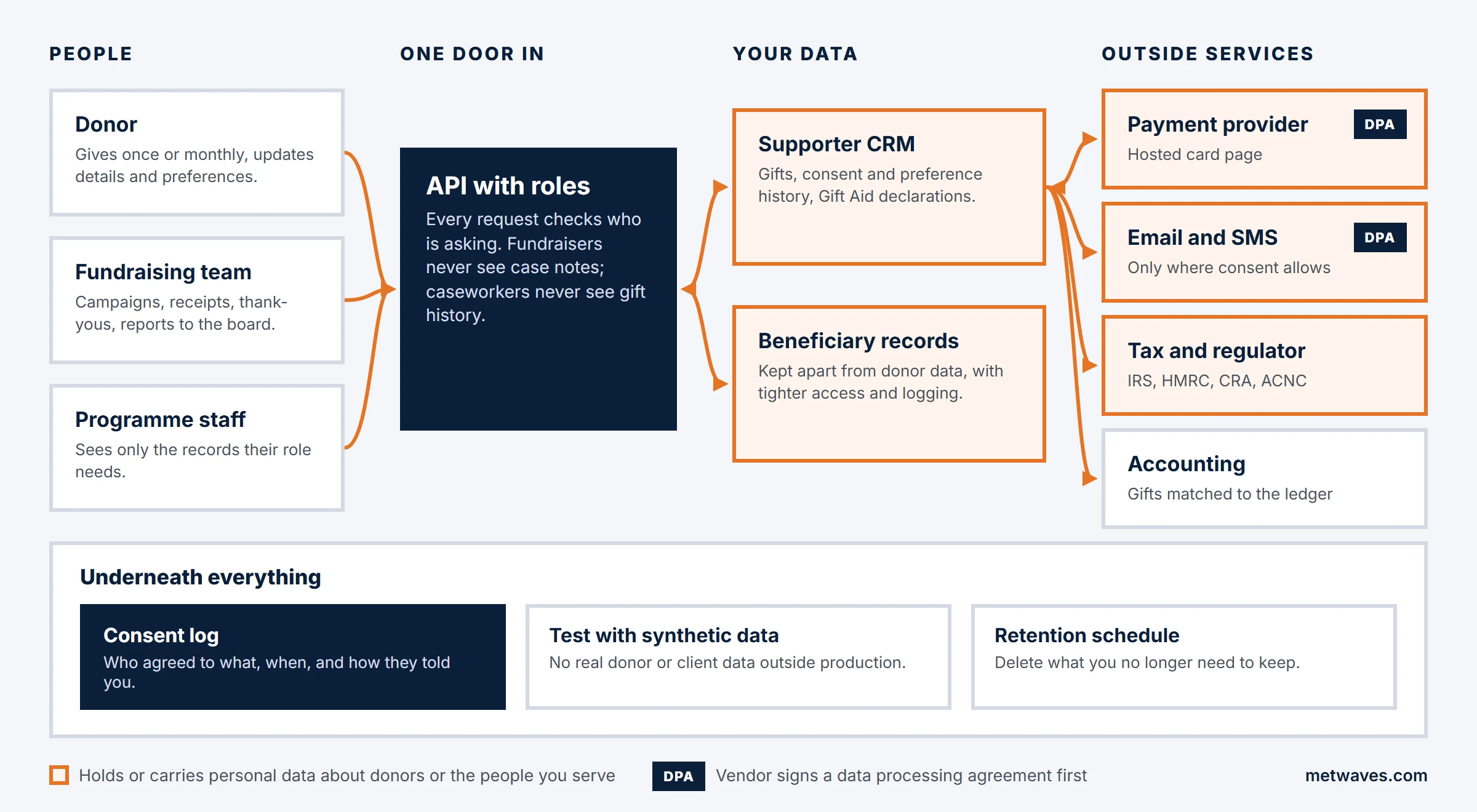
Before any screen is designed, we map where supporter and beneficiary data lives, who can see it and which outside services touch it. This is the map for a typical charity system.

How donor data moves through charity software: donor, fundraising team and programme staff reach one API that checks each role; the supporter CRM and beneficiary records are kept apart; a payment provider, email and SMS, tax and regulator filings and accounting connect outside; a consent log, synthetic test data and a retention schedule sit underneath
Orange boxes hold or carry personal data about donors or the people you serve. Every vendor marked DPA signs a data processing agreement before it sees any.

OUR WORK

Non-profit work: what we have built, and what transfers

We have not shipped a project for a non-profit or charity yet, and we will not show you one we did not build. These projects are real, and each solves a problem charities have: answering questions from your own content, personalising what people see, running an accessible public site and taking manual entry out of finance.

Copilot Studio helpdesk agent in Microsoft TeamsCASE STUDY

Professional services firm · United Kingdom

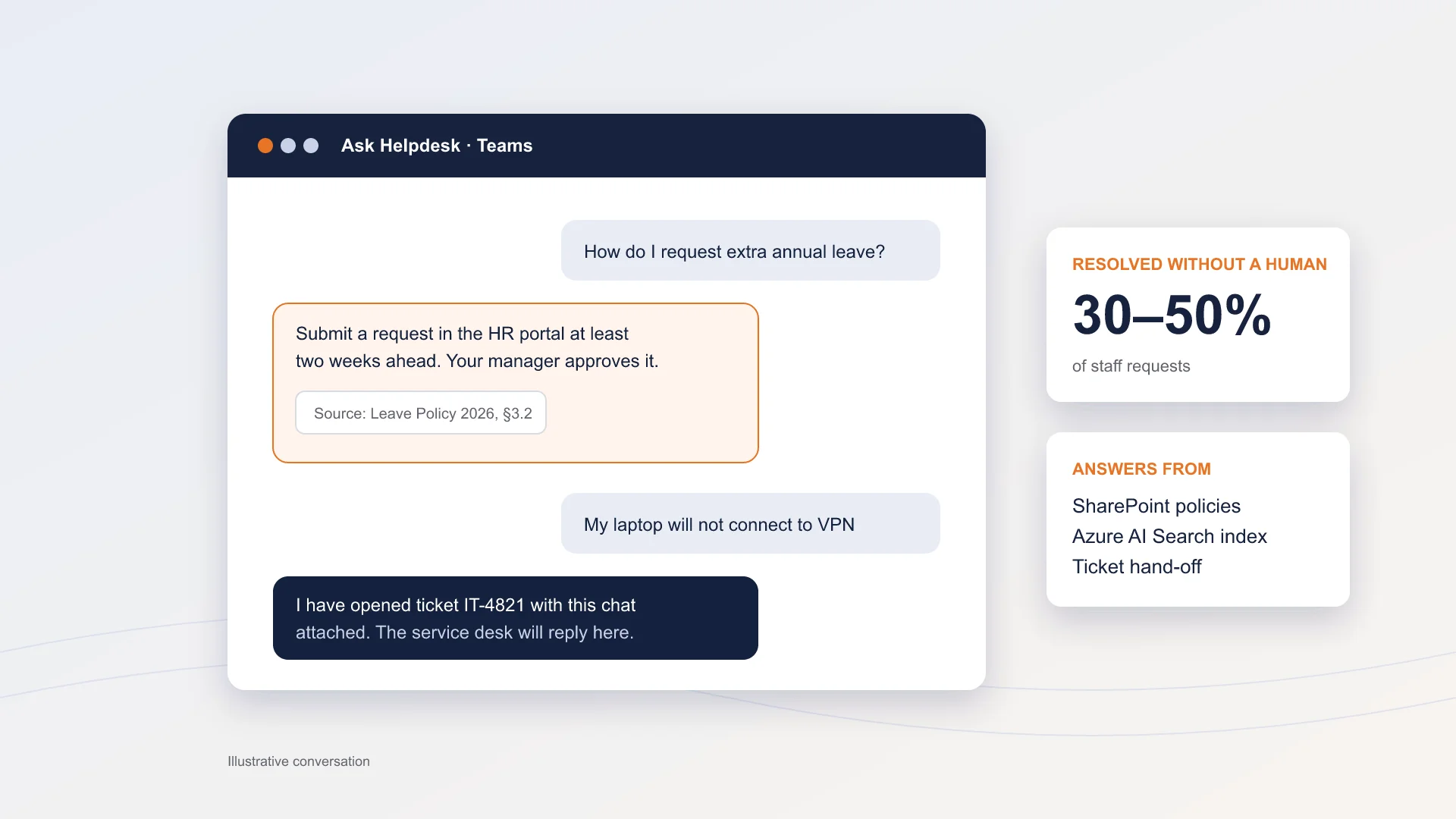
A Teams agent that answers staff questions from policy

A Copilot Studio agent answers IT, HR and policy questions from SharePoint, cites the document it used, never shows content a person cannot open, and opens a ticket with the conversation when it cannot help.

What carries over: a supporter or volunteer assistant needs the same habits: answer from your own content, respect permissions, hand over cleanly.

  • 30–50%of requests resolved without a person
  • 8 to 12weeks to go live

Read the helpdesk agent case study >

Personalised home page and recommendations in the online grocery storeCASE STUDY

Membership online store · organic groceries, beauty and home goods

AI personalisation and smart search for a membership store

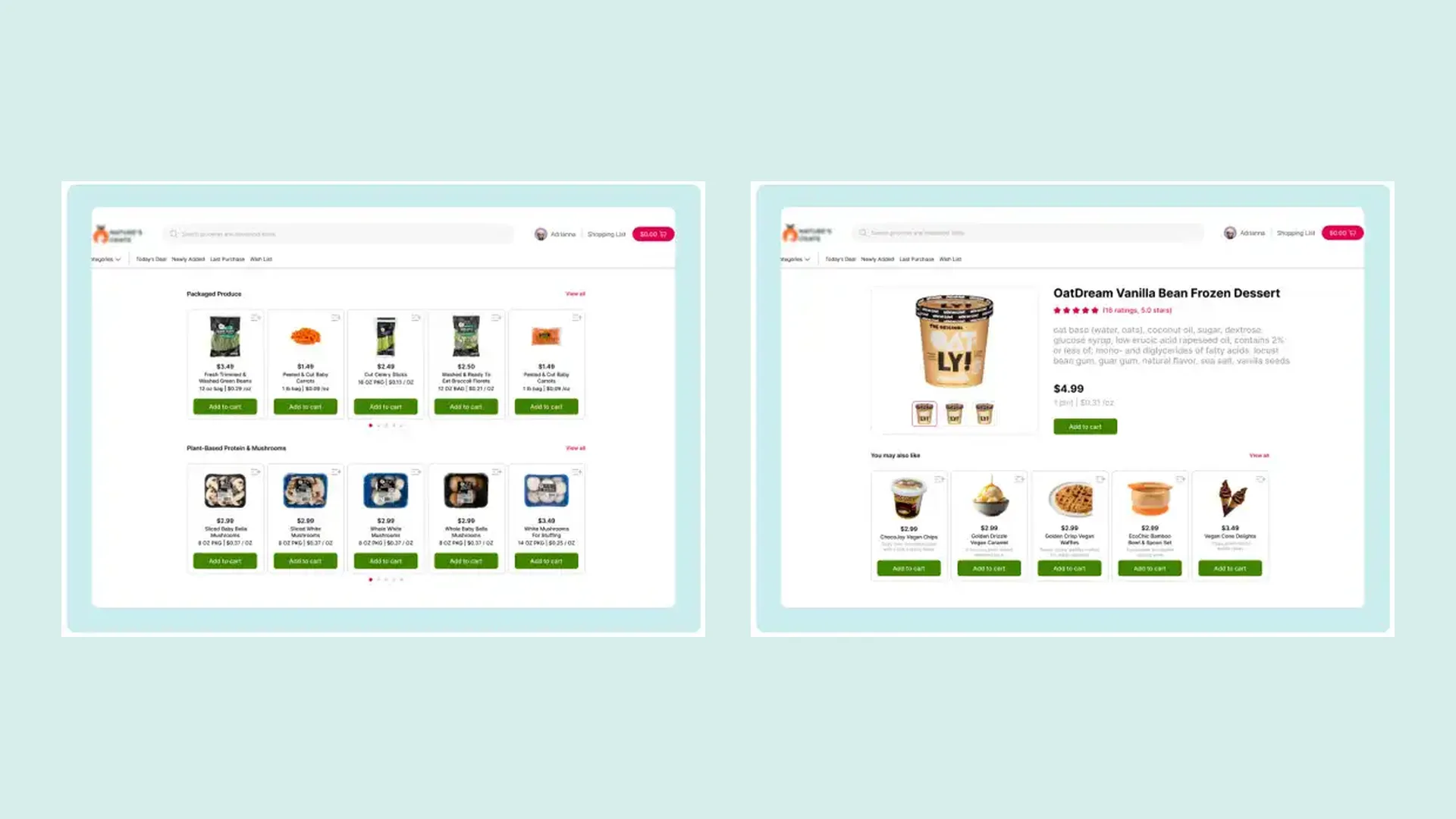
We added AI recommendations to the home page, product pages, cart and emails of a running store with more than 6,000 products, and a search that ranks results by each shopper's behaviour and preferences.

What carries over: the same approach makes appeals and thank-yous match what each supporter cares about.

  • 18%more orders
  • 6,000+products in the catalogue
  • 4places shoppers see recommendations

Read the personalisation case study >

Urgent care clinic websiteA public site with one-click booking and staff-edited notices, checked for ADA accessibility before launch and supported for six years. A charity's public site needs the same.
AI invoice processing agentReads about 1,000 supplier documents a month into SAP Business One with about 80% less manual entry. Gift and receipt reconciliation is the same shape of work.

Off-the-shelf charity CRM or custom software: what usually fits

Most charities should start with a good off-the-shelf CRM and donation platform. Custom work earns its place where your programmes, your data or your integrations do not fit the box.

Your situationWhat usually fitsWhy
Standard fundraising: appeals, regular giving, eventsAn off-the-shelf CRM and donation platformCheaper and faster. We will tell you so on the first call.
Staff re-key gifts between the donation page, CRM and accountsIntegrate before you rebuildConnecting what you have often removes the re-keying without replacing anything.
Your services need case records, rotas or outcomes no CRM handles wellA custom service app beside your CRMBeneficiary data stays separate from donor data, with its own access rules.
You give grants and run applications by emailA grant portal, bought or builtBuy if a product fits your process; build if your review and reporting steps are unusual.
Supporter and staff questions take hours every weekAn AI assistant on your own contentIt answers the routine questions and hands the rest to a person with the conversation attached.

How we work with charities

Charity software has to work for part-time staff and volunteers, so training and a small pilot are part of the plan. Nothing touches real supporter or client data until the safeguards are in place and tested.

  1. Step 1

    Discovery call

    Thirty minutes on your supporters, your systems and what wastes the most staff time.

  2. Step 2

    Map one gift and one case

    From the donate button to the annual return, and from referral to outcome.

  3. Step 3

    Build in phases

    One workflow at a time, tested with synthetic data, never real supporter records.

  4. Step 4

    Test with real services

    Payment provider sandboxes, email platform test lists and your accounting test company.

  5. Step 5

    Pilot with one team

    One appeal or one service first. Staff and volunteer feedback shapes the next release.

  6. Step 6

    Hand over or support

    Training and documentation, then hand over or keep it running and patched.

How to choose a nonprofit software development company

Ask these five questions of anyone you shortlist, us included. One thing we are not: a CRM vendor. If a product already does what you need, buy it and we will help you connect it.

Question to askA good answerA warning sign
Will card numbers ever touch your servers or ours?No: a hosted payment page or provider fields.“We'll store the cards securely.”
How do you record consent and opt-outs?Per person, channel and purpose, with the date and source.A single “subscribed” tick box.
Which non-profit system have you built?A named project, or a plain “none yet” and the work that transfers.Logos with no project behind them.
What data do your developers and testers use?Synthetic data outside production.An export of your supporter database.
Can we take our data and code with us if we leave?Yes: you hold the accounts, the code and exports in open formats.Hosting and data under the vendor's own account.

Related services

Engagement models and technology choices are on each service page.

Web application developmentDonation pages, portals and admin tools in the browser.
Mobile app developmentVolunteer and caseworker apps for iOS and Android.
Software integrationCRM, payments, email and accounting, connected.
AI chatbot developmentAssistants that answer from your own content.
Support and maintenanceKeeping your systems patched and running.

QUESTIONS & ANSWERS

Nonprofit software and compliance: frequently asked questions

Straight answers on donor privacy, receipts, consent, card payments, AI and cost. If you don't see an answer to your question, you can send us a message from our contact form.

Generally no. Exempt organisations must make their annual returns available for public inspection for three years, but apart from private foundations they are not required to disclose contributors' names and addresses (IRS). Your software should produce public copies with donor identities removed, and keep the full version only for the IRS.

In the US, a donor needs a written acknowledgment from you to deduct any single gift of $250 or more, and you must give a written disclosure when a payment over $75 is partly for goods or services (IRS Publication 1771). In Canada, official receipts must carry set details, including your registration number, a unique serial number and the CRA's name and website (CRA). We generate receipts from the gift record so the wording is right every time.

Since 5 February 2026, UK charities can use the new charitable-purpose soft opt-in to email or text supporters about their charitable purposes, if they meet the ICO's conditions (ICO). It cannot be used for contacts collected before that date. Anyone else still needs consent, and anyone can opt out at any time, so your CRM needs a dated record of how each contact was collected.

Yes, every organisation that accepts cards falls under PCI DSS, now version 4.0.1 (PCI SSC). The simplest way to keep the work small is a hosted payment page or payment fields from your provider, so card numbers never touch your servers. We design donation pages that way by default.

California's CCPA does not generally apply to non-profits (CPPA), but several newer state laws do. Colorado's applies to non-profits above its data thresholds, Oregon's has covered non-profits since July 1, 2025, and Delaware's applies to both for-profit and non-profit organisations. If you hold data on many residents of those states, plan for access, deletion and opt-out requests.

Start with low-risk work that saves staff time: answering supporter questions from your own content, drafting thank-yous and finding duplicate records. Keep a person approving anything that goes to a donor, a funder or a client, sign a data processing agreement with the AI provider, keep beneficiary data out unless the task needs it, and log every result.

It depends on how many systems have to connect (CRM, payments, email, accounting), the number of user roles, and whether staff or volunteers need a mobile app. A donation page with receipting is much smaller than a case-management system. We price after a short discovery, with running costs such as hosting, payment fees and email sending listed separately.

Not yet, and we say so. We have built a Microsoft Teams agent that resolves 30 to 50% of staff questions for a UK firm, AI personalisation that lifted an online store's orders by 18%, and a clinic website we supported for six years. Those carry over directly to supporter assistants, donor journeys and public sites for charities.

INSIGHTS & NEWS

Discover IT Industry Insights and Technology Trends

Nikit Nandan    Nikit Nandan November 22, 2026
Drupal 10 Reaches End of Life on December 9, 2026: Upgrade to Drupal 11 or Move Platform?

Drupal 10 reaches end of life December 9, 2026. How to move to Drupal 11 with Upgrade Status, Rector and Composer, what it needs, and when to switch platforms.

Learn More >
Software Development 10 min read
Nikit Nandan    Nikit Nandan November 22, 2026
PHP 8.2 Stops Getting Security Fixes on December 31, 2026: What Should a Business App or WordPress Site Do?

PHP 8.2 security support ends December 31, 2026. Which PHP version WordPress sites and business apps should move to, what breaks, and how to test first.

Learn More >
Software Development 11 min read
Nikit Nandan    Nikit Nandan November 22, 2026
Power Apps Premium Goes to $22 a User in January 2027: When Is a Custom App Cheaper?

Power Apps Premium rises to $22 per user per month on January 1, 2027, after the per app plan went off sale and AI Builder credits ended. A break-even table shows when a custom app is cheaper.

Learn More >
Microsoft Technologies 9 min read

Let’s build your idea!

Let us help you with free analysis & estimate. Our product expert will contact you within 12 hours.

 All your information is kept confidential and protected by NDA.