Updated November 21, 2026. Dates are from Drupal's core release schedule; requirements are from Drupal's PHP and database requirement pages and the official Drupal 10 to 11 upgrade guide.
Short answer. Drupal 10 reaches end of life on December 9, 2026: no more security releases for core after that date, and contributed modules will follow. Most Drupal 10 sites should upgrade to Drupal 11, which is supported until early December 2028. It is the smallest move, it keeps your content model, and you cannot reach Drupal 12 without passing through 11.3 anyway. Move platform only if you no longer use what Drupal is good at, or the site needs a rebuild regardless.
Key dates and facts
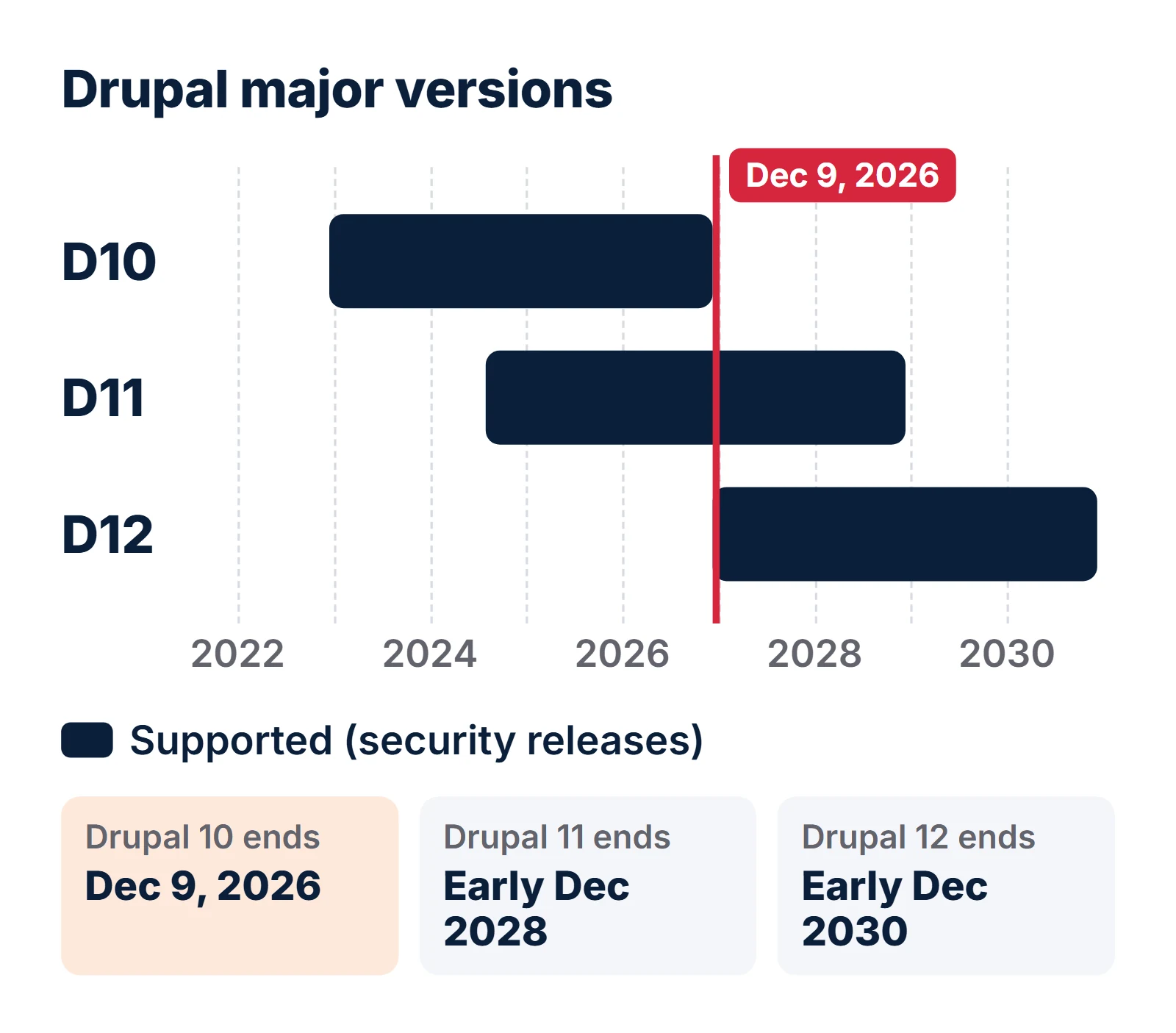
- Drupal 10 end of lifeDecember 9, 2026. Drupal 10.6.x is the last minor
- Drupal 11Released August 2, 2024; supported until early December 2028
- Drupal 12Releases the week of December 7, 2026; supported until early December 2030
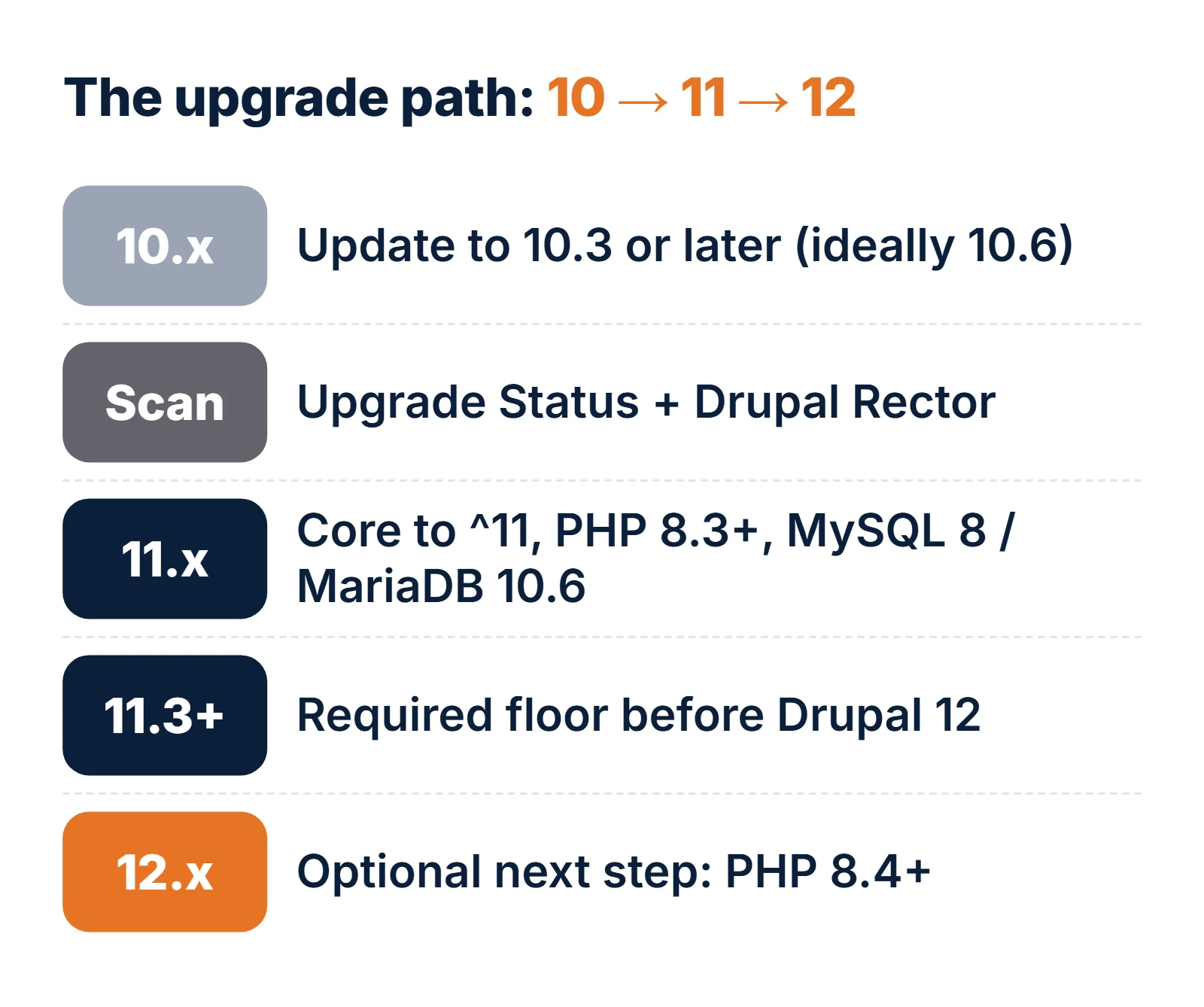
- Upgrade entry pointDrupal 10.3.0 or later is required before moving to 11
- Drupal 12 entry pointDrupal 11.3.0 or later is required before moving to 12
- Drupal 11 needsPHP 8.3+, MySQL 8.0+ or MariaDB 10.6+ or PostgreSQL 16+ or SQLite 3.45+
What changes when Drupal 10 reaches end of life on December 9, 2026?
Drupal supports each major version for four to four and a half years, ending in early December of the fourth year. For Drupal 10 that date is December 9, 2026, the same week Drupal 12.0.0 and 11.5.0 are released and security support ends for Drupal 10.6.x and 11.3.x.
- No more core security releases. The Drupal Security Team stops issuing advisories and fixes for Drupal 10. The monthly security window keeps running for 11.x and 12.x only.
- Contributed modules move on. Maintainers drop Drupal 10 from new releases over the following months, so even modules you keep updated stop shipping fixes you can install.
- The hosting floor rises. Drupal 11 needs PHP 8.3 and newer database servers. If your host still runs PHP 8.1 or MySQL 5.7 for this site, that changes too, and PHP 8.1 itself has been out of support since December 2025.
The site will not stop on December 10. It just stops being patched, which for a public site with logins, forms or payments is the part that matters.
Should you upgrade to Drupal 11, or wait for Drupal 12?
Upgrade to Drupal 11 now. Drupal 12 has two problems as a target this year. It ships the same week Drupal 10 loses support, so contributed modules will not all have Drupal 12 releases on day one. And there is no direct path: a change record from April 2026 says sites "must update to Drupal 11.3.0 or higher, prior to upgrading to Drupal 12.0.0", because Drupal 12 removed the database update hooks added before 11.3. Every Drupal 10 site goes through Drupal 11 first.
| Drupal 10 | Drupal 11 | Drupal 12 | |
|---|---|---|---|
| Supported until | December 9, 2026 | Early December 2028 | Early December 2030 |
| PHP | 8.1 to 8.4 | 8.3 or later (8.5 from 11.3) | 8.4 or later |
| MySQL / MariaDB | 5.7.8+ / 10.3.7+ | 8.0+ / 10.6+ | 8.0+ / 10.11+ |
| PostgreSQL / SQLite | 12+ / 3.26+ | 16+ / 3.45+ | 18+ / 3.45+ |
| Main platform changes | Symfony 6, CKEditor 5 | Symfony 7, jQuery 4, newer PHPUnit | Claro and Olivero themes removed from core |
| Can you move to it from 10? | n/a | Yes, from 10.3.0+ | No: via 11.3.0+ first |
How do you check if your Drupal 10 site is ready for Drupal 11?
The Upgrade Status module is the standard tool. It checks your environment against the next major's requirements, lists which contributed projects have a compatible release, and runs PHPStan with Drupal's deprecation rules over your custom code. Version 5.0.0 (released November 16, 2026) runs on Drupal 10.4 and later and covers both 10 to 11 and 11 to 12.
composer require 'drupal/upgrade_status:^5.0'
drush pm:install upgrade_status -y

# whole-site report: environment checks, then projects grouped by next step
drush upgrade-status:report

# deep scan of everything installed, saved as HTML for the team
drush upgrade-status:analyze --all --ignore-uninstalled --format=html > upgrade-status.html
The report sorts every project into groups such as remove, update, collaborate,
fix-with-rector and fix-manually. That grouping is your work list, and its size is the best early
predictor of effort. In CI, upgrade-status:analyze exits with code 3 when a project still has problems for
the next major, so you can fail a build on it.
Check the environment items first, because they involve your host rather than your code:
php -v                       # needs 8.3+ for Drupal 11
drush status --fields=drupal-version,php-version,db-driver
mysql --version              # MySQL 8.0+ or MariaDB 10.6+
Which core modules and themes leave in Drupal 11 and 12?
Modules removed from core still exist as contributed projects, so they are a Composer change, not a rewrite. But they must be swapped while you are still on Drupal 10.3 or later, before the core upgrade.
| Extension | Status | What to do |
|---|---|---|
| Actions UI, Activity Tracker, Book, Forum, Statistics, Tour | Removed from core in Drupal 11 | composer require the contrib version on Drupal 10, then upgrade |
| Classy, Stable (themes) | Moved to contrib with Drupal 10 | Sub-themes of these need the contrib theme or a new base |
| Ban, Contact, Field Layout, History, Migrate Drupal and Migrate Drupal UI, Search, Settings Tray, Shortcut, Telephone | Deprecated in Drupal 11, removed in Drupal 12 | Fine on 11; plan replacements before 12 |
| Claro and Olivero (themes) | Deprecated in 11.5, removed in 12 | Claro's successor is the new Default Admin theme; both remain as contrib |
Drupal picks up a contrib copy of a removed module automatically once Composer downloads it, because it looks in
core/modules last. On the Extend page the core copy stops showing as, for example,
"Book (Deprecated)".
What are the exact steps to upgrade Drupal 10 to 11?
This follows the official guide, trimmed to the commands. Do it on a copy of production with a fresh database dump.
1. Get to the latest Drupal 10 and update every contrib module
composer update "drupal/core-*" --with-all-dependencies
composer outdated "drupal/*"
drush updatedb -y && drush cache:rebuild
2. Fix custom code
Drupal Rector rewrites many deprecated API calls automatically. Upgrade Status tells you which modules it can handle (fix-with-rector) and which need a developer (fix-manually).
composer require --dev palantirnet/drupal-rector
cp vendor/palantirnet/drupal-rector/rector.php .
vendor/bin/rector process web/modules/custom --dry-run   # review, then run without --dry-run
Then declare Drupal 11 support in each custom module and theme:
# web/modules/custom/acme_orders/acme_orders.info.yml
name: 'Acme orders'
type: module
core_version_requirement: ^10.3 || ^11
Custom JavaScript deserves a test pass too: Drupal 11 moved to jQuery 4, which removes several long-deprecated jQuery functions.
3. Handle contrib modules with no Drupal 11 release
Composer will refuse the upgrade while any module's requirements exclude Drupal 11. The output looks like this:
Your requirements could not be resolved to an installable set of packages.

  Problem 1
    - drupal/example_module 1.4.0 requires drupal/core ^9.4 || ^10 -> found drupal/core[10.3.0, ..., 10.6.x]
      but these were not loaded, likely because it conflicts with another require.
Look for a newer release first. If the module is abandoned but the code works (many are only missing the version constraint), Drupal's lenient Composer endpoint lets you install it while you patch or replace it:
composer require mglaman/composer-drupal-lenient
composer config --merge --json extra.drupal-lenient.allowed-list '["drupal/example_module"]'
4. Upgrade core
chmod u+w web/sites/default web/sites/default/*settings.php web/sites/default/*services.yml

composer require 'drupal/core-recommended:^11' 'drupal/core-composer-scaffold:^11' \
  'drupal/core-project-message:^11' --no-update
composer require drush/drush --no-update
composer update --dry-run     # read it, then:
composer update

drush updatedb:status
drush updatedb -y
drush cache:rebuild

chmod 755 web/sites/default
chmod 644 web/sites/default/*settings.php web/sites/default/*services.yml
From Drupal 11.4, the guide also asks you to allow the Symfony runtime Composer plugin with
composer config allow-plugins.symfony/runtime true. If you customised scaffold files such as
.htaccess or robots.txt, re-apply those changes after the update.
5. Test, deploy, watch
Run your test suite, click through editorial workflows, forms and search, then deploy. For the first days, watch the
log with drush watchdog:tail and confirm cron runs (drush cron).
How long does a Drupal 10 to 11 upgrade take?
| Site profile (estimate) | Typical shape | Effort (estimate) |
|---|---|---|
| Small | Brochure or content site, about 20–40 contrib modules, a contrib or lightly customised theme | 3–5 days |
| Medium | Custom theme, a few custom modules, Webform, Search API, multilingual | 2–4 weeks |
| Large | Many custom modules, Commerce or integrations, multisite or several environments | 1–3 months |
What makes it longer: contributed modules with no Drupal 11 release and no active maintainer, custom modules written against APIs deprecated back in Drupal 9, a host that cannot offer PHP 8.3 or MySQL 8, and themes built on Classy or Stable.
Should you upgrade to Drupal 11, go headless, or move to WordPress?
An end-of-life date is a fair moment to ask whether Drupal is still the right tool. Drupal is strongest with structured content: many content types, fine-grained roles and permissions, editorial workflows, multilingual sites and complex integrations. If your site has grown into a set of pages and news posts edited by two people, a lighter platform may cost less to run.
| Option | Best when | What it costs you | Rough effort (estimate) |
|---|---|---|---|
| Upgrade to Drupal 11 | You use Drupal's content model, roles, workflows or languages | Least change; same team skills; Drupal 12 upgrade by 2028 | Days to weeks |
| Drupal 11 as a headless back end | The same content feeds an app, kiosk or several sites; you want a modern front end | Two codebases to run (Drupal plus a JavaScript front end); preview and SEO need work | Upgrade, plus 1–3 months for the front end |
| Move to WordPress | Mostly pages and posts, small editorial team, simple permissions | A content migration, redirects for every URL, re-built forms and integrations | 3–8 weeks for a typical marketing site |
| Rebuild on another stack | The site is really an application (portals, workflows, data) | A full project; often the right call when Drupal was a workaround | Months |
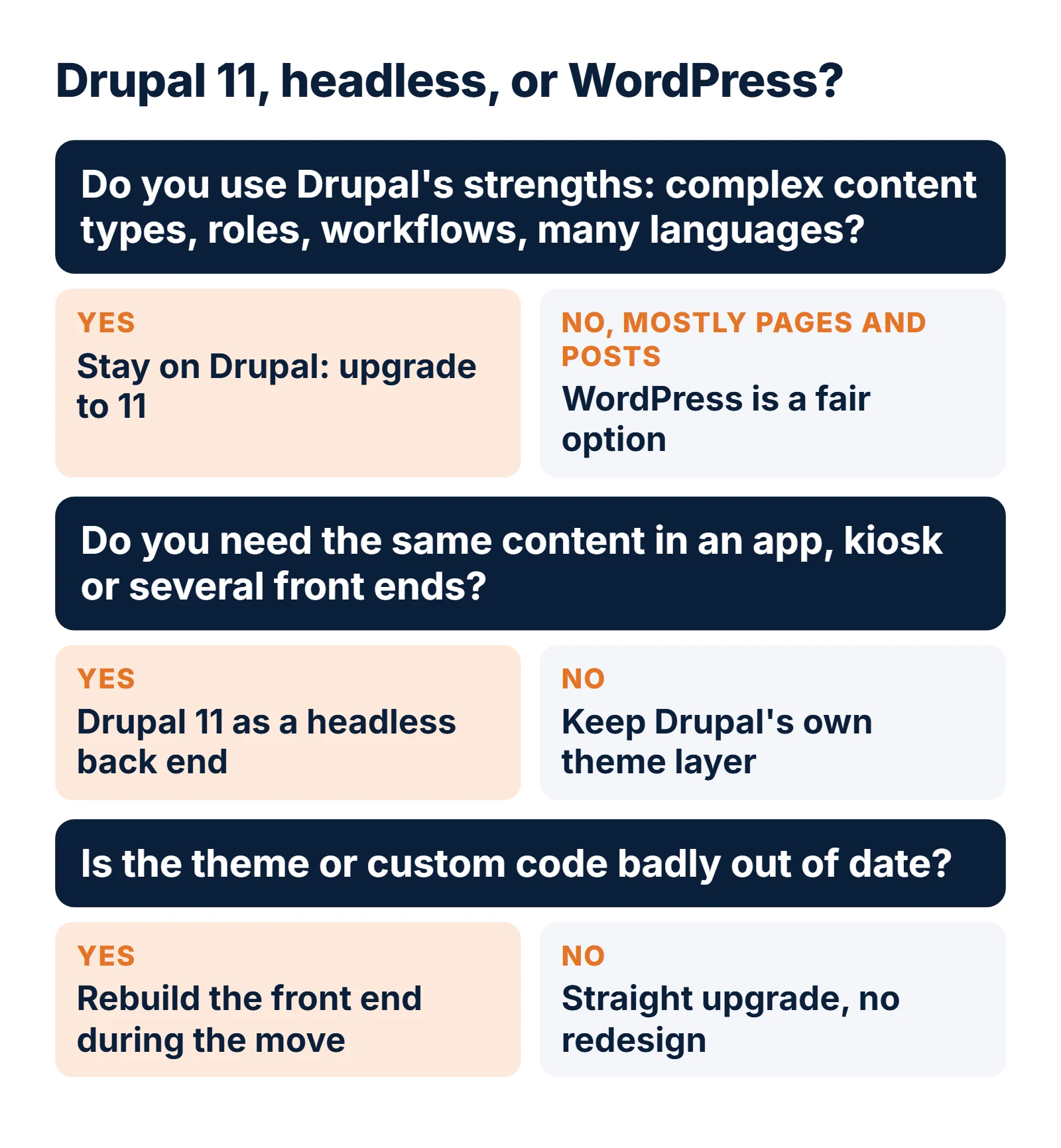
Whichever way you go, a platform move is a migration project, not a weekend: every URL needs a 301 redirect, every form and integration needs rebuilding, and content needs mapping field by field. Do not let December 9 rush that decision. Upgrading to Drupal 11 first buys two years in which to make it properly.
What this means for you: owner or IT manager
- Drupal 10 stops getting security fixes on December 9, 2026. Drupal 11 is covered until early December 2028.
- Moving to Drupal 11 is usually a contained project. A platform change is a full migration and should not be rushed.
- Check with your host now: Drupal 11 needs PHP 8.3 and MySQL 8.0 or MariaDB 10.6.
- Plan the Drupal 12 upgrade for 2027 or 2028, once contributed modules have caught up.
What this means for you: developer
- Get to the latest 10.x, then run
drush upgrade-status:analyze --all. - Swap Book, Forum, Statistics, Tour, Actions UI and Activity Tracker for their contrib versions while still on 10.
- Run Drupal Rector on custom code and add
^11tocore_version_requirement. - Use the lenient endpoint only as a bridge; replace or patch abandoned modules properly.
What should you do before December 9, 2026?
- Install Upgrade Status on a copy of the site and read the report this week.
- Confirm hosting: PHP 8.3 or later and a database version Drupal 11 accepts.
- Update to the latest Drupal 10 release and every contrib module.
- Swap removed core modules for contrib, and fix custom code with Rector.
- Upgrade a staging copy, test the journeys that matter, then deploy.
- Decide the long-term platform calmly, from a supported Drupal 11 site.
Check the server at the same time: PHP 8.2 itself stops getting security fixes on December 31, 2026, according to php.net, so a Drupal 11 site should go straight onto PHP 8.4.
Frequently asked questions
When does Drupal 10 reach end of life?
December 9, 2026. After that the Drupal Security Team issues no more security releases for Drupal 10. Drupal 10.6.x is the last minor version.
How long is Drupal 11 supported?
Until early December 2028, according to drupal.org's release schedule. Drupal 12 is supported until early December 2030.
Can I upgrade directly from Drupal 10 to Drupal 12?
No. Sites must be on Drupal 11.3.0 or higher before upgrading to Drupal 12, because Drupal 12 removed the update hooks added before 11.3. A Drupal 10 site upgrades to Drupal 11 first.
What version of Drupal 10 do I need before upgrading to Drupal 11?
Drupal 10.3.0 or later. The official upgrade guide recommends updating to the latest Drupal 10 release and all contributed modules before the core upgrade.
What PHP and database versions does Drupal 11 need?
PHP 8.3 or later, and MySQL 8.0+, MariaDB 10.6+, PostgreSQL 16+ or SQLite 3.45+.
What if a contributed module has no Drupal 11 release?
Look for a newer release or an alternative first. If the module works but only lacks the version constraint, Drupal's lenient Composer endpoint (mglaman/composer-drupal-lenient) lets you install it while you patch or replace it.
Is it worth leaving Drupal instead of upgrading?
Only when you no longer use Drupal's strengths, such as complex content types, permissions, workflows and languages, or the site needs a rebuild anyway. Otherwise upgrade to Drupal 11 and decide on the platform from a supported site.
Need the upgrade done, or a second opinion on moving platform? We upgrade Drupal sites and migrate content between CMSs for businesses in the US, UK, Canada and Australia. It starts with an Upgrade Status report and a fixed quote. See our CMS development service and application modernization, or ask for a Drupal upgrade review.
For a headless front end on top of Drupal 11, see web application development; for patching and monitoring after the upgrade, see application support and maintenance.

Nikit Nandan
Strategy Director
Nikit is experienced in conducting in-depth research to stay abreast of industry trends and emerging technologies.