
Travel App and Software Development
Looking for a travel app development company that starts with your suppliers, not your screens? We build booking sites and apps, itinerary apps, supplier integrations and booking chatbots for tour operators, agencies, activity providers and rental firms in the US, UK, Canada and Australia. We have not built for a travel client yet; you can try our own car rental assistant today.

Car rental assistant demo on Google Cloud · real-time alerts at 10,000 concurrent users (fintech) · not yet a travel client
THE TRAVEL INDUSTRY
What the travel industry is, and how money moves through it
The travel industry is every business that moves people and looks after them away from home: airlines, rail and coach operators, hotels and short-term rentals, car rental firms, tour operators, travel agencies and the activities people book once they arrive. Most of it is sold through a chain of intermediaries, so a single trip can touch five companies' systems.
Money flows backwards along that chain. The traveller pays the agency or operator; the seller keeps a commission or a margin and pays each supplier later, often weeks after the booking. Inventory comes from global distribution systems (GDS) such as Amadeus, Sabre and Travelport, from airlines directly through NDC, from bed banks and channel managers for hotels, and from activity platforms. Each connection has its own contract, certification and fees.
Travel software development fills the gaps in that chain: bookings that arrive by email and are re-keyed, availability that is out of date, changes handled by phone, and supplier invoices matched to bookings by hand.
Tour operators
Packages, group tours, destination companies
- Package pricing
- Supplier contracts
- Itineraries
Travel agencies
High-street, home-based and online agencies
- Booking tools
- Quotes
- Customer records
Activities
Tours, attractions, experiences
- Online booking
- Capacity
- Check-in
Stays
Small hotel groups and short-term rentals
- Property systems
- Channel managers
- Guest apps
Transport and rental
Airlines, rail, coach, car and van rental
- Reservations
- Fleet
- Check-in
CHALLENGES
The challenges travel businesses face
Six problems travel teams deal with every season, and where software makes a real difference.
Bookings re-keyed from email
Enquiries and supplier confirmations arrive by email, and staff copy them into the reservation system, the itinerary and the invoice. One typo sends a traveller to the wrong hotel.
Booking forms that write straight to the reservation system, and document reading for supplier confirmations, with a person checking exceptions.
Availability that is out of date
The website shows a tour or room that sold out an hour ago, or hides one that is free, so you oversell or turn people away.
Live availability from suppliers or channel managers, cached carefully, and checked again before payment.
Changes and disruption by phone
When a flight is cancelled or a tour is weathered off, everyone calls at once, and rebooking is done by hand while refund deadlines run.
Self-service changes in the app, an assistant that answers the routine questions, and refund rules built into the system rather than kept in someone's head.
Supplier invoices matched by hand
Hotels, ground handlers and guides invoice in their own formats, weeks later, and someone matches each line to a booking before anyone is paid.
Invoice reading that matches lines to bookings and flags differences, so staff only handle what does not match.
Tools that cannot price your trips
Off-the-shelf booking tools handle a standard tour, but not your packages, group rules, seasonal pricing or add-ons.
A pricing engine around your own rules, connected to the booking tool you already use where it works.
Losing travellers at checkout
Most travel searches happen on phones, and long forms, surprise fees and slow pages lose bookings at the last step. Hidden fees are now targeted by law in several markets.
Short mobile checkout, the full price from the first screen, and saved traveller details for next time.
AI IN TRAVEL
How AI can help travel businesses, from planning to the trip home
AI fits travel well where questions repeat and documents pile up. It needs a person behind it wherever money comes back or a traveller could be stranded.
- PlanCheck the rules
Trip planning assistant
Suggests itineraries from your own bookable products, dates and budget, not from the open web.
A person stays in chargeStaff curate what it can recommend, and it only offers what can be booked.
Any price it shows must be the full price a traveller will pay.
- BookCheck the rules
Booking assistant
Answers questions and collects the details for a booking in conversation, as our car rental demo does.
A person stays in chargeStaff confirm anything the system cannot book on its own.
Card details go only through the payment provider's page, never into the chat.
- PriceCheck the rules
Pricing and packaging
Suggests prices and bundles from demand, season and supplier costs.
A person stays in chargeA revenue manager sets floors, ceilings and what can be bundled.
Advertised prices must include mandatory fees, and packages can trigger package travel rules.
- PrepareStrict rules
Entry and document reminders
Reminds travellers about passports, visas and check-in times, linking to official sources.
A person stays in chargeStaff own the wording; it never gives its own entry advice.
Wrong entry advice can strand a traveller. Point to the official source every time.
- DisruptionStrict rules
Rebooking and refund assistant
Offers alternatives when a supplier cancels and explains the traveller's options.
A person stays in chargeAn agent approves refunds outside policy and every unusual case.
Refund rights are set by law: automatic airline refunds in the US, 14-day package refunds in the UK.
- AfterLight rules
Supplier invoice matching
Reads supplier invoices and matches each line to a booking, flagging differences.
A person stays in chargeFinance approves before anything is paid.
Finance controls rather than travel law.
The car rental demo shows the booking assistant pattern. The others are uses we would scope with you.
COMPLIANCE
Travel rules your booking software has to follow
Travel software takes payments, holds passport and travel data and promises refunds, so the rules reach every step of a booking. These are the ones that change what the software must do, in order.
Showing a price
Is the price on screen the price they will pay?
- US
Airfares: the advertised price must be the entire price the customer pays (DOT, 14 CFR 399.84)
- US
Hotel stays and rentals: total price upfront, including mandatory fees (FTC rule, since May 12, 2025), for travel agents and platforms too
- UK
Drip pricing is banned under the DMCC Act 2024
- CA
A price made unattainable by fixed mandatory fees is misleading (Competition Act)
- AU
Rules on fees revealed only at checkout start on July 1, 2027
Taking the booking
Are you allowed to sell this, and is the money safe?
- ALL
PCI DSS v4.0.1: take cards on the provider's hosted page or iframe
- UK
Packages need set pre-contract information and insolvency protection (Package Travel Regulations 2018); ATOL, run by the CAA, covers packages with a flight
- US
Some states register sellers of travel; California requires all sellers of travel to register with its Attorney General
- CA
Ontario travel sellers must be registered under the Travel Industry Act, 2002; British Columbia licenses travel agents through Consumer Protection BC
Accessible booking
Can every traveller book on their own?
- US
Airlines with aircraft of more than 60 seats: booking pages to WCAG 2.0 AA since 2015 and the whole site since 2016 (Air Carrier Access Act rules)
- US
Large online ticket agents must offer web fares to people who cannot use the site because of a disability
- CA
Ontario's AODA: WCAG 2.0 AA for organisations with 50 or more employees
- ALL
Elsewhere, equality and disability law: the Equality Act 2010 (UK), the Disability Discrimination Act 1992 (AU)
When plans change
Who refunds, how fast?
- US
Cancelled or significantly changed flights: automatic refunds within 7 business days to a card or 20 days otherwise; ticket agents included (DOT, 2024)
- UK
Package refunds within 14 days of termination (Package Travel Regulations 2018)
- CA
Air Passenger Protection Regulations set airline duties for delays, cancellations and refunds
- AU
Consumer guarantees: services with due care and skill, and they cannot be excluded
What is changing
What to build for now
- US
DOT pauses refund enforcement for renumbered flights until July 2027 and plans to redefine a cancellation
- US
The 2024 airline fee disclosure rule was vacated in February 2026; the 2011 rules apply again
- UK
Linked travel arrangements are abolished for bookings from April 6, 2027; many become packages
- AU
Unfair trading practices and subscription traps banned from July 1, 2027
A summary for planning, not legal advice. Checked in November 2026; confirm the details with your adviser.
FOUR MARKETS
Travel rules in the US, UK, Canada and Australia, side by side
The same booking meets different rules in each market. This is the comparison we use when a client sells in more than one.
| Requirement | USUnited States | UKUnited Kingdom | CACanada | AUAustralia |
|---|---|---|---|---|
| Selling travel | Some states register sellers of travel, such as California | Package Travel Regulations 2018; ATOL for packages with a flight | Provincial: registration in Ontario, licensing in British Columbia | Australian Consumer Law, enforced by the ACCC |
| Air passenger rights | DOT rules: automatic refunds, full fare advertising | UK261 for flight delays and cancellations, enforced by the CAA; the PTR for packages | Air Passenger Protection Regulations (CTA) | Consumer guarantees under the Australian Consumer Law |
| Price display | Entire price for airfares; total price for hotel stays (FTC, May 2025) | Drip pricing banned (DMCC Act 2024) | Fixed mandatory fees must be in the price (Competition Act) | Hidden-fee rules from July 1, 2027 |
| Traveller data | No single federal law; state privacy laws | UK GDPR and the Data Protection Act 2018 (ICO) | PIPEDA; Alberta, British Columbia and Quebec have their own laws | Privacy Act 1988 and the Notifiable Data Breaches scheme |
| Accessibility | Air Carrier Access Act rules for airline sites; ADA Title III for other businesses | Equality Act 2010 | Ontario's AODA: WCAG 2.0 AA for organisations with 50 or more employees | Disability Discrimination Act 1992 |
| Card payments | PCI DSS v4.0.1, through your acquirer | PCI DSS v4.0.1, through your acquirer | PCI DSS v4.0.1, through your acquirer | PCI DSS v4.0.1, through your acquirer |
A summary for planning, not legal advice. Confirm the details for your business with your adviser.

That is the industry. Here is where Metwaves fits: travel businesses whose suppliers, prices and changes need to live in one system, with these rules built in from the first release.
Custom software development for travel: what we build
Six kinds of system, each linked to the page that explains how we build it. Pick one to see what it does and who usually buys it.
Booking websites and apps
Search, live availability, pricing with your rules, and a short mobile checkout that shows the full price from the first screen. Built around the booking system you have where it works, and replacing only what cannot price your trips.
- Usually bought by
- Tour operators, activity providers and agencies
- Search
- Availability
- Package pricing
- Checkout
- Saved travellers
Customer and itinerary apps
Every booking, document and voucher in one app that works offline abroad, with alerts when something changes and self-service for the changes your rules allow.
- Usually bought by
- Operators and agencies with repeat travellers
- Itineraries
- Offline documents
- Change alerts
- Self-service changes
Supplier and channel integrations
Connections to GDS, NDC, bed banks, channel managers and activity platforms, with retries, mapping and alerts. The contract and certification steps are planned first, because they set the timeline.
- Usually bought by
- Any travel business selling other companies' inventory
- GDS
- NDC
- Bed banks
- Channel managers
- Activity platforms
Booking and service chatbots
Assistants that answer booking questions, collect details and hand over to staff, like our own car rental demo. Changes in the reservation system go through checks, not straight from the chat.
- Usually bought by
- Agencies and rental firms with busy phones
- Booking questions
- Detail capture
- Staff handover
- Change requests
Supplier invoice and document automation
Supplier invoices, confirmations and vouchers read into structured data and matched to bookings, with a person checking every exception.
- Usually bought by
- Operators paying many small suppliers
- Invoice reading
- Booking match
- Exceptions queue
- Accounting export
Car and van rental software
Reservations, fleet availability and rental chat. Our automotive page covers rental fleets in more depth.
- Usually bought by
- Rental firms and fleet operators
- Reservations
- Fleet availability
- Rental chat
Supplier connections: what each one needs
Supplier connections set the timeline and the running cost of travel software. Each starts with a contract.
| Connection | What it gives you | What you sign | What sets the timeline |
|---|---|---|---|
| GDS (Amadeus, Sabre, Travelport) | Airline, hotel and car inventory through one connection | A GDS agreement, usually with per-booking fees | Certification and contract, more than the code |
| NDC | Airline offers and ancillaries direct from the airline, often richer than GDS content | An airline or aggregator agreement for each source | One airline at a time, each with its own rules |
| Bed banks | Wholesale hotel rates to package with other services | A trade agreement with the bed bank | Mapping hotels and room types across sources |
| Channel managers | Live room availability and rates from hotels | Access through the hotel or the channel manager's partner programme | Partner approval and mapping per property |
| Activity platforms | Tours and attractions with live capacity | Reseller or API terms with the platform | Capacity rules and cancellation terms per product |
Vendors named are examples of the market, not integrations we have built.
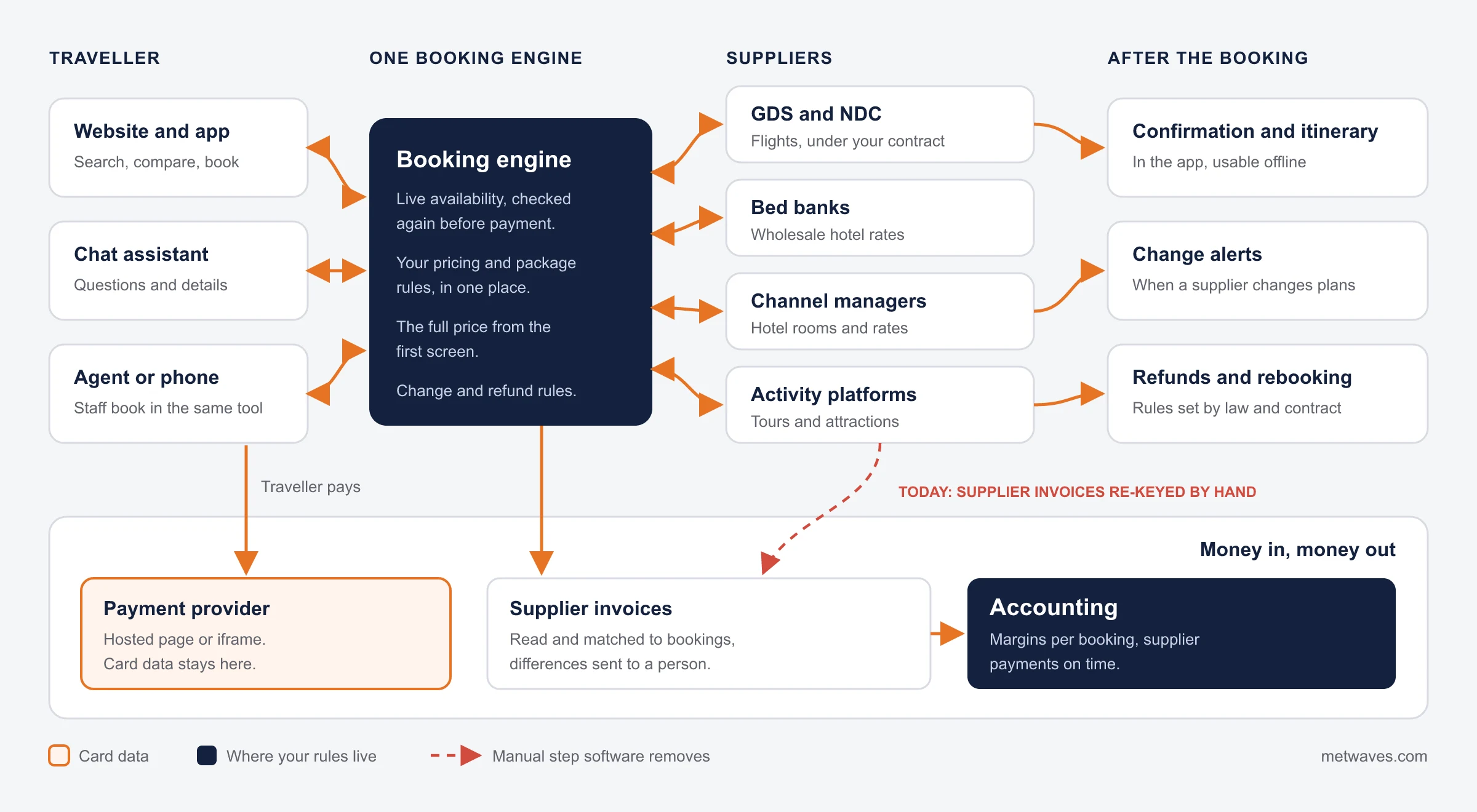
How a booking moves through the system
One booking engine holds your prices and rules; suppliers, payments and the traveller's app all connect to it.
OUR DEMO AND WORK THAT TRANSFERS
Try a booking assistant: our car rental demo
We have not built software for a travel client yet. What you can try today is our own car rental assistant: a demo on Google Cloud that helps someone reserve a car, SUV, van or truck, compares economy and luxury options, and suggests roomier vehicles for families and long trips. It is a demo, not a client system, and we label it that way.
Two client projects from other industries transfer directly. TradeAlert, built for a stock trader, sends real-time alerts by email, SMS and app notification and was built to handle up to 10,000 concurrent users: fare drops and availability alerts are the same pattern. Our invoice agent reads about 1,000 supplier documents a month into SAP Business One for an Australian business: hotel and ground handler invoices are the same shape of work.
- Our demoCar rental assistant on Google Cloud
- LabelledDemo, not a client system
- Transfers from fintechReal-time alerts, up to 10,000 concurrent users
- Transfers from financeAbout 1,000 supplier documents a month
- Travel clientsNone yet
Buy, extend or build: what usually fits
Many travel businesses should buy, not build. This is the advice we give on the first call.
| If you... | What usually fits | Why |
|---|---|---|
| Sell standard tours or activities | An off-the-shelf booking system | Cheaper and faster to launch. We will tell you so on the first call. |
| Run a hotel | A property management system and a channel manager | They exist for this; custom software rarely beats them. |
| Have a booking tool that fits, but staff re-key from email | Integration and document automation | Remove the re-keying without replacing anything. |
| Get the same booking questions all day | A booking chatbot with staff handover | Try our car rental demo to see the pattern. |
| Sell packages, pricing or an experience that is the product | A custom booking app around licensed supplier content | Your rules in the software, with suppliers connected through their APIs. |
| Need airline content | A GDS or NDC aggregator agreement first | The contract sets the timeline more than the code does. |
What drives the cost of travel software
Supplier connections, not screens, drive the cost of travel software. We quote after discovery.
Supplier connections
Each GDS, NDC, bed bank or channel manager has its own contract, certification and mapping work.
Change and refund rules
Encoding who refunds what, how fast, is where travel software gets complex.
Payments and currencies
Several currencies, deposits, balances and payouts to suppliers add logic and testing.
Offline itineraries
Apps that work abroad without signal need careful sync.
Peak-season load
Sales and school holidays bring traffic many times normal; testing for it costs time.
Package rules
Selling packages brings information, protection and refund duties into the software.
Supplier per-booking fees, hosting and app store costs are listed separately in every quote.
How we work with travel businesses
Contracts and suppliers come first, because they set the timeline. Then one booking flow, end to end, before the season.
- 1
Discovery call
Thirty minutes on what you sell, who supplies it and where bookings get stuck.
- 2
Walk one booking
From search to supplier invoice, with every system and email it passes through.
- 3
Contracts and plan
Which supplier agreements you need, which you have, and a costed plan for the first release.
- 4
One flow, one supplier
The first booking flow built on one supplier connection, end to end.
- 5
Load test
Tested at peak-season traffic before the season, not during it.
- 6
Support through the season
We watch the first season with you, then hand over or keep running it.
How to choose a travel app development company
Ask these five questions of anyone you shortlist, us included. Where we may not win today: travel-specific integration history.
| Question to ask | A good answer | A warning sign |
|---|---|---|
| Which supplier systems have you integrated? | Named GDS, NDC or channel manager projects. (Ours: none yet in travel.) | “We can connect to anything.” |
| Who signs the GDS and supplier contracts? | You do, so the access stays yours. | Access through the vendor's own account. |
| How do you test for peak season? | Load tests at your expected peak, with the numbers. | No load test before launch. |
| How does the app work abroad without signal? | Itineraries and documents stored on the phone. | Everything needs a connection. |
| Would you tell us to buy a booking system instead? | Yes, when it fits. | Every answer is a custom build. |
Related services
Each page explains how we work and what it costs to run.
QUESTIONS & ANSWERS
Travel apps and booking software: frequently asked questions
Straight answers on cost, GDS, build or buy, chatbots, refunds and package rules. If you don't see an answer to your question, you can send us a message from our contact form.
Supplier connections, not screens, drive the cost. A booking site for your own tours on one booking system is much smaller than an app that packages flights, hotels and activities from several suppliers. We price after a short discovery, with per-booking supplier fees and running costs listed separately.
A GDS connection starts with a contract and the GDS's certification process, not with code, and the contract should be in your name. We have not yet built a GDS integration; we would plan the contract, certification and testing with you before quoting the build.
Buy one if you sell standard tours, activities or rooms; they are mature and cheaper. Build when your pricing, packaging or experience is the product and off-the-shelf tools cannot handle it, and keep the parts that work.
It can answer questions, collect the details and explain the options. Changes in the reservation system should go through an agent with checks, or a person, because refund rules apply. Try our car rental demo to see the conversation side.
In the US, airlines and ticket agents owe automatic refunds for cancelled or significantly changed flights: within 7 business days to a card, 20 days otherwise. In the UK, package refunds are due within 14 days of termination. Canada has the Air Passenger Protection Regulations, and Australia's consumer guarantees cannot be excluded.
For bookings from April 6, 2027, linked travel arrangements are abolished: the first type becomes a package with full protection, and the second disappears. Booking flows that combine services need to know which side of the line a sale falls.
Not for a client. We have a car rental assistant demo, a real-time alert platform built for up to 10,000 concurrent users, and an invoice agent that reads about 1,000 supplier documents a month. If travel integration history matters most, ask every vendor for named GDS or channel manager projects.
Our integration projects in other industries have gone live in 8 to 12 weeks. Travel timelines depend most on supplier contracts and certification, so we give a date once those are known.
INSIGHTS & NEWS
Discover IT Industry Insights and Technology Trends
 Nikit Nandan
November 17, 2026
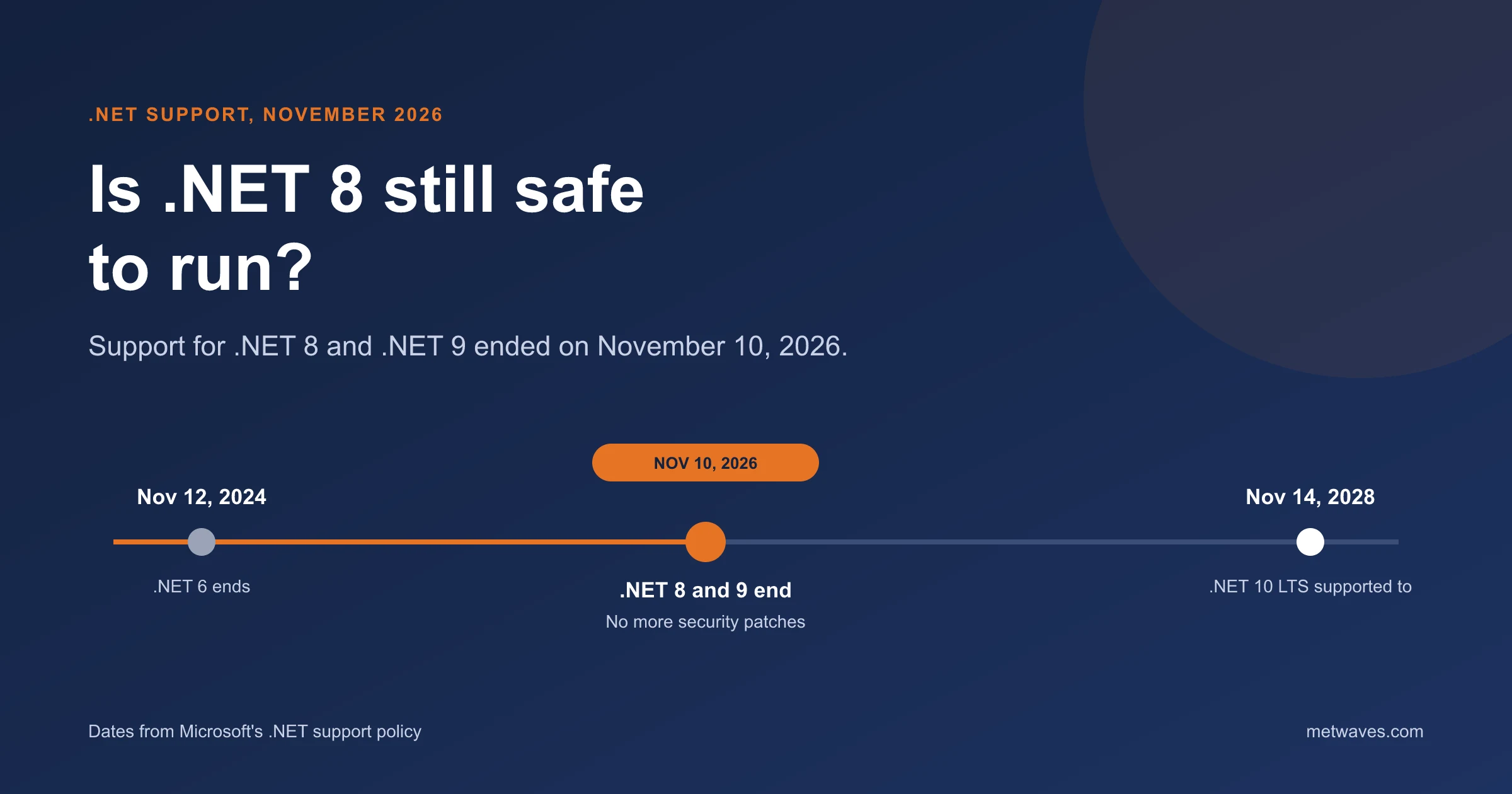
Is .NET 8 Still Safe to Run After November 2026?
Support for .NET 8 and .NET 9 ended on November 10, 2026. What that means for apps still on them, how risky it is, and how to plan the move to .NET 10.
Learn More >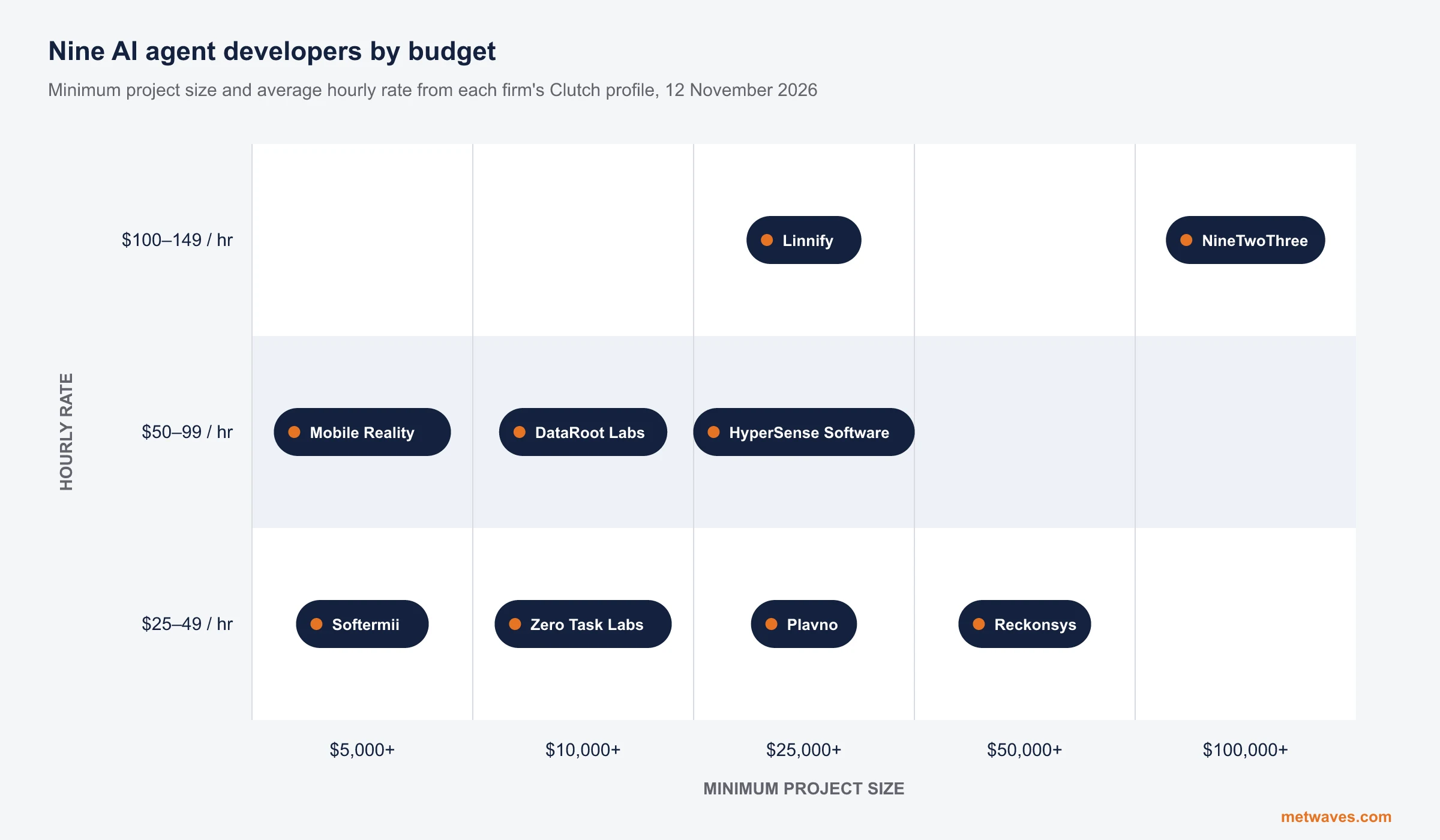 Nikit Nandan
November 12, 2026
Top AI agent development companies for small and mid-sized businesses (2026)
Nine AI agent development firms a small or mid-sized business can shortlist, with Clutch figures, minimum budgets and the weaknesses their own clients name. Published by Metwaves, which is not ranked.
Learn More >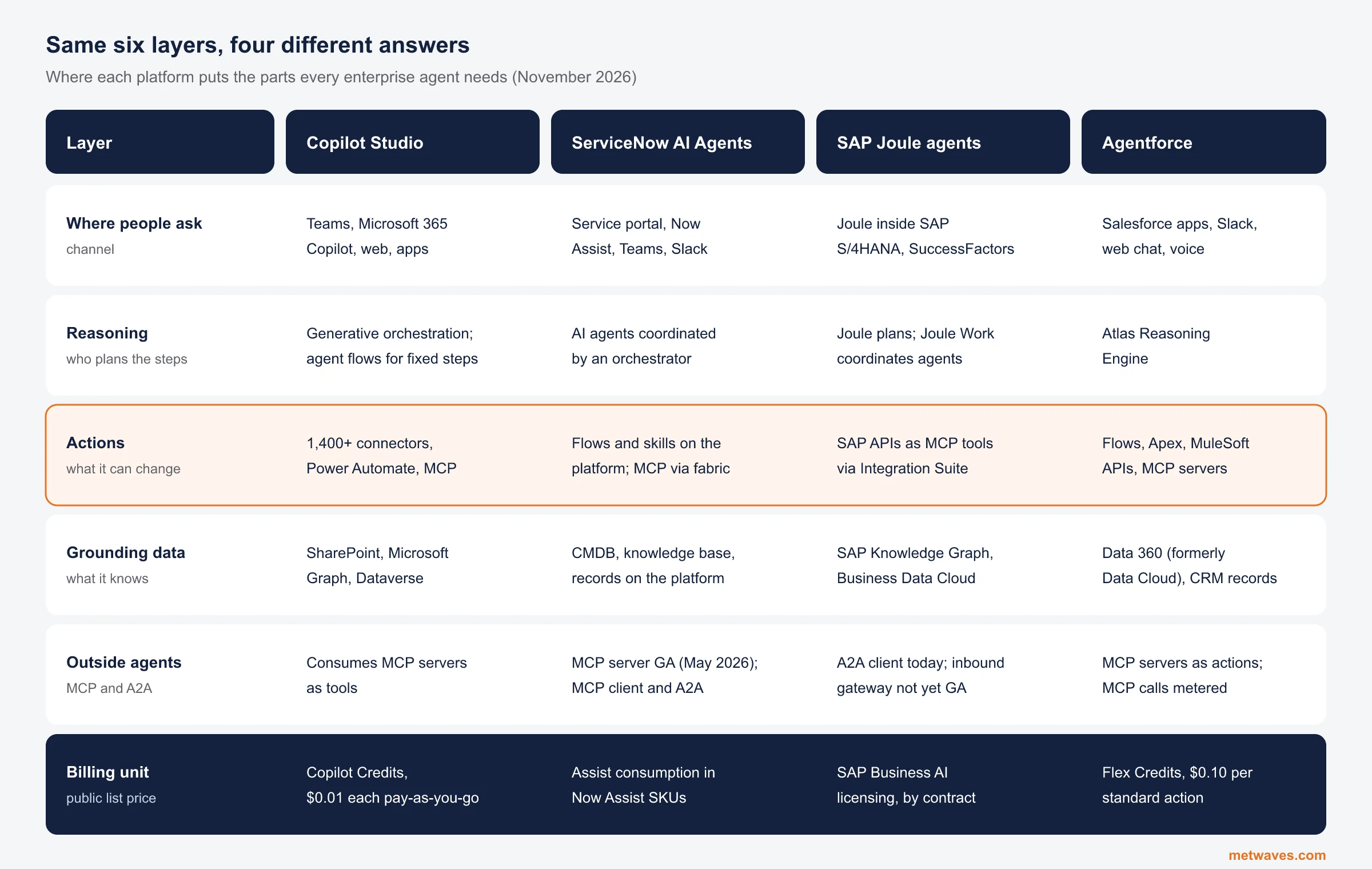 Nikit Nandan
November 12, 2026
Enterprise AI Agent Platforms Compared (2026)
An architecture review of the four big enterprise AI agent platforms: where each one reasons, acts, finds its data and connects to outside agents, what it costs, and when a custom build is the better choice.
Learn More >Let’s build your idea!
Let us help you with free analysis & estimate.
Our product expert will contact you within 12 hours.