
Google Cloud consulting services
Architecture, cost and security reviews of your Google Cloud projects, and new apps, data pipelines and Gemini features built on them. For businesses with one to a handful of projects and no full-time cloud team. The organisation, the billing account and the code stay in your name.

Trusted by businesses across the world

When Google Cloud is the right choice, and when it isn't
Google Cloud is strongest where your data and your AI features live. We build on AWS and Azure too, so we will tell you when another cloud fits better.
Google Cloud fits well. Keep the apps next to the data their users already query.
Cloud Run is a good start. Sign-in lines up with Workspace, and containers deploy without managing servers.
Vertex AI and Gemini fit. The model, your documents and the app stay in one project you control.
Usually Azure. Sign-in, licensing and tooling line up. See our Azure page.
Stay on AWS and tidy it up. Moving is rarely cheaper than fixing what you have. See our AWS page.
Plan for when they run out. Credits end; the architecture and its bill stay. We will show what the setup costs at full price before you build on it.
Google Cloud consulting services we provide
Google Cloud consulting is outside help to design, review, secure and reduce the cost of what your business runs on Google Cloud. For a small or mid-sized business it usually starts with a written review of your organisation and projects, followed by a short list of fixes ranked by risk and saving, and then help building on Cloud Run, BigQuery or Vertex AI. Metwaves works in your own Google Cloud organisation, so the projects, the access and the code stay in your name.
The work comes down to six jobs. Each ends with something you keep: a written review, a smaller bill, a safer setup, or a system running in your own project.

Google Cloud architecture and security review
We read your organisation through a role you grant and can remove, and write down what is risky, fragile or too expensive, ranked by impact. It covers the ground of Google's Cloud Architecture Framework: security, reliability, performance, cost and operations. Typical findings: everyone has the Owner role, service account keys sitting in code, one project for everything, no budget alert. The findings are yours either way.

Google Cloud cost review
We trace the bill to the queries, instances and logs behind it, make the changes you approve and track the bill for a month afterwards. BigQuery is often the surprise: one dashboard that scans a whole table on every refresh can cost more than the app it reports on.

Apps on Cloud Run or GKE
Web apps and APIs packaged as containers, deployed through a pipeline and scaled by Google Cloud. Cloud Run suits most small products because it scales down to nothing when idle; GKE is for teams that need Kubernetes.

BigQuery reporting and data pipelines
Data from your apps, CRM and spreadsheets loaded into BigQuery, modelled for the reports people actually read, with partitions and limits so query costs stay predictable. Larger data platforms are planned on our data engineering page.

Gemini and Vertex AI features
Assistants that answer from your own documents, document reading and classification, built on Google's Gemini models through Vertex AI. Our healthcare, university and car rental assistant demos run on Google Cloud with Gemini. See our AI chatbot development services.

Moving to Google Cloud
Servers, apps and databases moved one system at a time, each with a way back. We plan migrations on our cloud migration page, whichever cloud you are moving to.

BigQuery or Compute Engine costs rising every month, and nobody can say why? Start with a cost review.
What a sound Google Cloud setup looks like
A sound setup keeps production in its own project, gives people roles by group instead of Owner on everything, caps what queries can cost and warns you before your customers or finance team notice a problem.
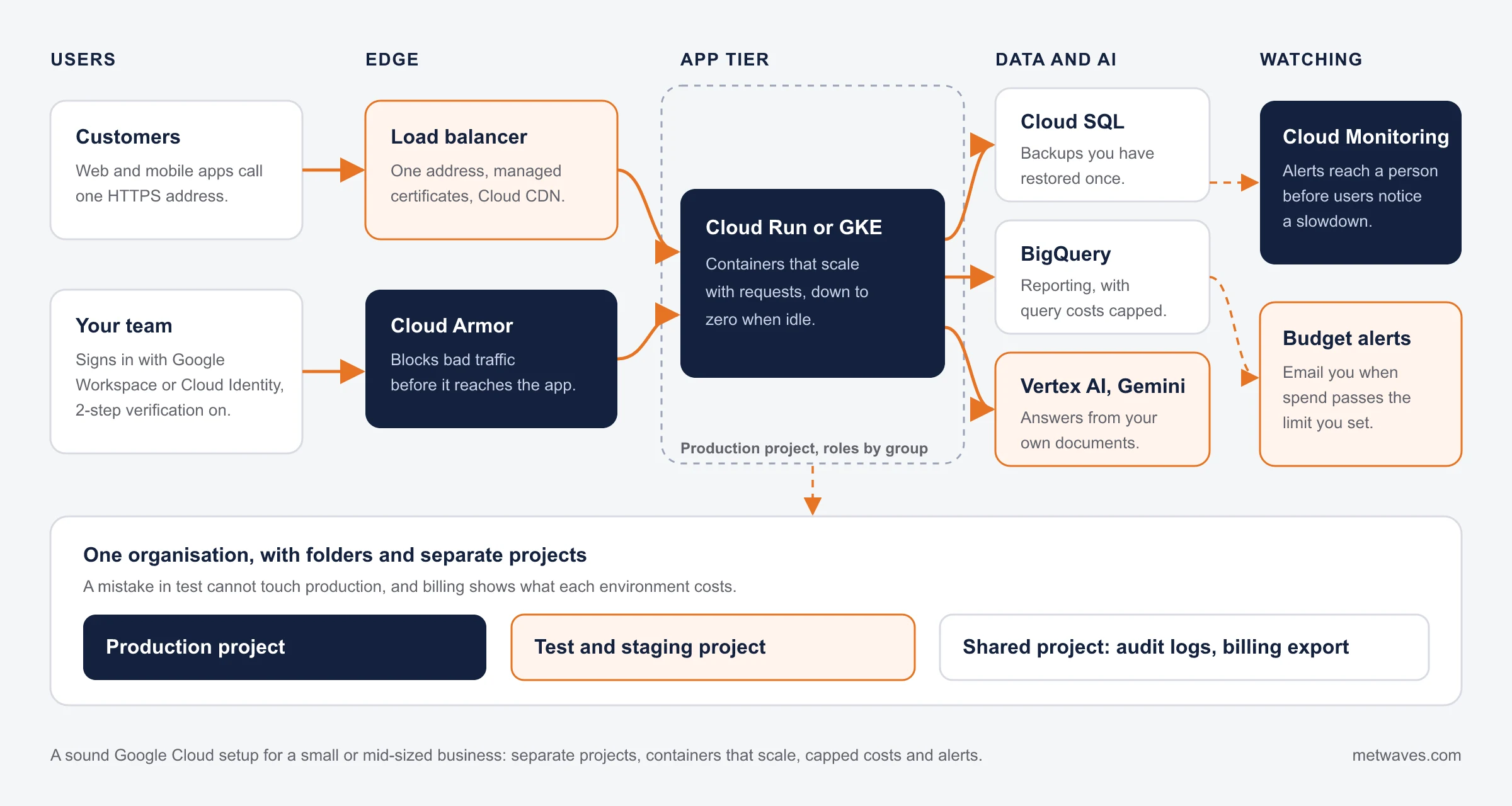
When to call us
Signs you need a Google Cloud consultant

A BigQuery bill nobody owns
Query costs rise every month and nobody can say which report or job is running them.

The person who set it up has left
One person created the organisation and projects, and nobody else knows how they fit together.

Everyone is an Owner
Every developer has the Owner role on every project, and service account keys live in code or chat.

One project for everything
Production, testing and experiments share one project, so a test can break what customers use.

One server, deployed by hand
The app runs on a single Compute Engine VM and releases mean someone copying files to it.
An AI feature to ship
You want Gemini answering from your own documents, and need it secure and costed before launch.

Where Google Cloud costs hide in small setups
Most small Google Cloud bills fall when you cap what queries scan, switch off what is idle and commit only to what is steady. These are the places we look first.
| Cost source | What to check | Typical fix |
|---|---|---|
| BigQuery queries | Bytes scanned per query in the job history; dashboards that scan whole tables | Partition and cluster large tables, select only the columns you need, set per-user query limits |
| Compute Engine VMs | CPU and memory use in the Recommender; VMs running at night and weekends | Resize, schedule test VMs off, or move the app to Cloud Run |
| Cloud Run and GKE | Minimum instances kept warm; node pools sized for peak | Lower minimum instances outside peak hours, enable cluster autoscaling |
| Cloud Logging | Log volume per project and retention on log buckets | Exclude noisy debug logs, set retention to what you need to keep |
| Storage and snapshots | Buckets without lifecycle rules; old disk snapshots and images | Lifecycle rules to cheaper storage classes, delete what nobody restores |
| Steady workloads at list price | Usage that runs around the clock for months | Committed use discounts for the steady part only |
Cloud Billing reports, the billing export to BigQuery and the Recommender show most of this. Set a budget alert first.
OUR DEMOS ON GOOGLE CLOUD
AI assistants running on Google Cloud with Gemini
We built three assistant demos to show what a Gemini feature looks like in practice: one for a healthcare clinic, one for a university and one for a car rental business. Each answers questions in plain language from the business's own information.
These are our own demos, not client projects. They show the stack we use for this work, and you can try them before you talk to us.
- Runs onGoogle Cloud
- ModelGoogle Gemini
- DemosHealthcare, university, car rental
- Related serviceAI chatbot development
How a Google Cloud engagement runs
Every engagement starts with view-only access. Nothing changes until you have agreed what to fix.
Tell us what runs on Google Cloud today, and we will tell you on the first call what we would review first and what it would cost.
First call and access you control
We agree what you want from Google Cloud. You give our accounts a viewer role on the projects to review, and you can remove it at any time. Every action is recorded in your Cloud Audit Logs.
Review
Organisation and project structure, access, reliability and cost, checked against how your business actually uses the system.
Written findings
Every finding ranked by risk and by saving, with what it takes to fix and a fixed quote for the work.
Fix or build
We make the changes you approve, as code wherever possible, so they can be reviewed and repeated.
Hand over or stay on
Your team takes over with the documentation, or we stay on with monthly check-ins.
What Google Cloud consulting costs
A review is a fixed price agreed before we start; build and support work is priced by scope or by the month. These factors move the price most.
Number of projects and workloads
One project and one app is a short review. Dozens of unlabelled projects take longer to map.
Size and shape of the build
A new app or pipeline is priced by scope: screens, integrations, data volume and how much it must scale.
How much is documented
If nobody knows why a project or bucket exists, we trace what depends on it before anything is switched off.
Security and AI requirements
A customer security questionnaire, a regulated industry or a Gemini feature on sensitive documents adds checks and written evidence.
Your Google Cloud bill is separate and paid by you to Google. A good review lowers it; we show the expected saving for each change before we make it.
Ways to work with us on Google Cloud
Start with a review, or go straight to a build if you already know what you need.

Google Cloud review
For a written list of risks and savings before you change anything. A fixed price, agreed before we start.

Cost clean-up
For a bill, often BigQuery, that has grown faster than the business. A fixed price for the changes in the review.

Build on Google Cloud
For a new app, data pipeline or Gemini feature. A fixed scope, or a dedicated team for longer builds.

Ongoing support
For changes, monitoring and monthly check-ins. Time and materials, billed monthly.
How to choose a Google Cloud consulting company
Google Cloud Partner status and specialisations matter if you want Google-funded migration help. For a review, a cost clean-up or a build, ask who will do the work. Whoever you hire, these show whether you will stay in control of your projects.
| A good partner | A warning sign |
|---|---|
| They confirm in writing that the organisation, projects, billing account and code are yours. | Projects are created under the consultant's organisation or billing account, so you cannot leave without a migration. |
| They give you a written review before they change anything. | Every finding leads to a new service to buy, and none to a saving. |
| They talk about query limits, idle VMs and log retention, not only what to add. | Changes are made by hand in the console, with no code or record to repeat them. |
| They ask for roles you grant and can remove, never shared passwords or downloaded service account keys. | Nobody can tell you what the monthly Google Cloud bill will be after the work is done. |
Need Google funding for a large migration? Shortlist a Google Cloud Partner with the right specialisation.
Our Google Cloud tech stack
The services we design with most. The review decides which your workload needs, along with Cloud Armor, Cloud Monitoring, Secret Manager and budget alerts.





Where Google Cloud work connects to the rest of your systems
A Google Cloud review often leads to one of these. Each page covers the work on either side of it.
| Service | When it fits |
|---|---|
| Cloud migration | Move servers, apps and data to the cloud one step at a time, with a way back. |
| Cloud consulting | Choose between Google Cloud, AWS and Azure before you commit. |
| AI chatbot development | Assistants that answer from your own content, on Gemini or another model. |
| Data engineering | Pipelines and warehouses for reporting, on the cloud you already use. |
Frequently asked questions
Straight answers on Google Cloud cost, access, partner status and ownership.
A Google Cloud consultant reviews how your organisation and projects are set up, fixes what is risky or costs too much, and designs or builds systems on Google Cloud. For a smaller business that means a written review first, then a short list of changes.
A review is a fixed price agreed before we start, based on how many projects and workloads you run. Fixes and new builds are quoted by scope, and ongoing support is priced by the month. A cost review should find savings larger than its own fee; if we do not think yours will, we will tell you before you pay for it.
We do not show a Google Cloud Partner badge or specialisation on this page, so do not choose us for Google-funded migration programmes. If you want that funding, shortlist a partner with the right specialisation in Google's partner directory.
You add our accounts to the projects with a viewer role for the review, and remove them whenever you like. Every action is recorded in your Cloud Audit Logs. We never ask for shared passwords or downloaded service account keys.
If your data team works in BigQuery or your company runs on Google Workspace, Google Cloud usually fits. If you run on Microsoft 365 and .NET, Azure is usually simpler; if your product already runs on AWS, stay and tidy it up. We will tell you which on the first call.
Usually, yes. Most BigQuery cost comes from queries that scan more data than they need. Partitioning and clustering large tables, selecting only the columns a report uses and setting query limits per user or project bring it down. We show the expected saving per change before we make it.
Yes. Our assistant demos run on Google Cloud with Gemini; try the healthcare demo. For your business we build it in your own project, so your documents and the conversations stay there.
You own the organisation, the projects, the billing account, the infrastructure code and any application code we write. We sign an NDA before you share details of your systems.
INSIGHTS & NEWS
Discover IT Industry Insights and Technology Trends
 Nikit Nandan
November 12, 2026
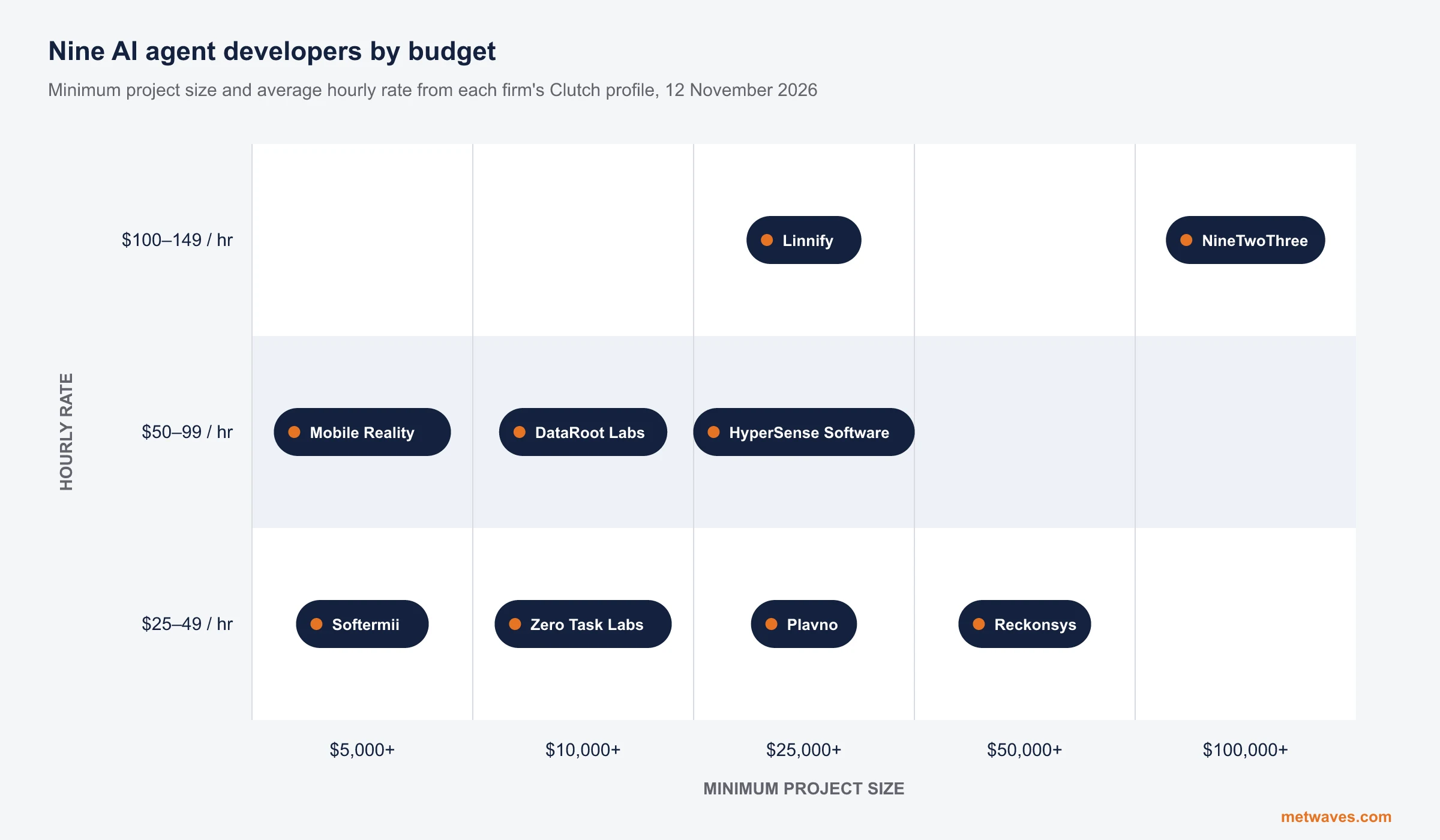
Top AI agent development companies for small and mid-sized businesses (2026)
Nine AI agent development firms a small or mid-sized business can shortlist, with Clutch figures, minimum budgets and the weaknesses their own clients name. Published by Metwaves, which is not ranked.
Learn More >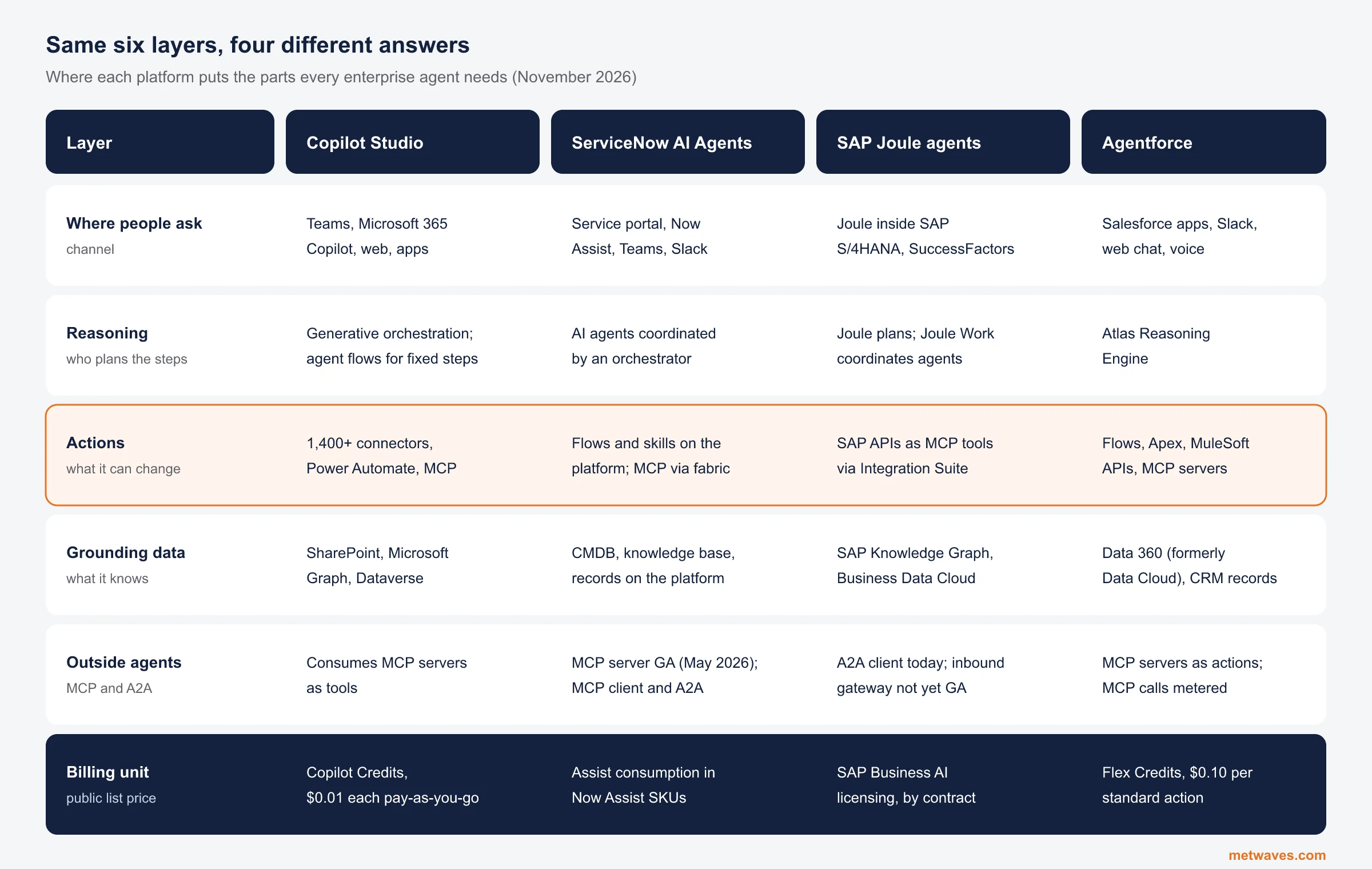 Nikit Nandan
November 12, 2026
Enterprise AI Agent Platforms Compared (2026)
An architecture review of the four big enterprise AI agent platforms: where each one reasons, acts, finds its data and connects to outside agents, what it costs, and when a custom build is the better choice.
Learn More > Nikit Nandan
November 01, 2026
Top custom software development companies for small and mid-sized businesses (2026)
Ten custom software firms a small or mid-sized business can shortlist, with Clutch figures, minimum budgets and the weaknesses their own clients name. Published by Metwaves, which is not ranked.
Learn More >Let’s build your idea!
Let us help you with free analysis & estimate.
Our product expert will contact you within 12 hours.