
React JS, Angular and Vue Development Services
Web front ends in the framework your team can keep, connected to the APIs and data you already have. We build web apps, dashboards, customer portals and admin tools for businesses in the US, UK, Canada and Australia, and the .NET, Node.js or Python back end behind them.

Trusted by businesses across the world

React vs Angular vs Vue at a glance
All three build fast, modern web apps. They differ in how much structure they impose and how easy it is to hire for them. The last row is what we have shipped in each.
| Question | React |  Angular |  Vue |
|---|---|---|---|
| What it is | A library for building screens from components; you choose routing, state and data tools | A full framework from Google with routing, forms, HTTP and testing tools built in | A progressive framework you can add to one page, or grow into a full app |
| Language | JavaScript or TypeScript | TypeScript | JavaScript or TypeScript |
| Structure | Flexible: the team agrees its own conventions | Opinionated: one standard way to do most things | Light conventions, easy to adopt step by step |
| Hiring pool | The largest of the three in most developer surveys | Smaller, and common in enterprise teams | Smaller than React's |
| Usually best for | Products, dashboards and public sites that change often | Large internal apps with many forms, roles and developers | Small teams and gradual upgrades of existing pages |
| Our shipped work | TradeAlert and an urgent care clinic website | The Fiberpipe VoIP web app | None yet. We support Vue but have no Vue project to show. |
React, Angular or Vue: which fits your project
There is no best front-end framework. There is the one your team can hire for, test and keep running for years.
React. Most front-end developers know it, so your team is easier to grow.
React rendered on the server (for example with Next.js), or a CMS. Search engines and AI assistants read server-rendered HTML more reliably than pages built in the browser.
Angular. Its built-in structure keeps a big codebase consistent as people come and go.
Vue or plain JavaScript. Neither needs a rebuild; both can start on a single page.
A rebuild in Angular or React, route by route. AngularJS support has ended, and there is no in-place upgrade path.
A CMS, not a framework. Your team can edit it without a developer. See CMS development. We will say so on the first call.
Signs you need front-end developers
If one of these describes your app, a short review will tell you whether it needs a fix, an upgrade or a rebuild.
Your app still runs on AngularJS or jQuery, and nobody on the team wants to touch it.
Pages are slow on phones and your Core Web Vitals report shows red.
Every new screen takes weeks, because there is no shared component library and each page is built by hand.
Your back-end developers are building the user interface because there is nobody else to do it.
You have an API or an internal system and need a customer portal or admin tool on top of it.
You are choosing a framework for a new product and want a reason, not a fashion.
React JS development services for web apps and portals
React JS development services design, build and maintain web front ends written in React: the screens, components and state that run in the browser, connected to your APIs. A good provider also helps you choose between React, Angular and Vue, builds or adapts the API behind the screens, and leaves you a component library your own team can keep extending. Metwaves has React and Angular front ends in production on Node.js and ASP.NET Core back ends; Vue is a framework we support without a shipped project to show yet.
Six kinds of React work, from a new dashboard to fixing the app you already have. We choose the framework per project and write the reason down, so the next developer knows why.

React web apps and dashboards
Data-heavy screens that update live without page reloads. Our TradeAlert platform, built in React on Node.js, handled up to 10,000 concurrent users.

Customer portals and admin tools
Sign-in, roles, forms, tables and reports on top of the API or system you already run, so customers and staff stop emailing for what they could look up.

Component libraries and design systems
One set of tested components your designers and developers share, so a new screen takes days instead of weeks. Pairs with our UI/UX design work.

Performance and accessibility fixes
We find what makes pages slow or hard to use with a keyboard or screen reader, fix it and measure it again, without a rebuild where one is not needed.

React with a Node.js or .NET back end

A mobile app from the same team
When a React team also needs a phone app, React Native or another cross-platform option often fits. See cross-platform app development.
Still on AngularJS? Its support ended in January 2022, and there is no in-place upgrade.
Angular, Vue and JavaScript development services
Angular and React are both in production in our case studies. Here is what we do in each of the others, and where we have no project to show.
AngularAngular development services for business apps
Angular suits large business applications with many forms, roles and screens, where one opinionated structure helps a team stay consistent. We built the web app for Fiberpipe's custom VoIP service in Angular, on an ASP.NET Core API with PostgreSQL, alongside the Android and iOS apps.
- New Angular apps for internal tools, portals and products with complex forms.
- Angular version upgrades, one major version at a time, with tests run at each step.
- Angular developers in your team, when you own the roadmap and need more hands.
AngularJS upgradesAngularJS apps: rebuild the front end route by route
AngularJS is not an older version of Angular you can update in place. Its official support ended in January 2022, so an AngularJS app is a rebuild of the front end into Angular or React.
- We map every route, form and API call the old app uses before writing new code.
- New and old screens run side by side, and users move over one section at a time.
- The API and data usually stay, which keeps the rebuild to the part that is out of support.
When the back end is old too, see application modernization.
VueVue.js development services, honestly scoped
Vue is a good fit for smaller teams and for adding interactive parts to existing pages one piece at a time, without rebuilding the site. Our developers work in Vue, but we have no Vue project in our case studies, and we would rather say so than imply one.
- If you already run Vue, judge us on our React and Angular work and a paid review of your code.
- If you are starting fresh, we will tell you whether Vue, React or plain JavaScript fits your team better.
 JavaScript and TypeScript
JavaScript development services without a full rebuild
Not every front end needs a framework. Many sites need a form that validates properly, a pricing calculator or a search box that works on phones.
- Plain JavaScript and TypeScript for interactive parts of an existing site.
- jQuery replacement, swapping old plugins for modern browser features.
- Moving JavaScript to TypeScript file by file, so errors show up before release, not in production.
React and Angular front ends we have shipped
A real-time trading platform, a VoIP service with web and phone apps, and a clinic website we have supported for six years. Each card is a project you can read in full.



CASE STUDY
A real-time stock and crypto alert platform in React
TradeAlert sends stock and crypto alerts as markets move, so its screens have to update live without page reloads, for many users at once.
We built the front end in React and the API in Node.js and Express on AWS, with MongoDB behind it, so the screens and the data they depend on were designed by the same team.
- Built withReact, Node.js, Express, AWS, MongoDB
- ScaleUp to 10,000 concurrent users
- Result85% positive feedback from beta testers
How a React or Angular front end fits the rest of your system
The front end is the part users see, but it depends on sign-in, an API and your data. We design them together, so the screens never wait on a back end nobody planned.
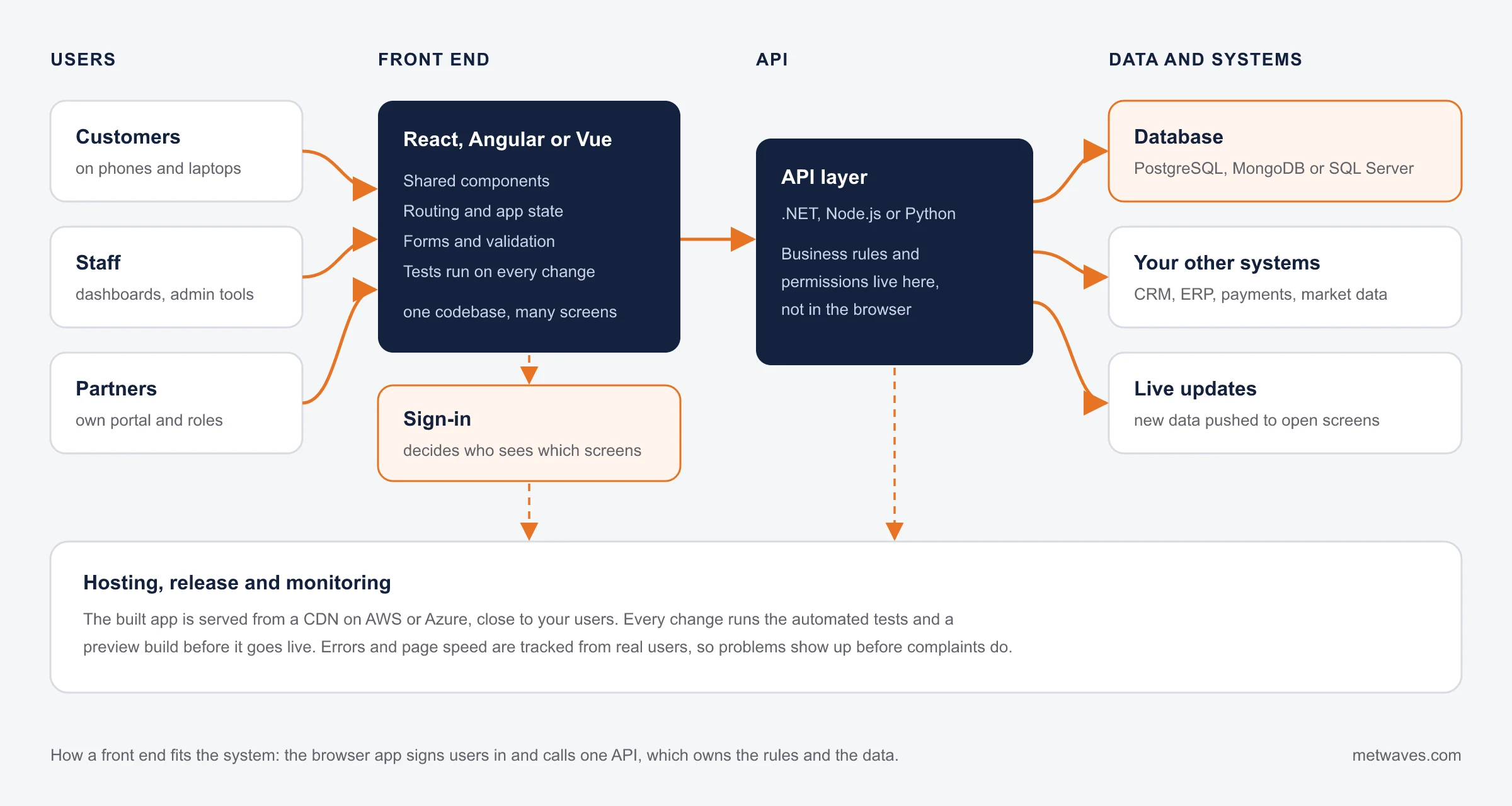
Our React, Angular and Vue tech stack
React, Angular, .NET, AWS, Node.js and the databases below appear in our React and Angular case studies. Python and Azure come from our other projects. Vue is a framework we support without a published project.





Send us the URL of your app. We will tell you what we would keep, fix or rebuild.
How a front-end project runs
Every project starts with a review and a written framework choice, and every step after that ends with something you can click.
You see working screens on real data from the third step, not pictures of them.
Review the current front end or the product brief
We open your app on a laptop and a phone, read the code if there is some, and look at how it is built and released. For a new product we read the brief and the API, if one exists. You get a short written list: what to keep, what to fix and what to rebuild.
Choose the framework and write the reason down
React, Angular, Vue or plain JavaScript, with the reasons in one page: your team's skills, the hiring market, the type of app and what already exists. A future developer should be able to read why.
Design system and first screens
We build the shared components first (buttons, forms, tables, layout), then the screens that matter most to your users, connected to real data. You click through working screens, not pictures of them.
Build in short releases, with tests
Each release adds screens you can use and runs automated tests on every change. Upgrades and rebuilds go live a section at a time, so users never wait for one big switch-over.
Hand over, or stay on to support it
You get the code, the component library and notes on how to build and release it. If you want us to stay, we keep the framework and libraries up to date and add features as you need them.
What drives the cost of React JS development
We do not publish prices, because two apps with the same number of screens can need very different amounts of work. These factors move the quote most.
Number of screens and user roles
Each role sees different screens and data. A portal with customers, staff and admins is three apps' worth of permissions to build and test.
API and integration work
If the API the screens need already exists, the front end moves fast. If it has to be built, or your CRM, ERP or payment system has to be connected, that is often the larger part of the budget.
Starting point
A new app, an upgrade of a current Angular or React app and an AngularJS rebuild cost very different amounts. The review on the first call tells you which one you have.
Design system
Building a shared component library costs more at the start and less on every screen after it.
Accessibility and speed targets
A named standard such as WCAG 2.2 AA, or Core Web Vitals targets on phones, adds design and testing time.
Browsers and devices
Modern browsers behave alike. Old browser versions or kiosk devices add testing.
Running costs are usually small for a front end: hosting and a CDN. The API, database and any third-party services behind it are where monthly costs sit.
Hire React or Angular developers, or hand us the build
Every engagement starts with a front-end review of your app or brief. Pick the model by how clear the scope is and who owns the roadmap.

Fixed-scope build
A defined app, portal or AngularJS rebuild with agreed screens. Fixed quote after a front-end review.

One or two developers in your team
Your team owns the roadmap and needs React or Angular developers. Monthly, per developer.

A dedicated product team
Front end, back end and testing for a whole product. Monthly, per team.

Ongoing support
A live app that needs fixes, framework upgrades and small features. Time and materials.
Six questions to ask any React, Angular or Vue team
How to choose a front-end development company

Can we see a live app in the framework we picked?
Look for: a link you can open, built by the people on your project. Our answer: React: TradeAlert and a clinic website. Angular: the Fiberpipe VoIP web app. Vue: none yet.

How do you test changes to the screens?
Look for: automated tests on every change, plus a person checking the main journeys on real phones. Our answer: Both, and the tests stay in your repository.

Who owns the code and the design system?
Look for: you, in your own repositories, from the first day. Our answer: You do. We work in your repositories or hand them over.

How do you handle accessibility?
Look for: a named standard, such as WCAG 2.2 AA, and tests against it. Our answer: We agree the standard at the start. Our clinic website had an ADA accessibility check before launch.

Do you build the back end too?
Look for: yes, or a clear plan for who does and how the API is agreed. Our answer: Yes: .NET, Node.js and Python.
Where would you not be the best choice?
Look for: an honest answer. Our answer: If your product is Vue-only and you want a team with many Vue projects behind it, a Vue specialist may suit you better.
See our web application development services >

Where the front end meets the rest of the build
Most front-end projects touch one of these. Each link is the service page for that part.
| Service | When it fits |
|---|---|
| Web application development | The whole web app: front end, API, data and hosting. |
| Application modernization | When the AngularJS front end sits on an old back end that needs work too. |
| Node.js development | APIs and real-time services behind React and Angular apps. |
| .NET development | ASP.NET Core APIs and business logic, like the VoIP project's back end. |
| UI/UX design | Research, design systems and screens before the first component is coded. |
Frequently asked questions
Straight answers on frameworks, AngularJS upgrades, cost and ownership.
It depends mostly on the number of screens and user roles, how much API and integration work sits behind them, and whether you need a shared component library. A dashboard on an existing API is a small project; a customer portal with several roles, payments and a CRM connection is a larger one. We quote after a short review of your app or brief, so the price reflects your project rather than a package.
Choose React when you want a flexible interface and the largest pool of developers to hire from. Choose Angular for large internal apps with many forms and roles, where one standard structure keeps a big team consistent. The comparison table above sets out the rest.
Yes. AngularJS support ended in January 2022 and there is no in-place upgrade, so we rebuild the front end in Angular or React route by route, with old and new screens running side by side until the switch is complete. If the back end needs work too, see application modernization.
Yes, our developers work in Vue. We have no Vue project in our case studies yet, so we will not claim one. If Vue is your framework, we suggest a paid review of your code first so you can judge the work before a larger commitment.
You do. The code, the component library and the tests live in your repositories, and you can take them to another team at any time.
Yes. You can add one or two developers to your team through IT staff augmentation, or hand a whole product to a dedicated development team.
It can be. Pages rendered on the server, or built ahead of time, give search engines and AI assistants complete HTML to read. Apps that build every page in the browser are fine behind a login, where SEO does not matter, but are a poor choice for public pages that need to rank.
Ask for a live app built by the people who will work on yours, ask how they test changes to the screens, and confirm you own the code. The six questions above are the ones we would ask in your place.
INSIGHTS & NEWS
Discover IT Industry Insights and Technology Trends
 Nikit Nandan
November 12, 2026
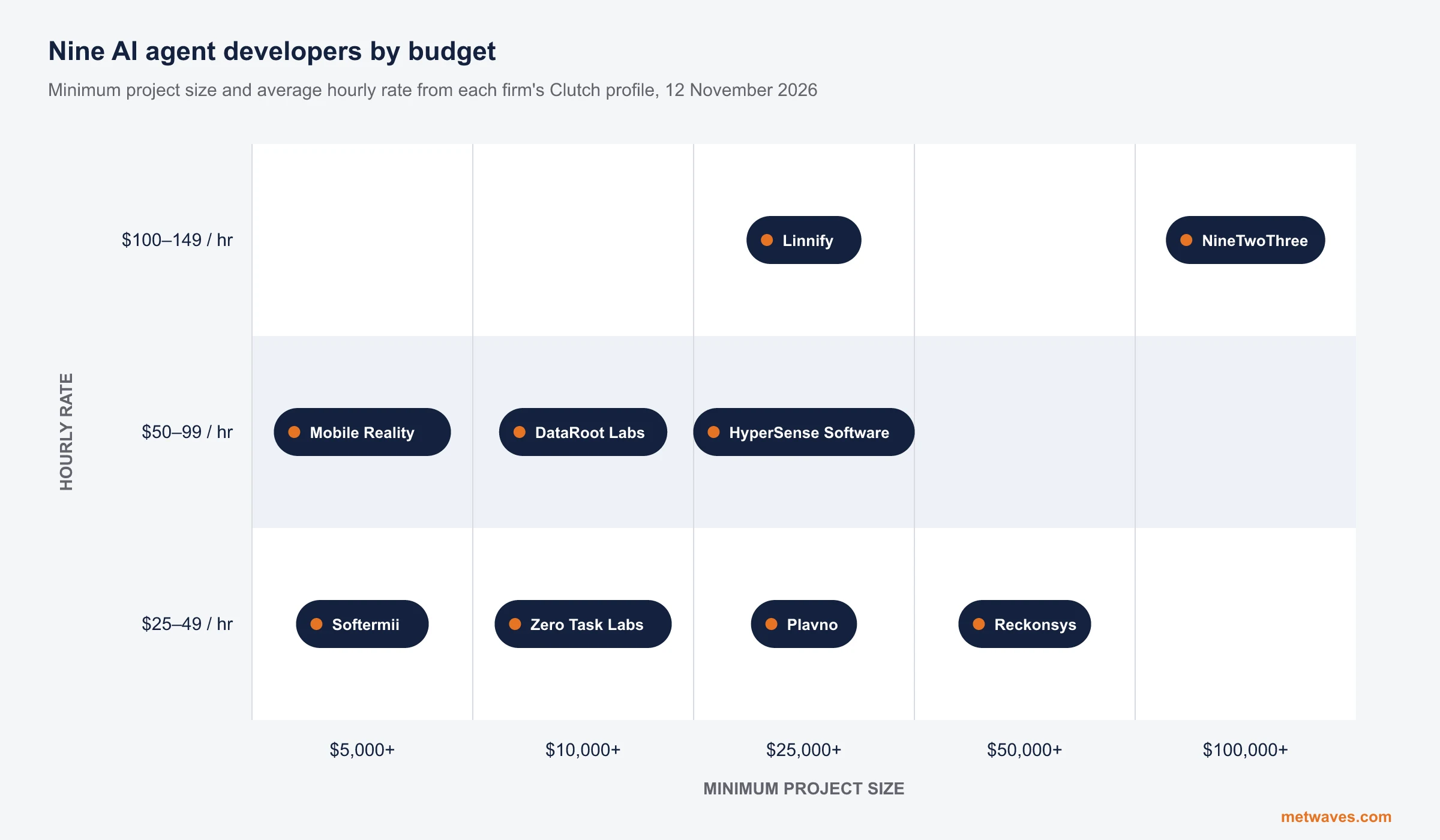
Top AI agent development companies for small and mid-sized businesses (2026)
Nine AI agent development firms a small or mid-sized business can shortlist, with Clutch figures, minimum budgets and the weaknesses their own clients name. Published by Metwaves, which is not ranked.
Learn More >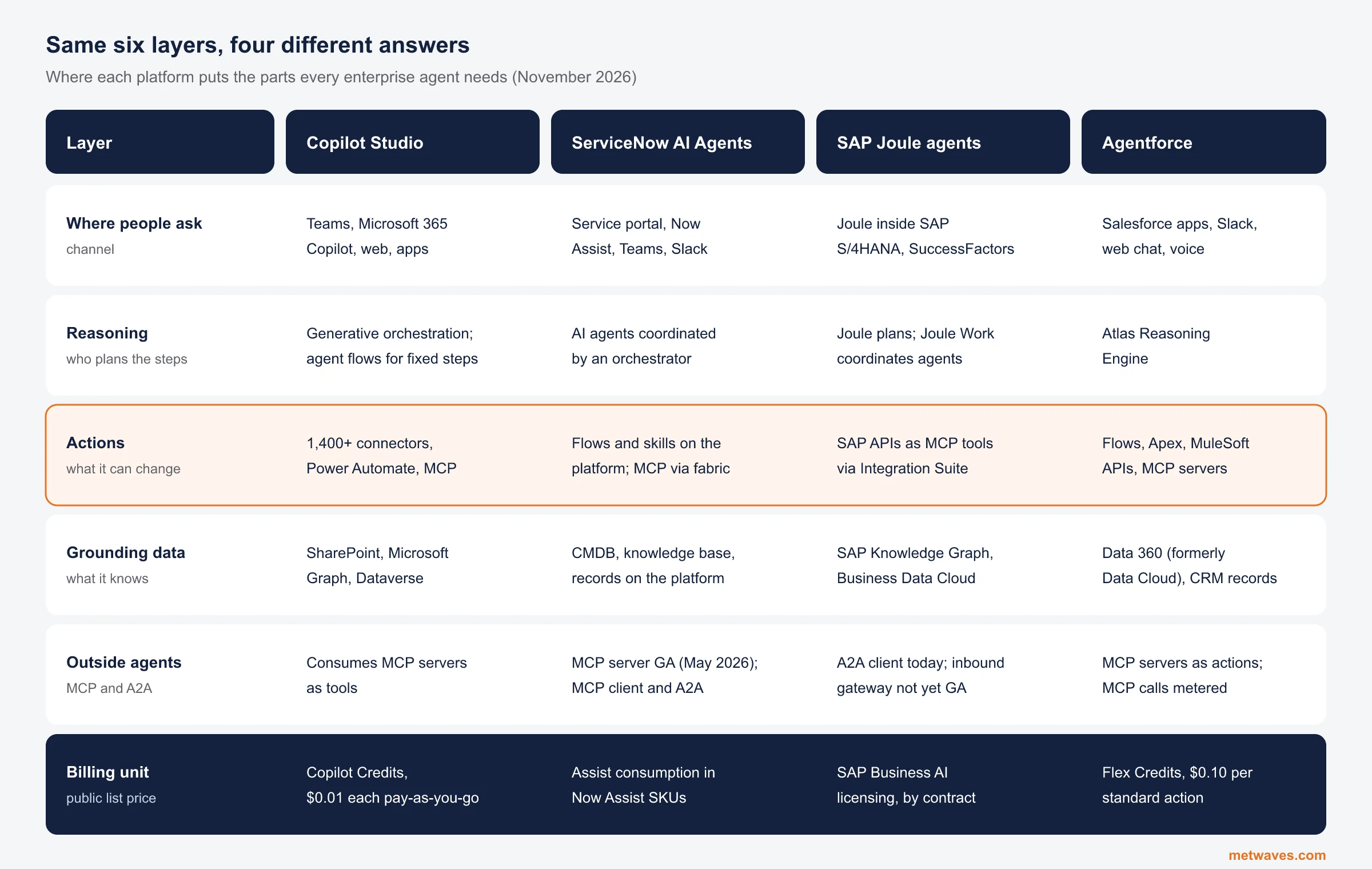 Nikit Nandan
November 12, 2026
Enterprise AI Agent Platforms Compared (2026)
An architecture review of the four big enterprise AI agent platforms: where each one reasons, acts, finds its data and connects to outside agents, what it costs, and when a custom build is the better choice.
Learn More > Nikit Nandan
November 01, 2026
Top custom software development companies for small and mid-sized businesses (2026)
Ten custom software firms a small or mid-sized business can shortlist, with Clutch figures, minimum budgets and the weaknesses their own clients name. Published by Metwaves, which is not ranked.
Learn More >Let’s build your idea!
Let us help you with free analysis & estimate.
Our product expert will contact you within 12 hours.