Generative AI development company

Metwaves is a generative AI development company. We build assistants, document agents and search that read, answer and act on your own data, on Azure OpenAI, Anthropic Claude, Google Gemini or an open-weight model. Tested on your own examples, with a person in charge of what matters, in a cloud account in your name.

Trusted by businesses across the world

Logos of Metwaves clients

THE TECHNOLOGY

What generative AI and large language models are

Generative AI is software that produces new text, images, code or audio from an instruction, called a prompt. For business software the workhorse is the large language model (LLM): a model trained on a very large amount of text to predict the next piece of text, one token at a time. Because it has read so much writing, an LLM can summarise, draft, classify, translate, pull fields out of a messy document and answer questions in plain language.

Two things follow from how it works. It does not look anything up unless your software gives it a way to, and it knows nothing about your business unless you pass your own data in with the question. Most of the work in a generative AI project is that second part: getting the right data in front of the model, checking what comes back, and keeping a person in charge where a mistake would cost money.

Token

The unit a model reads, writes and bills by: a word or part of one. Anthropic puts 1 million tokens at roughly 555,000 words on its current models (Anthropic).

Context window

How much text the model can take in one request: your instructions, the retrieved documents and the conversation so far.

Embedding

A list of numbers that captures what a passage means, so software can find passages by meaning rather than by exact words.

Hallucination

A fluent, confident answer that is wrong. Grounding in your documents and checks in code reduce it; nothing removes it completely.

Agent

A model given tools, such as search or an API, and allowed to choose the next step within limits you set.

Good at

  • Drafting and summarising emails, reports, notes and replies
  • Reading invoices, forms and contracts in many layouts and pulling out the fields
  • Answering questions from a defined set of documents, with the source cited
  • Sorting and routing emails, tickets and requests by topic or urgency
  • Working in many languages, and turning plain questions into search queries or code

Weak at

  • Arithmetic, totals and tax: do those in ordinary code, then compare
  • Facts it has not been given, such as today's prices or your stock levels
  • Regulated or high-value decisions without a person approving them
  • Tasks that need the exact same output every time with no checks
  • Jobs a simple rule, a report or a database query already does well

MODEL FAMILIES

The main model families, and how to choose between them

Four families cover most business work. Each is described from its maker's own documentation; we left out version numbers and prices because they change every few months.

OpenAI, hosted by Microsoft

GPT models on Azure OpenAI

Deployed in your own Azure subscription through Microsoft Foundry.

What the maker says
Microsoft says prompts and completions are not available to OpenAI and are not used to train foundation models without your permission. Prompts are processed in the geography you choose, unless you pick a Global or DataZone deployment.
Choose it when
You already run on Microsoft 365 and Azure, want sign-in through Microsoft Entra ID and one Azure bill, or need Azure AI Search and Document Intelligence next to the model.
Watch for
The deployment type decides where prompts are processed. Abuse monitoring can store flagged prompts for human review unless Microsoft approves you for modified abuse monitoring.

Source: Microsoft Learn: data, privacy and security

Anthropic

Claude

Through the Claude API, Amazon Bedrock, Google Cloud or Microsoft Foundry.

What the maker says
Anthropic sells the family in tiers: Opus "for long-running agentic coding and knowledge work", Sonnet as "the best combination of speed and intelligence", and Haiku "for high-volume, latency-sensitive tasks such as classification, extraction, and routing". Its current models accept up to 1 million tokens in one request.
Choose it when
The work involves long documents or contracts, or an agent that must use many tools in order. On AWS, Bedrock keeps it inside the account you already run.
Watch for
Amazon Bedrock and Google Cloud set their own retirement dates for the Claude models they host, so check the route you will use, not only Anthropic's own page.

Source: Anthropic: models overview

Google

Gemini

On Google Cloud through Gemini Enterprise Agent Platform, which now includes Vertex AI.

What the maker says
Google offers tiers: Pro, its "reasoning-first model optimized for complex agentic workflows and coding", Flash, its "workhorse model", and Flash-Lite, its "most cost-efficient model" for high-volume, low-latency traffic.
Choose it when
Your data already sits in BigQuery or Google Workspace, or you build on Google Cloud. Our own assistant demos run on Gemini.
Watch for
The global endpoint can serve a request from any region; use a regional one if data must stay put. Google may log prompts to detect abuse.

Source: Google Cloud: Gemini models

Meta and others

Open-weight models such as Llama

Weights you download and run on your own servers or private cloud, or a managed copy in Microsoft Foundry.

What the maker says
Meta publishes the models through Hugging Face and Kaggle, with guides for private cloud deployment and self-hosting in regulated industries. Each Llama release comes with its own licence and use policy.
Choose it when
Prompts must never leave your network, volume is high and steady enough to keep servers busy, or you need to fine-tune the model itself.
Watch for
You run the GPUs, the updates and the security. The licence terms differ by release and are worth a lawyer's read before a product launch.

Source: Meta: Llama

How we choose: start with the cloud you already pay for, then run two or three models on a few dozen of your own real examples and compare accuracy, speed and cost per request. Names and prices change every few months, so we design the app to switch models without a rebuild.

Have a pilot that answers well in demos and badly in real use? We will test it against your own examples.

PROMPTING, RAG OR FINE-TUNING

Custom LLM development: which approach your use case needs

Start at the cheapest rung that passes your tests, and climb only when it fails. Each rung adds cost and time, and each fits a different kind of problem.

  1. 1

    Prompting

    Days

    What changesThe instructions and examples sent with each request.

    FitsDrafting, summarising, classifying and extracting from documents the model already reads well.

    Falls short whenThe answer depends on information the model has never seen.

  2. 2

    Retrieval-augmented generation (RAG)

    Weeks

    What changesThe app searches your documents first and passes the relevant passages in with the question, so the answer can cite its source.

    FitsPolicy and helpdesk answers, product and catalogue questions, contract and manual search.

    Falls short whenThe documents are out of date or contradict each other. Cleaning content and permissions is most of the work.

  3. 3

    Agent workflow

    Weeks to months

    What changesThe model gets tools (search, your ERP's API, a calculator) and a graph of allowed steps, built with a framework such as LangGraph, which can pause for a person and resume.

    FitsMulti-step jobs such as reading an invoice, checking it against the ERP and posting it or queuing it.

    Falls short whenNobody can write down what a correct outcome looks like for each step.

  4. 4

    Fine-tuning

    Large example set

    What changesThe model's own weights, adjusted with pairs of example inputs and the outputs you want.

    FitsA fixed format or tone at high volume, or teaching a smaller, cheaper model one narrow task.

    Falls short whenThe goal is new or changing facts: those belong in retrieval, not in the weights.

Most requests for custom LLM development turn out to need prompting and retrieval with checks in code, not a model trained from scratch or even fine-tuned. We fine-tune when tests on your examples show the first rungs fall short, and we show you the scores either way.

The generative AI stack: what sits around the model

A working generative AI app is mostly ordinary software: search, permissions, checks, logs and a queue for people. The model is one call inside it.

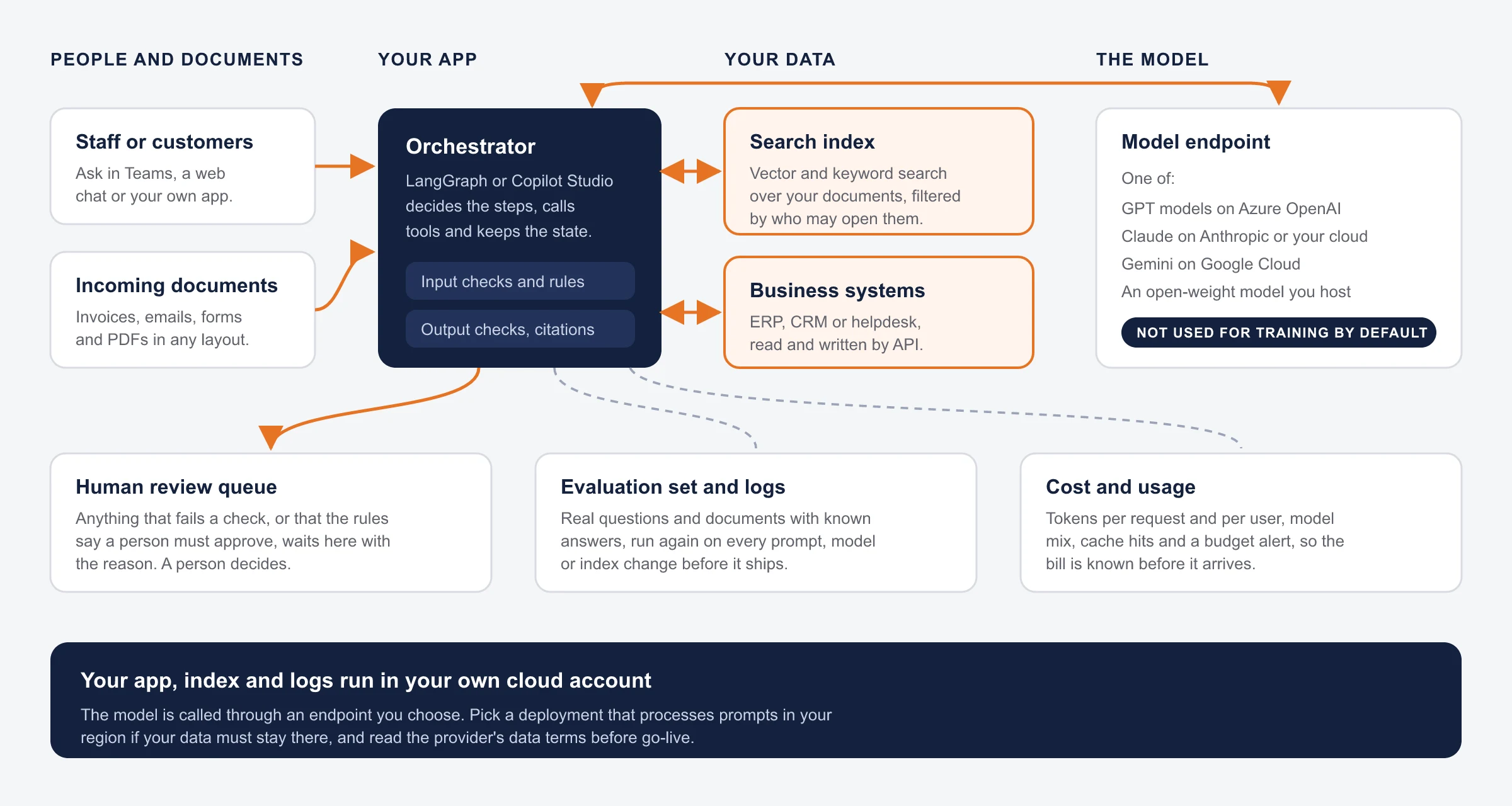
How a generative AI app answers from your own data: staff, customers and incoming documents reach an orchestrator such as LangGraph or Copilot Studio, which checks the input, searches an index of your documents filtered by permission, reads and writes business systems by API, calls a model endpoint (GPT on Azure OpenAI, Claude, Gemini or a self-hosted open-weight model), checks the output, and sends anything that fails to a human review queue, while an evaluation set, logs and cost tracking watch it
The model is one box of many. Retrieval, checks, review and cost tracking decide whether it is useful.
  • Retrieval and vector search

    An index such as Azure AI Search that finds passages by meaning and keyword, and drops anything the user may not open.

  • Orchestration and agents

    LangGraph for custom agents in Python; Copilot Studio when the agent lives in Microsoft Teams.

  • Models

    Azure OpenAI, Claude, Gemini or an open-weight model, behind one interface so it can be swapped.

  • Evaluation

    A test set of real questions and documents with known answers, scored on every change.

  • Guardrails

    Content filters, rules checked in code, citations, and a person approving what matters.

Generative AI development services we provide

We build six kinds of generative AI work. Each ends with software running in your own cloud account, a test set that proves it works, and a running cost you know in advance.

Still deciding which tasks are worth automating? Generative AI integration services start with that question.

Assistants that answer from your documents

Retrieval-augmented assistants in Teams, on your website or in your app, answering from policies, manuals or product data, citing the source and respecting who may see what. See our AI chatbot development services.

Document reading and data entry agents

Invoices, orders, claims and forms read in any layout, checked against your systems and posted, with anything doubtful sent to a person. Our invoice agent for an accounts payable team works this way.

Agent workflows with LangGraph

Multi-step jobs where the model calls your APIs, waits for approval and picks up where it stopped. See our AI agent development services.

Generative AI features inside your product

Summaries, drafting, search by meaning and natural-language questions added to a SaaS product or internal tool, with per-customer data kept apart and the cost per user measured.

Model evaluation and switching

A test set built from your own data, scores for each candidate model, and an app that can move from one provider to another when prices or quality change.

From pilot to production

A demo that impressed in a meeting, hardened with permissions, logging, monitoring and a review queue. See how we take a proof of concept to production.

PROOF

What we have shipped as a generative AI development company

Two client projects in production and three demos of our own. The figures come from the published case studies.

Client work

Invoice processing agent

An accounts payable team in Australia, posting to SAP Business One

A LangGraph agent reads each supplier invoice with Azure Document Intelligence, with Azure OpenAI handling layouts the standard models miss. Checks in code cover the vendor, purchase order, arithmetic, GST and duplicates. The agent never posts on extraction confidence alone; anything that fails goes to a review queue with the reason.

  • About 1,000invoices and documents a month
  • About 80%less manual entry
  • 8 to 12 weeksfrom first sample to full rollout
  • LangGraph
  • Azure OpenAI
  • Azure Document Intelligence
  • Python
  • SAP Business One
Read the invoice agent case study →
Client work

Helpdesk agent in Microsoft Teams

A professional services firm in the UK, for IT and HR questions

A Copilot Studio agent answers from SharePoint and an Azure AI Search index of the policy library. Azure OpenAI writes answers only from the passages it retrieves and cites the document. Superseded policies are kept out of the index, and staff only get answers from documents they are allowed to open.

  • 30% to 50%of staff requests resolved without a person
  • 8 to 12 weeksfrom first question review to firm-wide rollout
  • Copilot Studio
  • Azure OpenAI
  • Azure AI Search
  • SharePoint
  • Teams
Read the helpdesk agent case study →
Our own demo

Assistants on Gemini

Built by us to show the stack: not client projects

Three assistants, for a healthcare clinic, a university and a car rental business, running on Google Cloud with Gemini. Each answers plain-language questions from that business's own information. You can try them before you talk to us.

  • 3 demoshealthcare, university and car rental
  • Geminion Google Cloud
  • Gemini
  • Google Cloud
Try the healthcare assistant demo →

Data privacy: where your prompts go with each model

The short answer: on business terms, the big providers do not train on your prompts by default, but where prompts are processed depends on the deployment you choose. Here is what each provider's own documentation says.

RouteUsed to train models?Where prompts are processedWhat to set up
GPT on Azure OpenAI (Microsoft)No. Prompts and completions are not available to OpenAI and not used to train foundation models without your permission.In the geography you choose; anywhere the model runs if you pick a Global deployment, or within the data zone for DataZone.A regional deployment where residency matters. For sensitive data, ask Microsoft about modified abuse monitoring.
Claude (Anthropic)Not by default for commercial products such as the API. Feedback a user chooses to submit can be used.Depends on the route. Through Amazon Bedrock or Google Cloud you can choose regional endpoints.Use a regional cloud route if data must stay in one region, and turn off feedback sharing for staff.
Gemini on Google Cloud (Google)Google says it won't use your data to train or fine-tune models without your prior permission or instruction.In the location you select; the global endpoint can serve requests from any region.A regional endpoint. Note that Google may log prompts to detect abuse of its acceptable use policy.
An open-weight model on your own serversNo outside model provider receives the prompts.Wherever you run it.You own access control, patching and logging, so plan who runs it before you choose it.

A summary of each provider's published terms as of November 2026, not legal advice. Read the current terms for the route you use before go-live.

What generative AI costs to run

Running costs are mostly tokens and hosting, paid by you to the provider. These factors move the monthly bill most.

high impact

Tokens in and out

Every provider bills per token read and written. Pasting whole documents into every request multiplies the bill; good retrieval sends only the passages that matter.

high impact

Which model tier

Larger tiers cost more per token than smaller ones. We send simple steps, such as sorting and routing, to a small model and keep the large one for the hard steps.

high impact

Hosting an open-weight model

GPU servers cost the same whether they are busy or idle. Self-hosting pays off at steady high volume, or where prompts must not leave your network.

medium impact

Repeated work

Batch requests and prompt caching cut the cost of repeated jobs. Anthropic, for example, lists batch requests at 50% off its standard price.

medium impact

Search index and storage

A managed search index runs all month, sized by how many documents and passages it holds.

low impact

Testing and monitoring

Each run of the evaluation set costs tokens. Small, but it recurs with every change, and it is what keeps quality from drifting.

We quote the build after a first call and give an estimated monthly running cost from your proof of concept before you commit.

How we build a generative AI feature

The test set comes first, so every later decision, from model choice to go-live, is measured against your own data.

  1. Step 1

    Samples and a test set

    You send real examples: documents, questions, past tickets. Together we write down what a correct answer is for each. That becomes the evaluation set.

  2. Step 2

    Prototype on two or three models

    Prompting first, retrieval if needed, each scored against the test set with its cost per request.

  3. Step 3

    Build with checks

    Integrations, permissions, guardrails, logging and a review queue for anything a person must approve.

  4. Step 4

    Pilot beside your team

    It runs alongside the current process and the results are compared before anyone switches over, as with the invoice agent.

  5. Step 5

    Roll out and watch

    Answer quality, unanswered questions and cost are tracked, and the test set is run again on every change.

Not sure yet where generative AI fits in your business? Start with AI consulting.

Ways to work with us on generative AI

Start with a proof of concept on your own samples, or go straight to a build if you already know what you need.

Proof of concept

Your samples on two or three models, with test scores and an estimated monthly running cost. A fixed price, agreed before we start.

Fixed-scope build

One assistant, agent or product feature taken to production, priced on the scope the proof of concept settled.

Dedicated AI team

Engineers who stay on your product for a longer roadmap of generative AI features.

Ongoing tuning and support

Model changes, new content, test runs and cost checks. Time and materials, billed monthly.

Our generative AI tech stack

The tools we build with most. Agents are written in Python with LangGraph or built in Copilot Studio; the proof of concept decides which model and cloud your use case needs.

Azure OpenAI
Azure OpenAI
Claude
Claude
Google Gemini
Google Gemini
Llama
Llama
Python
Python
Node.js
Node.js
Copilot Studio
Copilot Studio
Azure AI Search
Azure AI Search
Document Intelligence
Redis
Redis
Azure
Azure
AWS
AWS
Google Cloud
Google Cloud
Kubernetes
Kubernetes

Frequently asked questions

Straight answers on models, cost, data privacy, accuracy and ownership.

It builds the software around a large language model: connecting it to your documents and systems, checking its answers, controlling who sees what, keeping a person in charge of decisions that matter and tracking what it costs. The model itself comes from a provider such as OpenAI through Azure, Anthropic, Google or Meta.

We quote after a first call, because cost depends on how many systems the app connects to, how clean your content is and how many checks the work needs. A proof of concept is a fixed price. Running costs are paid by you to the model and cloud provider, and we estimate them per month before you commit to a build.

Usually the one on the cloud you already pay for, unless a test says otherwise. We run two or three models on your own examples and compare accuracy, speed and cost per request, then build so the model can be swapped later.

Not by default on the routes we use. Microsoft, Anthropic and Google each state in their own documentation that business customers' prompts are not used to train their models without permission; the table above links each one. A self-hosted open-weight model never sends prompts to a model provider at all.

Rarely at the start. Custom LLM development usually means prompting and retrieval over your data, with checks in code. Fine-tuning helps when you need a fixed format at high volume or want a smaller model to do one narrow job well, and we only recommend it when tests show the simpler options fall short.

We ground answers in retrieved passages and show the source, check figures and rules in ordinary code, test every change against real questions with known answers, and route anything uncertain to a person. No one can promise zero errors, so the design assumes it will sometimes be wrong.

Our invoice agent and helpdesk agent each went live in 8 to 12 weeks from the first sample to full rollout. A proof of concept on your samples is much shorter; we agree the timeline once we have seen the data.

You do. The code, prompts, test sets and search index live in your repository and your cloud account, and the model is called with your own keys. We sign an NDA before you share documents.

INSIGHTS & NEWS

Discover IT Industry Insights and Technology Trends

Nikit Nandan    Nikit Nandan November 17, 2026
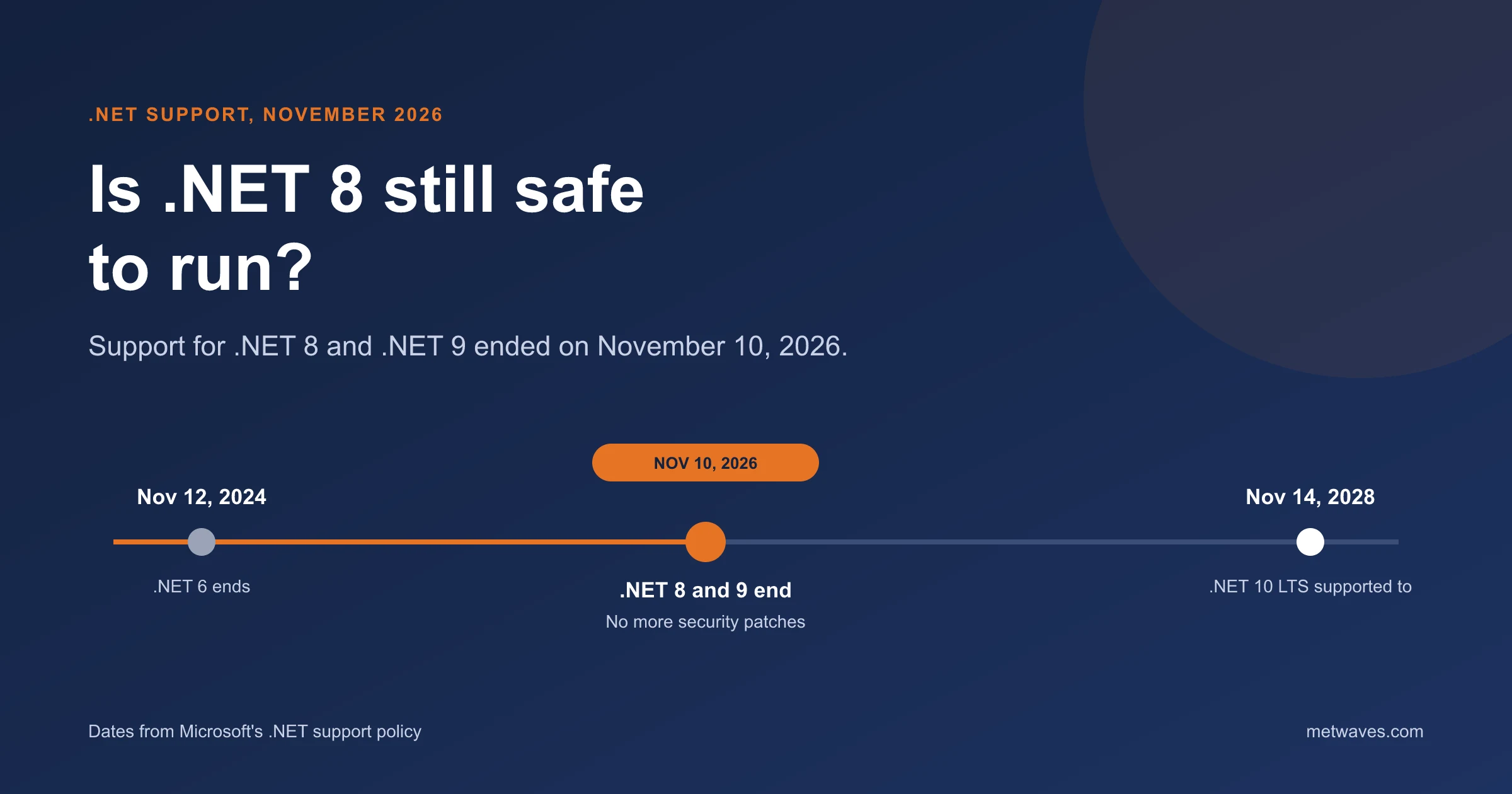
Is .NET 8 Still Safe to Run After November 2026?

Support for .NET 8 and .NET 9 ended on November 10, 2026. What that means for apps still on them, how risky it is, and how to plan the move to .NET 10.

Learn More >
Microsoft Technologies 5 min read
Nikit Nandan    Nikit Nandan November 12, 2026
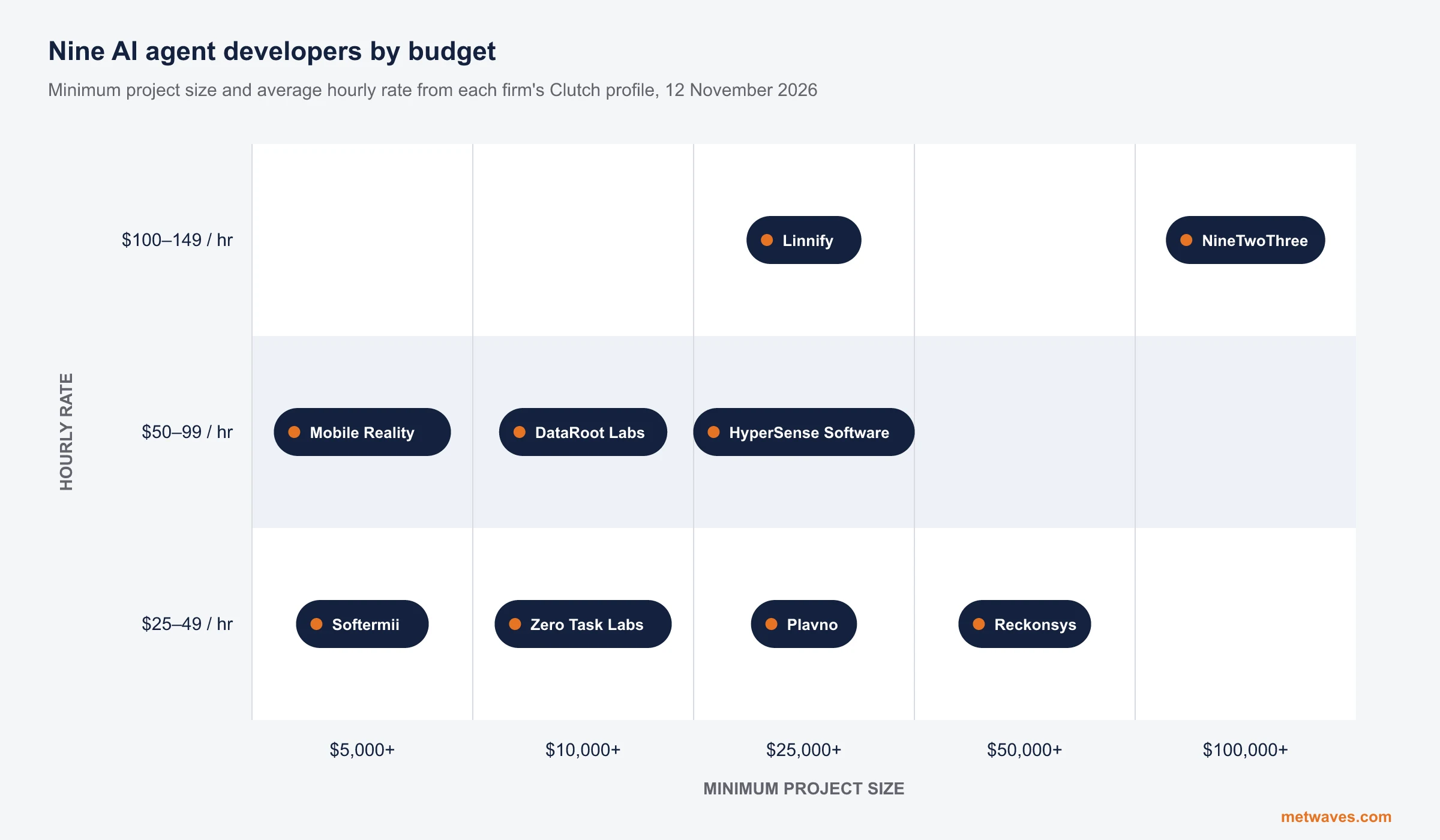
Top AI agent development companies for small and mid-sized businesses (2026)

Nine AI agent development firms a small or mid-sized business can shortlist, with Clutch figures, minimum budgets and the weaknesses their own clients name. Published by Metwaves, which is not ranked.

Learn More >
AI Development 9 min read
Nikit Nandan    Nikit Nandan November 12, 2026
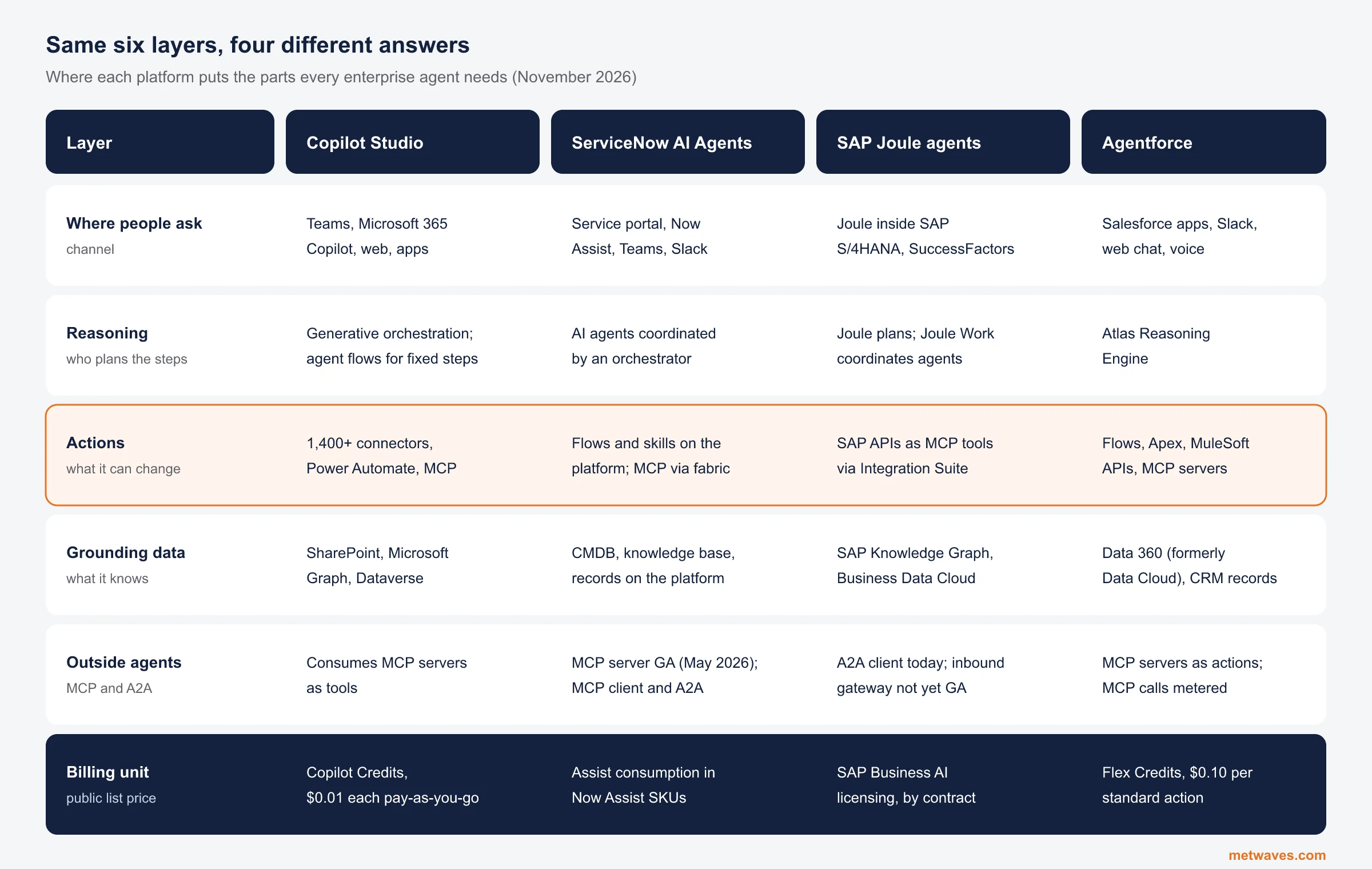
Enterprise AI Agent Platforms Compared (2026)

An architecture review of the four big enterprise AI agent platforms: where each one reasons, acts, finds its data and connects to outside agents, what it costs, and when a custom build is the better choice.

Learn More >
AI Development 9 min read

Let’s build your idea!

Let us help you with free analysis & estimate. Our product expert will contact you within 12 hours.

 All your information is kept confidential and protected by NDA.