Manufacturing Software Development

A manufacturing software development company for plants in the US, UK, Canada and Australia: production tracking, quality records, machine data and the ERP links between them. We have not shipped plant-floor software yet; we bring integration, data and AI work from other industries, and we say which.

Work that transfers: BIM-to-ERP integration for a US construction-technology company · AI material recommendations for a Swedish builder · SAP Business One invoice agent

THE MANUFACTURING INDUSTRY

What manufacturing is, and how a plant makes money

Manufacturing is every business that turns materials into products: metal parts and machinery, electronics, food and drink, chemicals, plastics, medical devices and the components that go into cars and aircraft. Discrete manufacturers make countable things on lines and cells. Process manufacturers make batches or continuous flows, where the recipe matters as much as the machine.

How a plant earns money shapes its software. A make-to-stock plant wins on throughput and cost per unit, so it watches uptime, scrap and changeovers. A job shop wins on quoting fast and shipping on the promised date, so it watches capacity and late jobs. Suppliers to large customers also live by their customers' audits: quality records, traceability and, more and more, cybersecurity questionnaires.

Most plants run an ERP for orders, stock and finance, some form of manufacturing execution (MES) for work orders and quality, often a spreadsheet in smaller plants, and the control systems that run the machines. A manufacturing software development company earns its fee in the gaps between them, where people re-type counts and rebuild the same report every Monday.

12.7 millionpeople employed in US manufacturing, October 2026US Bureau of Labor Statistics
9.7%of US GDP came from manufacturing value added, Q2 2026US Bureau of Economic Analysis
27.7%of incidents IBM X-Force responded to were in manufacturing, the most attacked industry for the fifth yearIBM X-Force Threat Intelligence Index 2026

Discrete

Machined parts, fabrication, machinery, electronics, assembly

  • Work orders
  • Routings
  • Machine status

Process

Chemicals, plastics, coatings, building materials

  • Batch records
  • Recipes
  • Lab results

Food and drink

Processing, packing, co-packers

  • Lot traceability
  • Allergen checks
  • Recalls

Regulated products

Medical devices, pharmaceuticals, supplements

  • Electronic records
  • E-signatures
  • Device history

Defence and aerospace supply

Machine shops and suppliers to primes

  • Controlled data
  • Supplier quality
  • First article

HOW A PLANT RUNS ON SOFTWARE

The five levels of plant software

Most plants describe their systems in the levels of the ISA-95 standard, from the machines up to the ERP. The gaps between levels are where most of the manual work hides.

L4

Business planning

Orders, stock, purchasing, costing and finance. The plan for what the plant should make and when.

  • ERP
  • CRM
  • Purchasing
  • Finance
Owned byFinance and operationsCustom software usually lives here
L3

Manufacturing operations

Work orders on the floor, scheduling, quality checks, maintenance and traceability. In many plants this level is a whiteboard and a spreadsheet.

  • MES
  • Scheduling
  • Quality
  • Maintenance (CMMS)
  • Traceability
Owned byOperations and qualityCustom software usually lives here
L2

Supervision

Screens operators use to watch and adjust the process, and historians that store machine values over time.

  • SCADA
  • HMI
  • Historian
Owned byControls engineers
L1

Control

The logic that runs each machine in real time.

  • PLCs
  • Drives
  • Robot controllers
Owned byControls engineers or your integrator
L0

The process

Machines, sensors and actuators doing the physical work.

  • Machines
  • Sensors
  • Actuators
Owned byMaintenance

We work at Levels 3 and 4 and read from Level 2. Control logic at Levels 0 and 1 stays with your controls engineers or integrator.

CHALLENGES

The challenges manufacturers face

Six things plant managers, quality leads and owners say, each with where software helps.

01

“We find out about downtime at the end of the shift.”

Where software helps: machine states captured automatically, reasons picked by the operator in two taps, and a live board instead of a Monday report.

02

“Quality checks live on paper travellers and spreadsheets.”

Where software helps: electronic check sheets at the station, limits that flag a failure as it is entered, and records tied to the lot and the operator.

03

“The ERP says one thing, the floor says another.”

Where software helps: work order status, scrap and counts posted back to the ERP as they happen, so planners and accounts see the same numbers.

04

“Our best people are retiring, and what they know goes with them.”

Where software helps: work instructions with photos at each step, set-up sheets per machine and a searchable record of fixes that worked.

05

“Every customer audit means a week of digging.”

Where software helps: lot genealogy from raw material to shipment, so one search shows which supplier lot went into which finished goods.

06

“The plant network is connected now, and so are the attackers.”

Where software helps: read-only data paths out of the control network, separate zones, access by role and a log of who changed what.

AI IN MANUFACTURING

How AI can help manufacturing, and who stays in charge

AI earns its place first on paperwork and early warnings, where a person still decides. Each use shows how much regulation applies.

01

Maintenance alerts

Watch vibration, temperature or current on key machines and flag the ones drifting from normal before they fail.

Who decides

the maintenance planner decides whether and when to stop the machine.

Light rules

No AI-specific rules for internal use. Nothing writes back to the controls.

02

Supplier document intake

Read supplier invoices, packing lists and certificates of conformance into structured data and match them to purchase orders.

Who decides

a person approves anything that fails a check.

Light rules

The same pattern as our invoice agent for an Australian business, built on SAP Business One.

03

Work instruction assistant

Answer an operator's question from your own SOPs and set-up sheets, citing the document and its revision.

Who decides

quality owns the documents; the assistant only answers from the controlled version.

Light rules

An answer from an old revision is a quality problem.

04

Planning suggestions

Suggest a schedule that cuts changeovers, or a reorder date from usage and lead times.

Who decides

the planner accepts or edits every suggestion.

Prove it first

Low legal risk, high business risk. Run it beside the current plan first.

05

Visual inspection

Cameras check parts for defects at line speed and divert the suspects.

Who decides

quality confirms every reject pattern and owns the acceptance limits.

Prove it first

For regulated products, the inspection system is part of the quality system and has to be validated.

06

Regulated quality decisions

Help review batch or device history records and complaints for FDA-regulated products.

Who decides

a qualified person signs; AI prepares and flags.

Regulated records

21 CFR Part 11 and the FDA's quality system rules apply to the records. Validate before relying on it.

Before AI touches plant data

  • Read-only connections to anything on the control network
  • Only the data the task needs leaves the site, and you choose where it is processed
  • A person approves every action that changes a record, an order or a machine
  • Every AI output logged with its input and who approved it
  • Tested on history first, then run beside the current process

COMPLIANCE

Industrial cybersecurity and quality rules manufacturing software touches

No single law covers plant software. Which rules apply depends on what you make, who you sell to and whether your product connects to the internet. Pick what applies to you.

StandardAsset owners, integrators, product suppliers

ISA/IEC 62443 series

The international series for securing industrial automation and control systems, with parts for plant owners, system design and product makers.

What it asks of software

  • Zones and conduits: plant networks separated, with known paths between them
  • Accounts and access by role, including for vendors and remote support
  • For software you sell into plants: a secure development lifecycle (62443-4-1)

Source: International Society of Automation (ISA)

GuidanceUS plants and their suppliers

NIST SP 800-82 Rev. 3 and CSF 2.0

NIST's Guide to Operational Technology Security (September 2023) covers securing systems that touch the physical process without hurting safety or uptime. CSF 2.0 (2024) is the wider framework customers often ask suppliers to map to.

What it asks of software

  • An inventory of OT assets and data flows
  • Monitoring that does not disturb the process
  • A plan for recovering production after an incident

Source: National Institute of Standards and Technology (NIST)

Certification standardAny certified plant

ISO 9001 quality management

The quality standard most customers ask suppliers for, built on controlled documents and records. A new edition, ISO 9001:2026, is now published, with a transition of about three years expected.

What it asks of software

  • Document control: the right revision at the station, old ones withdrawn
  • Records that cannot be quietly changed, with who and when
  • Nonconformance and corrective action tracked to closure

Source: ISO; LRQA on the transition period

In forceMakers of FDA-regulated products

FDA 21 CFR Part 11 and the QMSR

Part 11 covers electronic records and signatures that FDA rules require. Since February 2, 2026, device makers follow the Quality Management System Regulation, which brings in ISO 13485:2016.

What it asks of software

  • Access limited to authorised people, with device and authority checks
  • Electronic signatures linked to their records, with meaning and time
  • Validation and audit trails, applied on a documented risk basis

Source: US Food and Drug Administration

Phase 2 suspendedUS Department of Defense suppliers

CMMC 2.0

The Cybersecurity Maturity Model Certification rule (32 CFR Part 170) started in contracts on November 10, 2025 with self-assessments. In July 2026 the Department of War suspended Phase 2, the third-party Level 2 assessments due from November 10, 2026, pending a review.

What it asks of software

  • Self-assessments and SPRS scores still apply, and so does DFARS 252.204-7012
  • Controlled unclassified information kept in systems that meet NIST SP 800-171
  • Clear records of where that information lives and who can reach it

Source: US Department of War release, July 13, 2026

In forceMost US employers with more than 10 staff

OSHA injury and illness records

29 CFR Part 1904 requires Forms 300, 300A and 301, kept for five years, with the 300A summary posted from 1 February to 30 April. Establishments with 100 or more staff in listed industries also submit Forms 300 and 301 electronically each year.

What it asks of software

  • Incident capture on the floor, on a phone or kiosk
  • Forms produced from the same records, not re-typed
  • Privacy cases handled the way the rule requires

Source: Occupational Safety and Health Administration

In force since April 29, 2024Makers of consumer connectable products sold in the UK

UK PSTI product security regime

The Product Security and Telecommunications Infrastructure Act 2022 bans default passwords and requires a reporting route and a published security update period.

What it asks of software

  • Unique or user-set passwords from first use
  • A published vulnerability reporting route with response times
  • A support end date published, and updates shipped until then

Source: UK government, enforced by the Office for Product Safety and Standards

Phased: 2026 to 2027Anyone selling products with digital elements into the EU

EU Cyber Resilience Act

In force since December 10, 2024, with reporting duties from September 11, 2026 and the main obligations from December 11, 2027. It reaches any maker whose products are sold in the EU.

What it asks of software

  • Security designed in and documented for the CE marking
  • Vulnerability handling and security updates
  • Reporting actively exploited vulnerabilities within set deadlines

Source: European Commission

In force since March 4, 2026Makers and suppliers of consumer smart devices

Australia's smart device security standards

Rules made under the Cyber Security Act 2024 set three requirements for consumer-grade smart devices supplied in Australia, close to the UK's.

What it asks of software

  • Passwords unique per device or set by the user
  • A published way to report security issues
  • A published end date for security updates, never shortened

Source: Federal Register of Legislation, F2025L00276

Statuses as of November 2026. Rules change; check the source before you rely on a date.

FOUR MARKETS

The same questions in the US, UK, Canada and Australia

Plant security, connected products, defence work, injury records and personal data, side by side.

RequirementUSUnited StatesUKUnited KingdomCACanadaAUAustralia
Plant network securityNIST SP 800-82 Rev. 3 and CSF 2.0: guidance, not law, for most plantsIEC 62443 is the usual reference; no OT-specific law for most plantsThe Critical Cyber Systems Protection Act (Royal Assent June 2026) covers designated finance, telecoms, energy and transport operators, not most factoriesBusinesses with turnover above A$3 million must report a ransomware payment within 72 hours (Cyber Security Act 2024)
Connected products you sellCalifornia requires “reasonable security features”, such as a unique password per device (Civil Code 1798.91.04)PSTI regime since April 29, 2024: no default passwords, a reporting route, a published support periodNo dedicated product security law yet; privacy law covers personal data the product collectsSmart device security standards since March 4, 2026, made under the Cyber Security Act 2024
Defence suppliersCMMC 2.0: self-assessments in force; Phase 2 suspended in July 2026Def Stan 05-138 Issue 4 sets the cyber controls for MOD suppliers and subcontractorsCanadian Program for Cyber Security Certification: Level 1 self-assessment since April 2026, Levels 2 and 3 in developmentDefence Industry Security Program (DISP) membership for Defence tenders and contracts
Workplace injury recordsOSHA 29 CFR 1904: Forms 300, 300A and 301, kept five yearsRIDDOR: report specified injuries, occupational diseases and dangerous occurrences to the HSESet by each province and territory, with its own regulatorNotify the WHS regulator immediately of deaths, serious injuries and dangerous incidents; the model WHS Act was amended in December 2025
Medical device regulatorFDAMHRAHealth CanadaTGA
Personal dataState privacy laws; no single federal lawUK GDPR and the Data Protection Act 2018PIPEDA for private sector organisationsPrivacy Act 1988 and the Australian Privacy Principles

A summary for planning, not legal advice. Confirm what applies to your plant with your adviser.

That is the industry. Here is where Metwaves fits: manufacturers that need the gaps between the ERP, the floor and the machines closed, without touching control logic.

Manufacturing software we build

Six kinds of system, each linked to the service page that explains how we build it. None is shown as shipped for a manufacturer.

Production tracking

Work orders on a tablet at each station: start, stop, count, scrap and reason, posted back to the ERP as they happen. It replaces the end-of-shift report with numbers people trust.

Usually bought by
Plant managers and operations directors
  • Work order status
  • Downtime reasons
  • Scrap and rework
  • Shift handover
  • Live boards

Custom software development >

WORK THAT TRANSFERS

Built for other industries, and what carries over

We have no manufacturing client to show you. These projects are from construction and finance, labelled as such, and each solved a problem plants also have.

Built for a US construction-technology company

BIM model data mapped into estimating and the ERP

An integration that reads IFC building models, calculates quantities, maps each element to a cost code and loads the results into the estimating system and the ERP. Elements that do not map go to an exception report instead of being guessed.

  • Days to hoursquantity takeoff
  • 8 to 12 weeksto go live
What transfers to a plant

The same job as mapping CAD or PLM part data and machine output into ERP codes: messy source data, a rules table your team can edit, and exceptions for a person.

Read the BIM integration case study >

Built for BioBuild, a construction firm in Sweden

AI that ranks materials on cost, carbon and structural fit

A recommendation engine that reads the live BIM model and ranks candidate materials for each element, with engineers feeding corrections back. Piloted on one live project before rollout.

  • 40%less time per material choice
  • 20%lower material cost against previous estimates
What transfers to a plant

Ranking options against several goals at once is the shape of material substitution, supplier choice and schedule trade-offs in a plant.

Read the material recommendation case study >

Built for an Australian accounts payable team

An invoice agent posting into SAP Business One

A LangGraph agent that reads about 1,000 supplier documents a month, checks each against SAP Business One and the client's rules, posts what passes and queues the rest for review.

  • ~1,000documents a month
  • ~80%less manual data entry
What transfers to a plant

Plants get the same supplier paperwork, plus certificates of conformance that must match the order and lot.

Read the invoice agent case study >

Results are the clients' own, in their industries. We do not present them as manufacturing results.

How data moves from the machine to the ERP

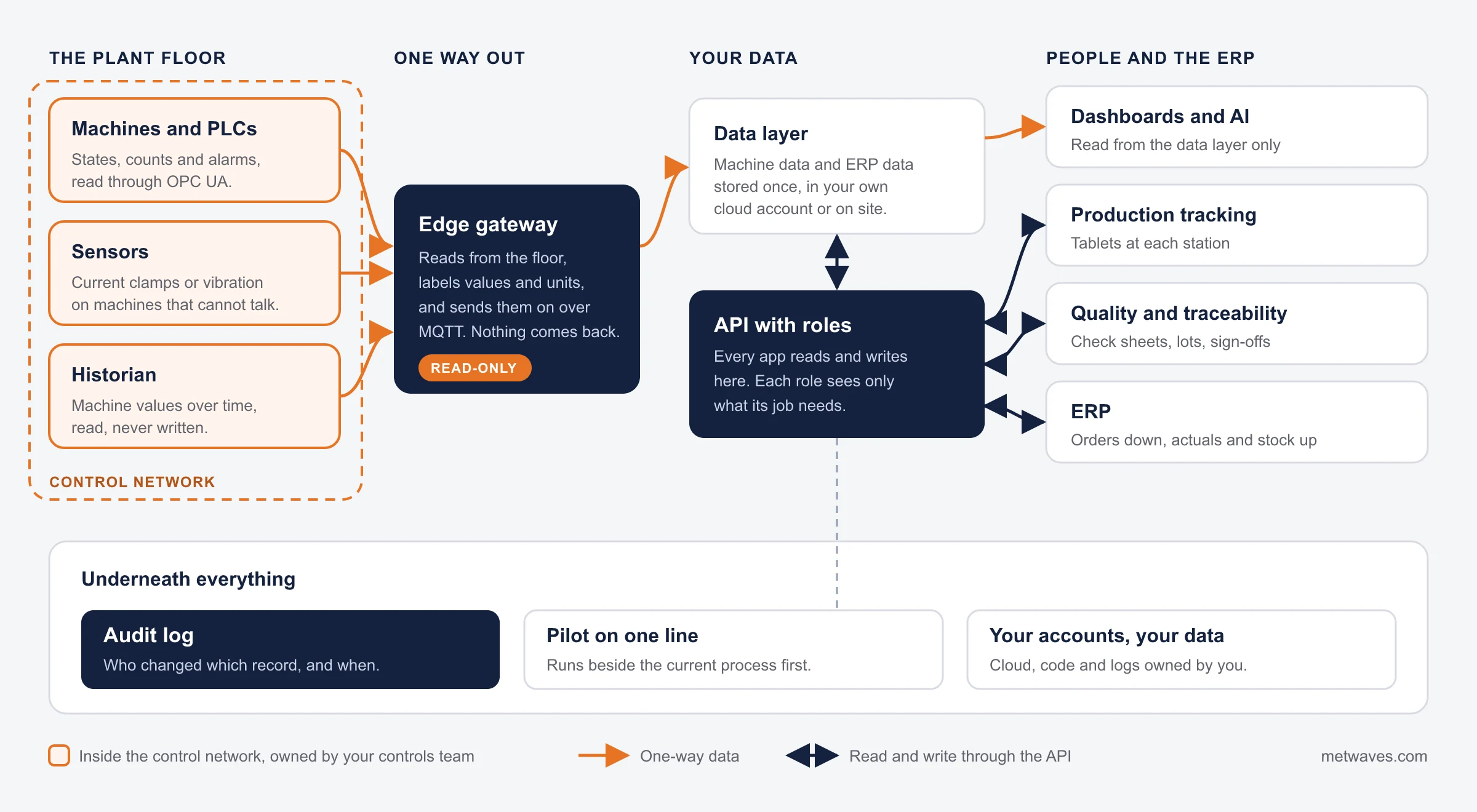
Before any screen is designed, we agree where data comes from, which way it flows and who can change it.

How plant data moves: machines, PLCs and sensors feed an edge gateway inside the plant network that only reads; data passes one way to a data layer; production tracking and quality apps and the ERP read and write through one API; dashboards and AI read from the data layer; an audit log and access by role sit underneath
    Orange marks the boundary of the control network. Data leaves it one way, through the gateway, and nothing in the business layer writes back to a machine.

    MACHINE DATA

    Three ways to get data out of machines

    Which route fits depends on the age of your equipment and what your controls team will approve.

    OPC UA

    The standard many modern machines and PLCs expose for reading values and states with their meaning attached.

    Suits
    Newer equipment, and plants standardising how machines publish data
    Who approves
    Controls engineers, who decide which tags are exposed and to whom
    Watch for
    Older machines without it, and security settings left at their defaults

    MQTT through a gateway

    A light publish and subscribe protocol, often used by an edge gateway that collects from several machines.

    Suits
    Mixed fleets of old and new machines, and sending data to a cloud or data layer
    Who approves
    IT and controls together, because it crosses the plant network boundary
    Watch for
    Agreeing topic names and units early, or every dashboard needs its own mapping

    Historian, files or sensors

    Where machines cannot talk: read from the historian you already run, from files a machine drops, or add a simple sensor such as a current clamp.

    Suits
    Older plants and quick pilots on one line
    Who approves
    Maintenance, and the historian's owner
    Watch for
    Clock differences between sources, which make downtime look longer than it was

    We prove the route on one machine before we quote the rest of the line.

    What moves the cost of custom software for manufacturing

    Access to the machines and the ERP sets the cost more than the number of screens does. We price after discovery.

    high impact

    Machine connectivity

    How many machines, how old, and whether they speak OPC UA or need a gateway or sensors. A mixed fleet costs more than the screens.

    high impact

    ERP integration

    Which ERP, which version, what API it offers and who has to approve access. On-premises ERPs with no API add an integration layer.

    high impact

    Regulated records

    Part 11 records, e-signatures and validation for FDA-regulated products add design, testing and documentation to every release.

    medium impact

    Number of stations and roles

    Operators, leads, quality, maintenance and planners each need their own screens and permissions.

    medium impact

    Offline and shop-floor hardware

    Tablets, scanners, label printers and Wi-Fi gaps on the floor shape the app and its testing.

    low impact

    Number of sites

    A second plant usually costs less than the first.

    Running costs such as hosting, licences and hardware are listed separately in every quote.

    Build, buy or extend: what fits your plant

    Custom manufacturing software development is worth it when your process is the advantage. Often it is not, and a product or a module is the answer.

    Your situationWhat usually fitsWhy
    Your ERP vendor sells a production or MES module that fits how you workBuy or extend the moduleCheaper to run and supported by the vendor. We will say so on the first call.
    Standard MES fits most of your floor, with a few gapsBuy, then integrateCustom work only for the gaps: a check sheet, a report, an ERP link.
    Your process, product mix or customers' rules make you differentCustom software around the ERPThe software follows your routings and checks instead of forcing a generic flow.
    You need CRM or ERP for manufacturingA product, not a buildThese are mature product categories. Custom work makes sense only around them.

    How we would start in your plant

    One line first, running beside what you do today, so production never depends on unproven software.

    1. 1

      Discovery call

      Thirty minutes on one line, its systems and the report that takes longest to build.

    2. 2

      Walk the floor

      One product from order to shipment, every system and paper form it touches.

    3. 3

      Plan

      A data map, the integration route for each machine and the ERP, and a costed first release.

    4. 4

      Pilot one line

      Running beside the current process until the numbers match what supervisors see.

    5. 5

      Train and adjust

      Operators and leads trained at the station; changes from their feedback.

    6. 6

      Roll out and support

      Line by line, then site by site, with support or a handover to your team.

    How to choose a manufacturing software development partner

    Ask these questions of anyone you shortlist, us included. Where we do not win: years on plant floors. We have none yet, and firms that do are worth a look if your project is mostly control-system work.

    Question to askA good answerA warning sign
    Which plant-floor systems have you built that are still running?Named projects, with what they connect to.Screenshots only, or a list of logos.
    Will you change our PLC logic or control systems?No, or only with your controls engineer and integrator.“We'll just connect straight to the PLCs.”
    How does data leave the control network?One way, read-only, through a gateway you approve.A remote connection into the plant for the vendor.
    Who holds the code, the cloud account and the data?You do, from the first day.Hosting under the vendor's own account.
    Would you tell us to buy instead?Yes, when an ERP module or MES product fits.Every answer is a custom build.

    Related services

    Each service page covers engagement models and the technology we use.

    Software integrationERP, MES and the systems around them.
    Data engineeringMachine and ERP data in one place.
    AI agent developmentDocument intake and other agents.
    Custom softwareFloor apps and production tracking.
    Enterprise softwareMulti-site systems and portals.

    QUESTIONS & ANSWERS

    Manufacturing software development: frequently asked questions

    Straight answers on experience, machines, MES, FDA Part 11, CMMC and cost. If you don't see an answer to your question, you can send us a message from our contact form.

    Software that fills the gaps between the ERP, the floor and the machines: production tracking, quality records, ERP and MES integration, machine data dashboards and document automation. A good one also tells you when an ERP module or MES product already does the job.

    Not on a plant floor yet. We bring integration, data and AI work from other industries: a BIM-to-ERP integration for a US construction-technology company, AI material recommendations for a Swedish builder and an invoice agent posting into SAP Business One.

    We read data through the route your equipment supports, usually OPC UA, a gateway using MQTT, a historian or an added sensor, and we agree it with your controls engineers first. We do not change PLC logic, and data leaves the control network one way.

    Buy when a product or your ERP's own module fits most of your floor, and integrate the gaps. Build when your process or customers' rules make a generic flow cost more in workarounds than software would.

    Access limited to authorised people, electronic signatures linked to their records, audit trails, validation on a documented risk basis, and controls over system documentation. For device makers, the FDA's Quality Management System Regulation has applied since February 2, 2026.

    CMMC entered contracts on November 10, 2025 with self-assessments. In July 2026 the Department of War suspended Phase 2, the third-party Level 2 assessments, while it reviews the programme. Self-assessments and DFARS 252.204-7012 still apply.

    It depends most on machine connectivity, the ERP integration and whether records are regulated. We quote after a short discovery and list running costs separately.

    INSIGHTS & NEWS

    Discover IT Industry Insights and Technology Trends

    Nikit Nandan    Nikit Nandan November 17, 2026
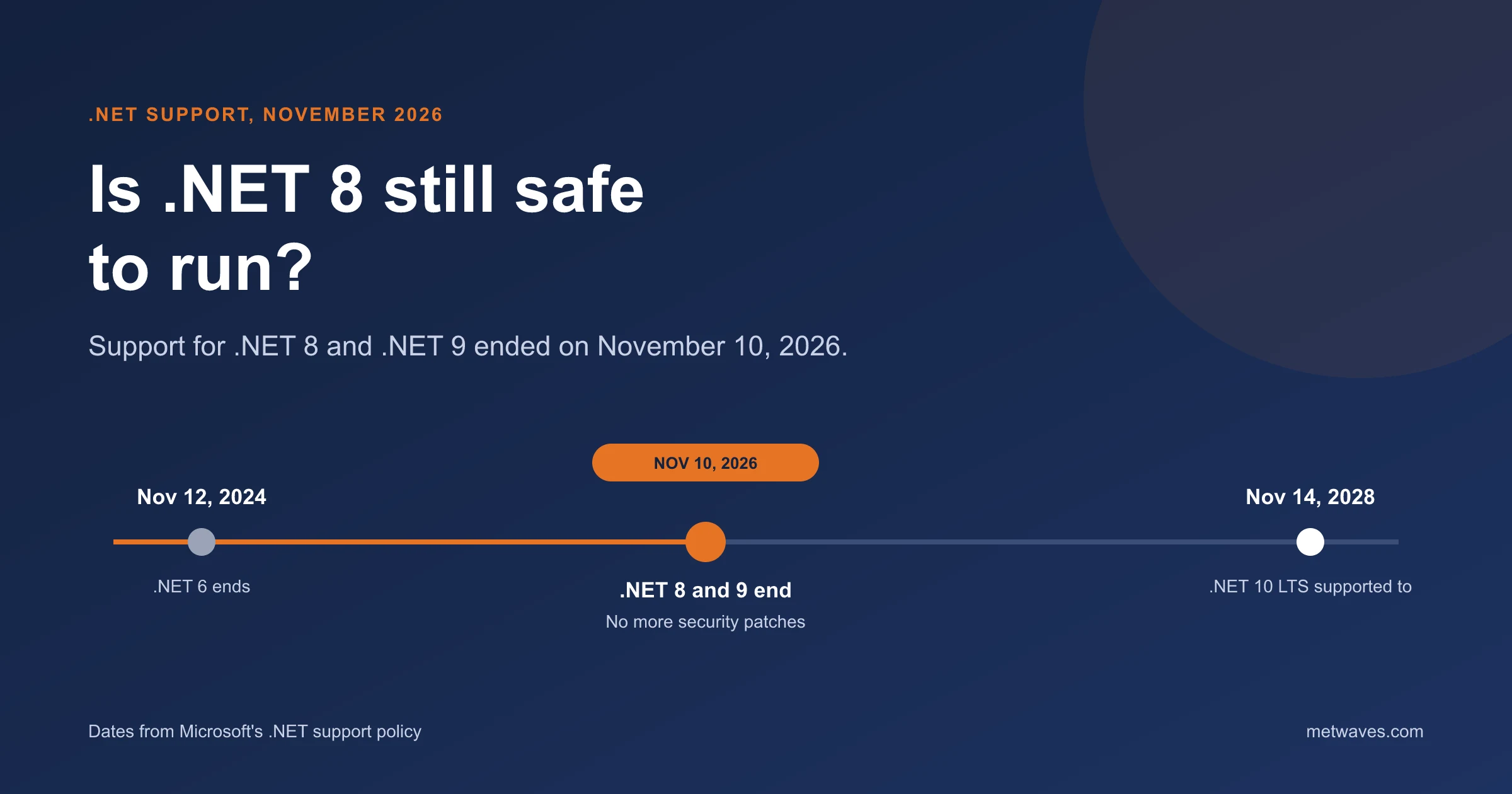
    Is .NET 8 Still Safe to Run After November 2026?

    Support for .NET 8 and .NET 9 ended on November 10, 2026. What that means for apps still on them, how risky it is, and how to plan the move to .NET 10.

    Learn More >
    Microsoft Technologies 5 min read
    Nikit Nandan    Nikit Nandan November 12, 2026
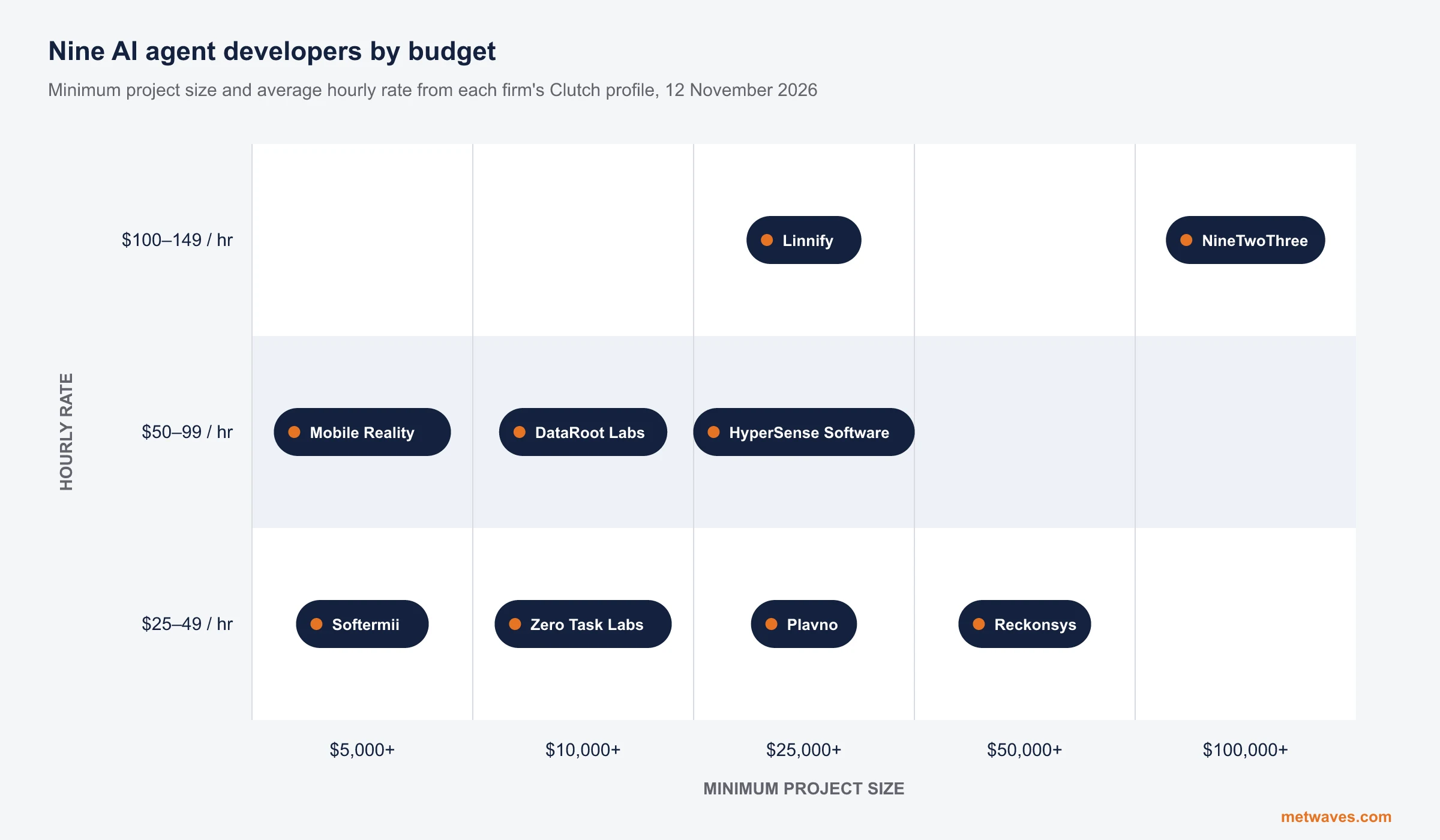
    Top AI agent development companies for small and mid-sized businesses (2026)

    Nine AI agent development firms a small or mid-sized business can shortlist, with Clutch figures, minimum budgets and the weaknesses their own clients name. Published by Metwaves, which is not ranked.

    Learn More >
    AI Development 9 min read
    Nikit Nandan    Nikit Nandan November 12, 2026
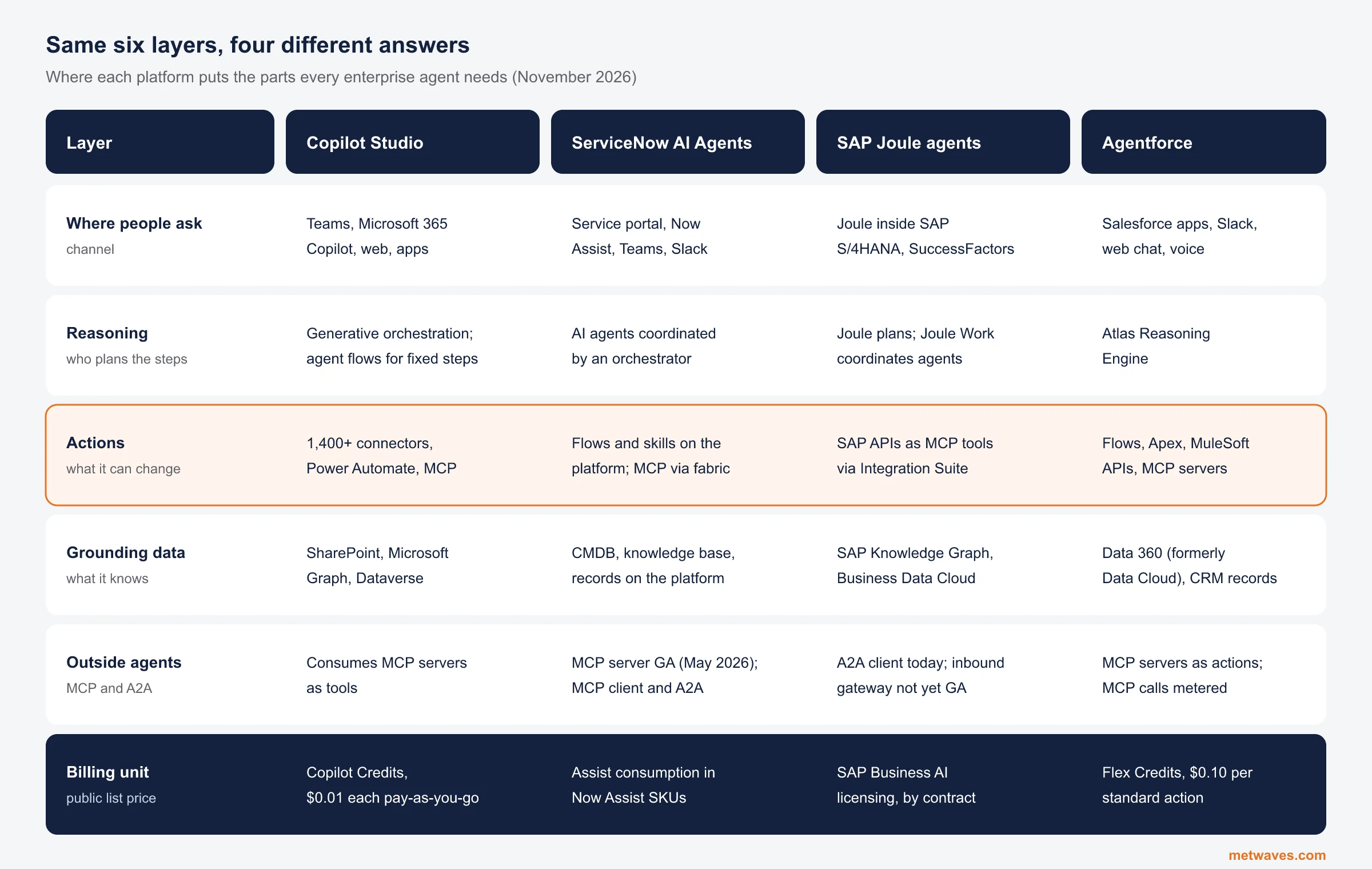
    Enterprise AI Agent Platforms Compared (2026)

    An architecture review of the four big enterprise AI agent platforms: where each one reasons, acts, finds its data and connects to outside agents, what it costs, and when a custom build is the better choice.

    Learn More >
    AI Development 9 min read

    Let’s build your idea!

    Let us help you with free analysis & estimate. Our product expert will contact you within 12 hours.

     All your information is kept confidential and protected by NDA.