
Cloud migration consulting services
Cloud migration consulting services for small and mid-sized businesses in the US, UK, Canada and Australia. We work out whether to move, which cloud fits, in what order your systems should go and what the monthly bill will be, before anyone moves a server. Already in the cloud? We review architecture, access, cost and backups, and rank every finding by risk and monthly saving.

We build on both Azure and AWS · TradeAlert on AWS, built for up to 10,000 concurrent users
WHAT IT IS
What is cloud migration consulting?
Cloud consulting is outside help to decide what runs in the cloud, how it is built and what it costs. Cloud migration consulting is the part that plans a move: what goes, where, in what order and at what running cost.
Metwaves delivers it as a written assessment: an inventory of your systems, a decision for each one, a monthly cost model and a wave plan, which our team or yours can then carry out.
What it is not
A hosting providerWe do not host your systems. The accounts and the bill are in your name.A licence resellerWe do not resell cloud services or licences.A 24/7 service deskWe are not a managed service provider with an operations centre.
WHEN TO CALL US
Signs you need cloud consulting
If two or more of these sound familiar, an outside view usually saves more than it costs.
Server hardware, licences or a data centre contract are up for renewal.
Where we would look firstWhat each system costs to run today, so moving can be compared with renewing.
You have quotes from two or three migration firms and no way to compare them.
Where we would look firstWhether each quote covers the same systems, the same decisions and a monthly run cost.
The cloud bill has grown faster than the business.
Where we would look firstUntagged resources, idle machines and capacity bought for a peak that never came.
One engineer set the whole account up and has since left.
Where we would look firstWho holds owner rights and root access, and what nobody can explain.
A customer or insurer sent a security questionnaire you cannot answer with confidence.
Where we would look firstSign-in, access rights, logging and backups, in that order.
Backups exist, but nobody has ever restored one as a test.
Where we would look firstWhat must come back, how fast, and a restore test to prove it.

Send us last month's cloud bill, or your server list. We will tell you on the call where we would look first.
What cloud consulting services cover
Six kinds of work, each ending in something written that you keep: a plan, a cost model, a ranked list of findings or a tested recovery.

Cloud readiness and migration assessment
An inventory of your systems and their dependencies, a decision for each one, a monthly cost model and a wave plan.

Migration strategy and roadmap
Landing zone design, wave order and how each wave rolls back. Our cloud migration team or yours carries it out.

Cloud strategy and provider choice
Azure, AWS or a hybrid stage, chosen from your software, licences, data location rules and skills. We build on both, so neither is the default.

Architecture and security review
For workloads already in the cloud, structured on the Well-Architected pillars, with access and sign-in checked first.

Cost review and FinOps
Tagging, budgets and alerts, rightsizing, switching off idle resources, and reserved capacity for steady usage.

Backup and disaster recovery plan
What must come back, how fast and from where, proved with a restore test rather than assumed.
ASSESSMENT
What a cloud migration assessment delivers
The assessment ends with a plan you can hand to any team, us included. These are the seven documents it produces.
- 01
Application and server inventory
Every system, who uses it, where it runs and what it costs today
Nothing gets forgotten in wave three
- 02
Dependency map
Which systems talk to each other, and which must move together
Stops a move from breaking something nobody listed
- 03
A decision per workload
Rehost, replatform, refactor, replace or retire, with the reason
You see where the effort and the saving sit
- 04
Target architecture and landing zone outline
Accounts or subscriptions, network, identity, logging, backups
The foundation every wave lands on
- 05
Monthly run-cost model
The expected cloud bill, beside what you pay today
You decide on numbers, not hope
- 06
Wave plan with rollback points
What moves in which order, and how each wave goes back if it fails
Risk is taken in small steps
- 07
Risk and compliance list
Data location, security questionnaire answers, licences, contracts that need notice
No surprises from legal or finance halfway through
- 08
The plan is yours
Hand it to our cloud migration team, your own team or another firm.
You decide on numbers, with no obligation to us
Seven documents and one decision: move, wait or stay. You keep them either way.
A DECISION PER SYSTEM
Every system gets its own decision
A migration is not one move. Each system gets one of six decisions, with the reason written next to it, and some do not move at all.
Move it as it is to virtual machines in the cloud.
Fits when The system works, has no cloud version and must move before a deadline.
Move it with small changes, such as a managed database or app hosting.
Fits when A .NET or Node.js app that can run on a managed service with little rework.
Change the code so it runs well in the cloud.
Fits when The system is central to the business and will keep changing for years.
Swap it for software as a service.
Fits when A file server, email or a standard tool where a subscription does the job.
Switch it off and archive the data.
Fits when Few people still use it, or another system already does the same thing.
Leave it where it is, with a date to look again.
Fits when A licence, hardware or contract has a year to run, or renewing costs less.
Effort to move, from none to most
How a cloud assessment works
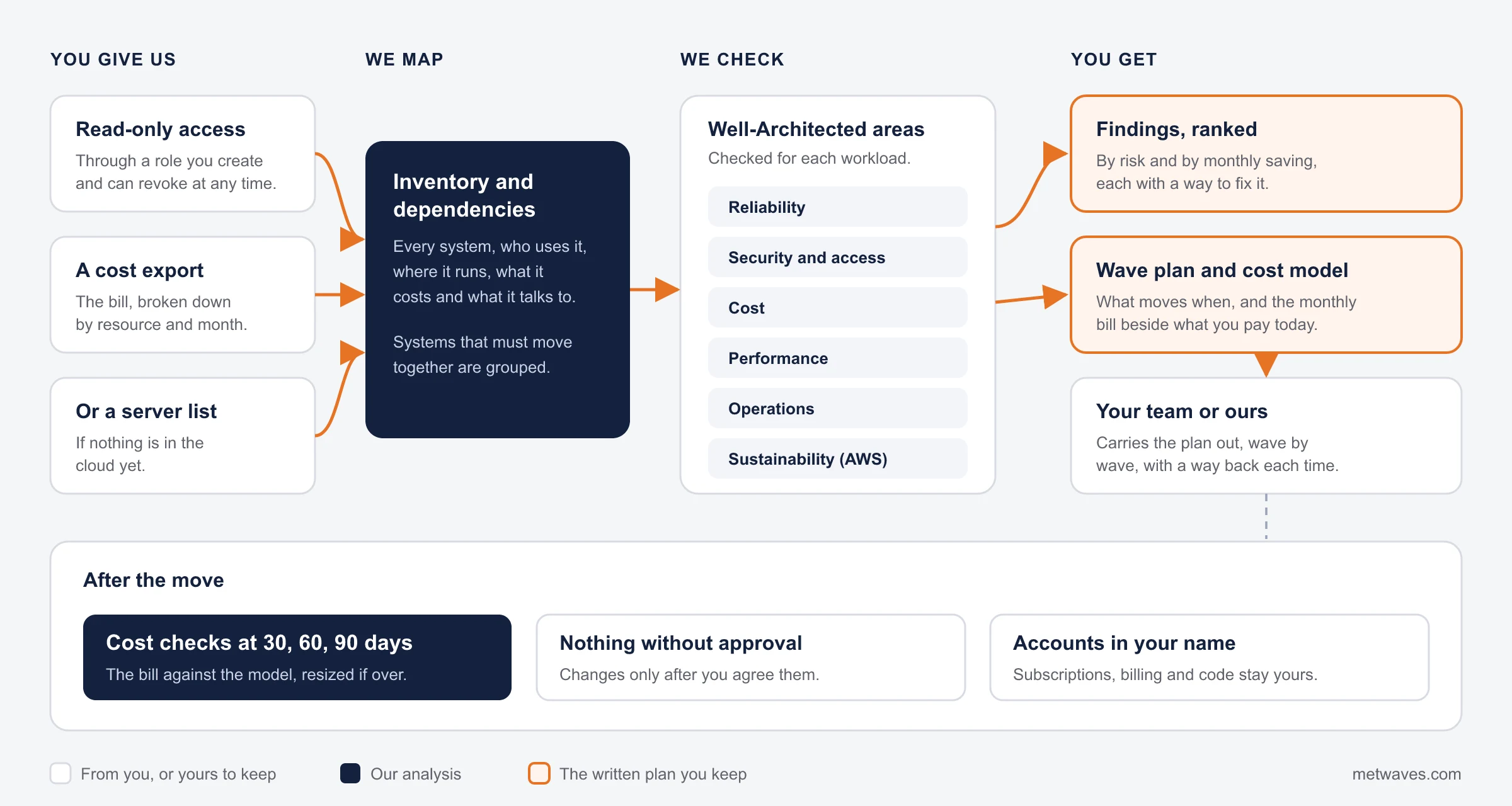
We start read-only, inventory what you run and what it costs, check it against the Well-Architected pillars, and rank every finding by risk and by monthly saving. Nothing changes until you have agreed the plan.
TIMELINE
How a cloud migration runs, stage by stage
A migration runs in five stages. Durations go in the plan once we have seen your inventory: a ten-server move and a hundred-server move share stages, not timelines.
- Plan
- Foundation
- Move
- Move
- Run and check
Not a time scale. The move itself is described on our cloud migration page.
Azure, AWS or hybrid: which cloud fits your business
The right cloud is usually the one that matches the software, licences and skills you already have.
| If you | What usually fits | Why |
|---|---|---|
| Run Microsoft 365, .NET and SQL Server | Usually Azure | Same sign-in, and licences you may be able to reuse. Azure consulting |
| Already have most workloads on AWS | Usually stay on AWS | Tidying up is cheaper than moving. AWS consulting |
| Need data kept in the UK, Canada or Australia | Choose the region first | Then pick the services offered in that region. |
| Run a handful of apps with no operations team | Managed services | App hosting and managed databases, not Kubernetes. |
| Are still on your own servers | An assessment, then the move | This page plans it; our cloud migration team carries it out. |
| Have one system that cannot move yet | Hybrid, as a stage | Planned with a date it ends, not as the end state. |
| Are weighing up two clouds for production | Usually one | Two clouds double the skills, security work and bills to watch, for little gain at small scale. |
AZURE VS AWS
Azure and AWS side by side for a small business
Both clouds can run almost anything a small business needs. What separates them for you is sign-in, licences, your team's skills and where your data must live.
| Requirement | AZAzure | AWSAWS | FITWhat usually decides it |
|---|---|---|---|
| Load rises and falls with use | App Service, Functions, scale sets | Auto Scaling, Lambda, Fargate | Either; choose the one your team knows |
| Architecture review framework | Azure Well-Architected Framework, five pillars | AWS Well-Architected Framework, six pillars | The same ground; AWS adds sustainability |
| Systems Metwaves has built on it | Telemeds+; AI agents and assistants on Azure AI services | TradeAlert, a real-time alert platform | We build on both |
Pillar counts from Microsoft's and Amazon's own Well-Architected documentation. On Google Cloud we run our own assistant demos; see Google Cloud consulting.
How a cloud consulting engagement runs
Every engagement starts read-only and ends with a plan your team can run without us.
- 1
Call
We agree what you want answered: whether to move, which cloud, or why the bill grew.
- 2
Read-only access
A cost export and read-only access you can revoke, or a server list if you are not in the cloud yet.
- 3
Assessment
Inventory, dependencies and checks across reliability, security, cost, performance and operations.
- 4
Walk-through
We take your team through the findings and the wave plan, ranked by risk and monthly saving.
- 5
Move or hand over
Our migration team carries it out, or your team does, with cost checks at 30, 60 and 90 days.
CLOUD SYSTEMS WE BUILT
A cloud build, not a migration: TradeAlert on AWS
We have not yet published a migration or cost-review case study, so this is the honest proof: a system we built on AWS. An experienced stock trader wanted a web platform that sends investors real-time stock and crypto alerts, and it had to stay fast under heavy load.
We built it with React and Node.js on AWS, with automatic scaling, load balancers and CloudWatch monitoring. On Azure we built the Telemeds+ telemedicine app with .NET and SQL Server, and our AI agents run on Azure AI services. When we review your cloud, the people reading it have run systems like these.
- Type of workNew build on AWS, not a migration
- Built withReact, Node.js, Express, MongoDB on AWS
- ScalingAutomatic scaling, load balancers and CloudWatch monitoring
- Built forUp to 10,000 concurrent users
What cloud migration consulting costs
The assessment is a fixed price agreed before we start. Three things set it. Keep the one-off fee apart from the monthly cloud bill, which the assessment exists to make smaller and predictable.
Systems and accounts
How many systems, servers, subscriptions or AWS accounts there are to inventory.
Dependencies
How tightly systems talk to each other, which decides how many must move together.
Rules and records
Data location rules, security questionnaires and contracts that need notice.
Ways to work with us
You only ever commit to the next step: the assessment first, then the move or the fixes, wave by wave.

Readiness assessment or review
A fixed price agreed before we start, set by how many systems and accounts you run.

Migration, wave by wave
Each wave quoted at a fixed scope once the plan exists, and fixes priced per finding.

Monthly cloud support
Changes, monitoring and a monthly look at the bill, billed for the time used.

A cloud engineer in your team
When there is a long run of changes and you want the person inside your team.
CHOOSING A PARTNER
How to choose a cloud consulting company
Six questions that show whether a firm will plan for your bill and your team, or for its next project. They include the ones we do not win on.
Do they start read-only?
A good firm asks for a cost export and read-only access you can revoke, not for an admin password.
Do they give you a monthly run cost?
The project fee is a one-off. The cloud bill is for years. Ask for both, in writing.
Are the accounts in your name?
Subscriptions, accounts, billing and infrastructure code should belong to you from day one.
Will they tell you to stay where you are?
If every assessment they have run ended in a migration, the assessment was a sales step.
Is their partner status stated plainly?
Partner tiers can unlock vendor funding for migrations. We do not claim one on this page, so if that funding matters to you, shortlist a tiered partner too.
Where might they not fit?
We are not a managed service provider with a 24/7 operations centre. Very large estates that need one should hire one.
Related services
Consulting decides and plans. These pages cover the move and each cloud.
QUESTIONS & ANSWERS
Cloud migration consulting: frequently asked questions
Straight answers on cost, access, partner status and which cloud fits. If you don't see an answer to your question, you can send us a message from our contact form.
The assessment is a fixed price agreed before we start, set by how many systems and accounts you run. The migration is priced per wave afterwards, and fixes per finding. Keep the one-off fee apart from the monthly cloud bill, which the assessment exists to make smaller and predictable.
Cloud consulting is outside help to decide what runs in the cloud, how it is built and what it costs. Cloud migration consulting is the part that plans a move: what goes, where, in what order and at what running cost.
Look for a firm that starts read-only, asks for a cost export first, gives a monthly run cost as well as its fee, and will tell you to stay where you are. The questions above are the ones we would ask.
It depends on your software, licences, data location rules and skills. A business on Microsoft 365, .NET and SQL Server usually lands on Azure; a product already mostly on AWS usually stays there. Hybrid is a stage during a move, rarely the end state for a small team. We have built production systems on both.
FinOps means knowing who spends what in the cloud and acting on it: tags, budgets and alerts, rightsizing, switching off idle resources, reserved capacity for steady usage and cheaper storage tiers. Most bills fall from those steps rather than from changing provider. We show the expected saving per change before making it.
No. The assessment runs on read-only access and a cost export, through a role or user you create and can revoke. Changes happen only with your approval.
This page does not claim an AWS or Microsoft partner tier, so do not choose us for vendor migration funding. Both AWS and Microsoft list their partners in public directories. Choose us for the plan and for the people who will do the work.
Consulting decides and plans: what moves, where, in what order and at what running cost. Migration services carry the move out: landing zone, waves, cut-over, rollback and the weeks after. We do both; the move is described on our cloud migration page.
INSIGHTS & NEWS
Discover IT Industry Insights and Technology Trends
 Nikit Nandan
November 17, 2026
Is .NET 8 Still Safe to Run After November 2026?
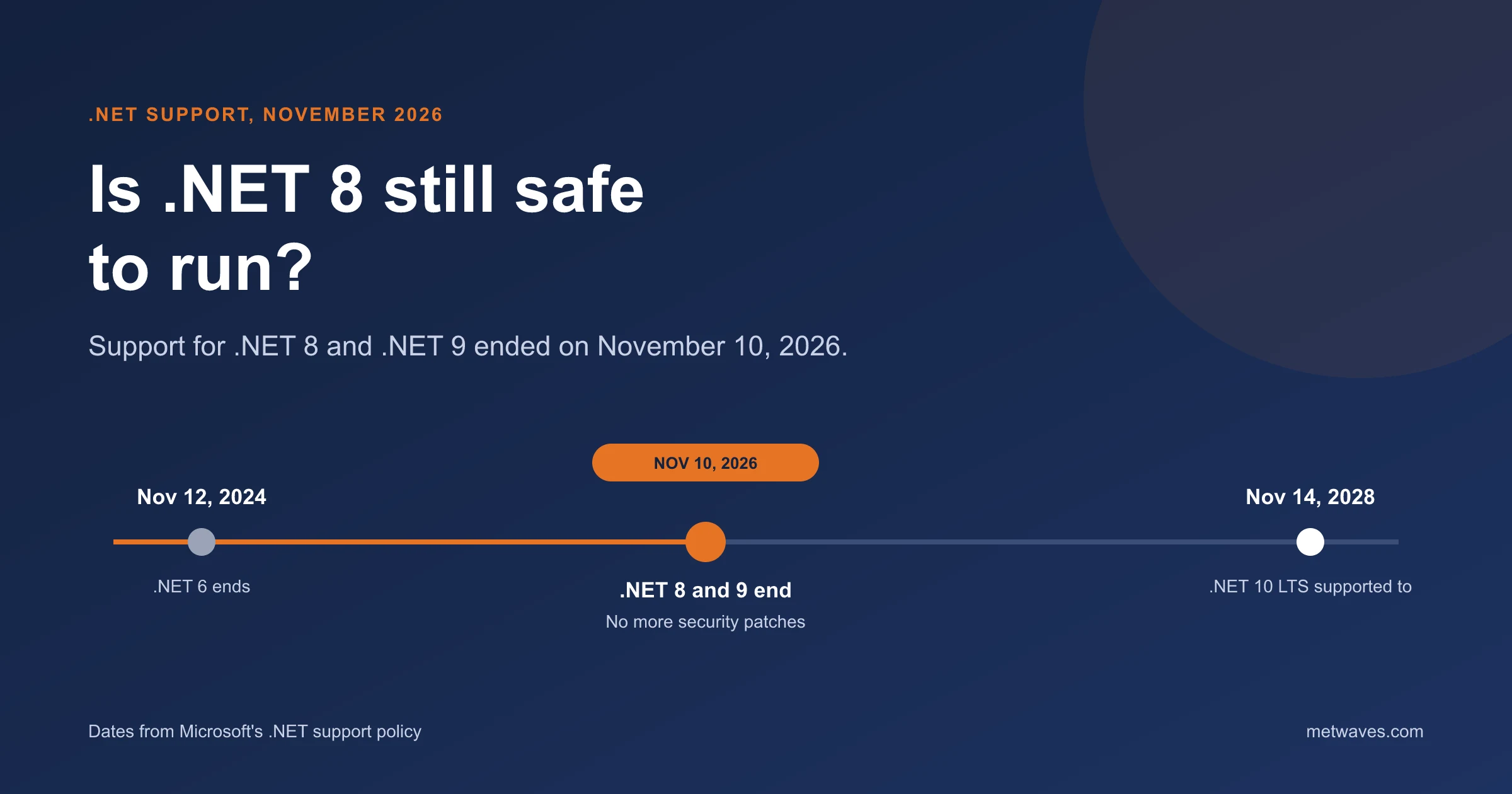
Support for .NET 8 and .NET 9 ended on November 10, 2026. What that means for apps still on them, how risky it is, and how to plan the move to .NET 10.
Learn More >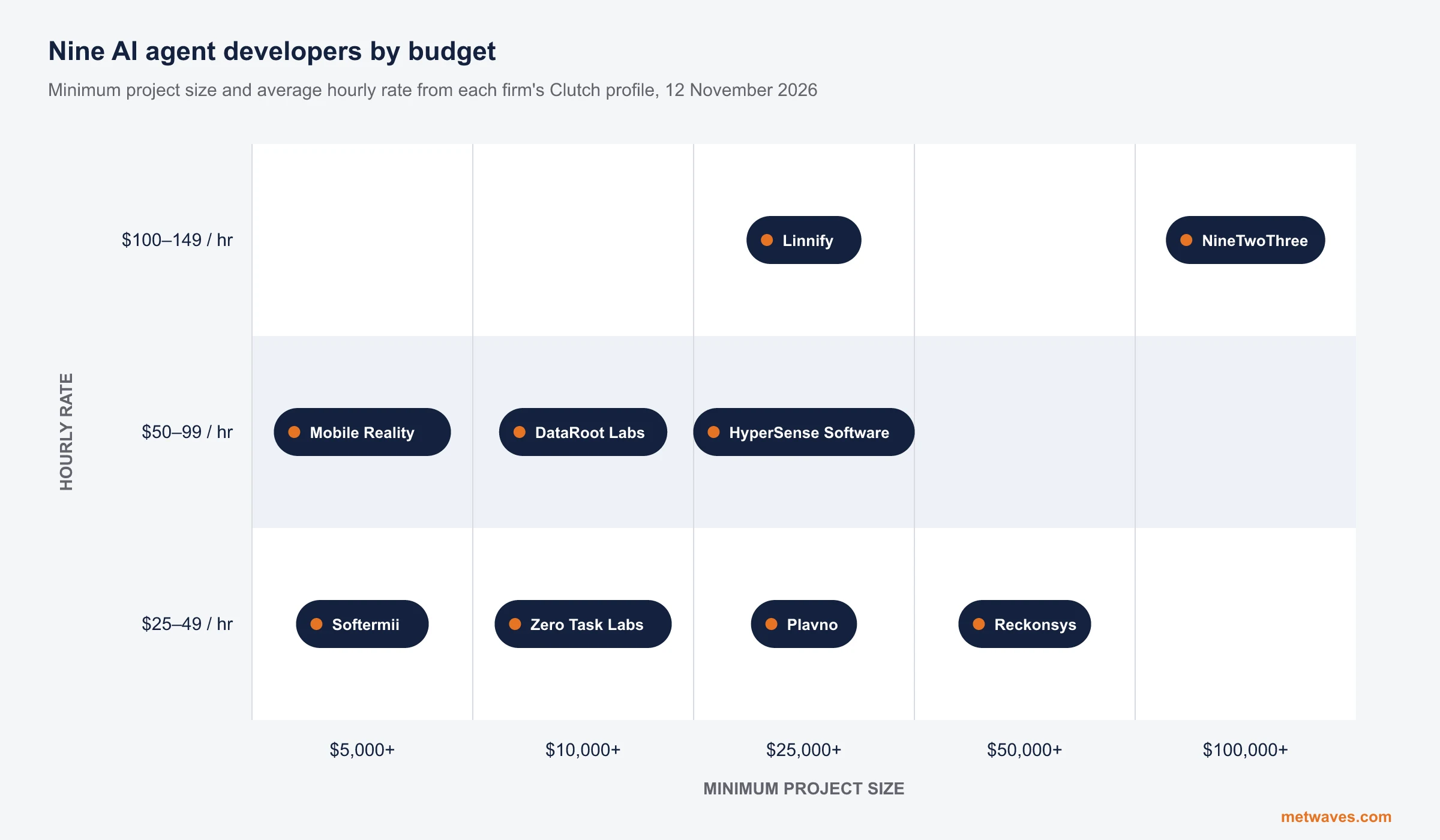 Nikit Nandan
November 12, 2026
Top AI agent development companies for small and mid-sized businesses (2026)
Nine AI agent development firms a small or mid-sized business can shortlist, with Clutch figures, minimum budgets and the weaknesses their own clients name. Published by Metwaves, which is not ranked.
Learn More >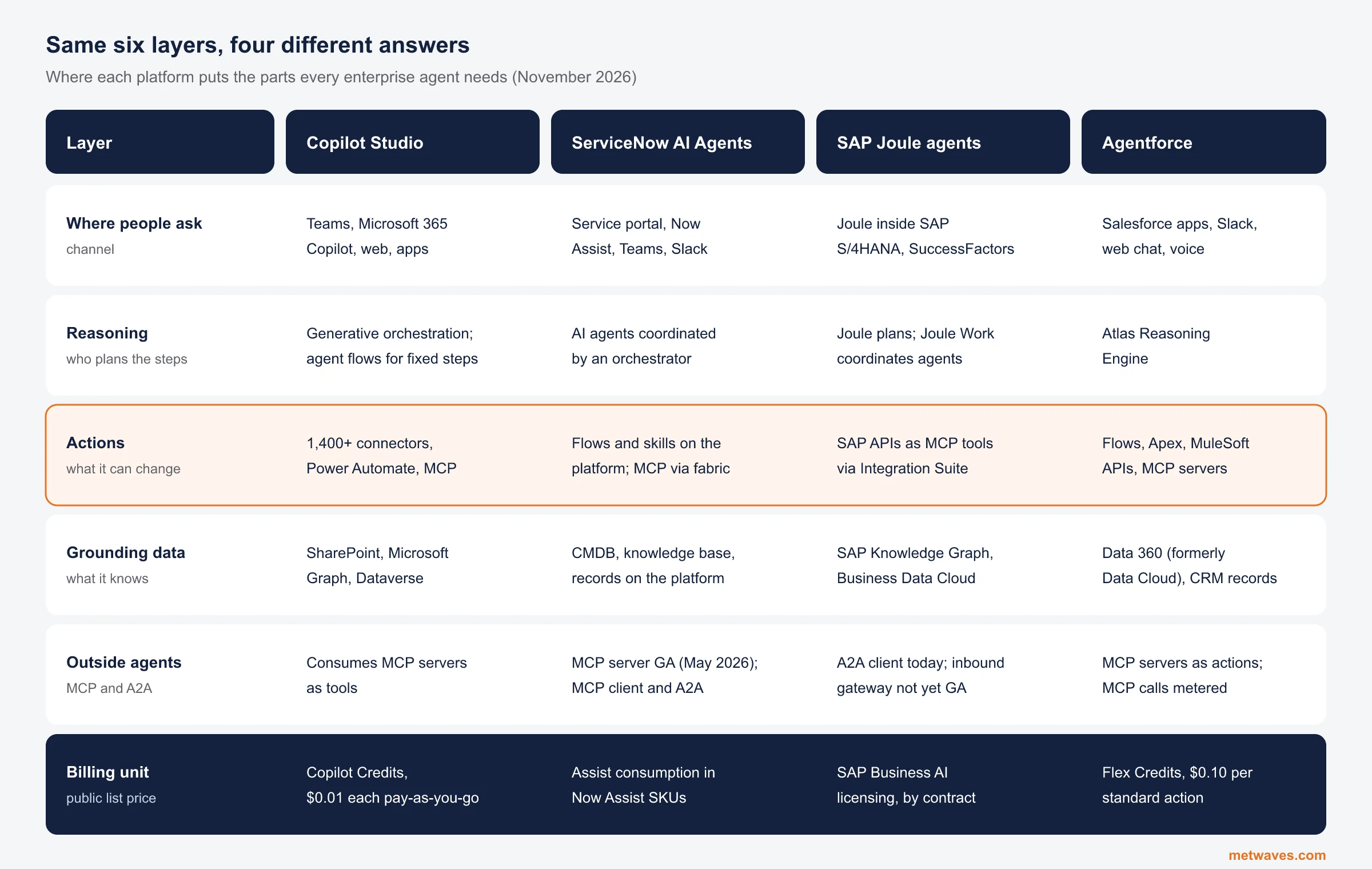 Nikit Nandan
November 12, 2026
Enterprise AI Agent Platforms Compared (2026)
An architecture review of the four big enterprise AI agent platforms: where each one reasons, acts, finds its data and connects to outside agents, what it costs, and when a custom build is the better choice.
Learn More >Let’s build your idea!
Let us help you with free analysis & estimate.
Our product expert will contact you within 12 hours.