Logistics Software Development

Freight moves on phone calls, PDFs and five systems that do not talk to each other. We build dispatch tools, tracking portals, driver apps and the integrations between your TMS, carriers, ELDs and accounting for carriers, brokers, 3PLs and shippers in the US, UK, Canada and Australia, with hours-of-service, customs and driver-privacy rules designed in from the first release.

Real-time platform built for 10,000 concurrent users · AI agent reading ~1,000 documents a month · Teams agent resolving 30–50% of staff requests

THE LOGISTICS INDUSTRY

What the logistics industry is, and how freight moves

Logistics is the business of moving and storing goods: trucking companies and owner-operators, freight brokers and forwarders, warehouses and third-party logistics (3PL) providers, couriers and last-mile delivery firms, and the manufacturers and retailers that run their own fleets. It is one of the largest parts of every economy we serve, and one of the most rule-bound, because it puts heavy vehicles on public roads and goods across borders.

Road does most of the work. In the UK, GB-registered lorries lifted 1.53 billion tonnes of goods in 2025. Australia's domestic freight task reached a record 786 billion tonne-kilometres in 2024–25, about a third of it by road. In the US, trucks carry roughly two-thirds of freight tonnage.

How money is made shapes the software. Carriers earn per mile or per load and lose money on every empty or idle hour. Brokers live on the margin between the shipper's rate and the carrier's. 3PLs bill for storage, picks and extra handling, and last-mile firms win or lose on cost per drop. Under all of them sits the same stack: a transport management system (TMS), a warehouse management system (WMS), ELDs and telematics, carrier and customer portals, and accounting. Custom logistics software development fills the gaps between them, where dispatchers still re-type, phone and email spreadsheets.

20.2 billion tonsof freight moved in the US in 2023, worth about $18.7 trillionBureau of Transportation Statistics
6.6 millionpeople work in US transportation and warehousing (October 2026, preliminary)US Bureau of Labor Statistics
8.6%of US GDP came from demand for transportation in 2025, $2.7 trillionBureau of Transportation Statistics

Trucking and fleets

Full and part loads, owner-operators, private fleets

  • Dispatch
  • Hours of service
  • Maintenance

Brokerage and forwarding

Freight brokers, forwarders, customs brokers

  • Quotes and margins
  • Carrier vetting
  • Customs data

Warehousing and 3PL

Contract warehouses, fulfilment, cold chain

  • WMS
  • Client billing
  • Client portals

Last-mile and courier

Parcel, same-day and field delivery

  • Route planning
  • Driver apps
  • Proof of delivery

Shippers

Manufacturers and retailers moving their own goods

  • Carrier selection
  • Tracking
  • Freight audit

CHALLENGES

The challenges logistics businesses face

Six pressures that carriers, brokers, 3PLs and shippers deal with every week, and where software makes a real difference.

01

Thin margins and rates that swing with fuel and capacity

A broker's margin is a few points, and a carrier loses money on every empty mile.

Where software helps: Margin, empty-mile and on-time reports that run every day, not at month end.

02

Customers who want to know where their load is without calling

Position data sits with carriers, ELDs and warehouses, each in its own format.

Where software helps: One tracking view built from carrier APIs and telematics feeds, with delay alerts before the customer asks.

03

Paperwork that holds up the invoice

Bills of lading, rate confirmations and proofs of delivery still arrive as PDFs and phone photos.

Where software helps: Capture in the driver app and AI that reads the documents, so the invoice goes out on the day of delivery.

04

Hiring and keeping drivers

Every new driver needs onboarding, documents, checks and a dispatcher's time.

Where software helps: A driver app that is quick to learn, digital onboarding and fewer calls to dispatch.

05

Rules that keep changing

Hours of service, electronic logs, customs declarations and driver privacy differ by market and change often.

Where software helps: Rules built into the workflow: hours left shown at dispatch, records kept for the required period, customs data captured once.

06

Systems that do not connect

The TMS, WMS, accounting, customer EDI and carrier portals each hold part of the truth.

Where software helps: An integration layer with retries and an exceptions queue, instead of another spreadsheet.

AI IN LOGISTICS

How AI can help logistics, and where it needs a person

AI is most useful today where the paperwork and the phone volume are high and a wrong answer is cheap to catch. Each use below shows the risk and where a person stays in charge.

Low risk

Shipment question assistant

Answers “where is my shipment?” and “can I change the delivery window?” from live TMS and carrier data, and rebooks within the rules you set.

A person stays in charge: dispatch takes over damage claims, disputes and anything outside the rules.

We compare ready-made and custom chatbots for exactly these questions in this post.

Low risk

Reading freight documents

Reads bills of lading, proofs of delivery, rate confirmations and commercial invoices into structured fields.

A person stays in charge: staff confirm any field the model is unsure of before it is saved.

The same pattern as our invoice agent, which posts supplier documents to SAP Business One.

Needs review

Quote and rate suggestions

Suggests a price from lane history, weight, size and current costs.

A person stays in charge: a person approves every quote, and anything below your margin floor.

A quote is a commitment. Log the suggestion and who approved it.

Needs review

Load and route planning

Suggests which driver takes which load and in what order, within the hours each driver has left.

A person stays in charge: the dispatcher accepts or changes every plan.

FMCSA treats using ELD data to pressure a driver into breaking hours-of-service limits as harassment (FMCSA).

Needs review

Customs data preparation

Pre-fills commercial descriptions, quantities and suggested tariff codes from the order and invoice.

A person stays in charge: your customs broker or trade team confirms every code before filing.

A declaration is a legal statement to customs. AI suggests; people sign.

High risk

Driver monitoring and camera analytics

Flags fatigue or distraction from in-cab video or driving data.

A person stays in charge: a trained person reviews every flag before any action is taken about a driver.

In the UK the ICO says a DPIA is required for this kind of monitoring (ICO). Tell drivers what is monitored and why.

Before any AI touches driver or customer data

  • A data processing agreement with every AI model provider, with no training on your data
  • Only the data the task needs in each prompt
  • A person approves anything that goes to a customer, to customs or into a driver's record
  • Every AI output logged with who approved it
  • Testing with synthetic data, never live driver or customer records
  • Drivers told what is monitored, why, and for how long it is kept

REGULATION AND COMPLIANCE

Logistics regulation and compliance: what software has to respect

Four areas touch almost every logistics system: drivers' hours, customs and trade data, the privacy of the drivers you track, and who in the supply chain is responsible for safety. US rules first, then all four markets side by side.

ELDs required since 2017

FMCSA electronic logging devices

Carriers whose drivers must keep records of duty status have had to use ELDs since December 18, 2017; older AOBRDs were allowed until December 16, 2019 (FMCSA checklist). Paper logs remain for drivers who log 8 days or fewer in 30, driveaway-towaway work and vehicles made before model year 2000 (49 CFR 395.8).

What it means for software

  • Hours left visible before a load is assigned
  • Logs and supporting documents kept for 6 months
  • Only devices on FMCSA's registered list; FMCSA removed fourteen devices in March 2026 and gave carriers 60 days to replace them
CBP and Census

Customs and trade data

Ocean importers file the Importer Security Filing (“10+2”) no later than 24 hours before cargo is loaded on a US-bound vessel (19 CFR 149.2). CBP's ACE is the US single window for import and export data. Exporters file Electronic Export Information through ACE AESDirect when a Schedule B line is worth more than $2,500 or needs a licence (15 CFR 30.37).

What it means for software

  • Shipment data captured once and passed to your broker or filing tool
  • Deadlines tracked per shipment, not in someone's inbox
  • A record of what was filed, when and by whom
Employees covered since 2023

Driver and employee privacy

Since January 1, 2023, California's CCPA has covered the personal information of employees and job applicants, not only customers (California Attorney General). It applies to businesses above set thresholds, including annual revenue of $26.625 million or more (CPPA).

What it means for software

  • A notice at collection for location and camera data
  • Requests to see or delete data handled from one place
  • Location history deleted on a schedule

Hours-of-service limits, as a dispatch checklist

Two markets with electronic logs and different numbers. A dispatch screen has to know which rules each driver is on.

US property carriers

  • 11 hours driving after 10 hours off
  • 14-hour on-duty window
  • 30-minute break after 8 hours driving
  • 60/70 hours in 7/8 days; 34-hour restart

49 CFR 395.3

Canada, south of 60°N

  • 13 hours driving, 14 hours on duty a day
  • No driving after 16 hours since the last 8 hours off
  • 10 hours off duty a day
  • 70 hours in 7 days or 120 hours in 14

SOR/2005-313

What dispatch needs

  • Each driver's rule set and cycle
  • Hours left, live from the ELD
  • A warning before an impossible plan is sent
  • A record of who overrode it, and why

OTHER MARKETS

Logistics rules in the US, UK, Canada and Australia, side by side

The names differ, but the questions are the same: how drivers' hours are recorded, who is responsible, how goods are declared at the border, and what you may do with a driver's location.

Requirement USUnited StatesUKUnited Kingdom CACanadaAUAustralia
Drivers' hours FMCSA hours of service: 11 hours driving in a 14-hour window (FMCSA) Assimilated rules (Regulation 561/2006 as it applies in the UK) for most goods vehicles over 3.5 tonnes; GB domestic rules for others (GOV.UK) Commercial Vehicle Drivers Hours of Service Regulations for federally regulated carriers (SOR/2005-313) Heavy Vehicle National Law fatigue rules, run by the NHVR; not in force in Western Australia or the Northern Territory (NHVR)
Electronic records ELDs since December 18, 2017, self-certified by the maker and listed by FMCSA Tachographs: download the vehicle unit at least every 90 days and driver cards at least every 28 days (GOV.UK) ELDs since June 12, 2021 (Transport Canada), certified by an accredited third party; enforced from January 2023 (Transport Canada) NHVR-approved electronic work diaries can replace written work diaries (NHVR)
Operator duties Query the Drug and Alcohol Clearinghouse before hiring and for every CDL driver at least once a year (49 CFR 382.701) A goods vehicle operator's licence for vehicles over 3,500 kg, issued by the traffic commissioners (GOV.UK) The federal hours and ELD rules apply to federally regulated (extra-provincial) carriers (Transport Canada) Chain of Responsibility since 1 October 2018: every party in the chain has a primary duty for safety (NHVR)
Border data ISF “10+2” for ocean imports; ACE single window; EEI for exports over $2,500 per line Customs Declaration Service for imports since September 2022 (HMRC) and exports since 4 June 2024 (HMRC); safety and security declarations for EU imports since 31 January 2025 (GOV.UK) eManifest data at least 1 hour before a truck reaches the border (CBSA); CARM is the official system for duties and taxes since October 21, 2024 (CBSA) Cargo reports in the Integrated Cargo System (ABF): sea cargo at least 48 hours and air cargo at least 2 hours before arrival (ABF)
Driver data California's CCPA covers employees and applicants since 2023; check each state you operate in UK GDPR: tell workers about vehicle monitoring; a DPIA is required for driver-behaviour monitoring and cameras (ICO) PIPEDA covers employee data at federally regulated businesses, including interprovincial and international transport (OPC); Ontario employers with 25+ staff need an electronic monitoring policy (Ontario) Employee records are exempt from the Australian Privacy Principles for private employers; contractors and applicants are not (OAIC)
Main regulators FMCSA, CBP, Census Bureau, state privacy regulators DVSA, traffic commissioners, HMRC, ICO Transport Canada, provinces, CBSA, Office of the Privacy Commissioner NHVR, Australian Border Force, OAIC

An ELD is not a compliance programme

The device records hours. The carrier still keeps supporting documents for 6 months, checks that its device stays on FMCSA's list, and replaces it if FMCSA revokes it.

Hauling into the EU

The GDPR covers EU drivers' data. Second-version smart tachographs have been required on new heavy vehicles since 21 August 2023 (Q&A), and vehicles in international transport had to retrofit by 18 August 2025 at the latest (European Commission).

The chain includes the shipper

In Australia, consignors, schedulers, loaders and consignees share the safety duty (NHVR). Delivery windows set in your booking software should be ones a driver can meet safely.

A summary for planning, not legal advice. Confirm the details for your operation with your compliance adviser or customs broker.

That is the industry. Here is where Metwaves fits: carriers, brokers, 3PLs and shippers that need software built around their own freight, with these rules in from day one.

WHAT WE BUILD

Logistics software development services

Six kinds of system, each linked to the service page that explains how we build it.

Dispatch and TMS tools

Load building, driver assignment with hours left, rate confirmations and exceptions on one screen, built around how your dispatchers already work.

Usually bought by
Carriers and private fleets
Typical data
Loads, drivers, vehicles, rates
  • Load board
  • Hours left
  • Rate confirmations
  • Exceptions

Custom software development >

Customer tracking portals

Booking, live status, documents and proof of delivery for your customers, so they stop phoning dispatch.

Usually bought by
Brokers, 3PLs and carriers with contract customers
Typical data
Shipments, events, documents
  • Self-service booking
  • Live status
  • POD download
  • Delay alerts

Web application development >

Driver apps

Stops, scans, photos, signatures and messages in one app that keeps working with no signal and syncs later.

Usually bought by
Last-mile, courier and regional fleets
Typical data
Stops, scans, photos, signatures
  • Offline mode
  • Barcode scanning
  • Photo POD
  • Navigation hand-off

Mobile app development >

Warehouse and 3PL client tools

Client portals, storage and handling billing, and stock views on top of your WMS, so month-end invoices are not built by hand.

Usually bought by
3PLs and contract warehouses
Typical data
Stock, orders, activity charges
  • Client portal
  • Activity billing
  • Stock views
  • Reports

Enterprise software development >

Integrations

Carrier and 3PL APIs, EDI with customers, ELD and telematics feeds, and accounting, connected with retries, alerts and an exceptions queue.

Usually bought by
Any team whose TMS sits among other systems
Typical data
Orders, events, invoices, hours
  • Carrier APIs
  • EDI
  • ELD and telematics
  • Accounting

Software integration >

AI agents for freight work

Agents that read freight documents, answer shipment questions from live data and prepare quotes, with a person approving the result.

Usually bought by
Brokers and 3PLs with high document and call volume
Typical data
Documents, shipment status, lane history
  • Document reading
  • Shipment questions
  • Quote drafts
  • Human approval

AI agent development >

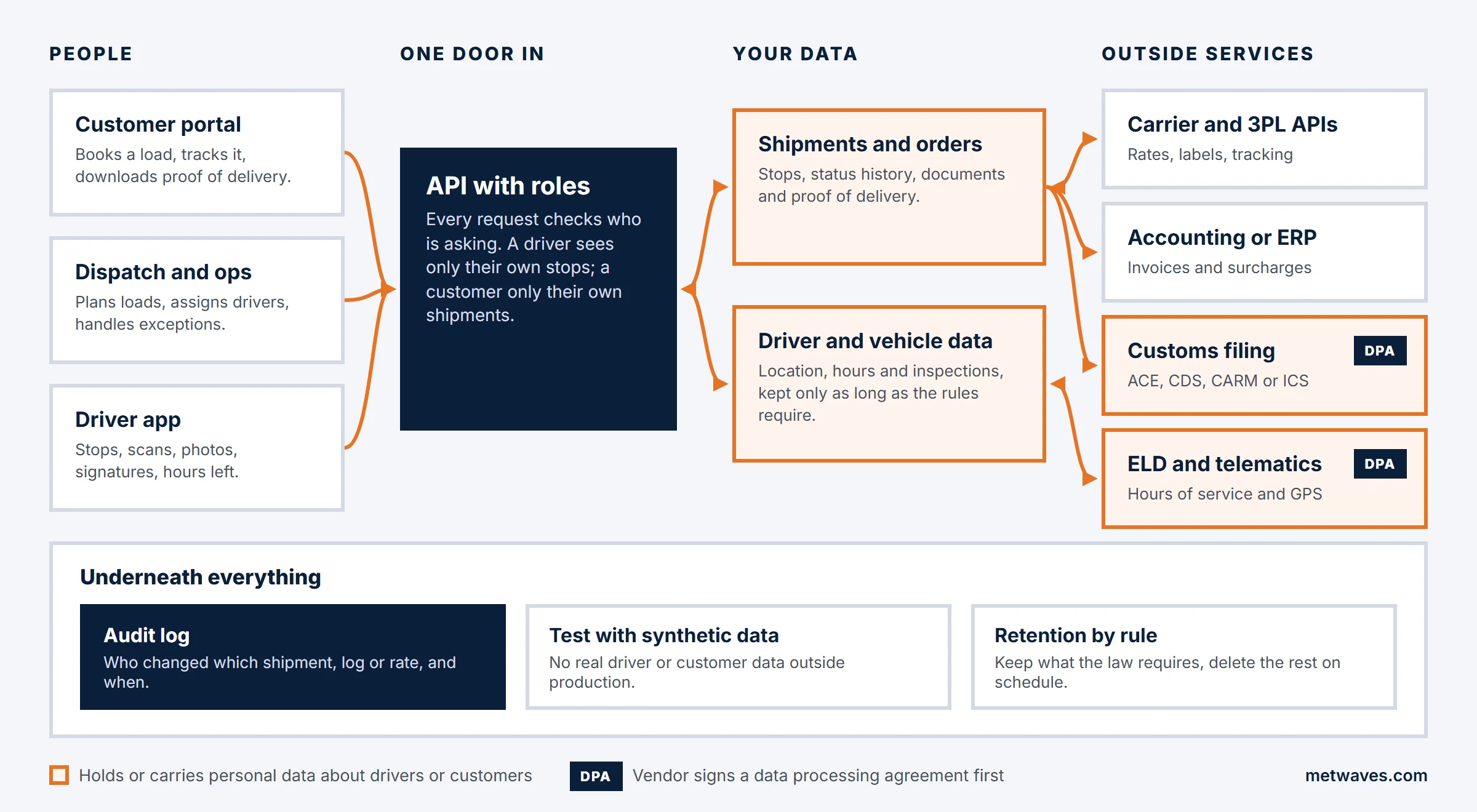
How shipment and driver data moves through the system

Before any screen is designed, we map where shipment and driver data lives, who can see it and which outside services touch it. This is the map for a typical carrier or 3PL system.

How shipment and driver data moves through logistics software: customer portal, dispatch and driver app reach one API that checks each role; shipments and driver data are stored separately; carrier APIs, accounting, customs filing and ELD telematics connect outside; an audit log, synthetic test data and retention rules sit underneath
Orange boxes hold or carry personal data about drivers or customers. Every vendor marked DPA signs a data processing agreement before it sees any.

OUR WORK

Logistics work: what we have built, and what transfers

We have not shipped a project for a logistics company yet, and we will not show you one we did not build. These four projects are real, and their hardest parts are the hard parts of logistics software: live data at volume, documents read into a system of record, and communication at scale.

Home screen of the real-time stock and crypto alert platformCASE STUDY

Trading alerts platform · for a stock trader with 10+ years in the markets

Real-time alerts for up to 10,000 users at once

A web platform with watchlists, automated alerts and MetaTrader integration, built on React, Node.js, AWS and MongoDB to deliver price signals without delay.

What carries over: pushing live events to thousands of screens is the same problem as live tracking and delay alerts.

  • 10,000concurrent users handled
  • 85%positive feedback from beta testers

Read the alerts platform case study >

Supplier invoice processing agentCASE STUDY

Built for an Australian accounts payable team

Supplier documents read and posted automatically

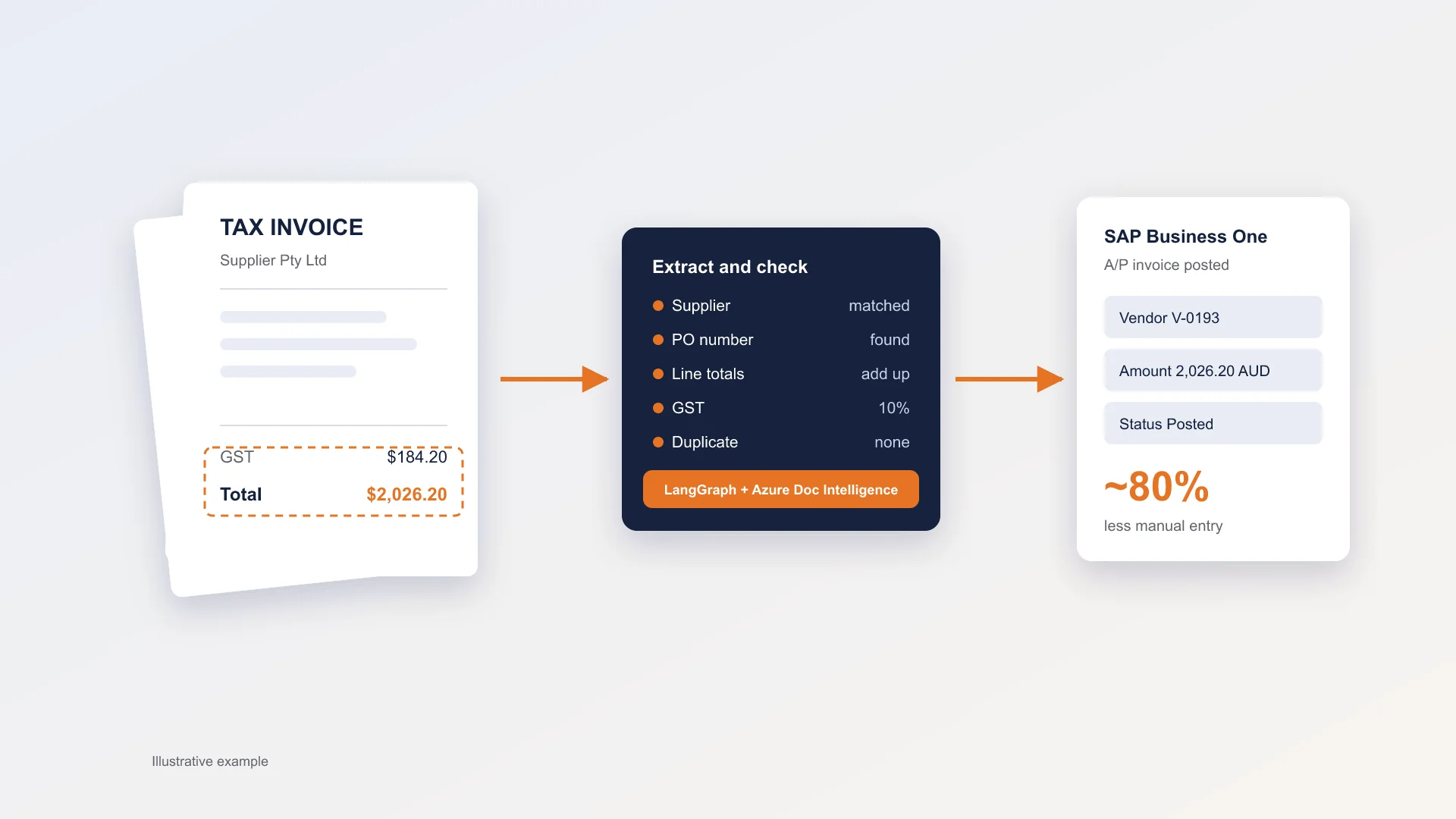
A LangGraph agent reads supplier documents with Azure Document Intelligence, checks each against SAP Business One and posts it, sending exceptions to a person with the reason.

What carries over: bills of lading, proofs of delivery and carrier invoices follow the same read, check, post and escalate pattern.

  • ~1,000documents a month
  • ~80%less manual data entry
  • 8 to 12weeks to go live

Read the invoice agent case study >

Custom VoIP calling on web, Android and iOSCASE STUDY

Fiberpipe · telecommunications provider

A custom VoIP system on web and mobile

Web and mobile calling built with Angular, ASP.NET Core, Kotlin and Swift, integrated with the provider's existing telecoms infrastructure and designed to scale with its client base.

What carries over: dispatch lives on calls and messages; driver and customer communication can sit inside your own system.

  • 20%more clients for the provider
  • 3platforms: web, Android, iOS

Read the VoIP case study >

Copilot Studio helpdesk agent in Microsoft TeamsCASE STUDY

Professional services firm · United Kingdom

A Teams agent that answers staff questions from policy

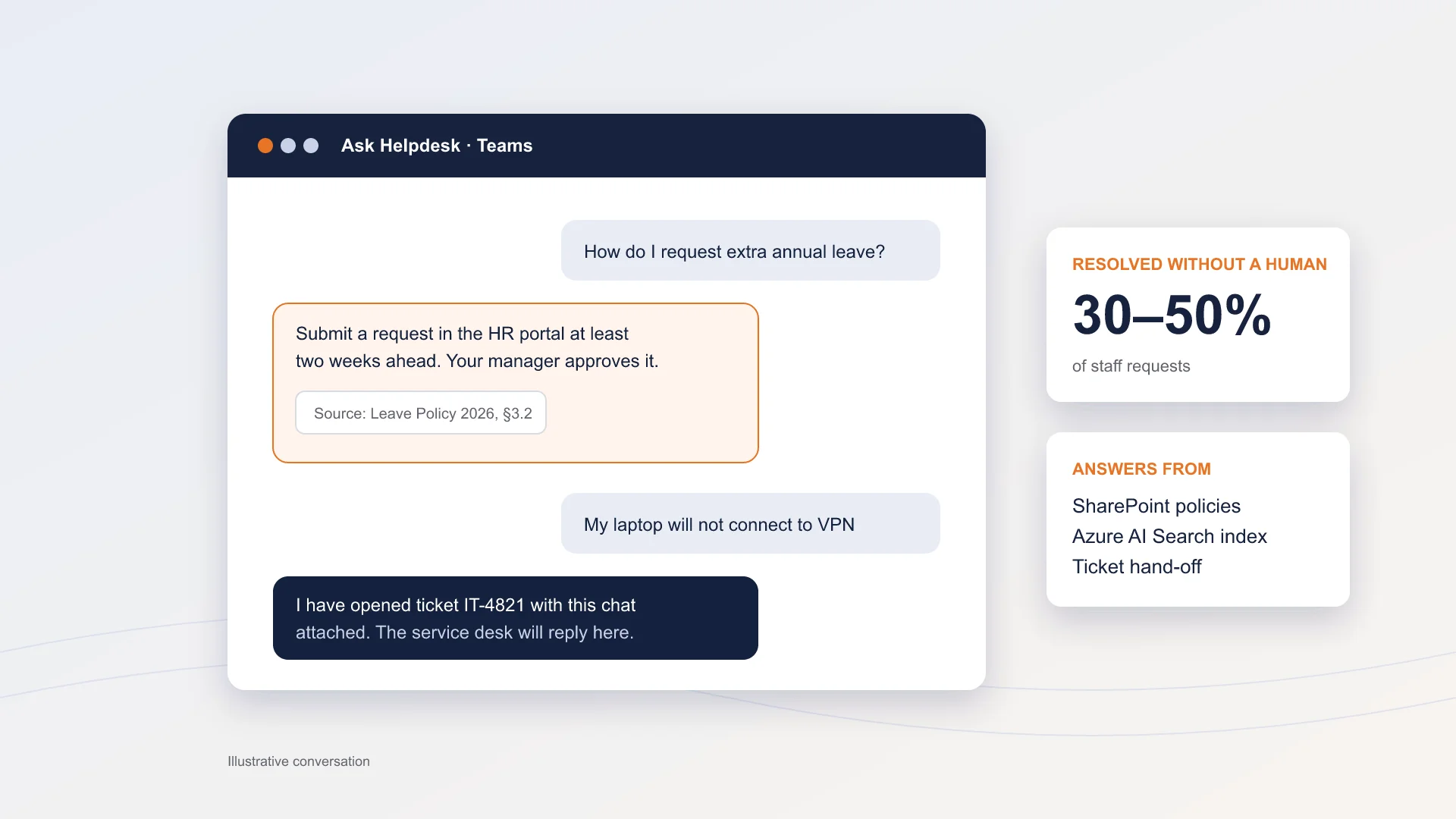
A Copilot Studio agent answers IT, HR and policy questions from SharePoint, cites the document it used, respects permissions and opens a ticket with the conversation when it cannot help.

What carries over: a shipment-question assistant needs the same habits: answer from the source, show it, and hand over cleanly.

  • 30–50%of requests resolved without a person
  • 8 to 12weeks to go live

Read the helpdesk agent case study >

Off-the-shelf TMS or custom logistics software: what usually fits

Custom software puts your service model into the software and leaves you owning the data and the roadmap. It also costs more to build and run than a subscription, so it is not always the answer.

Your situationWhat usually fitsWhy
Standard truckload or parcel work that one TMS already coversAn off-the-shelf TMSCheaper and faster. We will tell you so on the first call.
Customers phone all day to ask where their load isA tracking portal on top of your TMSThe data already exists; customers need a view of it, not a new TMS.
Staff re-key orders between the TMS, accounting and customer EDIIntegrate before you rebuildConnecting what you have often removes the re-keying without replacing anything.
Your service is what sets you apart: cold chain, special handling, scheduled routesCustom softwareThe software follows your process instead of forcing a generic one.
You sell software to carriers or shippersCustom, built for their reviewsRole-based access, audit logs and clean APIs from the first release make their security questionnaire easy.

What drives the cost of logistics software

We quote after discovery, because two dispatch tools with the same screens can differ by five integrations. These are the things that move the price most.

Big effect

Number of integrations

Each carrier API, ELD provider, EDI partner and accounting link is its own build, test and failure plan.

Big effect

Offline driver app

A native app that keeps scans and photos in dead zones and syncs later costs more than a web app.

Medium effect

How live the tracking is

Positions every few minutes for a few hundred vehicles is different from every few seconds for thousands.

Medium effect

Customs data

Feeding your broker's system is simpler than building a direct filing connection.

Smaller effect

Reports

Margin, on-time and empty-mile reports on data you already capture.

Smaller effect

User roles

Customer, dispatcher, driver and admin is a normal set; each extra role adds screens and tests.

Monthly running costs, such as hosting, maps, SMS and telematics API fees, are listed separately in every quote.

How we work with logistics teams

Logistics software only works if dispatchers and drivers use it on a bad day, so a pilot and training are part of the plan. Nothing touches live driver data until the safeguards are in place and tested.

  1. 1

    Discovery call

    Thirty minutes on your freight, your systems and what wastes the most dispatcher time.

  2. 2

    Map one load

    We follow one shipment from booking to invoice and list every system and person it touches.

  3. 3

    Build in phases

    One workflow at a time, tested with synthetic data, never live driver records.

  4. 4

    Test with real feeds

    Carrier sandboxes, ELD and telematics test accounts, and your accounting test company.

  5. 5

    Pilot

    One depot, one customer or one lane first. Dispatcher and driver feedback shapes the next release.

  6. 6

    Roll out and support

    Depot by depot, then hand over or keep it running and patched.

How to choose a logistics software development company

Ask these five questions of anyone you shortlist, us included. One thing we are not: a vendor of a ready-made TMS or ELD. If a product already does what you need, buy it.

Question to askA good answerA warning sign
Which logistics system have you built that you still support?A named project, or a plain “none yet” and the work that transfers.Logos with no project behind them.
What happens when a carrier API or ELD feed goes down?Retries, an exceptions queue and an alert to a named person.“It won't.”
Will the driver app work with no signal?Yes: it stores scans and photos and syncs when the signal returns.“Drivers just need to find signal.”
What data do your developers and testers use?Synthetic data outside production.A copy of your live database.
Who holds the cloud account, the code and the data?You do, from day one.Hosting under the vendor's own account.

Related services

Engagement models and technology choices are on each service page.

Web application developmentPortals, booking and dispatch tools in the browser.
Mobile app developmentDriver apps for iOS and Android that work offline.
Software integrationCarriers, EDI, ELDs and accounting, connected.
AI agent developmentAgents that read documents and answer shipment questions.
Enterprise software developmentLarger systems across depots and teams.

QUESTIONS & ANSWERS

Logistics software and compliance: frequently asked questions

Straight answers on ELDs, other markets, driver tracking, AI and cost. If you don't see an answer to your question, you can send us a message from our contact form.

Since December 18, 2017, US carriers whose drivers must keep records of duty status have had to record them on an electronic logging device, with a few exceptions such as drivers who keep logs 8 days or fewer in any 30-day period and vehicles made before model year 2000 (49 CFR 395.8). Your dispatch and payroll software does not have to be an ELD, but it should read hours left from the ELD before a load is assigned and keep supporting documents for 6 months.

No. In the US, manufacturers self-certify ELDs onto FMCSA's registered list, and FMCSA can remove them (FMCSA). In Canada, devices must be certified by a third-party body accredited by Transport Canada (Transport Canada). We integrate with the ELD or telematics provider you already use, through its API, so hours, location and logs appear in your own tools.

The UK uses tachographs and the assimilated drivers' hours rules for most goods vehicles over 3.5 tonnes, and an operator's licence from the traffic commissioners. Canada requires certified ELDs for federally regulated carriers and has its own hours limits. Australia's Heavy Vehicle National Law, run by the NHVR, applies everywhere except Western Australia and the Northern Territory, and adds the Chain of Responsibility. The table above compares them.

Under Australia's Heavy Vehicle National Law, every party in the chain, including consignors, packers, loaders, schedulers and consignees, has had a primary duty since 1 October 2018 to ensure the safety of its transport activities so far as reasonably practicable (NHVR). Scheduling and booking software sets delivery windows and loads, so it should make realistic plans easy and keep a record of the decisions behind them.

Usually yes, with rules. In the UK the ICO says you must tell workers and passengers about vehicle monitoring and will rarely be able to justify monitoring during permitted private use (ICO). Ontario employers with 25 or more employees need a written electronic monitoring policy. California's CCPA covers employees' personal information. We build notice, purpose and retention into the tracking design.

Start with low-risk, high-volume work: answering shipment questions from live data and reading bills of lading and proofs of delivery. Keep a person approving anything that commits money, goes to customs or affects a driver, sign a data processing agreement with the AI provider, send only the data each task needs, and log every result.

It depends most on the number of integrations (carriers, ELDs, EDI partners, accounting), whether drivers need a native app that works offline, and how live the tracking has to be. A customer tracking portal on top of your TMS is much smaller than a dispatch system. We price after a short discovery, with running costs such as maps, SMS and telematics API fees listed separately.

Not yet for a logistics company, and we say so. We have built a real-time alert platform for up to 10,000 concurrent users, an AI agent that reads about 1,000 supplier documents a month into SAP Business One, and a custom VoIP system for a telecoms provider. Those are the hard parts of logistics software: live data, documents and communication at volume.

INSIGHTS & NEWS

Discover IT Industry Insights and Technology Trends

Nikit Nandan    Nikit Nandan November 22, 2026
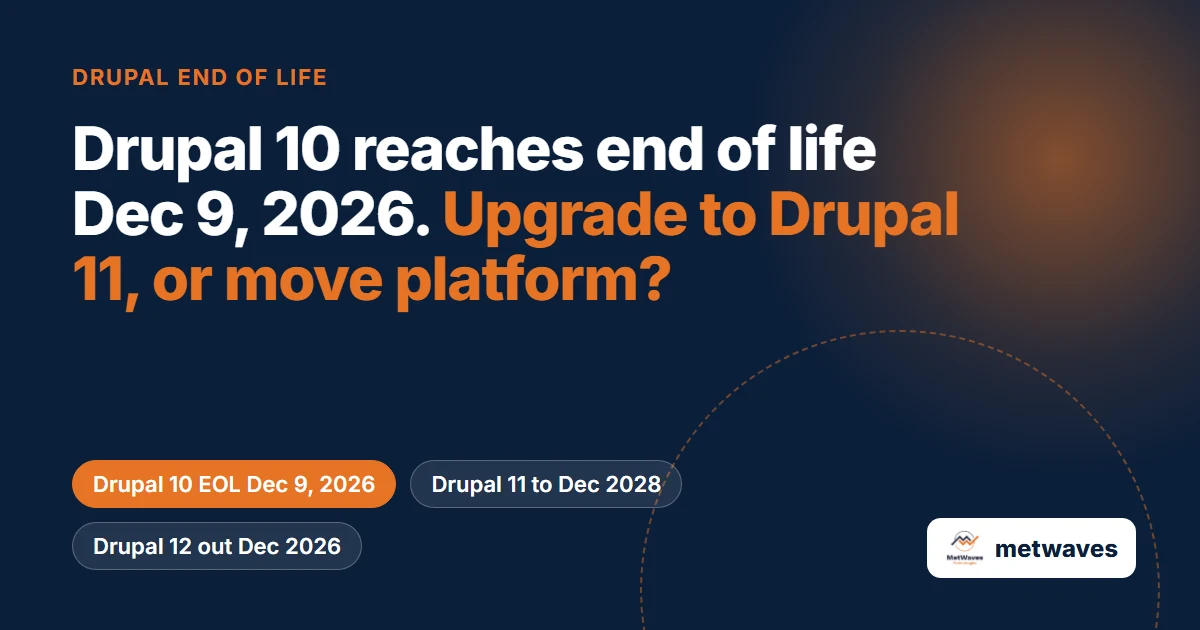
Drupal 10 Reaches End of Life on December 9, 2026: Upgrade to Drupal 11 or Move Platform?

Drupal 10 reaches end of life December 9, 2026. How to move to Drupal 11 with Upgrade Status, Rector and Composer, what it needs, and when to switch platforms.

Learn More >
Software Development 10 min read
Nikit Nandan    Nikit Nandan November 22, 2026
PHP 8.2 Stops Getting Security Fixes on December 31, 2026: What Should a Business App or WordPress Site Do?

PHP 8.2 security support ends December 31, 2026. Which PHP version WordPress sites and business apps should move to, what breaks, and how to test first.

Learn More >
Software Development 11 min read
Nikit Nandan    Nikit Nandan November 22, 2026
Power Apps Premium Goes to $22 a User in January 2027: When Is a Custom App Cheaper?

Power Apps Premium rises to $22 per user per month on January 1, 2027, after the per app plan went off sale and AI Builder credits ended. A break-even table shows when a custom app is cheaper.

Learn More >
Microsoft Technologies 9 min read

Let’s build your idea!

Let us help you with free analysis & estimate. Our product expert will contact you within 12 hours.

 All your information is kept confidential and protected by NDA.