Published November 25, 2026. Model prices are list prices from OpenAI and Anthropic, checked on November 21, 2026. Build costs and non-model run costs are our planning estimates, not quotes.
Short answer. In November 2026, a focused AI agent that does one job well typically costs about $15,000 to $40,000 to build, an agent wired into two or three business systems about $40,000 to $120,000, and a multi-step agent handling regulated data from $120,000 up (all estimates). Running it costs tokens times price per task, often a few cents, plus hosting, monitoring and the staff time to review exceptions, which at low volume is usually the bigger number.
Key facts at a glance
- Run cost formulaCost per task = sum over model calls of (input tokens x input price + output tokens x output price), plus tool fees
- Mid-size model prices (Nov 21, 2026)GPT-6.2 Sol and Claude Sonnet 5.5: $2 per million input tokens, $10 per million output tokens
- Small model pricesGPT-6 Luna and Claude Haiku 5.5: $0.10 input, $0.50 output per million tokens
- DiscountsBatch processing: half price on both Anthropic and OpenAI's batch rates for these models. Cached input: 5% to 10% of the input price on current models.
- Web search tool$10 per 1,000 searches on both OpenAI and Anthropic, plus tokens
- Real build timesOur helpdesk and invoice agents each went live in 8 to 12 weeks
What decides how much an AI agent costs to build?
An AI agent is software that uses a large language model (LLM) to decide the next step and calls tools, such as your CRM or ERP, to carry it out. The model is the cheap part. Most of the build budget goes into everything around it:
| Cost driver | Why it costs | Cheaper when |
|---|---|---|
| Number of systems it touches | Each integration needs auth, error handling, test data and a sandbox | The systems have clean, documented APIs |
| Read only, or does it write? | Writing to an ERP or EHR needs validation, approval steps and rollback | The first version only reads and drafts |
| How messy the input is | Scanned PDFs, emails and free text need extraction and checks | Inputs are forms or structured data |
| Accuracy bar | Every extra point of accuracy needs more test cases and more rules | A person reviews the agent's output anyway |
| Regulation | HIPAA, SOC 2 or financial controls add audit logs, access reviews and documentation | No personal or regulated data is involved |
| Where it lives | A custom web app costs more than a Microsoft Teams or Slack front end | Users already work in Teams, Slack or email |
What does each kind of agent cost to build?
These bands are our estimates for a small, senior team in the US, UK, Canada or Australia market. They include design, build, testing and launch, not the ongoing run cost.
| Agent type | Example | Build estimate | Time to live (estimate) |
|---|---|---|---|
| Proof of concept | One task, on real or mirrored data, with cost per task measured | $10,000 to $30,000 | 3 to 6 weeks |
| Single-task assistant | Answers staff questions from policies in Teams, with citations | $15,000 to $40,000 | 4 to 10 weeks |
| Workflow agent, 1 to 3 systems | Reads supplier invoices and posts them to the ERP, with a review queue | $40,000 to $120,000 | 8 to 16 weeks |
| Multi-step agent, regulated data | Patient or claims intake across several systems, with approvals and audit | $120,000 to $300,000+ | 4 to 9 months |
For reference points from our own work: the Copilot Studio helpdesk agent now resolves 30% to 50% of staff requests without a person, and the SAP Business One invoice agent handles about 1,000 documents a month with roughly 80% less manual entry. Both went live in 8 to 12 weeks.
Ongoing maintenance is its own line. Models are retired, APIs change and the business rules move. Plan on 15% to 25% of the build cost per year for updates and tuning (estimate). When OpenAI shut down its Assistants API on August 26, 2026, every agent built on it needed rework.
How do you calculate what an agent costs to run per task?
Providers bill per token. A token is a chunk of text, roughly three quarters of an English word. Every model call has input tokens (instructions, tool definitions, history, documents) and output tokens (the model's answer and tool calls). An agent makes several calls per task, so add them up:
cost_per_task = sum over each model call of:
    input_tokens  x input_price_per_token
  + output_tokens x output_price_per_token
  + tool fees (for example, web search: $10 per 1,000 searches)
Take a document task like invoice intake: the agent reads a 3,000-token document, looks up the supplier, checks totals and drafts an entry, in about five model calls. Because each call re-sends the instructions, tool definitions and earlier steps, the whole task adds up to roughly 25,000 input tokens and 2,500 output tokens. On GPT-6.2 Sol or Claude Sonnet 5.5 at $2 and $10 per million:
input:  25,000 x $2.00 / 1,000,000  = $0.050
output:  2,500 x $10.00 / 1,000,000 = $0.025
                                      ------
cost per task                         $0.075
x 1,000 tasks a month                 $75
x 10,000 tasks a month                $750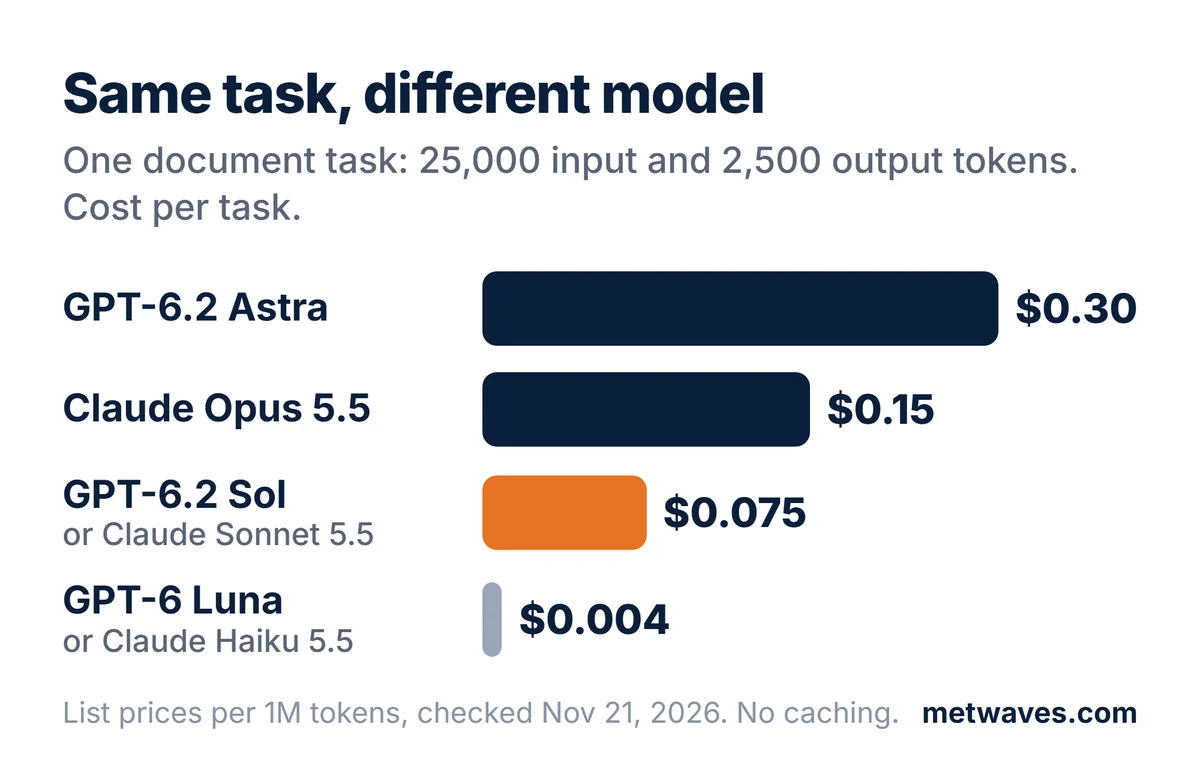
Current list prices for the models in the chart, per million tokens:
| Model | Input | Cached input | Output | Good for |
|---|---|---|---|---|
| GPT-6.2 Astra | $8.00 | $0.40 | $40.00 | Hardest reasoning steps |
| Claude Opus 5.5 | $4.00 | $0.20 | $20.00 | Long, complex agent work |
| GPT-6.2 Sol | $2.00 | $0.10 | $10.00 | Most agent workloads |
| Claude Sonnet 5.5 | $2.00 | $0.10 | $10.00 | Most agent workloads |
| GPT-6 Luna | $0.10 | $0.01 | $0.50 | Routing, classification, extraction |
| Claude Haiku 5.5 (prompts up to 100,000 tokens) | $0.10 | $0.01 | $0.50 | Routing, classification, extraction |
Sources: OpenAI API pricing (standard tier, short context) and Claude pricing, November 21, 2026. Model descriptions from OpenAI's model guide and Anthropic's models overview.
Two traps when comparing providers. First, the same text is not the same number of tokens everywhere: Anthropic notes that Claude 4.7 and later models use a tokenizer that produces about 30% more tokens for the same text than its earlier models, so equal per-token prices do not mean equal per-task cost. Second, the usage fields differ. OpenAI's input_tokens includes cached tokens (reported in input_tokens_details.cached_tokens); Anthropic's input_tokens excludes them, and its caching guide gives the total as cache_read_input_tokens + cache_creation_input_tokens + input_tokens. Measure real tasks on each model before you decide.
PRICES = {  # USD per 1M tokens, list prices checked 2026-11-21
    "gpt-6.2-sol":       {"in": 2.00, "cached": 0.10, "out": 10.00},
    "claude-sonnet-5-5": {"in": 2.00, "cached": 0.10, "out": 10.00},
    "gpt-6-luna":        {"in": 0.10, "cached": 0.01, "out": 0.50},
}

def openai_call_cost(model: str, usage) -> float:
    p = PRICES[model]
    cached = usage.input_tokens_details.cached_tokens   # included in input_tokens
    fresh = usage.input_tokens - cached
    return (fresh * p["in"] + cached * p["cached"] + usage.output_tokens * p["out"]) / 1_000_000

def anthropic_call_cost(model: str, usage) -> float:
    p = PRICES[model]
    # input_tokens excludes cache reads and writes; 5-minute cache writes bill at 1.25x input
    return (usage.input_tokens * p["in"]
            + usage.cache_read_input_tokens * p["cached"]
            + usage.cache_creation_input_tokens * p["in"] * 1.25
            + usage.output_tokens * p["out"]) / 1_000_000
Log this per task, not per call, and you will know exactly what each order, ticket or invoice costs to process. On OpenAI's GPT-5.6 and later models, cache writes are also billed (1.25 times the input price for the 30-minute cache), as its prompt caching guide explains; add them the same way.
What else is on the monthly bill?
Tokens are often the smallest line until volumes get large. A realistic month for 1,000 document tasks looks like this (estimates):
| Line | 1,000 tasks a month | 10,000 tasks a month | Notes |
|---|---|---|---|
| Model tokens | $75 | $750 | GPT-6.2 Sol, no caching; less with caching or a smaller model for simple steps |
| Human review of exceptions | $300 | $3,000 | 15% of tasks reviewed for 3 minutes at $40 an hour |
| Hosting | $150 to $600 | $400 to $1,500 | Container or serverless app, database, search index, storage |
| Monitoring and evaluation | $50 to $300 | $200 to $800 | Tracing tool, test runs on a fixed set of cases before each change |
| Tool fees | Varies | Varies | Web search, document OCR, paid APIs the agent calls |
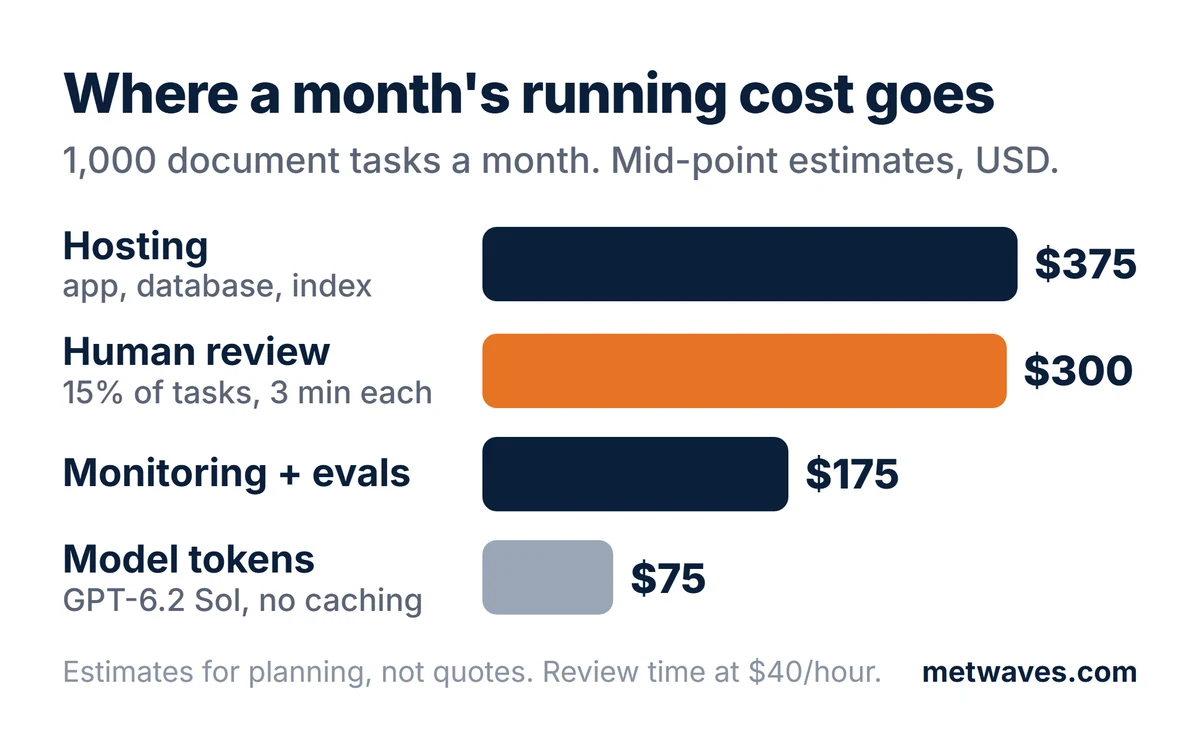
The review line is the one to design down. Every exception the agent can resolve safely on its own, with a clear reason logged, saves more than any model discount. That is why our builds start with the checks and the review queue, then automate.
How do you keep the run cost predictable?
- Use the smallest model that passes your tests for each step. Routing and extraction rarely need the flagship. In Figure 1 that is an 80 times difference.
- Turn on prompt caching. Put fixed instructions and tool definitions first so they are reused. Cached input costs 5% to 10% of the normal input price on current models.
- Batch what is not urgent. Overnight reconciliations or document backlogs can go through batch APIs at half price.
- Set budgets in code. A maximum number of steps per task and a token budget per user stop loops from becoming invoices.
- Track cost per task, per customer. Then pricing your own product, or justifying the agent internally, is arithmetic.
What should a proof of concept tell you before you commit the full budget?
The cheapest way to avoid an expensive agent that does not work is to pay for a small one first. A proof of concept (PoC) builds the core task as working software on your real or mirrored data, then measures it. By the end it should answer, with numbers:
- Accuracy. On 50 to 200 real cases, how often is the agent right, and how often does it correctly hand a case to a person?
- Cost per task. Measured tokens, tool calls and compute per task, projected to your expected volume.
- Review rate. What share of tasks need a person, and how long each review takes. This drives one of the largest run-cost lines above.
- Integration risk. Whether the APIs of your CRM, ERP or document store do what the agent needs, at the speed it needs.
- Security and logging. Whether every action can be logged and sensitive data kept inside your environment.
With those five numbers, the production budget becomes a calculation rather than a guess: build cost from the integrations and rules you now understand, run cost from measured tokens and review time, and payback from the hours the agent saves. If the numbers do not work, you stop after weeks, not months.
Should you build a custom agent or buy an off-the-shelf one?
| Question | Buy (SaaS agent or Copilot add-on) | Build (custom agent) |
|---|---|---|
| Is the task the same at every company? | Yes: meeting notes, email drafting, generic support | No: your rules, your systems, your exceptions |
| Does it need to write into your systems? | Only the systems the vendor supports | Any system with an API |
| How is it priced? | Per seat or per conversation, rises with headcount | Build once, then cost per task |
| Who owns the logic and data? | The vendor | You |
| Time to first value | Days | Weeks; a proof of concept in 3 to 6 weeks |
Many businesses do both: buy for generic productivity, build for the one or two workflows that are specific to them and run at volume.
What this means for owners
- Budget the build in two stages: a proof of concept that measures accuracy and cost per task, then the production build.
- Ask for the cost per task and the review rate, not just the build price. Those decide whether the agent pays back.
- Expect tokens to be a small share of running costs at low volume; staff review time and hosting are larger.
- Set aside 15% to 25% of the build cost a year for maintenance (estimate).
What this means for developers
- Log usage per task with model, input, cached and output tokens; compute cost with the provider's own field rules.
- Benchmark two or three models on the same 50 to 100 real cases before choosing.
- Keep the static prompt prefix stable so caching works; avoid timestamps at the top.
- Cap steps and retries per task, and alert on cost per task, not just monthly spend.
Frequently asked questions
How much does it cost to build an AI agent in 2026?
As planning estimates: about $10,000 to $30,000 for a proof of concept, $15,000 to $40,000 for a single-task assistant, $40,000 to $120,000 for an agent connected to one to three business systems, and $120,000 or more for multi-step agents handling regulated data. The number of integrations, whether the agent writes to systems, and compliance needs drive most of the difference.
How much does an AI agent cost to run per task?
Multiply each model call's input and output tokens by the model's prices and add them up. A document task using about 25,000 input and 2,500 output tokens costs about $0.075 on GPT-6.2 Sol or Claude Sonnet 5.5 at November 2026 list prices, and under half a cent on GPT-6 Luna or Claude Haiku 5.5.
Are tokens the biggest cost of running an AI agent?
Usually not at low volume. For 1,000 tasks a month, staff time reviewing exceptions and hosting typically cost more than the model tokens. Tokens become the main line at high volume or when the agent uses a large model for every step.
How long does it take to build an AI agent?
A proof of concept takes about 3 to 6 weeks. A production agent connected to one to three systems usually takes 8 to 16 weeks; our helpdesk and invoice agents each went live in 8 to 12 weeks. Regulated, multi-system agents take several months.
How can we reduce what an AI agent costs to run?
Use the smallest model that passes your tests for each step, turn on prompt caching for the fixed instructions and tool definitions, send non-urgent work through batch APIs at half price, and cap the steps and tokens each task can use.
What does maintaining an AI agent cost each year?
Plan on roughly 15% to 25% of the build cost a year as an estimate. Models are retired, provider APIs change and business rules move, and each change needs updates and a re-run of your test cases.
Want the real numbers for your workflow? Our proof of concept builds the core task on your data and reports its accuracy and cost per task before you commit to a full build. When you are ready for production, see our AI agent development service.

Nikit Nandan
Strategy Director
Nikit is experienced in conducting in-depth research to stay abreast of industry trends and emerging technologies.