Wearable App Development Services
Our wearable app development services build apps for Apple Watch and Wear OS watches, the phone app they pair with, and the backend that stores what they record. We start from what your user must do on the wrist in a glance, then plan battery, sync and health-data permissions around it. We have not shipped a wearable app for a client yet; the phone, health-data and backend work behind one is work we have done.

For product owners in the US, UK, Canada, Australia and New Zealand · Code, store accounts and data in your name
THE SHORT ANSWER
What is wearable app development?
Wearable app development is building software that runs on a smartwatch, fitness band or other body-worn device, almost always together with a companion phone app and a backend. On Apple Watch the app is written in Swift with SwiftUI and pairs with an iPhone. On Wear OS it is written in Kotlin, and Google recommends Compose for Wear OS for its screens. Health readings are read through Apple HealthKit or Android's Health Connect, with the user's permission for each type of data.
The hard part is rarely the watch screen. It is battery life, syncing when the phone or network is out of reach, permissions the app cannot see, and the privacy rules that come with health data. Those decide the architecture, so we settle them before the build starts.
PLATFORMS
Which wearable platform should you build for?
The phones your users carry usually decide. An Apple Watch pairs only with an iPhone, and Wear OS watches are built for Android phones. This is how the main options compare.
| Option | What we build | How health data arrives | Rule to know |
|---|---|---|---|
| Apple Watch app | A watchOS app in Swift and SwiftUI, with its iPhone companion app | HealthKit, with the user's permission for each data type | Since April 28, 2026, uploads must be built with Xcode 26 and the watchOS 26 SDK |
| Wear OS app | A Kotlin app with Compose for Wear OS, for watches such as Pixel Watch and Galaxy Watch, with its Android phone app | Health Connect, built into Android 14 and later | From August 31, 2026, new apps and updates must target Android 15 (API level 35) |
| Fitbit data, no watch app | Your phone or web app reads the user's Fitbit data from Google's cloud | The Google Health API, with Google sign-in | The Fitbit Web API was turned off on November 2, 2026 |
| An app on Google Fit | A move to Health Connect on the phone or the Google Health API in the cloud | Whichever of the two your app's use fits | Google Fit APIs are deprecated in 2026, with no new sign-ups since May 1, 2024 |
| Your own Bluetooth device | A phone app that pairs with your sensor, ring or band over Bluetooth Low Energy | From your device's firmware, then to your API | You own the protocol, so firmware documents and test units come first |
Checked in November 2026 against Apple, Google Play, the Google Health API and Google Fit.
CONSTRAINTS
What makes a wearable app harder than a phone app?
Five constraints shape every watch app. Each one is a design decision to make early, not a bug to fix after launch.
Battery and background limits
Constant sensor reads, frequent uploads and busy screens drain a watch quickly, and both watchOS and Wear OS restrict what an app may do in the background.
Decide which readings are continuous and which are on demand, batch the uploads, and measure battery on real watches before the full build is estimated.
Sync when something is out of reach
The watch loses the phone, the phone loses signal, and readings arrive twice or not at all.
An offline-first store on the watch, a sync queue with retries, and one written rule for which copy wins when two disagree.
Permissions the app cannot see
On iPhone, HealthKit does not tell an app whether someone refused read access. A refused permission looks the same as no data.
Screens that still work with partial data, permission prompts asked at the moment they are needed, and support notes that show users where to change them.
A few seconds of attention
People glance at a watch; they do not browse it. Long forms, menus and settings screens go unused.
One or two actions per screen, complications and tiles for the glance, and everything else on the phone.
Two stores and their health rules
Apple's guideline 5.1.3 bars using HealthKit data for advertising and storing personal health information in iCloud. Google Play asks every app for a health apps declaration, including each Health Connect data type it reads.
Store declarations and review notes written alongside the build, and a yearly update planned from the start for new OS versions.
Wearable app development services we offer
Six kinds of work, from a first watch app to moving an integration off a retired API. You own the code, the store accounts and the cloud data in every one.

Apple Watch apps
A watchOS app in Swift and SwiftUI with its iPhone companion, complications for the glance, and HealthKit reads and writes where the product needs them. See iOS development.

Wear OS apps
A Kotlin app with Compose for Wear OS, tiles and complications, and the Android phone app it pairs with. See Android development.

Companion phone apps
The phone app that sets up the watch, shows history and handles sign-in, built native or with Flutter or React Native for the phone screens. See cross-platform app development.

Health data integration
Reading and writing HealthKit and Health Connect, moving an app off Google Fit, and pulling Fitbit data through the Google Health API.

Apps for your own Bluetooth device
A phone app that pairs with your sensor, ring or band over Bluetooth Low Energy, recovers from dropped connections and sends readings to your API.

Backend, dashboards and AI summaries
An API and database in your cloud account, dashboards for coaches or care teams, and AI that drafts trends for a person to review. See AI agent development.
ARCHITECTURE
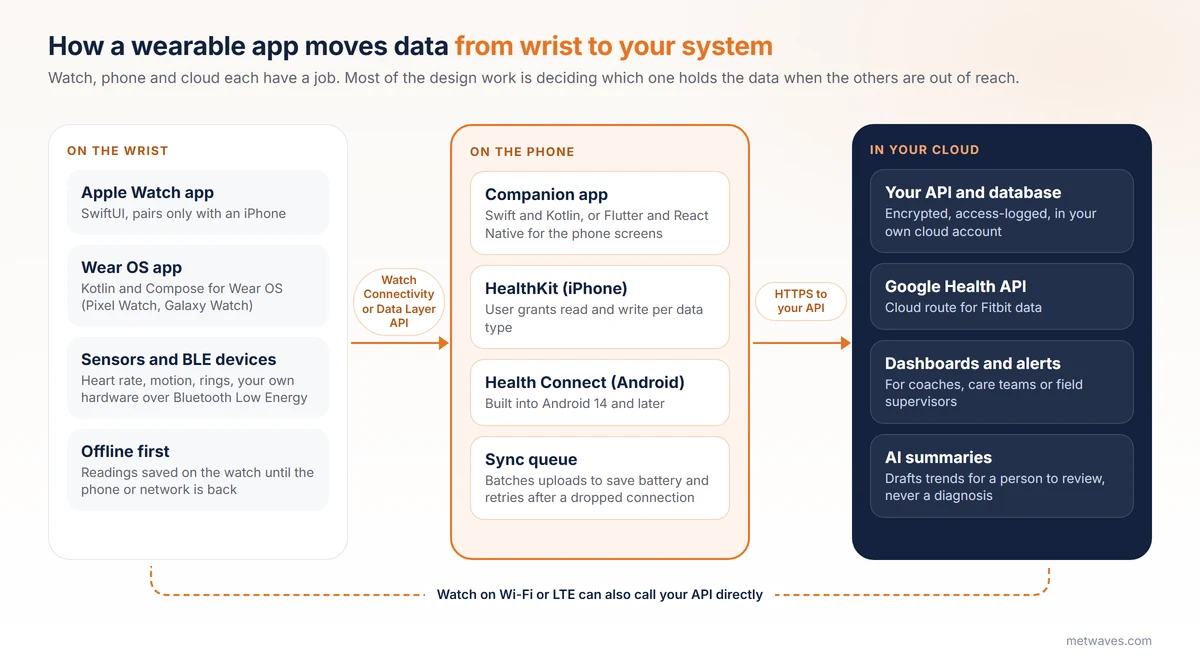
How does a wearable app get data from the wrist to your system?
Watch, phone and cloud each have a job. An Apple Watch talks to its iPhone through Apple's WatchConnectivity framework, and a Wear OS watch to its Android phone through Google's Data Layer API. Paired with an iPhone, a Wear OS watch has no such link and reaches your system over the internet.
PRIVACY AND HEALTH DATA
Which privacy rules apply to wearable health data?
It depends on who you are and what the data reveals, not on the device. A step count and a heart-rate alert can fall under different rules. This is where each market starts; your lawyer confirms the detail.
United States
HIPAA applies when you are a health provider, health plan or clearinghouse, or build the app for one. Most consumer health and fitness apps are outside HIPAA and fall under the FTC's Health Breach Notification Rule instead.
What it means for the app
- Breach notices to users within 60 days of discovery
- A business associate agreement with each vendor when HIPAA applies
- State laws as well, such as Washington's My Health My Data Act
United Kingdom
Data concerning health is special category data. The ICO says fitness tracker data is not automatically health data: it becomes health data when it reveals something about a person's health, as a heart rate can.
What it means for the app
- A lawful basis and a separate condition for health data
- A data protection impact assessment before large-scale processing
- Users can see, export and delete their data
Canada
PIPEDA covers personal information, including health data, held by private companies and needs meaningful consent. Provincial health laws such as PHIPA in Ontario apply when you work with health custodians.
What it means for the app
- Consent that names each kind of data collected
- Breach records, and reports where there is a real risk of significant harm
- Access and correction on request
Australia
Health information is sensitive information under the Privacy Act 1988 and the Australian Privacy Principles, so collecting it generally needs consent.
What it means for the app
- Consent before any health data is collected
- Notifiable Data Breaches scheme when serious harm is likely
- Safeguards before data is sent overseas
New Zealand
The Privacy Act 2020 covers every business. Health agencies also follow the Health Information Privacy Code 2020, most recently amended from 1 May 2026.
What it means for the app
- Collection only for a stated purpose
- Serious privacy breaches reported to the Privacy Commissioner
- Access and correction on request
App stores
Both stores add their own health rules on top of the law, and both check them at review.
What it means for the app
- No HealthKit data for advertising or data mining
- No personal health information stored in iCloud
- A Google Play health apps declaration listing each Health Connect data type
Wellness feature or medical device?
- The FDA reissued its General Wellness guidance on January 6, 2026, and it now covers non-invasive wearables that estimate values such as heart rate variability.
- Readings framed around sleep, activity, stress or recovery can stay a wellness product.
- Claims to screen for, diagnose or manage a disease make the app a medical device.
- The same line exists with the MHRA, Health Canada, the TGA and Medsafe. Plan the regulatory route before any code.
Sources: FTC, HHS, ICO, NZ Privacy Commissioner, Apple, FDA. This is a starting map, not legal advice.
PAST WORK
Have we built a wearable app before?
No. We have not shipped a wearable app for a client yet. These projects are where the parts of one come from, and each links to the full case study.
Telemeds+ telehealth app
A telemedicine app for a physician who owns two urgent care clinics in Virginia, with patient, doctor and administrator roles, video consultations, secure messaging and prescriptions.
- Built with
- Xamarin, .NET, SQL Server and Azure
- What transfers
- Health data, user roles and HIPAA compliance work
- Read more
- Telemeds+ case study
Fiberpipe VoIP apps
Native phone apps with real-time voice and video for a telecom provider's business clients, alongside a web app.
- Built with
- Kotlin, Swift, Angular and ASP.NET Core
- What transfers
- Swift and Kotlin, the languages Apple Watch and Wear OS apps are written in
- Read more
- VoIP case study
AI material recommendations for BIM
A recommendation engine that reads live building model data, scores the options and writes ranked results back into the designer's workflow.
- Built with
- Python, TensorFlow, Neo4j and Azure
- What transfers
- Turning a stream of structured readings into suggestions a person accepts or rejects
- Read more
- BIM case study
On a first wearable project we tell you which parts are new to us before you commit.

Tell us the one thing your user must do on the wrist. We will tell you which watch to start with, what the phone and backend need, and which privacy rules apply.
How do we build a wearable app?
Six stages. The second one exists because battery and sync problems are cheapest to find before the full build.
- 1
Wrist brief
What the user does on the watch in a glance, which data it needs, and which phones your users carry.
- 2
Battery and sync test
A small build on real watches that measures battery drain and sync before we estimate the rest.
- 3
Prototype
Watch and phone screens you can click through before code is written.
- 4
Build in sprints
Test builds reach your own watch and phone through TestFlight and a Google Play testing track.
- 5
Device and store checks
Real-watch testing for battery, dropped connections and permissions, then both store reviews with health declarations.
- 6
Yearly updates
New watchOS and Wear OS versions and store rule changes, planned and priced in advance.
Related services
Where wearable work connects to the rest of your product.
QUESTIONS & ANSWERS
Wearable app development: frequently asked questions
Straight answers on cost, platforms, frameworks, health data rules and our own experience. If you don't see an answer to your question, you can send us a message from our contact form.
It depends on the platforms, the health data, any Bluetooth device and the backend. A watch app is rarely alone: most also need a phone app and an API. We quote after a short battery and sync test on real watches, when the scope is clear enough to estimate honestly.
Start where your users are. An Apple Watch pairs only with an iPhone, and Wear OS watches are built for Android phones, so the phones your users carry usually decide. Many products launch on one and add the other once the sync and data model are proven.
Not well today. Flutter's list of supported platforms does not include watchOS or Wear OS, and Apple and Google document watch apps in Swift and Kotlin. We write the watch app natively and can build the phone app in Flutter or React Native.
Usually not, unless you are a health provider, health plan or clearinghouse, or build the app for one. Most consumer health and fitness apps fall under the FTC's Health Breach Notification Rule instead, which requires breach notices within 60 days. UK, Canadian, Australian and New Zealand privacy laws apply whoever you are.
Not if it stays a wellness product. The FDA's General Wellness guidance, reissued on January 6, 2026, covers non-invasive wearables whose readings relate to sleep, activity, stress or recovery. Once the app claims to screen for, diagnose or manage a disease, it is a medical device and needs a regulatory route first.
Google Fit APIs are deprecated in 2026 and have not accepted new developers since May 1, 2024. Google points Android apps to Health Connect and cloud integrations to the Google Health API. We map what your app reads today and move it to whichever fits.
No, not for a client. We have built a telehealth app, native Swift and Kotlin apps and AI over structured data, and we tell you which parts of your project are new to us before you commit.
INSIGHTS & NEWS
Discover IT Industry Insights and Technology Trends
 Nikit Nandan
November 22, 2026
Drupal 10 Reaches End of Life on December 9, 2026: Upgrade to Drupal 11 or Move Platform?
Drupal 10 reaches end of life December 9, 2026. How to move to Drupal 11 with Upgrade Status, Rector and Composer, what it needs, and when to switch platforms.
Learn More > Nikit Nandan
November 22, 2026
PHP 8.2 Stops Getting Security Fixes on December 31, 2026: What Should a Business App or WordPress Site Do?
PHP 8.2 security support ends December 31, 2026. Which PHP version WordPress sites and business apps should move to, what breaks, and how to test first.
Learn More > Nikit Nandan
November 22, 2026
Power Apps Premium Goes to $22 a User in January 2027: When Is a Custom App Cheaper?
Power Apps Premium rises to $22 per user per month on January 1, 2027, after the per app plan went off sale and AI Builder credits ended. A break-even table shows when a custom app is cheaper.
Learn More >Let’s build your idea!
Let us help you with free analysis & estimate.
Our product expert will contact you within 12 hours.