
WHAT WE COVER
The tools, models and stacks we audit
If an AI wrote the code, or an AI model makes decisions inside the product, it is in scope. These are the tools we see most.
| Category | Tools | What usually goes wrong |
|---|---|---|
| AI app builders | Lovable, Bolt.new, Replit Agent, v0, Base44, Firebase Studio | Database rules left open, keys in the front end, no server-side checks |
| AI coding assistants | Claude Code, Cursor, GitHub Copilot (agent mode), Windsurf, OpenAI Codex, Gemini CLI | Code that works but skips authorization, trusts user input or pulls in unvetted packages |
| Models behind your agent | Claude (Anthropic), GPT (OpenAI and Azure OpenAI), Gemini, Llama and Mistral, AWS Bedrock | Prompt injection, data leaks through retrieval, secrets in system prompts |
| Agent frameworks and platforms | OpenAI Agents SDK and Responses API, Claude Agent SDK, MCP servers, LangGraph, CrewAI, Microsoft Copilot Studio, Azure AI Foundry, Bedrock Agents, n8n | Tools with more permission than the task needs, no approval step, no audit log |
| Back ends and hosting | Supabase, Firebase, Next.js, Node.js, Python (FastAPI, Django), Vercel, Netlify, AWS, Azure | Row-level security off, public storage buckets, permissive CORS, verbose errors |
| Auth and payments | Supabase Auth, Firebase Auth, Clerk, Auth0, Stripe, Paddle | Tokens not verified on the server, webhooks not signed, roles set from the browser |

Claude

OpenAI GPT

Gemini

Copilot

AWS Bedrock

Azure OpenAI

Firebase

GitHub
VIBE-CODED APPS
What we check in an AI-built app
AI coding tools write working features fast, but they rarely write the access rules around them. These are the gaps we find most often.

Open database tables
Supabase or Firebase tables without row-level security, so anyone with the public key can read or change other users' data.

Secrets in the browser
API keys for OpenAI, Stripe or your database bundled into front-end code where any visitor can copy them.

Login and access checks
Pages and API routes that trust the browser, so a changed user ID or a skipped step opens someone else's account.

Payments and webhooks
Payment webhooks that are not verified, letting anyone mark an order as paid.

Abuse and runaway cost
No rate limits on sign-up, login or AI calls, so one script can run up your bill or lock out users.

Outdated packages
Dependencies with known vulnerabilities, and files or storage buckets left public by default.

Other users' records
API routes and server actions that load a record by ID without checking it belongs to the caller, so changing one number shows someone else's data.

Injection and server-side requests
Raw SQL built from user input, and URL fetchers an attacker can point at your internal services or cloud metadata.

Packages that should not exist
Dependencies an assistant suggested that are misspelt, abandoned or invented; attackers register those names and wait.
WHY IT MATTERS
This is not a hypothetical risk
In 2025 researchers found that many apps generated with Lovable left their Supabase tables open because row-level security was missing or wrong, letting unauthenticated visitors read and write data. The flaw was recorded as CVE-2025-48757; reports put the number of exposed apps at more than 170.
The tool was not the problem. The generated app worked, so nobody checked who else could use it. That check is what we do.
- Scan Free, for verified owners
- What you get A private findings report in plain English
- Fixes Fixed price, agreed before work starts
- Capacity Up to 10 free scans a week
AI AGENTS
What we test in an AI agent
An agent that reads email, documents or web pages and can call tools is only as safe as the worst thing it reads. We test it the way an attacker would, using the risks in the OWASP Top 10 for LLM Applications as the checklist.
| Risk | What we try | What a fix looks like |
|---|---|---|
| Prompt injection | Instructions hidden in user messages, uploaded files, emails and web pages the agent reads | Separating instructions from data, filtering inputs, limiting what injected text can trigger |
| Sensitive data leaks | Getting the agent to reveal other users' records, internal documents or personal data | Access checks on every retrieval, masking personal data, scoping the knowledge base per user |
| Excessive agency | Making the agent use tools or permissions it does not need, or act without approval | Least-privilege tool accounts, allow-lists, a human approval step for risky actions |
| System prompt exposure | Extracting the prompt, tool definitions, policy rules and keys | Keeping secrets out of prompts, enforcing rules in code rather than in the prompt |
| Unsafe output handling | Output that runs as code, SQL or HTML in the systems downstream | Validating and encoding agent output before anything acts on it |
| Unbounded consumption | Loops and oversized requests that run up model cost | Rate limits, token budgets and alerts per user and per task |
Building an agent from scratch? See our AI agent development service, where these controls are part of the build.
YOUR AI DEV SETUP
Claude Code, Cursor and MCP servers are part of the attack surface
A coding agent can read your files, run commands and call MCP servers. That is what makes it fast, and it is also how a poisoned README, issue or web page can steer it. We review the setup as well as the code it produced.
- Permission modes. Auto-approve or “skip permissions” settings that let the agent run shell commands, edit any file or push without a person looking.
- MCP servers. Third-party servers installed from a link, unpinned versions, tool descriptions that carry hidden instructions, and tokens with far wider scopes than the tool needs.
- Prompt injection through the repo. Instructions planted in issues, pull requests, docs or fetched pages that the agent reads and follows.
- Secrets in reach.
.envfiles, cloud credentials and production database URLs the agent can read, or that ended up committed in project config. - Unreviewed changes. Large agent-written diffs merged without review, tests or a security check in CI.
- Claude Code Permission settings, allowed tools, hooks, MCP config
- Cursor and Windsurf Rules files, auto-run settings, MCP servers
- GitHub Copilot Agent mode and coding-agent permissions, repository secrets
- CI Secret scanning, dependency checks and review gates before merge
HOW WE TEST
Tools and standards behind every scan
Automated tools find the obvious problems quickly. Most serious findings in AI-built apps are logic flaws, so every scan also includes a manual review by an engineer.
| Layer | How we test it | Checked against |
|---|---|---|
| Source code | Static analysis with Semgrep and CodeQL rules, plus manual review of every route that reads or writes data | OWASP Top 10, OWASP ASVS |
| Secrets | Repository history scanned with gitleaks and TruffleHog; built front-end bundles searched for keys | Your provider's key-rotation guidance |
| Dependencies | OSV-Scanner, npm audit and pip-audit, plus a check that every package exists and is maintained | Known-vulnerability databases |
| Database and storage | Supabase Security Advisor, Firebase rules review, bucket and table permissions tested with a non-owner account | Least privilege per table and bucket |
| Running app | OWASP ZAP and Burp Suite against a staging copy, then manual tests of login, roles and payments | OWASP Top 10, OWASP ASVS |
| AI agent | Adversarial test set run with promptfoo, garak or PyRIT, then manual attempts at injection, data leaks and tool misuse | OWASP Top 10 for LLM Applications, MITRE ATLAS |
We test staging or a copy wherever possible. Tests against production happen only when you authorize them in writing, at a time you choose.
THE REPORT
What you receive after the free scan
A short report written for the person who owns the app, with the technical detail your developer needs underneath.
- Summary. What we tested, what we found and what to fix first, in one page.
- Each finding. Severity, where it is, how we reproduced it, and the OWASP or CWE reference.
- The fix. What to change, with a code or configuration example where it helps.
- Scope and limits. What we did not test, so nobody reads the report as more than it is.
- Turnaround Agreed when you book, after ownership is verified
- Format PDF report plus a call to walk through it
- Who sees it Only the verified owner
- Fixing Optional, fixed price, or do it yourself from the report
HOW IT WORKS
From free scan to fixed
Every engagement follows the same five steps, and nothing is tested before step one is complete.
Verify ownership
You invite us to the repository from the owner's account and sign a short written authorization that names what we may test.Scan
Automated checks plus a manual review of access rules, secrets, authentication and, for agents, an adversarial test set.Private findings report
Each finding in plain English, ranked by risk, with how we found it. Only you receive it.Fix at a fixed price
Pick what to fix. We quote a fixed price before starting, and you can also fix it yourself from the report.Re-test
We re-run the checks for every finding we fixed and confirm the result in writing.
PRICING
The scan is free. Fixes are fixed-price.
Prices depend on the size of the app and how many findings you want fixed. These are our list prices; our first five clients get founding prices in return for a review.
| Package | What it covers | List price (USD) |
|---|---|---|
| Free scan | Scan and private findings report for one app or one agent | Free |
| Quick Fix | Fix the most serious findings in a small app, then re-test | $999 |
| Launch-Safe | Fix all high and medium findings before launch, then re-test | $2,500 to $3,500 |
| Agent Fix | Harden one AI agent: injection defences, permissions, approval steps, logging | $3,000 to $6,000 |
| Guard | Monthly re-scan after you ship new features, with fixes for small issues | $199 to $499 a month |
| Production Upgrade | Rework a prototype into a production app: tests, monitoring, access model, CI | $8,000 to $25,000 |
| Formal audit report | A written audit report for customers, investors or procurement | $6,000 to $12,000 |
OUR RULES
How we handle your app and your findings
- Owners only. We test only what its verified owner has authorized in writing.
- Findings stay private. We never publish, share or reuse what we find.
- No false promises. We never call an app 'secure' or 'certified'. The report says what we tested and what we found.
- Your code stays yours. Repository access is removed when the work ends, and you own every fix.
Find out what your app or agent is exposing
Tell us what you built, which tool you built it with and where it runs. We will reply with the authorization form and a date for your free scan.
Request a free scanQUESTIONS & ANSWERS
If you don't see an answer to your question, you can send us a message from our contact form.
Yes. The scan and the findings report cost nothing. We are paid only if you want us to fix what we find, at a fixed price agreed before any work starts. We run up to ten free scans a week, in the order requests are verified.
Testing an app or agent without its owner's permission is an attack, not an audit. Before we look at anything we need a repository invite from the owner's account and a signed written authorization naming what we may test. No exceptions.
Apps generated with Lovable, Bolt, Replit, v0, Base44, Cursor, Claude Code and similar tools, usually on Supabase or Firebase with a React or Next.js front end. If your code lives in a Git repository we can review it, whichever tool wrote it.
Yes. We review the code whichever assistant wrote it, and we also review the setup: permission modes, MCP servers, rules and config files, and which secrets the agent can reach.
Yes. The model matters less than what the agent can read and do. We test agents built on Claude, OpenAI GPT, Azure OpenAI, Gemini, AWS Bedrock and open models, using the OpenAI Agents SDK, the Claude Agent SDK, MCP, LangGraph, CrewAI, Copilot Studio or n8n.
For an app scan, yes: a read-only repository invite gives far better results than testing from outside. For an agent we also need a test environment and a list of the tools and data it can reach.
Prompt injection from users and from the documents, emails and web pages the agent reads; leaks of personal or confidential data; tools and permissions the agent does not need; actions it can take without a human approving them; system prompt and configuration exposure; and runaway cost from unbounded requests.
Never. Findings go only to the verified owner. We do not publish, share or reuse them, and we do not name clients without written permission.
No one can honestly certify that. Our report states exactly what we tested and what we found, and after a fix we re-test those findings. If you need a formal audit report for a customer or investor, that is a separate, paid deliverable.
No. We secure the AI agents and AI-built apps you own. Monitoring your network for attacks is the job of a managed security provider, and we will tell you if that is what you need.
Related: AI agent development · PoC to agentic production · QA and testing · Application modernization
INSIGHTS & NEWS
Discover IT Industry Insights and Technology Trends
 Nikit Nandan
November 22, 2026
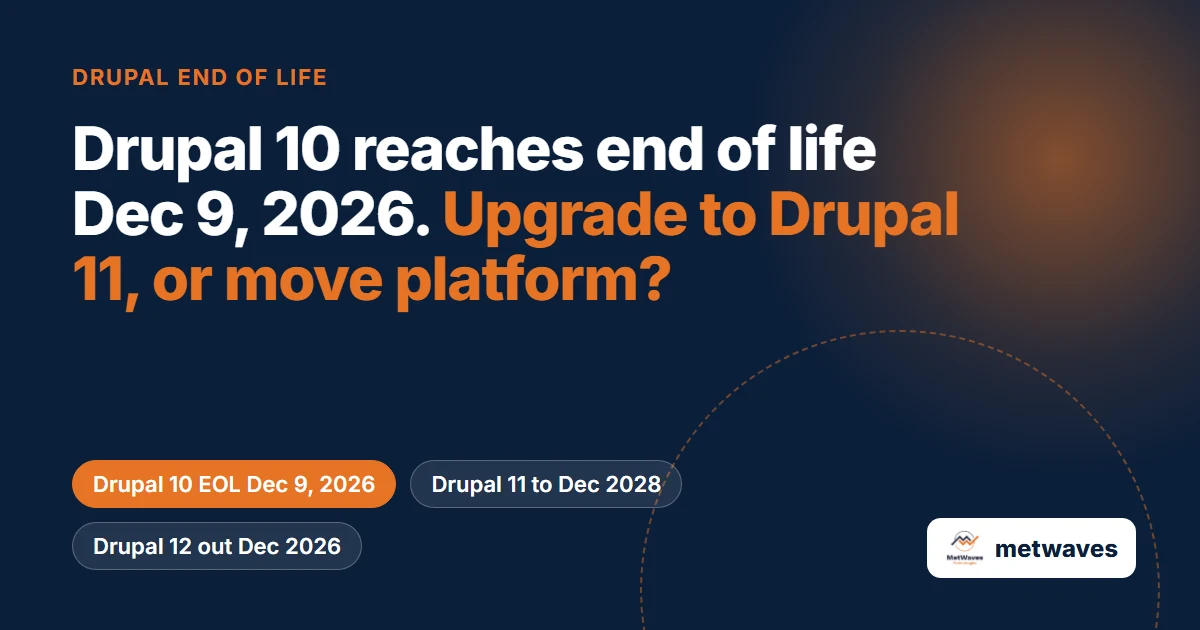
Drupal 10 Reaches End of Life on December 9, 2026: Upgrade to Drupal 11 or Move Platform?
Drupal 10 reaches end of life December 9, 2026. How to move to Drupal 11 with Upgrade Status, Rector and Composer, what it needs, and when to switch platforms.
Learn More >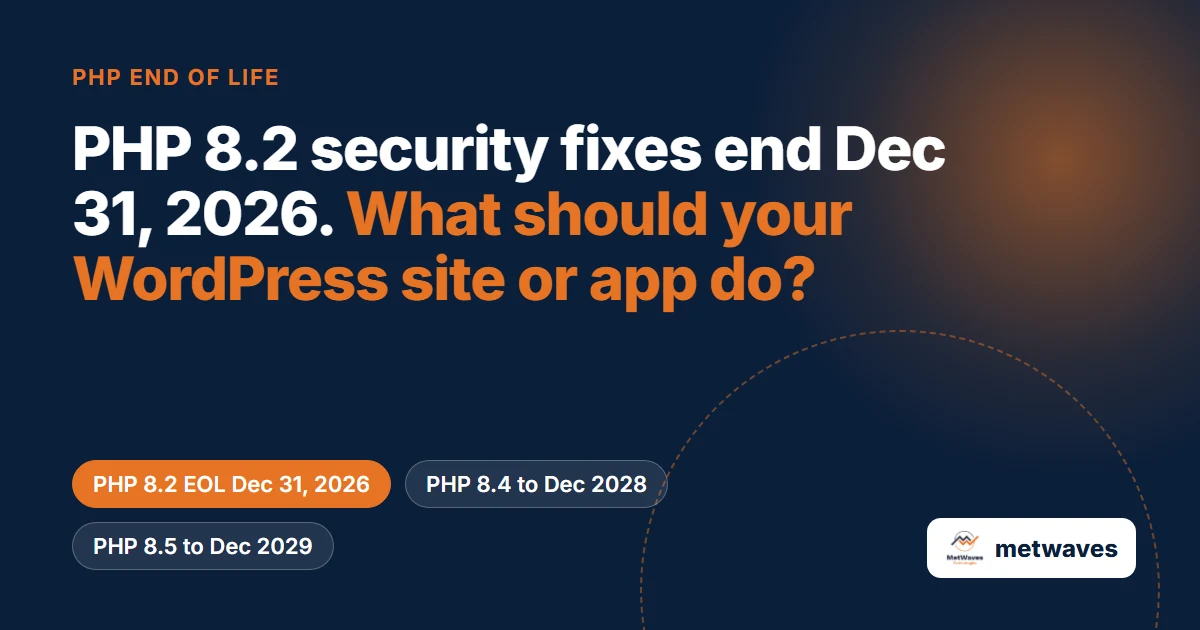 Nikit Nandan
November 22, 2026
PHP 8.2 Stops Getting Security Fixes on December 31, 2026: What Should a Business App or WordPress Site Do?
PHP 8.2 security support ends December 31, 2026. Which PHP version WordPress sites and business apps should move to, what breaks, and how to test first.
Learn More >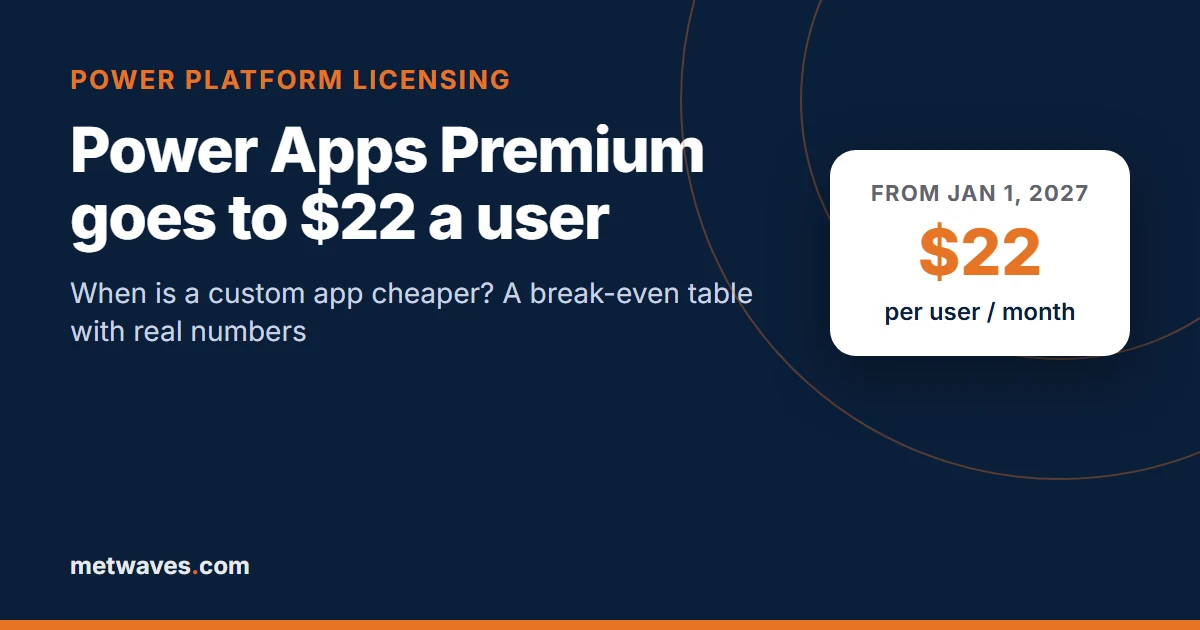 Nikit Nandan
November 22, 2026
Power Apps Premium Goes to $22 a User in January 2027: When Is a Custom App Cheaper?
Power Apps Premium rises to $22 per user per month on January 1, 2027, after the per app plan went off sale and AI Builder credits ended. A break-even table shows when a custom app is cheaper.
Learn More >Let’s build your idea!
Let us help you with free analysis & estimate.
Our product expert will contact you within 12 hours.