


Microsoft Fabric consulting services

Fabric architecture, capacity sizing, and moves from Power BI Premium, Azure Data Factory and Synapse, for businesses that run on Microsoft 365 and Power BI. We build in your own tenant and repository, so the capacity and the code stay yours.

Trusted by businesses across the world

Logos of Metwaves clients

Microsoft Fabric consulting services we provide

Microsoft Fabric consulting services help you decide whether Fabric fits, size the capacity you pay for, and build lakehouses, warehouses, pipelines and Power BI models on it. Microsoft describes Fabric as “delivered as a software-as-a-service (SaaS) platform” on OneLake, so the hard parts are choices, not servers: which F SKU, which workloads, how data gets in and who can see it. Metwaves works in your own Microsoft tenant, Azure subscription and Git repository.

This page is about the platform. Pipelines we build and run month to month sit under our data engineering consulting services.

Fabric fit and architecture review

Whether Fabric suits your data, your team and the Microsoft licences you already pay for, compared with Snowflake, Databricks or staying on Azure SQL. You get a target design: workspaces, domains, workloads and how data reaches OneLake.

Capacity sizing and cost review

We read the Fabric Capacity Metrics app, name the operations that fill your capacity, and size the F SKU, the pause schedule and any reservation to what you actually use.

Power BI Premium, Data Factory and Synapse moves

P SKU workspaces reassigned to an F SKU, Azure Data Factory pipelines upgraded, and Synapse dedicated SQL pools moved to Fabric Data Warehouse, with old and new run in parallel before reports switch.

Mirroring, shortcuts and pipelines

Databases mirrored into OneLake, files in ADLS, S3 or Google Cloud Storage read through shortcuts, and Data Factory pipelines only where neither fits.

Lakehouses, warehouses and Power BI models

Raw, cleaned and business-ready layers, and semantic models in Direct Lake mode, which Microsoft says loads data “without making a copy”.

Copilot and data agents on governed data

Copilot in Fabric switched on where it helps, after sensitivity labels and row-level security are in place. Assistants outside Fabric are on our generative AI page.

What Microsoft Fabric is

Fabric puts data movement, Spark, a SQL warehouse, real-time analytics, data science and Power BI in one service. Every workload reads and writes OneLake, which Microsoft calls “a unified data lake for your whole organization”, storing tables “in Delta Parquet or Iceberg format”.

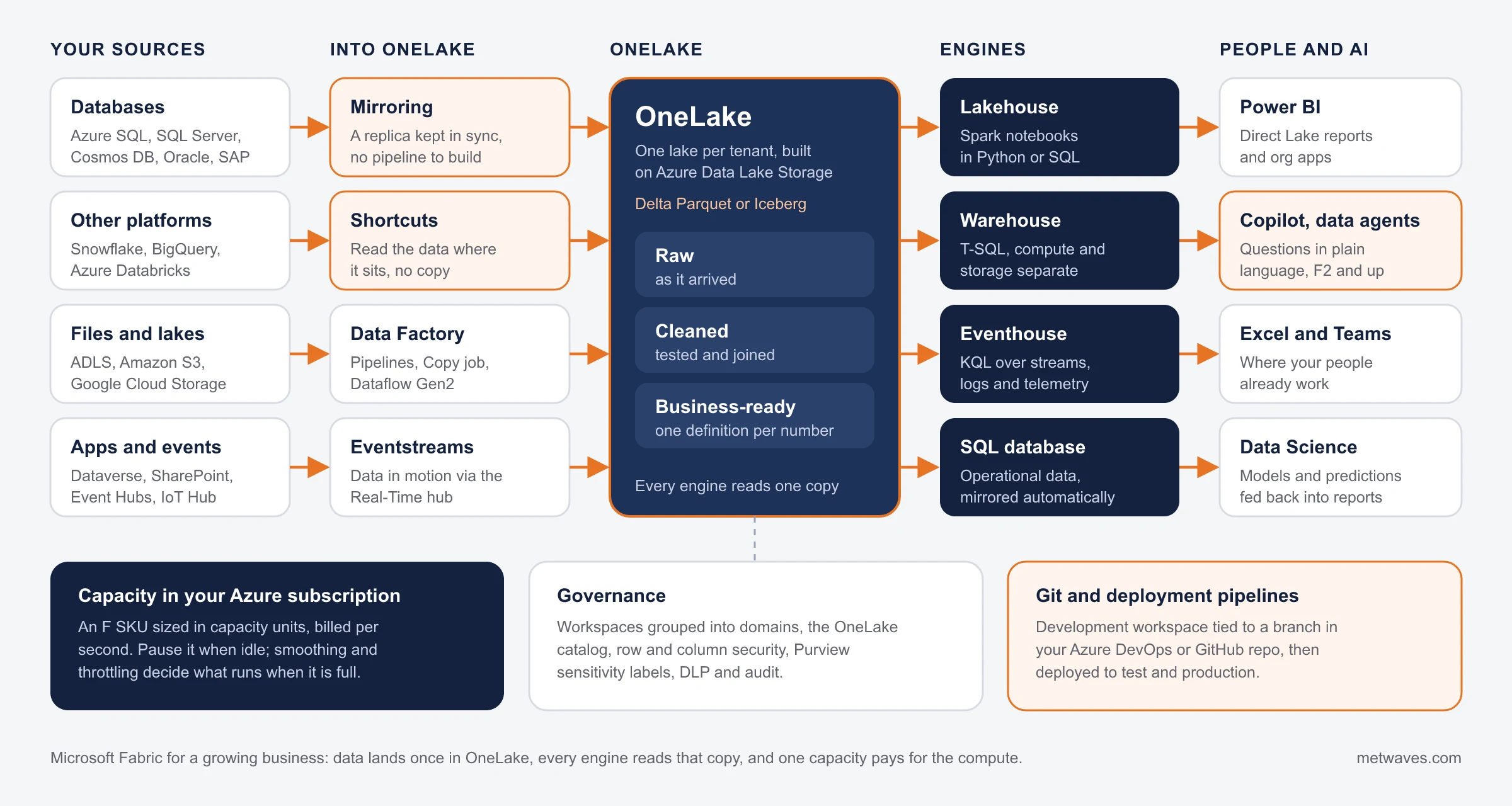
How Microsoft Fabric fits together: databases, other platforms such as Snowflake and BigQuery, files in ADLS, S3 or Google Cloud Storage, and apps and events reach OneLake through mirroring, shortcuts, Data Factory and eventstreams. OneLake holds raw, cleaned and business-ready tables in Delta Parquet or Iceberg, read by the lakehouse, warehouse, eventhouse and SQL database, and served to Power BI, Copilot and data agents, Excel and Teams, and data science. Underneath sit an F SKU capacity in your Azure subscription, governance with domains and Purview, and Git with deployment pipelines
Data lands once in OneLake, every engine reads that copy, and one capacity pays for the compute.

The Fabric workloads, and what each is for

Described from Microsoft's documentation. Most businesses use three or four of the eight.

WorkloadWhat Microsoft says it doesWhere we use it
Data FactoryIngest, prepare and transform data, with “more than 200 native connectors”.Sources that mirroring and shortcuts do not cover.
Data EngineeringApache Spark, with notebooks and scheduled jobs over lakehouses.Large or messy data and Python logic, from raw to cleaned.
Data WarehouseSeparates compute from storage and “natively stores data in the open Delta Lake format”.SQL-first teams, and moves from Synapse or SQL Server.
Real-Time IntelligenceAnalyses data “as it arrives, such as IoT sensor readings, application logs, or website clickstreams”.Telemetry and operations dashboards that need seconds.
DatabasesSQL database in Fabric, based on Azure SQL Database and mirrored to OneLake automatically.Small operational apps whose data you also report on.
Data ScienceBuild and deploy models, with experiment tracking and a model registry.Forecasts and scores that land back in Power BI.
Power BIConnect to data, build interactive reports and dashboards, and share them.The reports you already have, now reading OneLake.
Fabric IQ (preview)A workload “for unifying business semantics across data, models, and systems”.Not yet. We wait for general availability before building on it.

Sources on Microsoft Learn, read November 2026: Fabric overview, Mirroring.

What Fabric is good at, and what to watch

Everything shares one lake and one capacity. That is Fabric's strength and the source of most of its weaknesses.

Fabric is good atWatch out for
One copy of data read by Spark, T-SQL and Power BI, with no exports between them.One capacity is shared, so a heavy Spark job or refresh can throttle everyone's reports on it.
Power BI estates: Direct Lake reports, deployment pipelines, one tenant and one sign-in.Below F64, every person who views a Power BI report needs a Pro or Premium Per User licence.
Getting data in without pipelines, by mirroring Azure SQL, SQL Server, Oracle, Snowflake and more.Some items are still in preview, including Git integration for Power BI reports and semantic models.
Compute billed by the second, with pause and resume.Copilot does not run on trial capacities, and UK, Canadian and Australian capacities need cross-region processing switched on.
Governance in one place: the OneLake catalog, domains, sensitivity labels and audit.Leaving Azure Data Factory is not one click: identity, Key Vault and schedules work differently.

Sources on Microsoft Learn, read November 2026: OneLake, Licences, Git integration, Copilot, Data Factory upgrade.

Fabric, Snowflake, Databricks, BigQuery or Redshift

The best platform is usually the one next to your data and your team. Fabric can also mirror Snowflake, BigQuery and Azure Databricks catalogs into OneLake, so choosing it for Power BI need not mean leaving another platform.

PlatformWhat its documentation saysFits when
Microsoft Fabric“Delivered as a software-as-a-service (SaaS) platform”, on OneLake.Your company runs on Microsoft 365, Entra ID and Power BI, and wants data, reports and AI on one bill. See our Azure page.
Snowflake“Maintenance, management, upgrades, and tuning are handled by Snowflake.”Several teams or partners share data across clouds, and you want little to run. See our Snowflake page.
Databricks“A unified, open analytics platform”.A Python and Spark team runs data engineering and machine learning together. See our Databricks page.
Google BigQuery“A fully managed, AI-ready data platform”.You run on Google Cloud. See our Google Cloud page.
Amazon Redshift“A fully managed, petabyte-scale data warehouse”.Your product runs on AWS. See our AWS page.

Quotes from each vendor's documentation, read in November 2026: Fabric, Snowflake, Databricks, BigQuery, Redshift, Fabric mirroring.

Fabric capacity: F SKUs, capacity units and Power BI licences

You buy Fabric as an F SKU in Azure, billed per second with a one-minute minimum and no commitment, or less with a one- or three-year reservation. Each SKU's number is its capacity units (CUs). The line that changes your licence bill sits at F64.

  1. F22 CU 
  2. F44 CU 
  3. F88 CU 
  4. F1616 CU 
  5. F3232 CU 
  6. F6464 CU= P1
  7. F128128 CU= P2
  8. F256256 CU= P3
  9. F512512 CU= P4
  10. F10241,024 CU= P5
  11. F20482,048 CU 
  12. F40964,096 CU 
  13. F81928,192 CU 

Viewers need Power BI Pro or Premium Per UserFree licence and Viewer role are enough

Measure before you buy

On Power BI Premium today? Microsoft maps P1 to F64, then says to right-size with 30 to 45 days of the Capacity Metrics app. Long quiet periods point to a smaller SKU with pause and resume.

Keep development apart

Microsoft's own example is one F64 for production and a smaller development capacity paused when idle. An Azure runbook can pause and resume it on a schedule.

Try it first

A Fabric trial gives 64 capacity units for 60 days. Copilot does not run on trial capacities, so test AI features on a paid F SKU.

Sources on Microsoft Learn, read November 2026: Licences, Premium migration FAQ, Reservations, Copilot. Prices are regional; we show your expected monthly bill before you buy.

What happens when the capacity is full

Fabric lets jobs burst above the SKU, then spreads, or smooths, their cost over the following minutes or hours. Only when that future capacity is used up does it throttle, in four stages.

Timepoint30 seconds

Fabric accounts for capacity in 30-second timepoints, 2,880 a day.

Interactive work5 to 64 minutes

Report queries and other interactive operations are smoothed over at least five minutes and up to 64.

Background work24 hours

Spark jobs and semantic model refreshes are smoothed over a day, so scheduled jobs can overlap without a spike.

Future capacity already used up

  1. Up to 10 minutes

    Overage protection

    Jobs keep running on up to 10 minutes of future capacity.

  2. 10 to 60 minutes

    Interactive delay

    New interactive requests, such as report visuals, wait 20 seconds before they start.

  3. 1 to 24 hours

    Interactive rejection

    New interactive requests are rejected. Background jobs can still start.

  4. Over 24 hours

    Background rejection

    Every new request is rejected until idle capacity pays off what was borrowed.

Ways out of throttling

  • Wait. Capacities heal themselves as idle timepoints burn down the usage carried forward.
  • Scale up. A larger F SKU has more idle capacity in each timepoint, so the debt clears faster.
  • Pause and resume. Ends throttling at once, but the smoothed usage is added to your Azure bill when you pause.
  • Capacity overage billing. Stops throttling at three times the normal capacity rate.

Work already running always finishes. Sources on Microsoft Learn, read November 2026: Throttling and smoothing, Pause and resume.

Power BI Premium up for renewal, or reports slowing every morning? Start with a Fabric capacity review.

Shortcuts or mirroring: getting data into OneLake without a pipeline

Both put outside data in front of every Fabric engine. A shortcut reads it where it sits; mirroring keeps a copy in sync.

QuestionShortcutsMirroring
What it doesPoints OneLake at data stored elsewhere. Microsoft says shortcuts “behave like symbolic links”.Keeps a replica of a database in OneLake as Delta tables, with changes published “as fast as every 15 seconds”.
SourcesOneLake, ADLS Gen2, Azure Blob, Amazon S3 and S3-compatible storage, Google Cloud Storage, Dataverse, OneDrive and SharePoint, Iceberg tables, and on-premises storage through a gateway.Azure SQL, SQL Server, Cosmos DB, Azure Database for PostgreSQL, Oracle, SAP, Google BigQuery and Snowflake. Azure Databricks catalogs are mirrored as metadata only.
CostReads count against the capacity of the workspace holding the shortcut; an external store such as ADLS bills its own transactions. Caching for 1 to 28 days cuts cross-cloud egress.Replication compute is free, and storage is free up to 1 TB per capacity unit you buy: 64 TB on an F64. Queries are charged as normal.
Watch forMoving or renaming the target breaks the shortcut, and deleting files through it deletes them at the source.It needs a running capacity. While paused, nothing replicates and the replica's storage is billed.
Use it whenThe data already sits in open files in a lake another team owns.An operational database feeds reports and you do not want a pipeline to build and run.

Sources on Microsoft Learn, read November 2026: Shortcuts, Mirroring, OneLake consumption.

Moving to Fabric from Power BI Premium, Data Factory or Synapse

Most Fabric projects start as a move from something Microsoft already sold you. Each has its own tool and its own traps.

Power BI Premium P SKUFabric F SKU

Microsoft no longer sells new P SKUs, and each subscription retires at the end of its current agreement term. The move is not automatic: buy the F SKU, reassign each workspace, test, then cancel the P SKU. P1 maps to F64.

Watch for

  • After the P SKU ends, a 30-day grace period; from day 31 access is throttled, and from day 91 every operation is rejected.
  • F SKUs have no Autoscale. You resize or pause instead.
  • Moving to another region loses Fabric items and large semantic models unless you back them up and recreate them.

Azure Data Factory or Synapse pipelinesFabric Data Factory

Three paths: mount the factory in Fabric as an Azure Data Factory item (it still runs in Azure), use the built-in upgrade, which grades each pipeline Ready, Needs review, Coming soon or Not compatible, or rebuild by hand.

Watch for

  • Global parameters become variable libraries, and managed identity becomes workspace identity.
  • Key Vault integration is more limited, and schedules are set per pipeline.
  • Self-hosted integration runtimes give way to on-premises data gateways.
Synapse dedicated SQL poolFabric Data Warehouse

The Fabric Migration Assistant for Data Warehouse automates much of the move. Microsoft's runbook says to start small, run old and new in parallel and compare them before reports switch over.

Watch for

  • datetimeoffset is not supported, and types such as money and nvarchar map to decimal and varchar.
  • Some T-SQL needs rewriting; Fabric handles indexes and similar tuning itself.
  • A Synapse reservation can be exchanged for a Fabric capacity reservation.

Drawn from Microsoft Learn, read November 2026. Feature parity changes often; we recheck it for your move.

Governance in Fabric: who can see and change what

Fabric's own governance starts in the OneLake catalog. Microsoft Purview adds protection, audit and compliance on top.

ControlWhat it doesWho sets it
WorkspacesHold items, and sit on a capacity tied to one region and billed separately.Workspace and capacity admins
DomainsGroup workspaces by business area, so a department can govern its own data with some tenant settings delegated to it.A Fabric admin creates them; domain admins run them
OneLake catalogOne place to find items, with owners, lineage, endorsement and governance insights.Data owners
OneLake securityRoles down to folders, tables, rows and columns, enforced the same way in SQL, Spark and Power BI.Item owners
Microsoft PurviewSensitivity labels on every Fabric item, data loss prevention on lakehouses, warehouses and semantic models, and user activity in the audit log.Your compliance team

Sources on Microsoft Learn, read November 2026: OneLake, Domains, Purview with Fabric.

Copilot in Fabric in the US, UK, Canada and Australia

Copilot needs a paid F2 or larger capacity, or a P SKU, and does not run on trial capacities. It uses your capacity like any other workload. Where prompts are processed depends on your capacity's region.

Your capacity is inCopilot processes prompts inWhat your admin switches on
United StatesUnited StatesTurn on Copilot
United KingdomEU Data BoundaryTurn on Copilot and cross-geo data processing
CanadaUnited StatesTurn on Copilot and cross-geo data processing
AustraliaUnited StatesTurn on Copilot and cross-geo data processing

Prompts, schema and conversation history are sent; table contents only if you direct it. Sources on Microsoft Learn, read November 2026: Copilot in Fabric. A summary for planning, not legal advice.

How we build on Fabric

Everything lives in your tenant from the first day. Changes move from a development workspace tied to Git, through test, to production.

  1. 30 minutes

    Discovery call

    Your Power BI estate, sources, licences and what fails today.

  2. 1 to 2 weeks

    Assessment and capacity plan

    Target design, the F SKU and pause schedule, workspaces and domains, and a fixed quote.

  3. Day one

    Your tenant, your repository

    The capacity sits in your Azure subscription. Development workspaces connect to a branch in your Azure DevOps or GitHub repository.

  4. 6 to 12 weeks

    First domain, end to end

    One source-to-report path live, promoted by deployment pipelines from development to test to production.

  5. Ongoing

    Hand over or run it

    Runbooks for your team, or monthly checks on capacity, refreshes and cost.

What Microsoft Fabric costs to run

Running Fabric is a bill you pay Microsoft, separate from our work. These move it most.

high impact

Capacity size and hours

F SKUs bill per second with a one-minute minimum. A development capacity paused outside working hours stops billing for compute until it resumes.

high impact

Reservation or pay as you go

A one- or three-year reservation lowers the rate but applies hour by hour: unused hours are lost, and storage is not covered. Reserve the steady base only.

high impact

Power BI licences

Below F64, every report viewer needs Pro or Premium Per User. Count viewers before choosing F32 plus licences or F64.

medium impact

OneLake storage

Billed per GB separately from capacity units, and still billed while the capacity is paused. Soft-deleted files cost the same as live ones.

medium impact

Throttling fixes

Capacity overage billing costs three times the normal rate. Fixing or moving the job that fills the capacity usually costs less.

medium impact

Copilot and AI

Copilot draws on the same capacity as reports and pipelines, so heavy use can push a capacity towards throttling.

Sources on Microsoft Learn, read November 2026: Licences, Reservations, OneLake consumption, Throttling, Copilot. Prices are regional and change; we show the expected monthly bill before you commit.

Ways to work with us on Fabric

Start with a capacity review, or go straight to a migration if you already know your target.

Fabric capacity review

Capacity Metrics reading, F SKU and reservation advice, and the operations filling your capacity. A fixed price.

Migration to Fabric

Power BI Premium, Data Factory or Synapse moved on a fixed scope agreed after the assessment.

Dedicated data team

Data engineers who build your Fabric platform with your team over several months.

Run and extend

Monitoring, fixes, new sources and reports each month. Time and materials.

What we connect Fabric to

The systems we pair with Fabric most. Fabric's own workloads and Power BI are covered above.

Microsoft Azure
Microsoft Azure
Azure Data Lake Storage
Azure SQL
Azure SQL
SQL Server
SQL Server
Azure Cosmos DB
Azure Cosmos DB
Python
Python
.NET
.NET
GitHub
GitHub
Microsoft Teams
Microsoft Teams
Copilot
Copilot
Amazon S3
Amazon S3
Google BigQuery
Google BigQuery
Oracle Database
Oracle Database

Need pipelines built and run month to month, on Fabric or another platform? That is our data engineering consulting service.

Frequently asked questions

Straight answers on capacity, licences, migration, Copilot and ownership.

A fit and architecture review, F SKU sizing, getting data into OneLake by mirroring, shortcuts or pipelines, moves from Power BI Premium, Azure Data Factory or Synapse, and building lakehouses, warehouses and Power BI models. Pipelines we build and run sit under our data engineering consulting services.

Measure first. On Power BI Premium, start from its equivalent (P1 is F64) and read 30 to 45 days in the Capacity Metrics app. Otherwise run your heaviest refresh and busiest report hour on a trial or small F SKU, and size for normal load: background jobs are smoothed over 24 hours.

On F2 to F32, yes: every viewer needs Pro or Premium Per User. On F64 and larger, viewers with a free licence and the Viewer role can read reports. Authors need Pro or Premium Per User to publish to shared workspaces on any size.

Buy the F SKU before the P SKU ends, reassign and test each workspace, then cancel. Microsoft maps P1 to F64, but notes that long quiet periods can suit a smaller F SKU with pause and resume, so measure before you buy.

Fabric when your company runs on Microsoft 365 and Power BI. Snowflake when several teams or partners share data across clouds. Databricks when a Python and Spark team runs data engineering and machine learning. Fabric can mirror both, so it need not be all or nothing.

Yes, on a paid F2 or larger capacity, once your Fabric admin allows prompts to be processed outside your capacity's region: in the EU Data Boundary for UK capacities, and in the United States for Canadian and Australian ones. Check that against your data policies first.

You do. The capacity is in your Azure subscription, the workspaces in your tenant and the code in your repository from the first commit. You pay Microsoft directly for capacity, storage and licences, and we sign an NDA before you share details of your systems.

INSIGHTS & NEWS

Discover IT Industry Insights and Technology Trends

Nikit Nandan    Nikit Nandan November 24, 2026
SQL Server 2025 Ships Without SSRS: Move to Power BI Report Server, or Rebuild Reporting?

SQL Server 2025 drops SSRS in favor of Power BI Report Server, now included with Standard and Enterprise. Support dates for every SSRS version, licensing, migration steps and when to rebuild.

Learn More >
Microsoft Technologies 9 min read
Nikit Nandan    Nikit Nandan November 24, 2026
Azure Cloud Services (extended support) retires on 31 March 2027 with no extensions: App Service, AKS or Service Fabric?

Azure Cloud Services (extended support) retires March 31, 2027, with no extensions. How to move web and worker roles to App Service, AKS or Service Fabric.

Learn More >
Cloud Development 10 min read
Nikit Nandan    Nikit Nandan November 23, 2026
Is ChatGPT HIPAA Compliant, or Do We Need Our Own AI Agent for Patient Data?

Which ChatGPT plans OpenAI will sign a BAA for in 2026, what the BAA leaves out, and when patient data needs your own HIPAA-ready AI agent instead.

Learn More >
AI Development 12 min read

Let’s build your idea!

Let us help you with free analysis & estimate. Our product expert will contact you within 12 hours.

 All your information is kept confidential and protected by NDA.