
Databricks consulting services: lakehouse builds, migrations and cost control

Lakehouse design, Lakeflow pipelines, Unity Catalog, migrations from Hadoop or a legacy warehouse, and reviews of a DBU bill that keeps growing. For businesses in the US, UK, Canada and Australia, built in your own cloud account.

Trusted by businesses across the world

Logos of Metwaves clients

What Databricks is

Databricks describes itself as “a unified, open analytics platform” that works with the storage and security in your cloud account. Three ideas explain most of it.

1

The lakehouse

“A data lakehouse is a data management system that combines the benefits of data lakes and data warehouses.”

One copy of your data in cloud object storage serves dashboards, data engineering and machine learning, instead of a lake for one team and a warehouse for another.

2

Delta Lake

“All tables on Databricks are Delta Lake tables by default.”

Delta adds a transaction log to Parquet files. Writes are all-or-nothing, every write creates a new table version you can query later, and the schema is checked on write. It is open source.

3

Unity Catalog

“Unity Catalog is the unified governance layer for data and AI built into Databricks.”

Grants on tables, views, volumes, functions and models, named catalog.schema.object, with lineage and an audit log. Serverless compute needs it, so it is the first thing we set up.

Where Databricks runs, and whose account each part is in

  1. Databricks' account

    Control plane

    The workspace, notebooks, job scheduler and other backend services Databricks runs for you.

  2. Your cloud account

    Classic compute

    Clusters run in your own network on AWS, Azure or Google Cloud, so the virtual machines appear on your cloud bill as well as the DBUs.

  3. Databricks' account

    Serverless compute

    Databricks allocates and manages the machines. Faster to start and scale, with no virtual machines of yours to size.

From Databricks' architecture overview and serverless compute documentation, read in November 2026. Your tables stay in storage you choose either way.

Databricks consulting services we provide

Databricks consulting services help you plan, build, migrate and run a lakehouse on Databricks: where data lands, how pipelines refine it, who can read it and what the compute costs each month. For a growing business the work usually starts with a written assessment of your sources, workloads and bill, then one source-to-report path built end to end. Metwaves works in your own cloud account, Databricks workspace and repository, so the data, the code and the access stay in your name.

Databricks platform assessment

One to two weeks mapping your sources, the reports and models that depend on them, and what breaks today. You get a target design, the expected monthly Databricks and cloud cost, and a phased plan with a fixed quote. You keep it whether or not you hire us.

Workspace and Unity Catalog setup

Workspaces and catalogs for production and test, access by group and service principal rather than by person, storage in your own account, and compute policies and tags from the first day.

Ingestion and Lakeflow pipelines

Lakeflow Connect for SaaS tools and databases, Auto Loader for files, and Lakeflow pipelines that refine raw data into cleaned and business-ready tables, tested on every run.

Migration to Databricks

From Hadoop, on-premises Spark or a legacy warehouse, one workload at a time. Converted code is run beside the old system and the results compared before anyone switches over.

Databricks cost review

We trace the DBU bill to the jobs, clusters and warehouses behind it, then move scheduled work off interactive clusters, add auto termination and policies, and track the bill for a month afterwards.

Machine learning, AI and apps on Databricks

MLflow for models, Agent Bricks for agents, and Databricks Apps on governed data. Framework choices are on our machine learning and generative AI pages.

What Databricks is good at, and where it is weaker

Databricks is strongest when one team does engineering, analytics and machine learning on the same data. It asks more of you than a warehouse that runs itself.

One copy, several kinds of work. Engineers, analysts and data scientists read the same Delta tables in notebooks that take Python, SQL, Scala and R, under one set of permissions.

Spark underneath. Structured Streaming works directly with Delta tables, and it is the base for both Lakeflow pipelines and Auto Loader, so a nightly job can become a streaming one without a new tool.

Managed MLflow and models in Unity Catalog. Training runs, model versions and agent traces sit with the data they came from, under the same access rules.

Less lock-in. Delta Lake is open source, and Unity Catalog serves Iceberg tables to other engines through the Iceberg REST Catalog API.

More to decide. Compute types, runtimes, policies and pipelines are choices a warehouse makes for you. If nobody on the team writes Python, Snowflake, Fabric or BigQuery may be simpler to run.

Budgets warn; they do not stop spend. Databricks budgets send email alerts at a threshold, and only Unity Gateway budgets can block usage. A cluster nobody switches off keeps billing.

Expect renames. Delta Live Tables is now Lakeflow pipelines, Delta Sharing became OpenSharing in June 2026, Databricks Asset Bundles are now Declarative Automation Bundles and Genie Spaces are Genie Agents. Existing code keeps working; documentation and job adverts lag behind.

Databricks, Snowflake, Fabric, BigQuery or Redshift?

All five can serve a business's reporting. The choice usually comes down to who on your team will run it and which cloud you already use.

  • Choose Databricks when

    Your team writes Python and Spark as well as SQL, you need streaming or machine learning on the same data, and you want control over how compute is sized.

    Choose Snowflake when

    A SQL-first team wants little to run: Snowflake's documentation says “maintenance, management, upgrades, and tuning are handled by Snowflake.”

    Our Snowflake page

  • Choose Databricks when

    Engineering-heavy work, or more than one cloud. Azure Databricks is also an Azure service, billed by Microsoft, if you want Databricks inside Azure.

    Choose Microsoft Fabric when

    You run on Microsoft 365 and Power BI and want analytics “delivered as a software-as-a-service (SaaS) platform”, with tables in OneLake.

    Our Microsoft Fabric page · Our Azure page

  • Choose Databricks when

    You need Spark, Python pipelines or machine learning at scale. Databricks also runs on Google Cloud.

    Choose Google BigQuery when

    You are on Google Cloud and the work is mostly SQL analytics: Google calls BigQuery “a fully managed, AI-ready data platform”, with no clusters to size.

    Our Google Cloud page

  • Choose Databricks when

    Data engineering and machine learning outweigh plain reporting, or you want open tables other engines can read.

    Choose Amazon Redshift when

    Your product runs on AWS and you want a warehouse for reporting: “a fully managed, petabyte-scale data warehouse” with zero-ETL from Aurora and RDS.

    Our AWS page

Quotes from each vendor's documentation, read in November 2026: Snowflake, Fabric, Azure Databricks, BigQuery, Redshift. Whichever you shortlist, the right platform is usually the one closest to your team and your data.

Not sure Databricks is the right platform for you? Start with a two-week assessment.

The Databricks stack, and how to choose within it

Databricks has a product for almost every job. For each one, this is where we start and what we add only when a workload needs it.

  1. 01Get data in

    Start with

    Lakeflow Connect

    Managed connectors for SaaS tools such as Salesforce, Workday and HubSpot, and change data capture from MySQL, PostgreSQL and SQL Server.

    Docs
    Add when needed

    Auto Loader

    Files landing in S3, ADLS or Google Cloud Storage. It picks up only new files: JSON, CSV, XML, Parquet, Avro, ORC, text or binary.

    Docs
    Add when needed

    Lakehouse Federation

    Ad hoc or proof-of-concept reads from a source, in place and read-only. For higher volumes and lower latency, Databricks recommends Lakeflow Connect.

    Docs
  2. 02Clean and model

    Start with

    Lakeflow pipelinesformerly Delta Live Tables

    Batch and streaming pipelines declared in SQL or Python, built on Apache Spark Declarative Pipelines. Old DLT code still runs with no migration.

    Docs
    Add when needed

    Notebooks and Python jobs

    Logic that does not fit a declarative pipeline: calls to APIs, complex Python, one-off backfills.

    Docs
  3. 03Schedule and ship

    Start with

    Lakeflow Jobs

    Runs notebooks, pipelines and Python scripts in order, on a schedule or when new files arrive.

    Docs
    Add when needed

    Declarative Automation Bundlesformerly Databricks Asset Bundles

    Jobs and pipelines kept as source files in your repository, reviewed, tested and deployed by CI/CD.

    Docs
  4. 04Query and report

    Start with

    Databricks SQL on serverless SQL warehouses

    “A cloud data warehouse built on lakehouse architecture.” Databricks recommends serverless warehouses where available; your BI tool connects to the same warehouse.

    Docs
    Add when needed

    Metric views, AI/BI dashboards and Genie Agentsformerly Genie Spaces

    Define each KPI once, build dashboards, and let business users ask questions in plain language and get SQL, tables and charts back.

    Docs
  5. 05Machine learning and AI

    Start with

    MLflow

    “A fully managed and hosted version of MLflow”: experiment tracking, models registered in Unity Catalog, evaluation and tracing for agents.

    Docs
    Add when needed

    Agent Bricks

    “The Databricks agent developer platform”, with AI Search for retrieval and Unity Gateway for model access, rate limits and usage tracking.

    Docs
  6. 06Apps, Postgres and sharing

    Start with

    Databricks Apps

    Data and AI apps in Python (Streamlit, Dash, Gradio) or Node.js (React, Angular, Svelte, Express) on serverless compute, billed per hour while running.

    Docs
    Add when needed

    Lakebase

    “A fully managed Postgres database integrated into the Databricks platform”, for low-latency app reads of synced Unity Catalog tables.

    Docs
    Add when needed

    OpenSharingformerly Delta Sharing

    Share tables with partners “regardless of whether they use Databricks”.

    Docs

Names and descriptions from Databricks' documentation, read in November 2026. Several features carry Beta or Preview labels; we check the status of each before it goes into your design.

What a Databricks lakehouse looks like

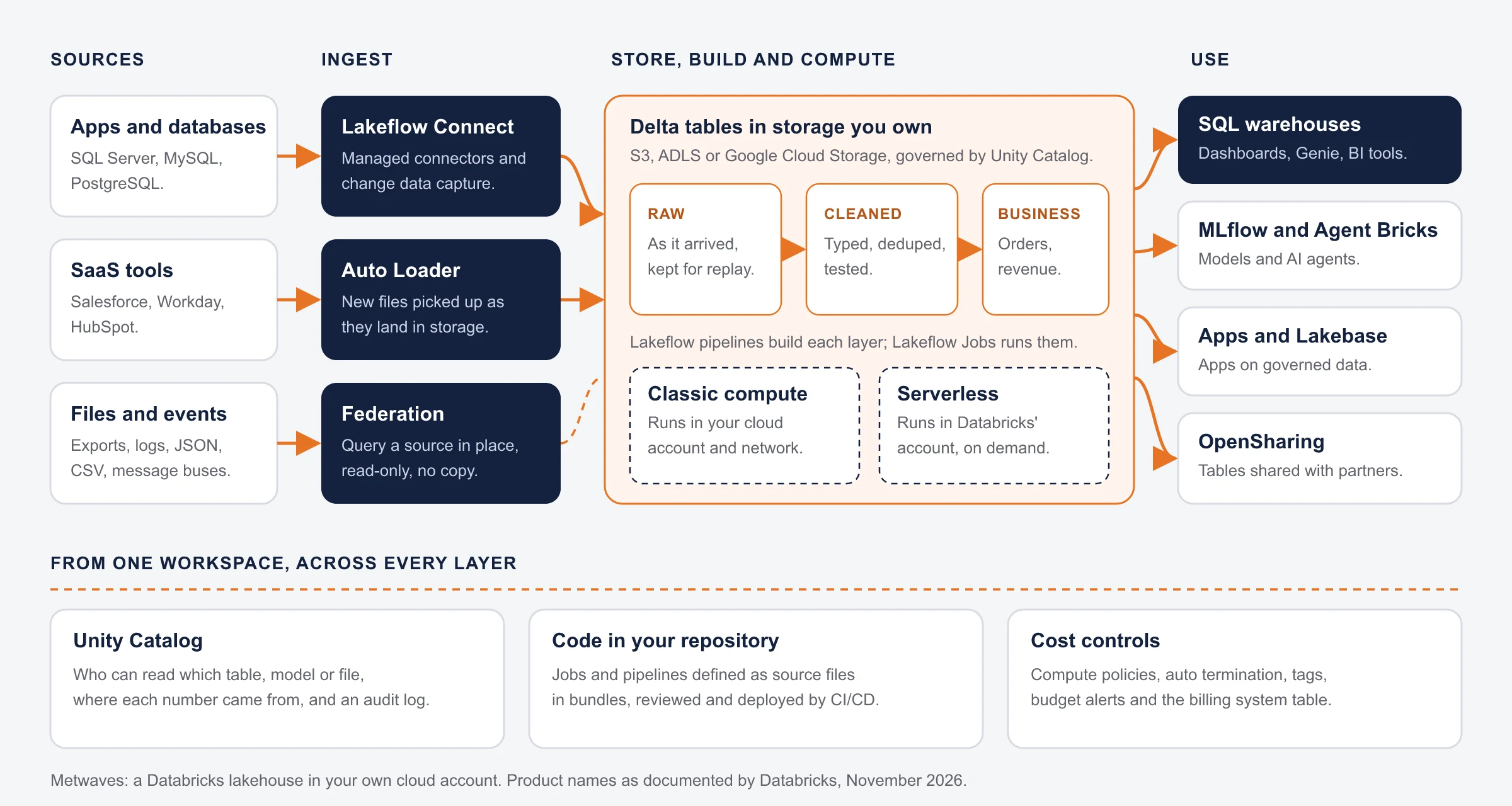
Data lands once in Delta tables in storage you own, is refined in three steps, and reaches dashboards, models, apps and partners. Access, code and cost are managed in one place.

A Databricks lakehouse: apps, databases, SaaS tools and files are ingested by Lakeflow Connect, Auto Loader or queried in place through federation; Delta tables in storage you own are refined from raw to cleaned to business-ready by Lakeflow pipelines on classic compute in your cloud account or serverless compute in Databricks' account; SQL warehouses, MLflow and Agent Bricks, Databricks Apps and Lakebase, and OpenSharing use the result; Unity Catalog, code in your repository and cost controls run across every layer
Data lands once in Delta tables you own, is refined in three steps, and is governed and costed from one workspace.

Serverless or classic: which compute to use

Compute is where most of a Databricks bill comes from, and the type you pick decides where it runs and how it is billed.

ComputeWhere it runsUse it forWatch
Serverless (notebooks, jobs, pipelines)Databricks' accountMost new jobs and pipelines. Starts and scales quickly; no machines to size.Standard mode costs less than performance-optimized mode. Needs Unity Catalog.
Serverless SQL warehouseDatabricks' accountDashboards, BI tools and ad hoc SQL. Databricks recommends it where available.Starts and scales in seconds and restarts on the next query, so it can stop when idle.
Job compute (classic)Your cloud accountScheduled work that needs your own network, instance types or libraries.Non-interactive work costs “significantly less” here than on all-purpose compute.
All-purpose compute (classic)Your cloud accountInteractive notebooks and exploration.Set auto termination. Never schedule production jobs on it.

Sources: serverless compute, SQL warehouses, cost optimization best practices.

What Databricks costs to run, and where the bill grows

Running Databricks is a monthly bill paid to Databricks and your cloud provider, separate from our work. These are the places we look first.

high impact

Interactive clusters left running

Databricks' own advice: “Configure auto termination for all interactive compute resources.” A cluster left on overnight bills DBUs and, on classic compute, virtual machines.

high impact

Scheduled jobs on all-purpose compute

The same job on job compute or serverless costs less. Moving scheduled work off interactive clusters is usually the first saving we find.

high impact

No compute policies

Policies limit who can create compute and how: cluster type, maximum compute per user and maximum DBUs per hour. Without them anyone can start a large cluster.

medium impact

The wrong serverless mode

Serverless jobs and pipelines run in standard or performance-optimized mode. Standard costs less and suits work that can wait a few minutes to start.

medium impact

Photon where it does not help

Photon is on by default for SQL warehouses and serverless, and uses DBUs at a different rate. Queries under two seconds see no meaningful gain; long queries over large data gain most.

medium impact

Spend nobody can trace

Tag workspaces and compute from the start. The system.billing.usage table records usage by SKU, tag and job, and budgets email an alert when spend crosses a threshold.

A DBU, Databricks Unit, is “a normalized unit of processing power”, billed per second with no up-front cost on pay-as-you-go, and discounted for committed use. Sources: Databricks pricing, compute policies, Photon, billing system table, budgets. Prices change and differ by cloud; we show the expected monthly cost before anything is built.

Migrating to Databricks

Most migrations are one of these four. Each moves one workload at a time, with the old system running until the new one matches it.

Moving fromWhat moves and howWhat to watch
Hadoop or on-premises SparkData copied from HDFS into your cloud storage and written as Delta. Databricks says most Spark workloads “require only a few changes to get into production”.Delta replaces MSCK repair and manual partition workarounds. Custom executor and JVM settings can slow jobs down; Spark version upgrades can break syntax.
A legacy data warehouseGenie Migrate assesses SQL and ETL code, such as T-SQL, Teradata or Informatica PowerCenter exports, and converts it to Databricks SQL or notebooks. Lakeflow Connect moves the data.Several Genie Migrate features are in Beta. We run converted code beside the old system and compare results before cutover.
A Hive metastore or AWS Glue catalogCatalog federation lets Unity Catalog read the old catalog while tables move over in phases.Serverless compute needs Unity Catalog, so this step comes first.
Delta Live Tables pipelinesNothing to move: “your code will still work” as Lakeflow pipelines.New code should use the pyspark.pipelines module rather than dlt.

Sources: migration overview, Spark migration, Genie Migrate, Lakehouse Federation, Where is DLT?.

How we build on Databricks

One source-to-report path goes live in your workspace before the rest are built, so you see tested data and a real monthly bill early.

  1. 30 minutes

    Discovery call

    Your sources, the reports and models that depend on them, and what fails today.

  2. 1 to 2 weeks

    Assessment

    Target design, compute choices, expected monthly cost, a phased plan and a fixed quote.

  3. 6 to 12 weeks

    First domain, end to end

    One source-to-report path live in your workspace, with tests, alerts and tags.

  4. Next

    Scale out

    Remaining sources follow the same pipeline pattern and bundle-based deployment.

  5. Ongoing

    Hand over or run it

    Runbooks for your team, or monthly monitoring, cost checks and changes from us.

Ways to work with us on Databricks

Start with an assessment, or go straight to a first domain if you already know your design.

Databricks assessment

A written review of your sources, workloads and bill, with a target design. A fixed price, agreed before we start.

First domain or cost clean-up

One source-to-report path, or the savings found in the review. A fixed scope.

Dedicated data team

Data engineers who build the lakehouse with your team over several months.

Run and extend

Monitoring, cost checks, fixes and new sources each month. Time and materials.

How to choose a Databricks consulting partner

Whoever you shortlist, us included, these answers show whether you will be able to run the lakehouse without them.

A good partnerA warning sign
The workspace, cloud account, storage and repository are yours from the first day.The workspace runs under the consultant's account, so leaving means a migration.
Jobs and pipelines live as code in bundles, reviewed and deployed from your repository.Production runs from notebooks edited by hand, with no record of what changed.
They state the expected monthly DBU and cloud cost, and set policies, tags and auto termination.Nobody can say what the platform will cost to run after the build.
They name the engineers on your project and the Databricks features each has shipped.Every product name on their site, and nobody who can say what they built with it.

Need pipelines built and run month to month, on Databricks or another platform? That is our data engineering consulting service.

Frequently asked questions

Straight answers on cost, compute, renamed products and ownership.

An assessment of your sources, workloads and bill; a target design with compute choices and expected monthly cost; Unity Catalog and workspace setup; Lakeflow pipelines and jobs; migration from Hadoop, Spark or a legacy warehouse; and cost reviews. The build itself is delivered through our data engineering consulting services.

Databricks when your team writes Python and Spark and needs machine learning or streaming on the same data. Snowflake when a SQL-first team wants the platform to manage tuning for it. We will say which on the first call.

You pay Databricks in DBUs, billed per second on pay-as-you-go, plus your cloud provider for storage and, on classic compute, the virtual machines. Most avoidable cost comes from idle clusters and scheduled jobs on interactive compute. We estimate the monthly bill before anything is built.

Serverless for most new jobs, pipelines and SQL warehouses: it starts quickly and leaves no machines to size. Classic job compute when work must run inside your own network or needs custom libraries. Serverless needs Unity Catalog.

Renamed. Delta Live Tables is now Lakeflow pipelines and existing code still works; Delta Sharing became OpenSharing in June 2026 and existing clients stay compatible.

Yes, one workload at a time. Spark code usually needs a few changes, warehouse SQL is converted with Genie Migrate and checked by hand, and every workload runs beside the old system until the results match.

You own the cloud account, the Databricks workspace, the storage, the repository and all the code we write. We sign an NDA before you share details of your systems.

INSIGHTS & NEWS

Discover IT Industry Insights and Technology Trends

Nikit Nandan    Nikit Nandan November 24, 2026
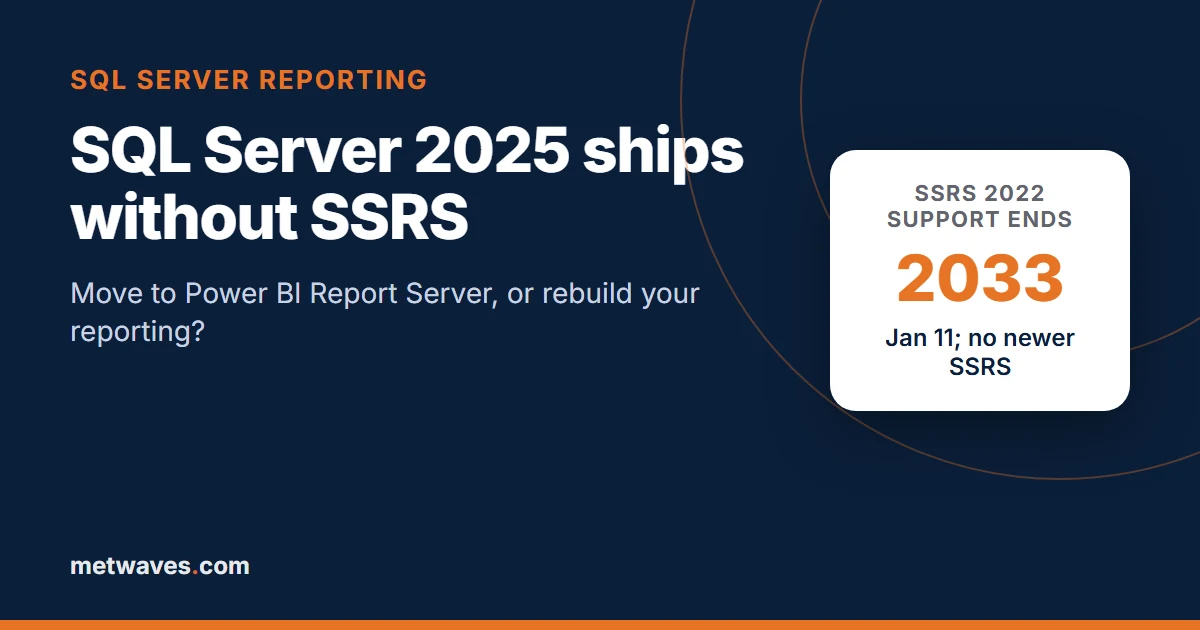
SQL Server 2025 Ships Without SSRS: Move to Power BI Report Server, or Rebuild Reporting?

SQL Server 2025 drops SSRS in favor of Power BI Report Server, now included with Standard and Enterprise. Support dates for every SSRS version, licensing, migration steps and when to rebuild.

Learn More >
Microsoft Technologies 9 min read
Nikit Nandan    Nikit Nandan November 24, 2026
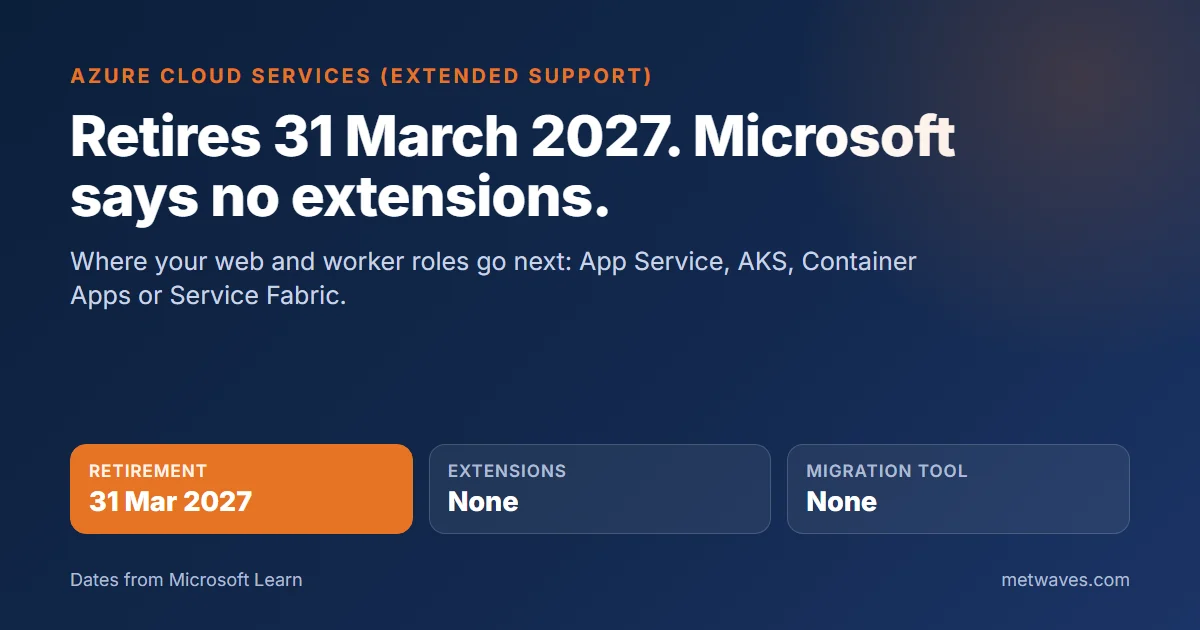
Azure Cloud Services (extended support) retires on 31 March 2027 with no extensions: App Service, AKS or Service Fabric?

Azure Cloud Services (extended support) retires March 31, 2027, with no extensions. How to move web and worker roles to App Service, AKS or Service Fabric.

Learn More >
Cloud Development 10 min read
Nikit Nandan    Nikit Nandan November 23, 2026
Is ChatGPT HIPAA Compliant, or Do We Need Our Own AI Agent for Patient Data?

Which ChatGPT plans OpenAI will sign a BAA for in 2026, what the BAA leaves out, and when patient data needs your own HIPAA-ready AI agent instead.

Learn More >
AI Development 12 min read

Let’s build your idea!

Let us help you with free analysis & estimate. Our product expert will contact you within 12 hours.

 All your information is kept confidential and protected by NDA.