Published November 23, 2026. Product coverage is from OpenAI's HIPAA-eligible products page, Microsoft's HIPAA compliance page and AWS's HIPAA eligible services list, checked on November 21, 2026. This is not legal advice; confirm your setup with your compliance lead.
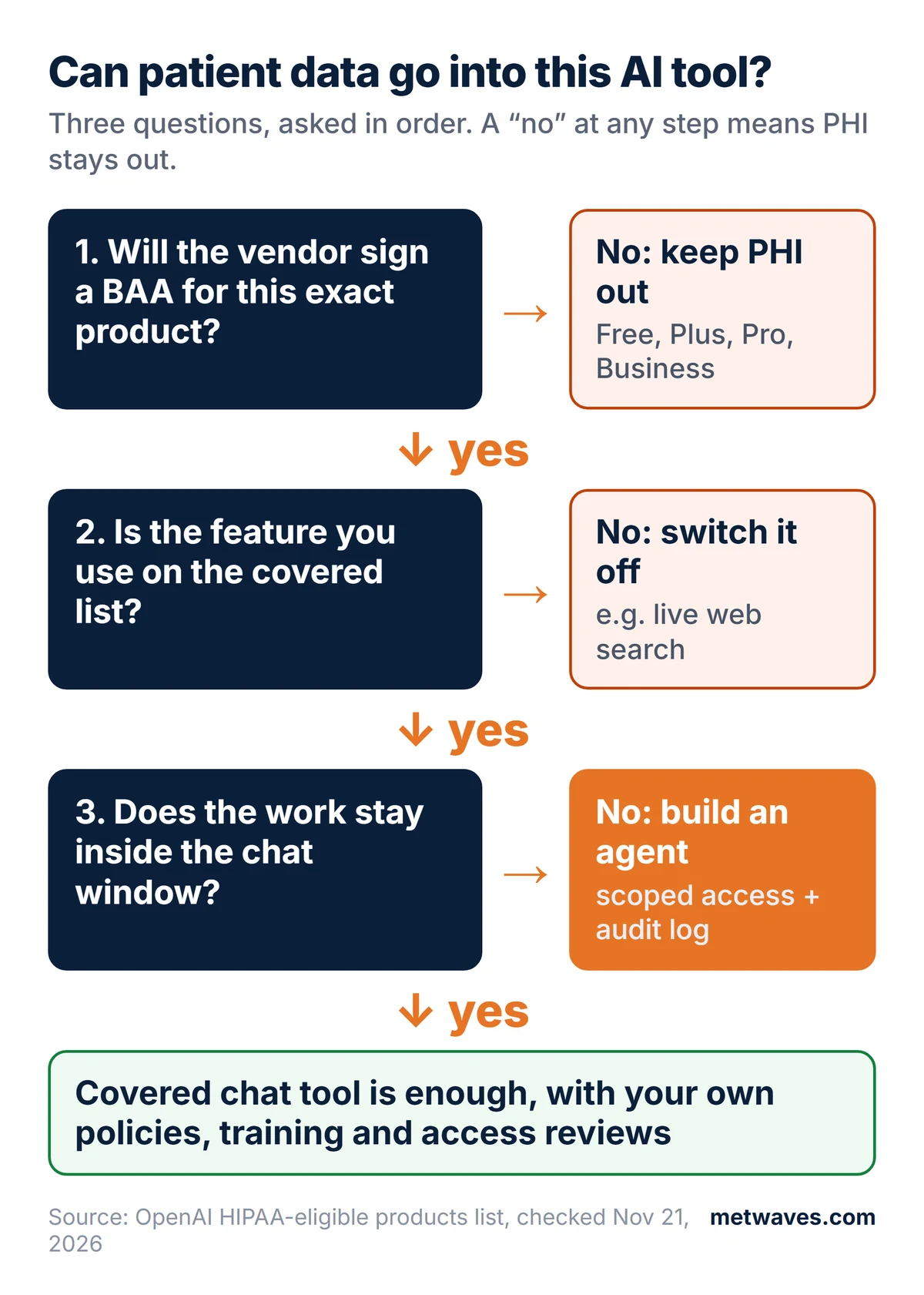
Short answer. As of November 2026, consumer ChatGPT (Free, Plus, Pro) and ChatGPT Business are not HIPAA eligible, so patient data must stay out of them. OpenAI does sign a Business Associate Agreement (BAA) for ChatGPT for Healthcare, ChatGPT Enterprise with a Regulated Workspace, ChatGPT for Clinicians and its API with Modified Retention. A BAA makes the tool eligible, not your use of it compliant; if patient data has to move between the AI and your own systems, you need an agent built for that.
Key facts at a glance
- HIPAA-eligible OpenAI productsChatGPT for Healthcare, ChatGPT for Enterprise with Regulated Workspace, ChatGPT FedRAMP, ChatGPT for Clinicians, API with Modified Retention, API FedRAMP with Modified Retention
- No BAAChatGPT Business, per OpenAI's BAA help article. Free, Plus and Pro are not on the eligible list.
- ChatGPT for Healthcare launchedJanuary 8, 2026 (OpenAI for Healthcare announcement)
- Azure OpenAIMicrosoft's HIPAA BAA comes by default through its Data Protection Addendum for covered entities and business associates
- Amazon BedrockOn AWS's HIPAA eligible services list (updated November 16, 2026), with an AWS BAA in place
- Security Rule updateProposed January 6, 2025; the final rule is now projected for July 2027
What does "HIPAA compliant" actually mean for an AI tool?
No product is HIPAA compliant on its own. HIPAA (the Health Insurance Portability and Accountability Act) applies to covered entities, such as providers and health plans, and to their business associates. When a vendor stores or processes electronic protected health information (ePHI) for you, it becomes your business associate, and the U.S. Department of Health and Human Services (HHS) requires a signed BAA before any PHI goes in. HHS's guidance on cloud computing is explicit that this holds even when the provider only stores encrypted data it cannot read.
So the question has two parts:
- Is the vendor eligible? Will it sign a BAA that names the exact product and features you use?
- Is your use compliant? Do you limit what goes in, control who can see it, log what happens and train your staff? That part is always yours. Microsoft says it plainly on its HIPAA page: there is no HHS-approved certification for HIPAA, and "using Microsoft services doesn't on its own achieve HIPAA compliance."
"HIPAA compliant ChatGPT" therefore means: an OpenAI product covered by a signed BAA, configured the way the BAA requires, used under your own policies.
Which ChatGPT plans will OpenAI sign a BAA for in 2026?
OpenAI's HIPAA eligible products list is the reference. Its BAA help article adds how each route is set up.
| Product | BAA available? | How you get it |
|---|---|---|
| ChatGPT Free, Plus, Pro | No | Not on the eligible list. Keep PHI out. |
| ChatGPT Business (formerly Team) | No | OpenAI states: "We do not offer a BAA for ChatGPT Business." |
| ChatGPT Enterprise or Edu | Only with a Regulated Workspace | Through OpenAI sales |
| ChatGPT for Healthcare | Yes | Through OpenAI sales; launched January 8, 2026 |
| ChatGPT for Clinicians | Yes | Individual clinicians accept a BAA in the product |
| OpenAI API | Yes, with Modified Retention | Self-serve in the API Platform: Settings, Organization, General, "HIPAA compliance support". Requires a history of API usage. |
Two details catch teams out. First, the BAA covers named services only: an Enterprise workspace without the Regulated Workspace configuration is not covered just because it is Enterprise. Second, once you switch on HIPAA support in the API Platform, OpenAI says it cannot be switched off for that organization, so many teams use a separate organization for regulated work.
What does OpenAI's BAA leave out, even on an eligible plan?
Eligibility is per feature. OpenAI lists functions that are not covered and where PHI should not be entered. As of November 21, 2026 these include:
- event-triggered scheduled tasks;
- internet access inside Canvas and code blocks;
- browser use and network access for Work in the cloud;
- Computer History and the improved memory feature (disabled by default in the regulated workspaces);
- sharing workspace agents that use agent-owned connections.
OpenAI also says features that are not listed are not automatically covered, and new features may not be listed yet. On the API side, its data controls guide states that "Web Search with live internet access is not HIPAA eligible and is not covered by a BAA." Only the offline, cache-only mode (external_web_access: false) can be covered, and only from a Zero Data Retention project.
A note on terms, because the sources differ: OpenAI's help center says the API needs "Modified Retention", while the developer guide talks about Zero Data Retention and Modified Abuse Monitoring. OpenAI's own HIPAA guide reconciles them: Modified Retention "means, as applicable, Modified Abuse Monitoring, Zero Data Retention, Safety Retention, or Eyes Off." Ask OpenAI which one your organization is provisioned for, and get it in writing.
What about Azure OpenAI and Amazon Bedrock?
Many healthcare teams already have a cloud BAA, which can be the quickest route to a covered model.
| Route | How the BAA works | What to check |
|---|---|---|
| OpenAI API | Self-serve BAA in the API Platform, or through sales | Modified Retention is provisioned; only listed endpoints carry PHI; no live web search |
| Azure OpenAI in Microsoft Foundry | Microsoft's BAA is included by default in its Data Protection Addendum for covered entities and business associates | The model and feature you use are in Azure's in-scope list. Partner and community models in Foundry are not covered just because Azure is. |
| Amazon Bedrock and Bedrock AgentCore | Sign the AWS BAA (through AWS Artifact) before any PHI goes in | AWS: "Customers are responsible for ensuring their own HIPAA compliance when using any AWS service." |
The pattern is the same on every platform: the provider covers its infrastructure under the BAA, and you own the configuration, the access rules and the logs. That is the boundary where a chat tool stops and your own agent starts.
When is a covered chat tool enough, and when do you need your own agent?
A BAA-covered ChatGPT workspace is a good fit when a person pastes in information, reads the answer and decides what to do. It stops being enough as soon as the AI needs to reach into your systems or act on its own.
| Job | Covered chat workspace | Your own agent |
|---|---|---|
| Summarize a referral letter a clinician pastes in | Good fit | Not needed |
| Draft a patient letter from notes | Good fit, with review | Not needed |
| Pull a patient's last three visits from the EHR and prepare a pre-visit brief | Not possible without custom connectors | Good fit |
| Read faxed referrals, match to patients and create tasks | No | Good fit |
| Answer patients on your website about their own appointments | No (patients may not get accounts) | Good fit, with identity checks |
| Code a claim and post it to billing | No | Good fit, with human approval |
Note the patient-facing row. OpenAI's HIPAA guide says customers may not create end-user accounts for patients, plan members or their families on ChatGPT for Healthcare, so anything patients use has to be your own application.
What does a HIPAA-ready AI agent look like?
An AI agent is software that uses a language model to decide the next step and calls tools, such as an EHR (electronic health record) API, to carry it out. To handle PHI safely, it needs controls in layers that your compliance team can point to.
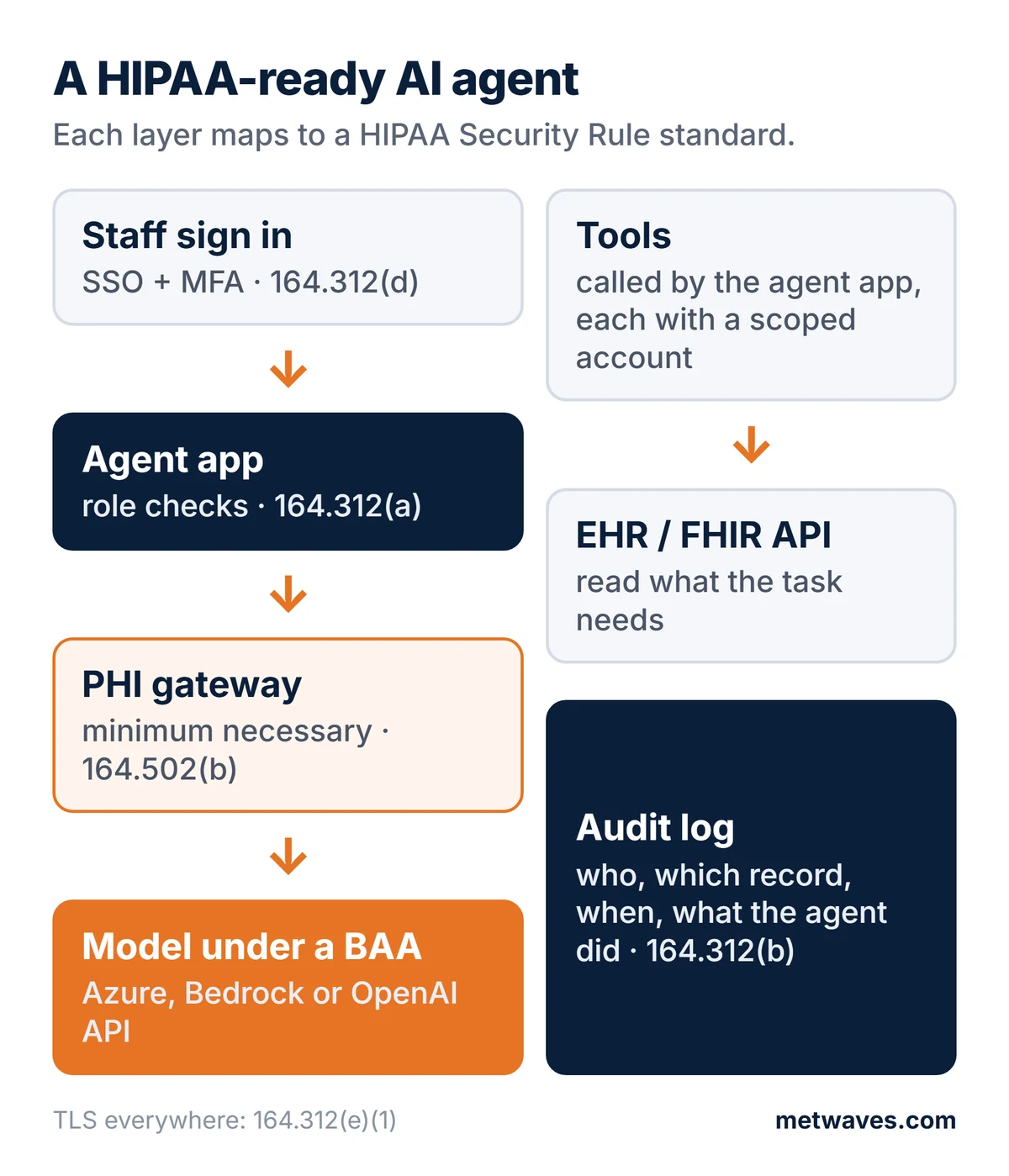
Here is what each layer does, and the rule it supports.
| Layer | What it does | HIPAA standard |
|---|---|---|
| Sign-in | Single sign-on and multi-factor authentication for staff; verified identity for patients | 45 CFR 164.312(d) person or entity authentication |
| Agent app | Checks the user's role before any tool call, not just at login | 164.312(a)(1) access control |
| PHI gateway | Sends the model only the fields the task needs; masks identifiers it does not need | 164.502(b) minimum necessary |
| Model endpoint | A model on a BAA-covered endpoint with the required retention setting | Business associate agreement |
| Tools | Each tool runs under its own scoped service account; read and write separated | 164.312(a)(1) access control |
| Audit log | Append-only record of who asked, which record was touched, what the agent did, and the approval | 164.312(b) audit controls |
| Transport | TLS on every hop, including model and tool calls | 164.312(e)(1) transmission security |
The PHI gateway is the piece most teams skip. The model rarely needs a full chart. A pre-visit brief needs recent problems, medications and the reason for the visit, not the Social Security number or the home address. Building the prompt from an allow-list of fields is simple and is the clearest evidence of the minimum necessary standard:
ALLOWED_FIELDS = {
    "pre_visit_brief": ["age", "sex", "active_problems", "medications", "allergies", "last_visit_summary"],
    "referral_triage": ["age", "referral_reason", "urgency_flags", "insurance_plan_type"],
}

def build_context(task: str, patient: dict) -> dict:
    """Return only the fields this task is allowed to send to the model."""
    allowed = ALLOWED_FIELDS[task]          # KeyError = task not approved for PHI
    return {k: patient[k] for k in allowed if k in patient}
On the OpenAI Responses API, set store=False so responses are not kept as application state; on a Zero Data Retention organization OpenAI forces this anyway. Your own audit record then holds what the regulation asks for, without copying the PHI itself:
{
  "event": "agent.tool_call",
  "time": "2026-11-23T14:02:11Z",
  "user": "dr.lee@clinic.example",
  "role": "physician",
  "patient_ref": "Patient/48213",
  "task": "pre_visit_brief",
  "fields_sent": ["age", "active_problems", "medications", "allergies"],
  "model": "deployment: brief-gpt (BAA-covered)",
  "tool": "fhir.read_encounters",
  "result": "ok",
  "approved_by": null
}
Write these events to storage the agent itself cannot edit or delete. Keep the debugging traces, which may contain prompts, in a separate store with shorter retention and tighter access.
What is changing in the HIPAA Security Rule?
HHS proposed a major update to the Security Rule on January 6, 2025, including mandatory encryption, multi-factor authentication and a written inventory of technology assets that touch ePHI. The final rule has slipped: the federal regulatory agenda now projects it for July 2027, as Alston & Bird reported in July 2026. An agent built today with the layers above already meets the direction of the proposal, so you will not have to rebuild when the final text lands.
What this means for owners
- Stop staff pasting patient details into personal or Business ChatGPT accounts today; write it into policy.
- If people mainly need help drafting and summarizing, buy ChatGPT for Healthcare or Enterprise with a Regulated Workspace and sign the BAA.
- If the AI needs to read from or write to your EHR, billing or scheduling systems, budget for an agent with audit logs and a review step.
- Ask any vendor for the BAA and the list of covered features before a pilot, not after.
What this means for developers
- Use a separate OpenAI organization or cloud subscription for PHI workloads, with the BAA and retention setting confirmed.
- Build prompts from an allow-list of fields per task; never send the whole record.
- Disable live web search and any feature not on the covered list.
- Log every tool call with user, patient reference and approval to append-only storage.
How long does it take to build a HIPAA-ready agent?
These are estimates for a single, well-defined workflow such as referral intake or pre-visit briefs. The real figure depends on your EHR's API, your security review and how many exceptions the workflow has.
- Scope and data map (1 to 2 weeks, estimate). Write down the task, the fields it needs, who may use it and what needs human approval.
- BAA and environment (1 to 3 weeks, estimate, often in parallel). Confirm the BAA and retention setting, set up the separate subscription or organization, and connect to a test copy of the EHR.
- Build the working slice (3 to 6 weeks, estimate). Agent, PHI gateway, tools, audit log and the review queue for low-confidence cases.
- Test hard (2 to 3 weeks, estimate). Edge cases, wrong patients, prompt injection in documents, and a security review.
- Pilot with one team, then widen.
Our invoice processing agent followed the same shape outside healthcare: checks first, automation second, and a review queue that shows staff the reason for every exception. It went live in 8 to 12 weeks.
Frequently asked questions
Is ChatGPT Plus HIPAA compliant?
No. ChatGPT Free, Plus and Pro are not on OpenAI's list of HIPAA-eligible products, and OpenAI does not sign a Business Associate Agreement for them. Do not enter patient information into them.
Does OpenAI sign a BAA for ChatGPT Business or Team?
No. OpenAI's help center states that it does not offer a BAA for ChatGPT Business, the plan formerly called Team. For a covered workspace you need ChatGPT for Healthcare or ChatGPT Enterprise with a Regulated Workspace.
Is the OpenAI API HIPAA compliant?
The API can be covered by a BAA when your organization is provisioned for Modified Retention and you use the listed endpoints, such as /v1/responses and /v1/chat/completions. Live web search is not covered. Your own application still has to meet HIPAA's access, audit and minimum necessary requirements.
Is Azure OpenAI HIPAA compliant?
Microsoft includes its HIPAA BAA by default in its Data Protection Addendum for covered entities and business associates, and Azure is in scope. Check that the specific model and feature you deploy are on Azure's in-scope list, then configure access control and logging yourself.
Does a BAA make our use of AI HIPAA compliant?
No. A BAA makes the vendor eligible to handle PHI for you. Compliance also depends on what data you send, who can access it, what you log and how staff are trained, which remain your responsibility.
Can patients use a ChatGPT for Healthcare workspace?
No. OpenAI's HIPAA guide says customers may not create end-user accounts for patients, plan members or their families. A patient-facing assistant has to be your own application on a BAA-covered model.
What is the minimum necessary rule for AI prompts?
Under 45 CFR 164.502(b) you must make reasonable efforts to limit PHI to the minimum necessary for the purpose. For an AI agent, that means building each prompt from an approved list of fields for the task instead of sending the whole patient record.
Need patient data in an AI workflow? We build HIPAA-ready AI agents for clinics and health businesses in the US, UK, Canada and Australia: BAA-covered models, minimum necessary prompts, audit logs and human review. See our AI agent development service, how we work in healthcare, or have an existing agent tested in an AI agent security audit.

Nikit Nandan
Strategy Director
Nikit is experienced in conducting in-depth research to stay abreast of industry trends and emerging technologies.