
Dedicated development team
A dedicated development team is a group of developers, QA and a delivery lead who work on your product and nothing else, for as long as it needs them. You set the priorities; our delivery lead runs the sprints and reports to you every month. The code, the repositories and the cloud accounts are yours from day one.
For companies in the US, UK, Canada and Australia · Six years with one clinic, with a team of two to five
WHAT IT IS
What a dedicated development team is, and who decides what
A dedicated development team is a team of developers, QA and a delivery lead that a software company assigns to one client's product, full time, and bills by the month. The vendor's lead runs the work day to day; the client's product owner decides what gets built and in which order. It suits a product that needs building or running for a year or more when the company has no engineering team of its own.
Your product owner decides
- What the product does, and for whom
- The order of the backlog, every sprint
- Whether finished work is accepted
- When a release goes to your users
Agreed together, every month
- Progress against last month's plan
- The cost of the team
- Whether to add, change or remove a role
Our delivery lead decides
- How the work is split across the team
- Sprint planning, task assignment and code review
- Who covers leave, and how a handover runs
- When to raise a problem with you: early
Before you start: a dedicated team needs a product owner on your side who can make decisions every week. Without one, the team waits, guesses or builds the wrong thing. If nobody on your side can own the priorities, a fixed-scope project fits better, and we will tell you so.
When a dedicated software development team fits, and when it does not
A dedicated team suits companies that need a product built or run for a long time and would rather not build an engineering department to do it. Five situations where it fits, and two where it does not.
| Your situation | What it looks like | Does a dedicated team fit? |
|---|---|---|
| You have a product and no engineers | A product to build or run for a year or more, and nobody in-house to build it. | Yes. Our lead runs the team; you own the priorities. |
| Version one was built by someone who has gone | A freelancer or agency built the first release and moved on, and the product still needs work every month. | Yes. The team takes the product over and keeps it moving, month after month. |
| Your engineers are booked on the core product | Your own team cannot stop for a second product or a large new module that is waiting. | Yes. A second team works on it, with its own lead, and leaves your core team alone. |
| You need several skills in the same quarter | Web, mobile, QA and data work at once, more than you could hire for one at a time. | Yes. The skills sit in one team, and the mix is reviewed every month. |
| You want one person accountable for delivery | You would rather hold one person to account than coordinate five contractors yourself. | Yes. One delivery lead, one monthly report, one call. |
| Nobody on your side can set priorities each week | The team would wait, guess or build the wrong thing. | No. A fixed-scope project, or discovery to define the product first. |
| You already have a tech lead and a backlog | Your lead can run developers; you are short of hands or one skill. | No. Add developers to your own team instead; it costs less than a whole team. |
Dedicated development team services
We shape the team around the product, not the other way round. These are the team shapes we propose most often, using roles we have put on our own projects. Pick one to see who is on it.
Product team
Builds and runs a web platform, portal or SaaS product, from the first release to steady monthly change. The usual shape when the product lives in the browser.
- Usually bought by
- Founders and product companies with a web product
- Delivery lead
- Full stack developers
- QA engineer
- UI designer as needed
- Business analyst as needed
Mobile app team
Builds the app and the API behind it, and keeps both current with every new iOS and Android release.
- Usually bought by
- Companies whose app is the product, or their main channel
- Delivery lead
- iOS and Android developers
- Back-end developer
- QA engineer
Data and AI team
Builds pipelines, warehouses and AI agents on your own data, and keeps them accurate as the data changes.
- Usually bought by
- Companies turning their own data into reporting or AI features
- Delivery lead
- Data engineers
- AI developers
- QA engineer
Support and run team
Keeps a live product patched, monitored and changing after launch, when the team that built it has moved on. Smaller than a build team, and sized to the work that arrives each month.
- Usually bought by
- Companies whose first builder has gone
- Delivery lead
- Developers who know your stack
- QA engineer
Discovery before the team starts
When the product is still an idea, a short discovery defines it before a team is sized: users, scope, a first backlog and a release plan. You keep the documents whether or not the team follows.
- Usually bought by
- Founders with an idea and no written scope
- Business analyst
- Delivery lead
- UI designer
HOW IT RUNS
How a dedicated team works with you, day to day and month to month
Your product owner decides what gets built; our delivery lead decides how the team gets it built. This is the rhythm we write into every team plan, so you know what to expect before anyone starts.
Every day
Our delivery leadDevelopers and QA work from the sprint backlog. The lead reviews code, clears blockers and keeps the board current.
YouAnswer questions in your own chat tool, or let the lead collect them for one short call.
What it leaves you withCommits and pull requests in your repositories
Every two weeks
Our delivery leadPlans the sprint with your product owner, then shows what was finished at the end of it.
YouOrder the backlog for the next sprint, and accept or send back each finished item.
What it leaves you withA release to your test or live environment
Every month
Our delivery leadReports progress, cost and team size in writing, and proposes any change to the team.
YouAgree next month's plan and any change of role or size.
What it leaves you withThe monthly report and a written list of decisions
When someone changes
Our delivery leadFinds the replacement and runs a handover overlap with the person leaving.
YouHear who is joining and why, before they start.
What it leaves you withHandover notes in your repository, not in someone's head
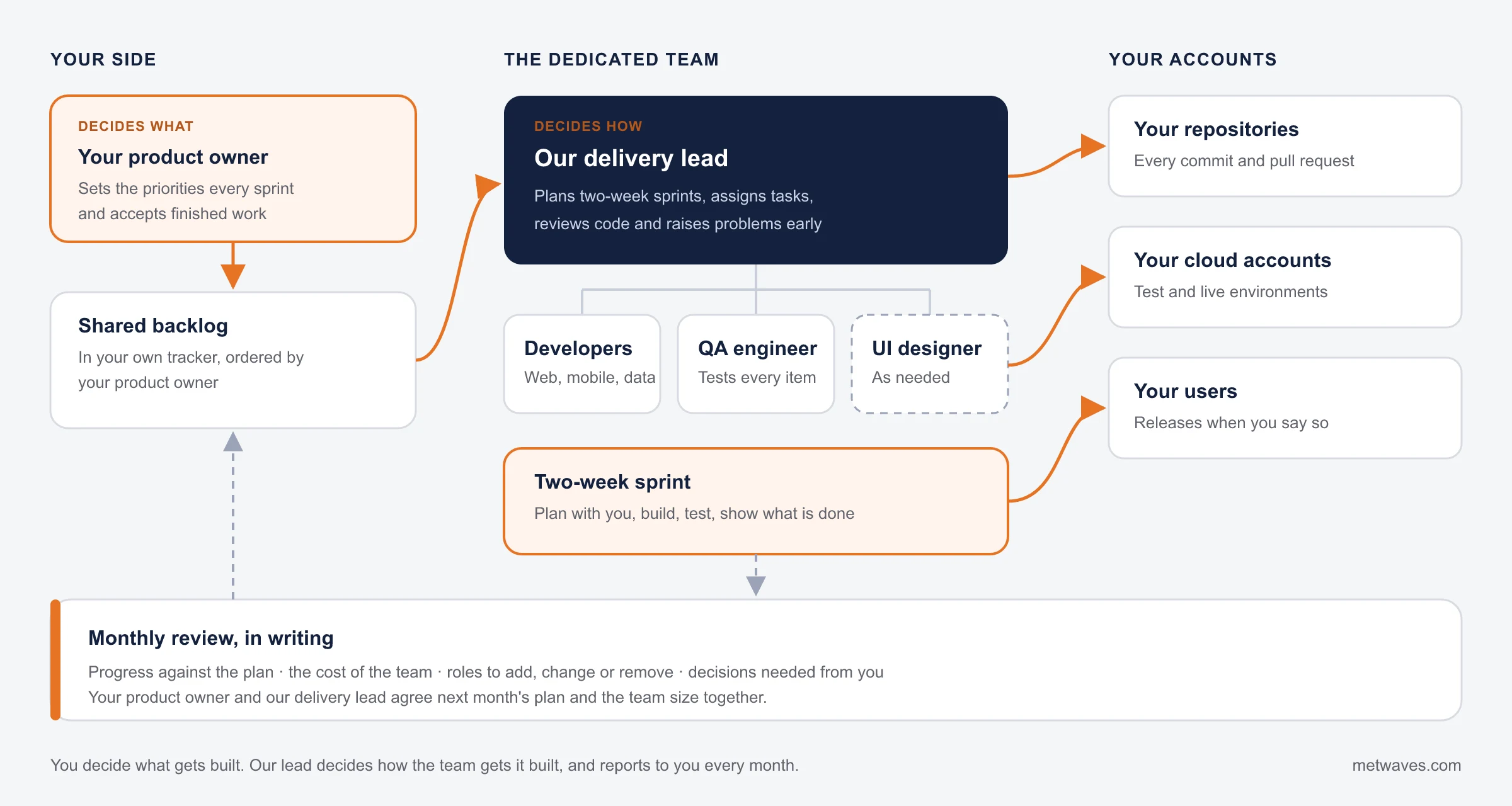
Where the work lives: your backlog, our team, your accounts
Releases go to your repositories and cloud accounts, never ours, so you can move the work in-house whenever you choose. This is how a typical dedicated team connects to your company.
Already have a team lead and only need one or two developers? See IT staff augmentation.
Dedicated team, staff augmentation or a fixed project?
The difference is who manages the work. With a dedicated team our lead does; with staff augmentation you do; with a fixed project we deliver an agreed scope.
| Model | Who manages the work | You pay for | Fits when |
|---|---|---|---|
| Dedicated team | Our delivery lead, with your product owner | A whole team, monthly | You need a product built or run long term with no team yet |
| Staff augmentation | You, in your tools | Each person's time, monthly or hourly | You have a lead and a backlog and need hands or a skill |
| Project outsourcing (fixed cost) | Us, against an agreed scope | The outcome, by milestone | The scope is clear and stable |
| Freelancers | You, person by person | Hours | Short, well-defined tasks; no cover if they leave |
| Local hire | You | Salary, benefits, recruiting fees | The role is permanent and core to the business |
How each model is billed is on our engagement models page.
What a dedicated development team costs
You pay a fixed monthly fee per team member, so the roles, their seniority and the size of the team set the bill. We price each team in its team plan rather than publish a rate card. The plan lists what the fee includes, and the minimum term, notice and replacement terms are agreed in writing before work starts.
| What sets the cost | Why | How to keep it in check |
|---|---|---|
| Roles | Developers, QA, design, data and the delivery lead are priced differently | Add a role when the backlog needs it, not up front |
| Seniority | A senior engineer costs more and needs less supervision | Mix seniority so the lead is not the only senior person |
| Team size | The monthly bill is the sum of the people on the team | Start small and grow after the first months |
| How long | Longer engagements are easier to staff and plan | Agree a review point rather than a fixed end |
| Hours of overlap | Working hours that overlap with yours are planned into the team | Agree the overlap you need before the plan is priced |
A dedicated team is billed as a dedicated resource: a fixed monthly cost per person, agreed after the skills discussion. If your scope is fixed and written down, compare a fixed-cost quote; while requirements are still settling, time and materials or hybrid may suit the first months.
WHAT TO EXPECT
Benefits and risks of a dedicated team, and the report that keeps them in view
A dedicated team buys continuity and one accountable lead. Its risks are real and manageable, and every one of them shows up in the monthly report before it becomes a problem. Ask any firm you compare how it handles each one.
- ShippedWhat was released this month, against the plan agreed last month
- Next monthThe plan, in the order your product owner set
- Team and costWho worked on the product, and the month's cost by role
- Changes proposedA role to add, change or remove, with the reason
- Decisions neededWhat the team needs from you to keep moving
- RisksAnything that could slip, raised before it does
What a dedicated team gives you
- One accountable lead
- People who learn your product
- Several skills in one team
- Monthly cost you can plan
The risks, and how each is handled
Dependency on the vendor
Code, documentation and cloud accounts stay in your name from day one, so you can move the work in-house.
Drift from your priorities
Your product owner sets the backlog every sprint; the lead does not decide what the product does.
Paying for skills you no longer need
Team size and roles are reviewed every month and changed as the product moves on.
Knowledge leaving with a person
Handover overlap when someone changes, and documentation kept in your repository.
LONG-RUNNING WORK
Six years with one clinic, with a team of two to five
We have not yet published a dedicated team case study, so here is the closest proof we can show. A walk-in urgent care clinic in Illinois worked with us from February 2016 to February 2022, with a team of two to five people: first a website with online booking, then six years of SEO, changes and support, with monthly progress reports by email and a response to any request within 48 hours.
It ran as a project team rather than a dedicated team billed by the month, and we describe it that way. What it shows is a small, stable team staying with one client for years.
A second example, from architecture and construction: for BioBuild in Sweden we built an AI material recommendation engine between August 2024 and January 2025, and have supported it since it went live. Read the BioBuild case study.
- ClientWalk-in urgent care clinic, Palatine, Illinois
- EngagementFebruary 2016 to February 2022
- TeamTwo to five people
- ModelProject team with ongoing support, not a dedicated team
How to start with a dedicated team
It starts with a conversation about your product and ends with a team plan you can compare with any other firm's, before anyone is assigned. You see working software at the end of the first sprint.
- 1
Call about your product
What you need built in the next six months, who on your side owns the priorities, and the hours your team works.
- 2
Team plan
The roles we recommend, the monthly cost and what the first 90 days would deliver. If a fixed project or adding developers to your own team fits better, the plan says so.
- 3
Meet the lead
You talk to the delivery lead who would run your team, not only to sales, and agree the terms in writing.
- 4
Onboarding
Access to your repositories and tools, a first backlog with your product owner, and a two-week plan.
- 5
First sprint review
At the end of the first two weeks the team shows working software, and you accept or send back each item.
- 6
Every month
Progress, cost and team size are reviewed with you. The team grows or shrinks with the product.
CHOOSING A PARTNER
How to hire a dedicated development team
The firm matters less than the people who will run your team and the terms you sign. Put these six questions to every firm you shortlist, us included, and compare the answers in writing.
Ask for a Team Plan
Who runs the team day to day?
Ask for a name and a call with that person, not a role description.
Good answerYou meet the delivery lead who will run your team before you sign.
Warning signYou only ever speak to sales, never to the person who will run the work.
What happens when someone leaves?
Ask how the replacement is found, how long the handover overlap is and who pays for it.
Good answerA plain answer, in writing, the first time you ask.
Warning signThe answer only appears after you ask twice.
How do we scale the team down, or stop?
Ask for the minimum term and the notice period before you sign.
Good answerBoth are in the contract, with the notice per person.
Warning signExit terms are vague, or “we never have that problem”.
Who owns the code and the accounts?
Ask where the repositories and cloud accounts will live, and when IP is assigned.
Good answerYou do, from the first commit, with IP assigned in the contract.
Warning signThe code lives in their repositories and you are promised access later.
What will the monthly report show?
Ask to see one before you sign.
Good answerA sample report covering progress, cost and team size.
Warning signA large team proposed before anyone has read your backlog.
Are the developers your employees?
Ask whether any of the work is subcontracted, and to whom.
Good answerA direct answer for each person on the team, in the team plan.
Warning signEvery answer is yes, including the ones that should be “not yet”.
Related services
Where a dedicated team fits with the rest of what we do.
QUESTIONS & ANSWERS
Dedicated development team: frequently asked questions
Straight answers on cost, start dates, management, scaling and ownership. If you don't see an answer to your question, you can send us a message from our contact form.
You pay a monthly fee per team member, so the roles, their seniority and the size of the team set the bill. We price each team in a team plan after a call about your product, rather than publishing a rate card, and the plan shows what is included.
The team plan comes first, after a call about your product. The start date depends on the roles you need, and we confirm it in the plan rather than promise one here.
Our delivery lead runs the work day to day: sprint planning, task assignment, code review and reporting. Your product owner sets the priorities every sprint and accepts what is delivered.
With a dedicated team, our lead runs a whole team on your product. With staff augmentation, our developers join your team and you manage them. See IT staff augmentation if you already have a lead and need one or two developers.
Yes. Team size is reviewed with you every month. The notice needed to change it is agreed in writing before work starts.
You do: the work lives in your repositories and cloud accounts, and IP is assigned to you in the contract before work starts.
Ask us, and ask any firm you are comparing. We answer it in writing in the team plan, together with who would be on your team.
Monthly, per person, as described under dedicated resource on our engagement models page. Fixed-cost and time-and-materials work are described there too.
INSIGHTS & NEWS
Discover IT Industry Insights and Technology Trends
 Nikit Nandan
November 17, 2026
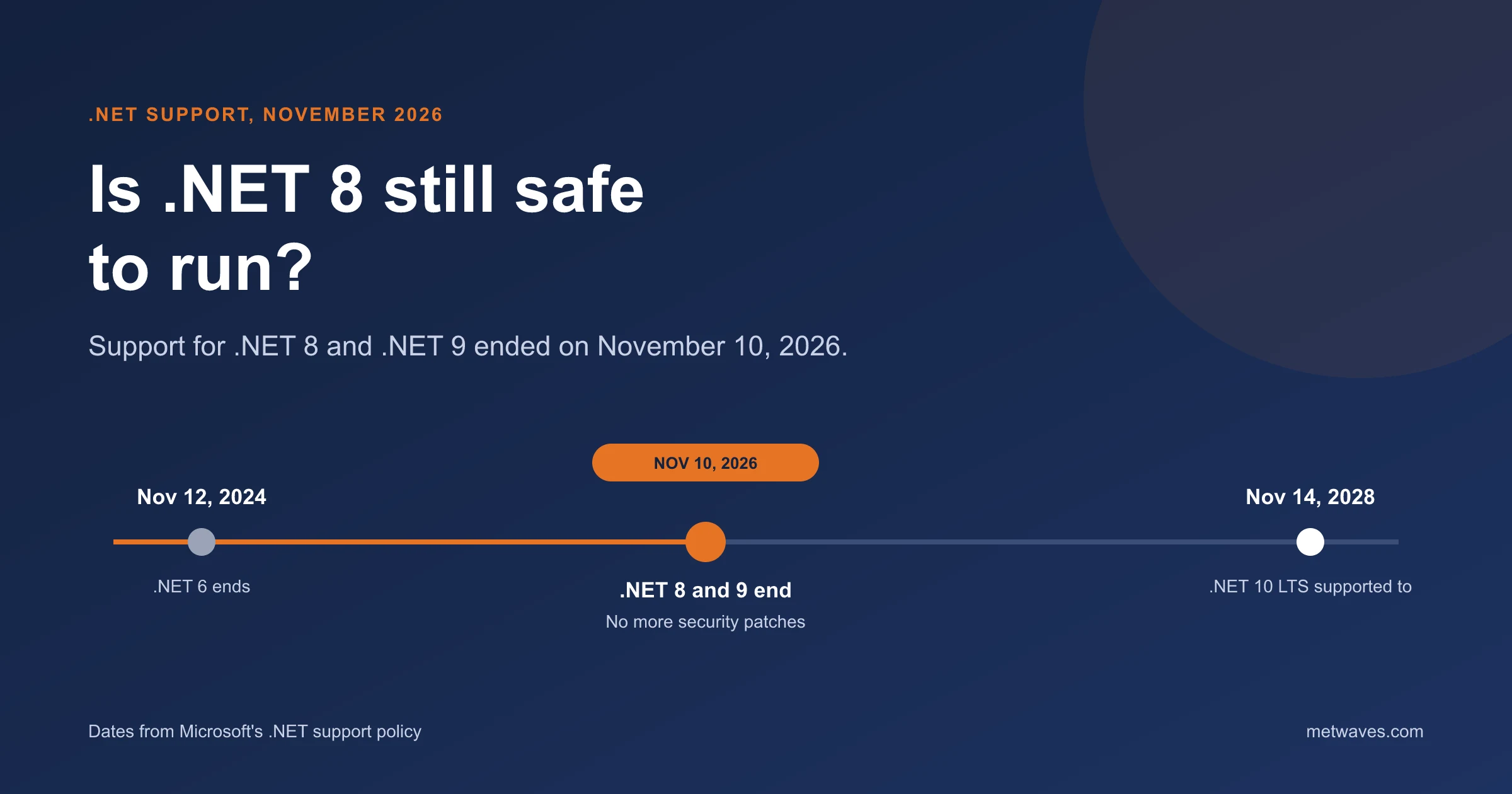
Is .NET 8 Still Safe to Run After November 2026?
Support for .NET 8 and .NET 9 ended on November 10, 2026. What that means for apps still on them, how risky it is, and how to plan the move to .NET 10.
Learn More >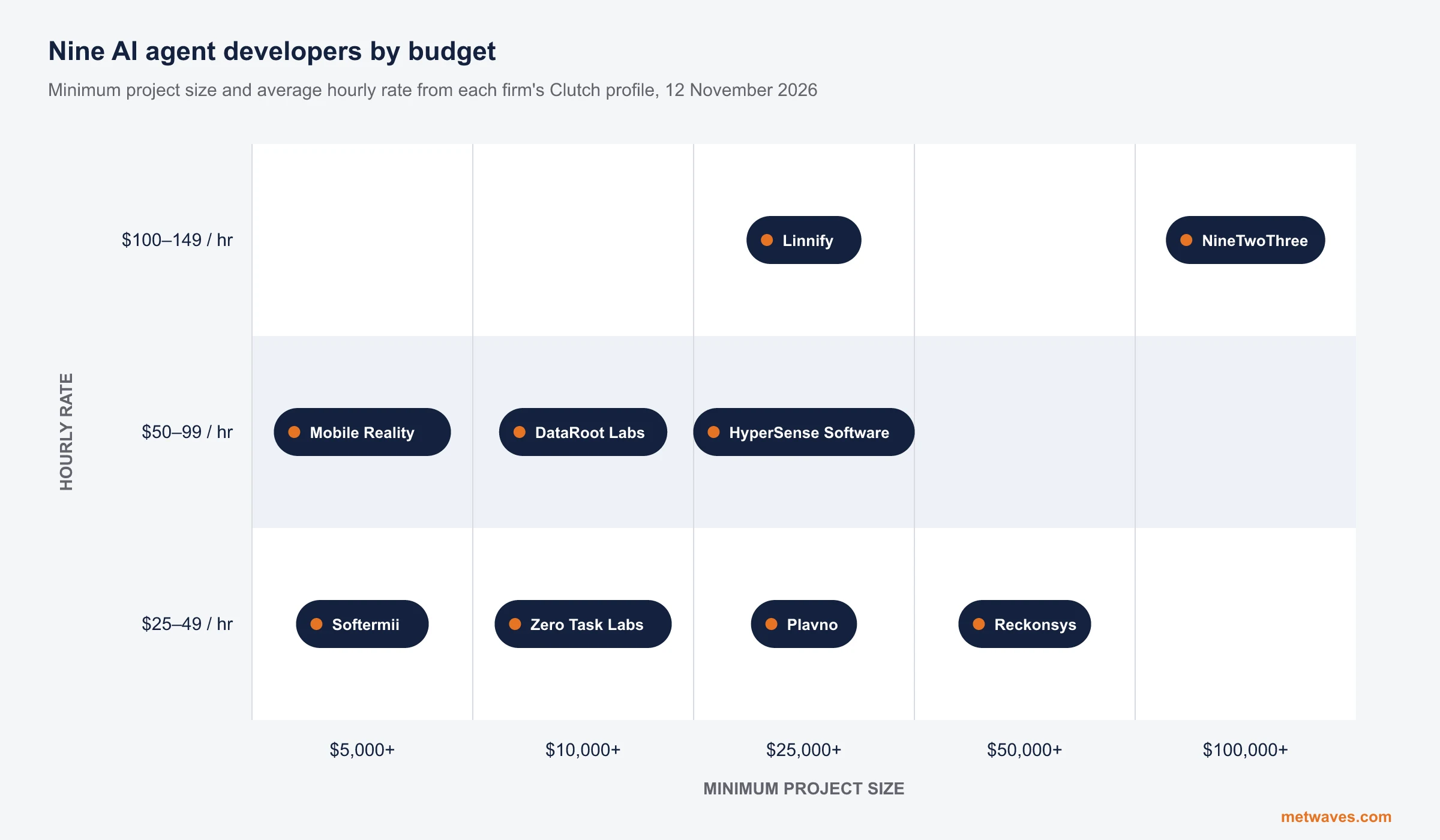 Nikit Nandan
November 12, 2026
Top AI agent development companies for small and mid-sized businesses (2026)
Nine AI agent development firms a small or mid-sized business can shortlist, with Clutch figures, minimum budgets and the weaknesses their own clients name. Published by Metwaves, which is not ranked.
Learn More >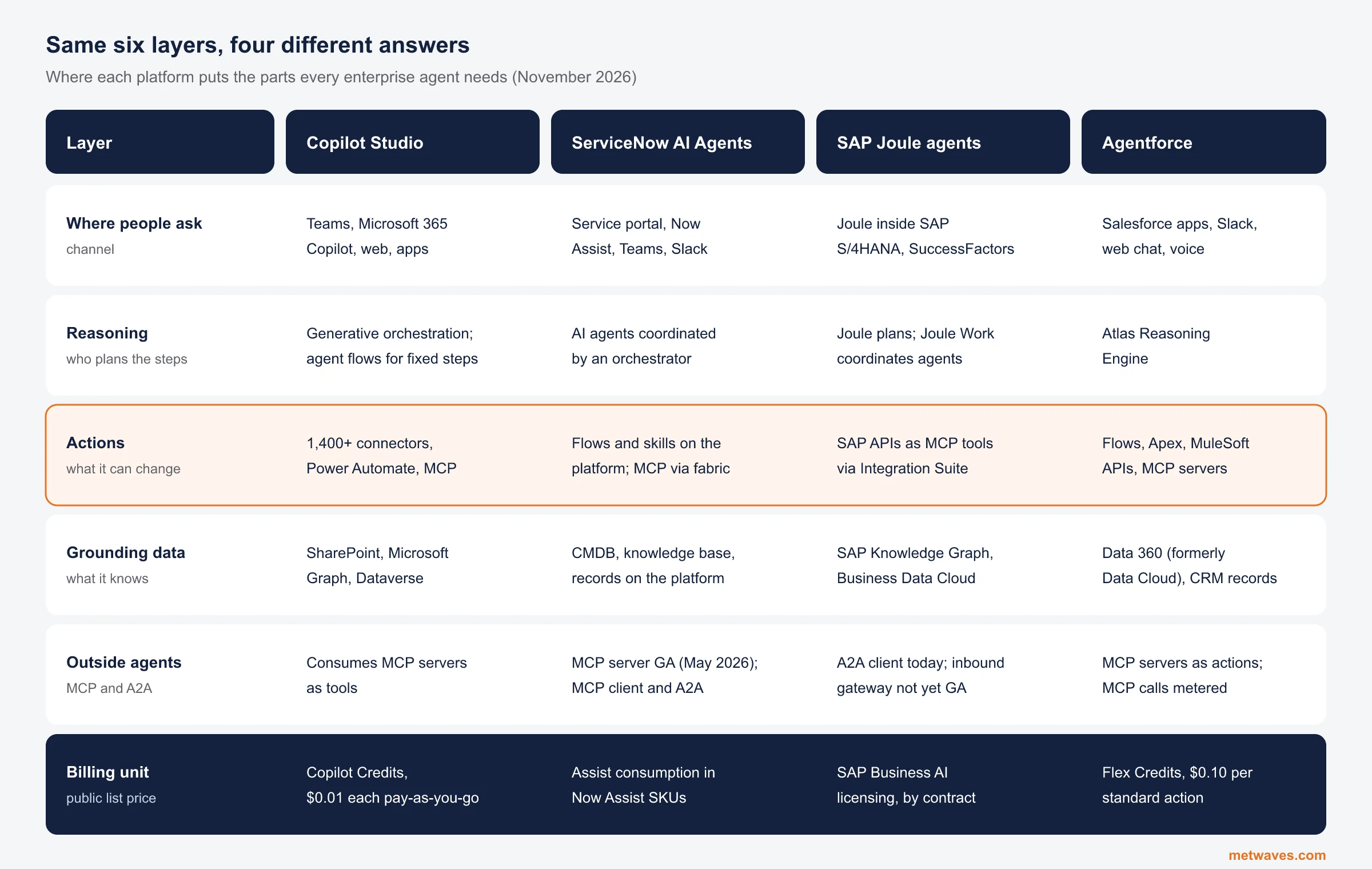 Nikit Nandan
November 12, 2026
Enterprise AI Agent Platforms Compared (2026)
An architecture review of the four big enterprise AI agent platforms: where each one reasons, acts, finds its data and connects to outside agents, what it costs, and when a custom build is the better choice.
Learn More >Let’s build your idea!
Let us help you with free analysis & estimate.
Our product expert will contact you within 12 hours.