Python development services

APIs, data pipelines, AI features and integrations, built in Python for small and mid-sized businesses. We start every project on a Python version that still gets security fixes, and keep it that way after launch. The code and the repository are yours.

Trusted by businesses across the world

Logos of Metwaves clients

Python development services we provide

Python development services cover designing, building and maintaining software written in Python: web APIs and back ends, data pipelines, AI and machine learning features, and the scripts and integrations that move data between business systems. Metwaves builds these for small and mid-sized businesses in the US, UK, Canada and Australia, on a Python version that still receives security fixes, in a code repository you own.

The work comes down to six jobs. Each one ends with software running in your own accounts, with tests and documentation your next developer can pick up.

Django development services

Business applications and customer portals on Django: accounts and permissions, an admin screen your staff can use from week one, and a database schema whose changes are kept in code. A good fit when the app has many screens, roles and records.

APIs with FastAPI

APIs for your web and mobile apps or for partners, with every request checked against typed models and documentation generated from the code. A good fit for services that other systems call, and for AI features that wait on a model.

Data pipelines and automation

Scheduled jobs that collect data from your apps, files and suppliers, clean it once and load it where people report on it. Larger platforms are planned on our data engineering page.

AI agents and machine learning in Python

Agents that read documents and act in your systems, and models trained on your own data, with people checking the cases the software is unsure about. See AI agent development and machine learning development.

Integrations between business systems

Python services that connect an ERP, a CRM, an estimating tool or a supplier feed, with checks so bad data stops before it is posted. More on our software integration page.

Python upgrades and maintenance

Moving an app off an end-of-life Python or framework version, adding the tests that make the move safe, and then keeping dependencies and security fixes current every month.

What Python is good for, and where it isn't

Python is the default language for data and AI work and a strong one for web back ends. It is not the right tool for every part of a product, and we build in other languages too, so we will tell you when something else fits better.

A strong choice for

  • APIs and web back ends

    Django gives you sign-in, an admin screen and a database layer from the first day. FastAPI suits lean APIs that other systems call, with request checks and API documentation generated from the code.

  • Data pipelines and reporting

    Pulling data from apps, spreadsheets and suppliers, cleaning it and loading it where reports read it. pandas and NumPy are the standard Python tools for it.

  • AI and machine learning

    The main model libraries and AI SDKs all work in Python: TensorFlow, PyTorch, LangGraph and the Azure OpenAI and Gemini clients. Agents, document reading and recommendation engines are built here.

  • Automation and integrations

    Jobs that replace copying and pasting between systems: reading invoices into an ERP, syncing a CRM, turning building models into cost estimates. Short to write and easy for the next developer to read.

  • Engineering and scientific files

    Python has open libraries for many specialist formats, such as IFC building models. Both of our BIM projects read IFC models in Python.

Usually better in something else

  • Screens in the browser

    The user interface of a web app is JavaScript or TypeScript. Python serves the API behind it. See our React, Angular and Vue page.

  • Native mobile apps

    iPhone and Android apps are built in Swift and Kotlin, or with a cross-platform toolkit. See our iOS and Android pages.

  • Number crunching in plain loops

    Python code is slower than compiled languages when it runs heavy calculations line by line. The fix is usually a library written in C, such as NumPy, or moving that one piece to another language.

  • Many long-lived connections

    Chat, live dashboards and other real-time features with many open connections are often simpler in Node.js, which is built around that model.

  • A company standardised on Microsoft

    If your team writes C# and runs SQL Server on Azure, adding a second language costs more than it saves for most business apps. See our .NET page.

PYTHON PROJECTS WE HAVE SHIPPED

Python in production for our clients

Three projects, three countries, all written in Python. The figures come from each case study.

Australia · Accounts payable

AI invoice processing agent for SAP Business One

An agent reads supplier invoices, checks them against SAP Business One, posts the safe ones and sends the rest to a review queue for a person to approve.

About 80%less manual data entry, on about 1,000 documents a month
  • Python
  • LangGraph
  • Azure Document Intelligence
  • Azure OpenAI
Read the case study >

United States · Construction technology

BIM model to cost estimate integration

Quantities are read from IFC building models, mapped to the client's cost codes and loaded into their estimating and ERP systems, with an exception report for anything that does not map.

Days to hoursfor quantity takeoff, live in 8 to 12 weeks
  • Python
  • .NET
  • IFC
  • REST APIs
Read the case study >

Sweden · BioBuild

AI material recommendation for BIM

A recommendation engine suggests building materials that balance cost, embodied carbon and structural requirements, replacing manual material selection in BIM.

40% fastermaterial selection, with material cost down 20%
  • Python
  • TensorFlow
  • Neo4j
  • BIMserver
Read the case study >

Which Python versions are still supported

Each Python version gets bug fixes for about two years, then only security fixes, and about five years after release it gets nothing. A new version has arrived each October since 2019. This is where each version stood in November 2026.

Bug and security fixes Security fixes onlyNovember 2026
  1. Python 3.15Bug and security fixes
    Ends Oct 2031
  2. Python 3.14Bug and security fixes
    Ends Oct 2030
  3. Python 3.13Security fixes only
    Ends Oct 2029
  4. Python 3.12Security fixes only
    Ends Oct 2028
  5. Python 3.11Security fixes only
    Ends Oct 2027
  6. Python 3.10End of life
    Ended 1 Oct 2026

Source: python.org, Active Python releases and the Python Developer's Guide, Status of Python versions, checked November 17, 2026. End-of-life months are scheduled and can move. Before 3.13, bug fixes ran for 18 months instead of two years. Versions in the security-only phase get no new installers for Windows or macOS.

Still on Python 3.10 or older? It no longer gets security fixes. Plan the upgrade before a problem forces it.

Python frameworks and how to choose

The framework follows from what the software has to do. These are the choices we make most often, and why.

Framework or libraryChoose it forWhy
DjangoA business app with many screens, user roles and an admin areaSign-in, permissions, admin, database layer and schema changes come built in, so the team writes business rules, not plumbing.
FastAPIAn API that other apps call, or a service that waits on AI models or other APIsTyped request models catch bad input at the edge, the API documentation is generated from the code, and it handles many waiting requests well.
FlaskA small service or an existing Flask appMinimal and easy to read. Larger apps need you to choose and wire up the database, sign-in and admin pieces yourself.
Task workers and schedulersImports, reports, emails and AI calls that take more than a second or twoThe request returns at once and the work runs in the background, with retries when a supplier system or model is slow.
pandas and NumPyCleaning, joining and summarising data in pipelines and reportsThe usual tools for table-shaped data in Python; very large data moves to a warehouse or Spark instead.
LangGraph, TensorFlow, PyTorchAI agents and trained modelsLangGraph for agents with checks and human review steps; TensorFlow or PyTorch for models trained on your own data.

How we structure a Python application

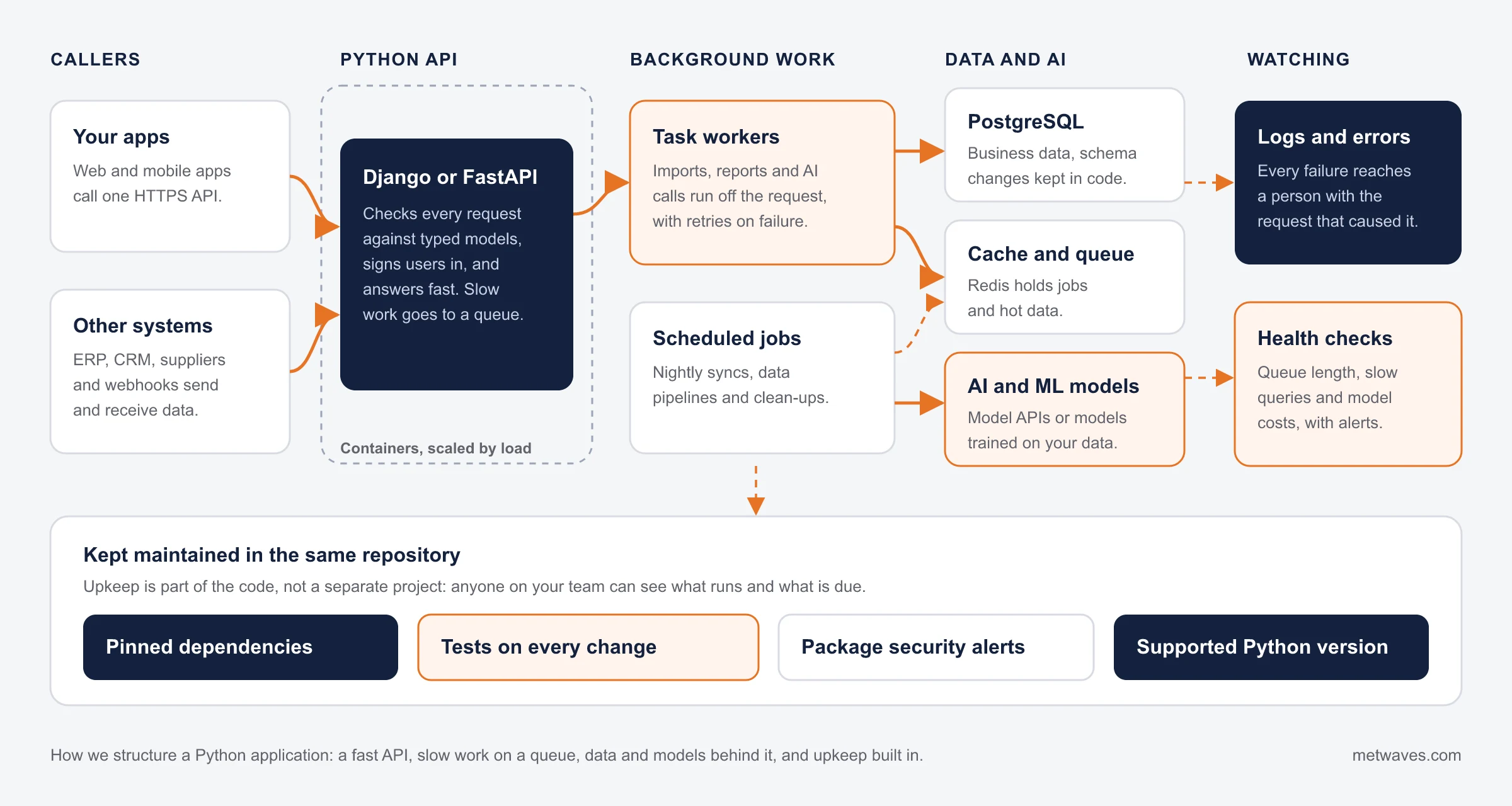
Most of the Python apps we build share one shape: an API that answers fast, slow work handed to a queue, data and models behind them, and alerts that reach a person. Upkeep lives in the same repository as the code.

How Metwaves structures a Python application: web apps, mobile apps and other systems call a Django or FastAPI service running in containers; slow work such as imports, reports and AI calls goes to task workers and scheduled jobs; PostgreSQL, a Redis cache and queue, and AI or machine learning models sit behind them; logs, error alerts and health checks watch it all; and pinned dependencies, tests, package security alerts and a supported Python version keep it maintained
A fast API, slow work on a queue, data and models behind it, and upkeep built into the repository.

How we build a Python app

The length of the build depends on the scope. Of the three projects above, the invoice agent and the BIM integration went live in 8 to 12 weeks, and BioBuild in about five months.

  1. Start

    Discovery

    We agree what the software must do, which systems it touches and how you will know it works. You get a written scope and a quote.

  2. Setup

    Repository and pipeline

    A repository in your name, a supported Python version, pinned dependencies, tests and a deployment pipeline before the first feature.

  3. Build

    Short cycles

    Working software at the end of each short cycle, on a test environment you can click through, with the code reviewed by a second developer.

  4. Pilot

    Real data, small group

    A small group uses it on real work. For AI features, people check every result until the numbers say they can stop.

  5. Launch

    Release and watch

    Release with logs, error alerts and a way back to the previous version. We watch it closely for the first weeks.

  6. After launch

    Hand over or stay on

    Your team takes over with the documentation, or we keep it maintained on a monthly plan.

How we keep a Python app maintained

Python apps rarely break on their own. They age: packages fall behind, security alerts pile up and the Python version reaches its end. A routine keeps that cheap.

How oftenWhat we doWhy it matters
Every changeAutomated tests, a type checker and a linter run before code can merge; a second developer reviews it.Mistakes are caught before your users see them, and the code stays readable for the next developer.
Every weekSecurity alerts on the packages the app depends on are checked, and urgent fixes go out the same week.A known flaw in a package is public. Caught early, the fix is usually a small version change.
Every monthRoutine package updates in one reviewed batch, with the lock file updated and the tests run.Small, regular updates are cheap. Two years of skipped updates turn into a project.
Every yearA plan to move to a newer Python version before the one you run stops getting security fixes, and a framework upgrade when its support ends.A new Python version has arrived each October since 2019; each gets about five years of fixes, then none.

Our Python tech stack

The Python toolset we design with, alongside Django, FastAPI, Flask and LangGraph. The project decides which it needs; the case studies above name what each project used.

Python
Python
SQL Server
SQL Server
MySQL
MySQL
Redis
Redis
pandas
pandas
NumPy
NumPy
TensorFlow
TensorFlow
PyTorch
PyTorch
Azure OpenAI
Azure OpenAI
Gemini
Gemini
AWS
AWS
Azure
Azure
Kubernetes
Kubernetes
GitHub
GitHub

What Python development costs

We quote after discovery, as a fixed price for a defined scope or a monthly figure for ongoing work. These factors move the price most.

high impact

Number of integrations

Every system the software reads from or writes to, such as an ERP, CRM or supplier feed, adds mapping, error handling and testing. It is usually the largest part of the work.

high impact

AI accuracy you need

An AI feature that may act on its own needs test sets, checks and a review queue. One that only suggests to a person needs less.

high impact

State of the existing code

An app on an end-of-life Python with no tests needs tests before it can change safely. A clean, current codebase does not.

medium impact

Data quality

Clean, consistent data loads quickly. Spreadsheets, scanned documents and hand-typed records need cleaning rules first.

medium impact

Screens and user roles

More screens, roles and approval steps mean more to build and test. Django's admin can cover internal screens cheaply.

low impact

Hosting and model usage

Cloud hosting and AI model fees are paid by you to the provider, separately from our work. We estimate them before you build.

Python itself, Django, FastAPI and the libraries we use are free and open source. You pay for the work, the hosting and any AI model usage.

Ways to work with us on Python

Start small with a proof of concept, or go straight to a build if you already know what you need.

Fixed-scope build

For a defined app, API, pipeline or integration. A fixed price agreed after discovery.

Proof of concept first

For an AI feature or a risky integration. A short fixed-price trial on your own data, then a decision.

Dedicated Python team

For a product that keeps growing. A team that works on your backlog month after month.

Maintenance and upgrades

For keeping a live Python app current and fixing what comes up. Time and materials, billed monthly.

Need Python developers inside your own team rather than a project? We place developers who work in your tools and backlog.

How to choose a Python development company

Whether you hire a Python development agency, a freelancer or us, these questions show whether you will stay in control of the code and whether it will still be safe to run in three years.

A good partnerA warning sign
They confirm in writing that the code repository, cloud accounts and any trained models are yours.The code lives in their repository and you get a copy at the end, if you ask.
They tell you which Python and framework versions they will use, and when those stop getting fixes.A new app starts on a Python version that is already in its last years of support, or one past its end.
They show you tests running in a pipeline, and name who reviews each change.Nobody can tell you how the code is tested or how a release is rolled back.
They tell you when Python is the wrong choice for part of the job.Every problem gets the same answer, whatever it is.
They price upkeep separately and explain what it covers each month.Maintenance is never mentioned until the first security alert arrives.

Related services

Python work often sits next to one of these.

ServiceWhen it fits
AI agent developmentAgents that read documents and act in your systems, usually written in Python.
Data engineeringPipelines and warehouses for reporting, when the data outgrows a few scripts.
Software integrationConnecting your ERP, CRM and supplier systems, in Python or .NET.
Application support and maintenanceMonthly upkeep for live apps, whatever they are written in.
IT staff augmentationPython developers who join your own team and work in your tools.

Frequently asked questions

Straight answers on Python versions, frameworks, cost and ownership.

Designing, building and maintaining software written in Python: web back ends and APIs with Django or FastAPI, data pipelines, AI and machine learning features, automation and integrations between business systems. With Metwaves it also includes the tests, deployment pipeline and monthly upkeep that keep the software safe to change.

For the back end, usually yes: Django and FastAPI are mature and widely used, and well-tested Python code can be handed to any Python developer when you bring the work in house. The screens your users see are still built in JavaScript or TypeScript, and native mobile apps in Swift or Kotlin.

Django when the app has many screens, user roles and an admin area, because those come built in. FastAPI when you mainly need an API that other apps call, or a service that spends its time waiting on AI models or other systems. Some products use both: Django for the admin side, FastAPI for a busy public API.

A version in its bug-fix phase, which in November 2026 means Python 3.14 or 3.15, according to the python.org release status table. We check that the libraries the project needs support it, and plan the next upgrade before its end of life.

Yes. Python 3.10 stopped getting fixes on October 1, 2026, and 3.9 on October 31, 2025, so new security problems in them will not be patched. The upgrade is usually a planned project of tests first, then the move, then package updates. We quote it after reading the code.

We quote after discovery, because the price depends mostly on how many systems the software connects to, how accurate any AI part must be and the state of any existing code. Fixed-scope work has a fixed price; maintenance and dedicated teams are billed monthly.

Yes. We start with a written review of the code, its tests, its dependencies and its Python version, and tell you what is risky before we change anything. Then we fix the urgent items and set up a monthly upkeep routine.

You own the code, the repository, the cloud accounts and any models trained on your data. We sign an NDA before you share details of your systems.

INSIGHTS & NEWS

Discover IT Industry Insights and Technology Trends

Nikit Nandan    Nikit Nandan November 17, 2026
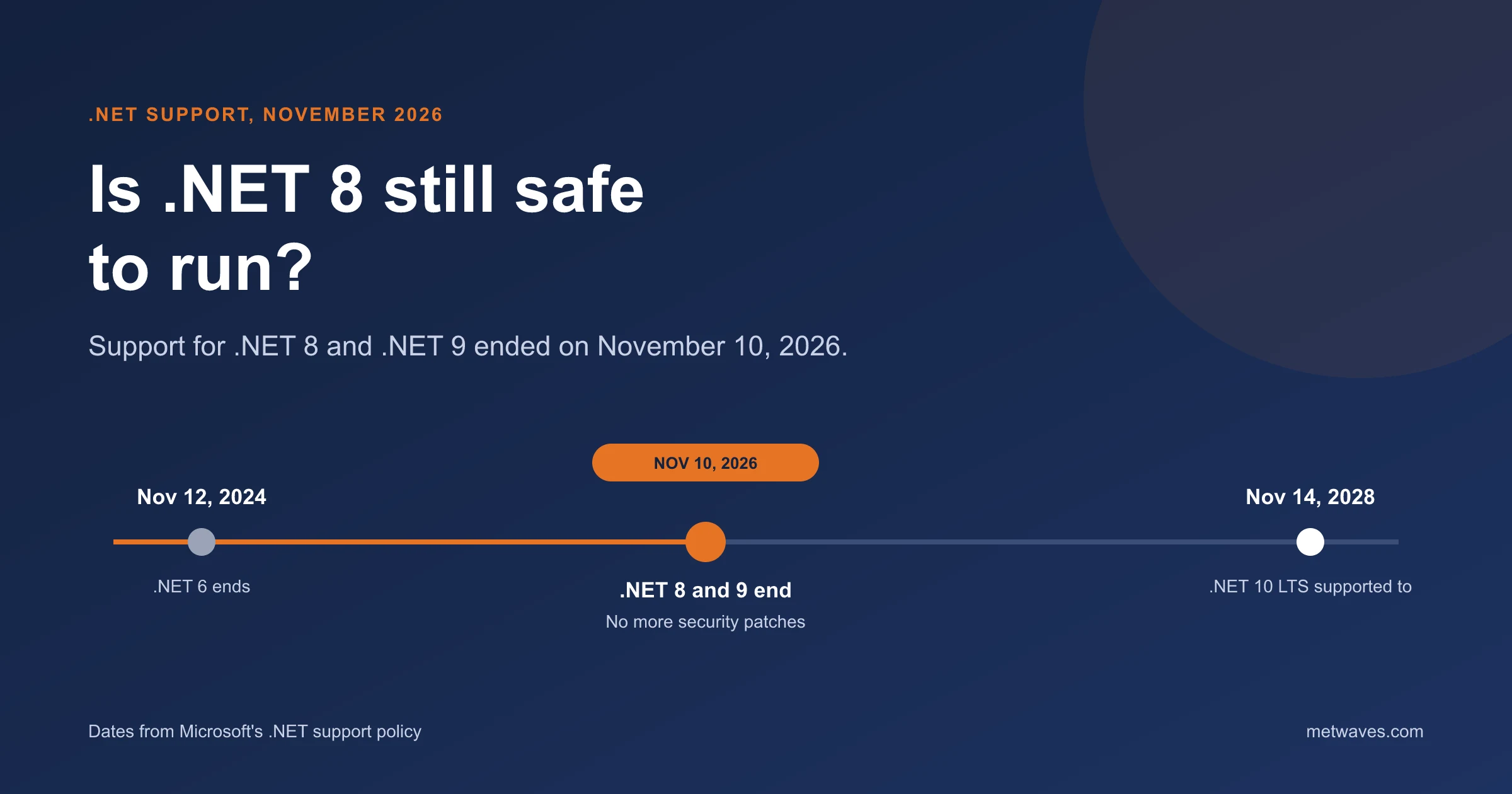
Is .NET 8 Still Safe to Run After November 2026?

Support for .NET 8 and .NET 9 ended on November 10, 2026. What that means for apps still on them, how risky it is, and how to plan the move to .NET 10.

Learn More >
Microsoft Technologies 5 min read
Nikit Nandan    Nikit Nandan November 12, 2026
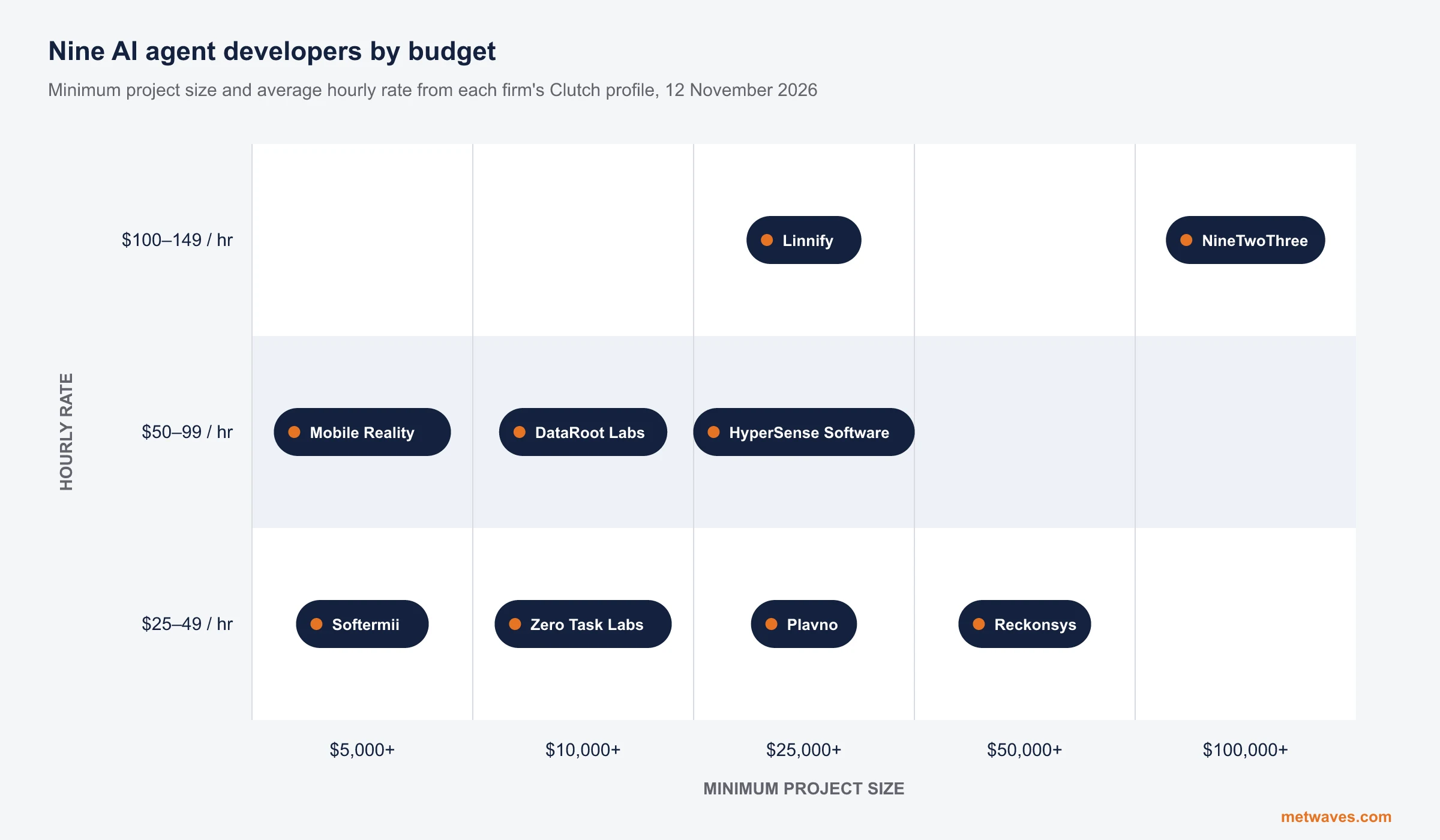
Top AI agent development companies for small and mid-sized businesses (2026)

Nine AI agent development firms a small or mid-sized business can shortlist, with Clutch figures, minimum budgets and the weaknesses their own clients name. Published by Metwaves, which is not ranked.

Learn More >
AI Development 9 min read
Nikit Nandan    Nikit Nandan November 12, 2026
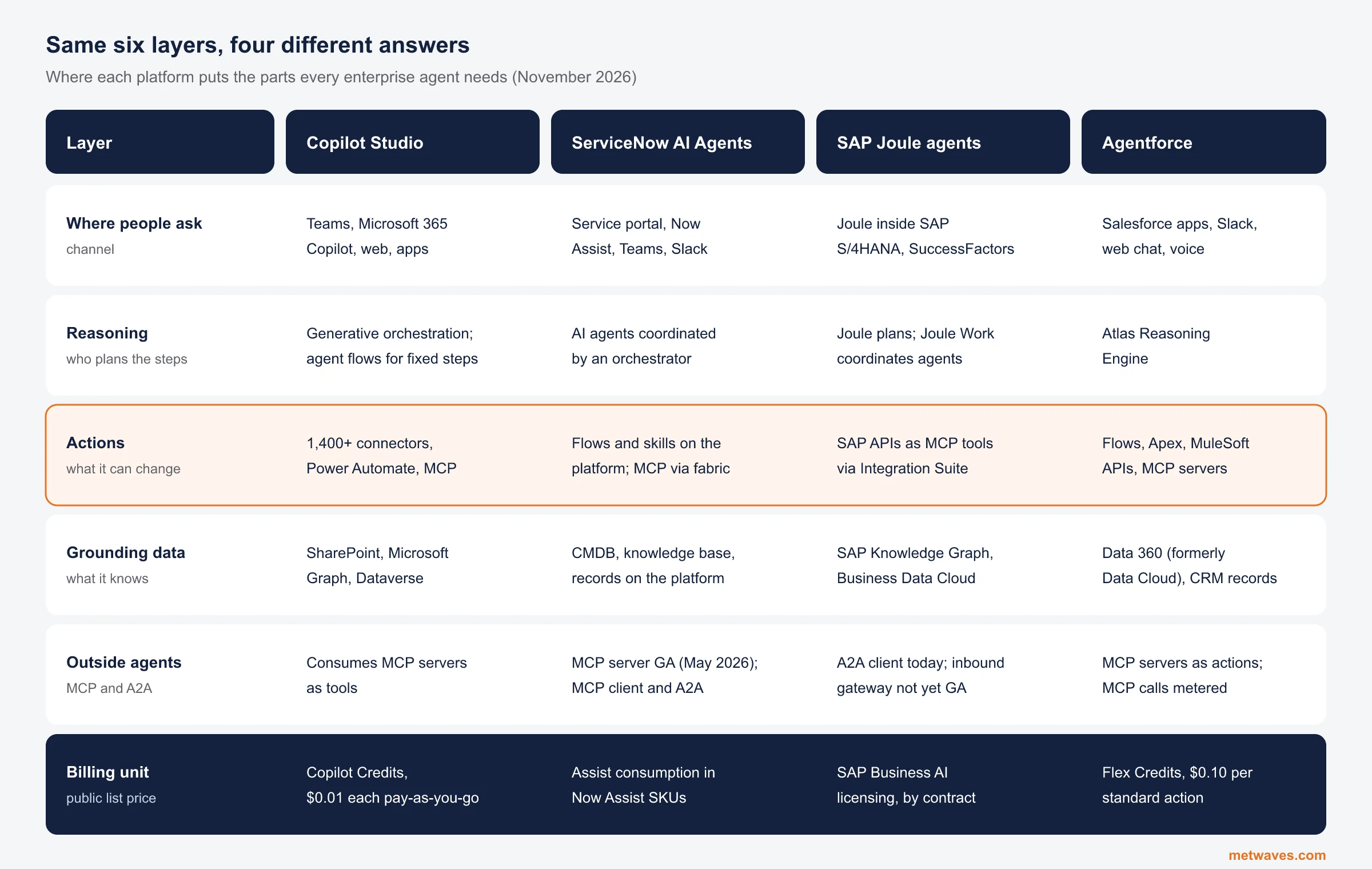
Enterprise AI Agent Platforms Compared (2026)

An architecture review of the four big enterprise AI agent platforms: where each one reasons, acts, finds its data and connects to outside agents, what it costs, and when a custom build is the better choice.

Learn More >
AI Development 9 min read

Let’s build your idea!

Let us help you with free analysis & estimate. Our product expert will contact you within 12 hours.

 All your information is kept confidential and protected by NDA.