
Web and mobile application testing services
Application testing services and mobile application testing services for web apps, iOS and Android apps, APIs and AI features. We test by hand where things are new, automate where things must not break, and keep every test in your repository so your team can run it after we leave.

Tested before launch: TradeAlert, built for 10,000 concurrent users · a Teams AI agent · a clinic website's ADA check
WHEN TO CALL US
Signs you need QA and testing services
Each of these is a ticket someone has already filed, in some form. Two or more usually means the release process needs a tester, not more developers.
Every release breaks something that used to work
Last month's fix is this month's bug, and nobody re-checked the old screens.
Reported by: a customerDevelopers test their own code, and nothing else
Each feature works on its own; nobody checks the flow from sign-up to invoice.
Reported by: your support teamReleases slip because regression takes days by hand
The same screens are clicked through before every release, and checks get skipped when the deadline is close.
Reported by: the release managerCustomers find the bugs first
The first report of a broken checkout comes through a review or a support ticket.
Reported by: a customer, againIt works on one phone and fails on another
Nobody knows which devices and OS versions your users actually have.
Reported by: an app store reviewThe AI answers seem to be getting worse
A model or content change went out, and nobody can say whether answers improved or not.
Reported by: a member of staffApplication testing services we provide
Six services, each used on systems we built and now run in production. We prepare the app for your penetration-test firm too, and fix and retest what it finds.

Functional and regression testing
Every feature checked against what it should do, and a regression suite that re-checks what used to work before each release. A failing check stops the release, not a customer.

Test automation
UI and API tests written as code, run on every change and kept in your repository, so they run without us.

Mobile application testing services
Real phones and tablets chosen from your analytics, several OS versions, weak networks, and the App Store's and Google Play's pre-release tracks. Our VoIP apps were tested under varied network conditions before rollout.

Performance and load testing
Traffic at the level you expect, then above it, before your users bring it. TradeAlert was built for up to 10,000 concurrent users.

Accessibility testing
Keyboard, screen reader, contrast and zoom checks against WCAG. The urgent care clinic website had an ADA accessibility check before launch.

AI feature testing
Evaluation sets of real questions with expected answers, and a pass rate tracked on every release. Our Teams helpdesk agent was measured against real staff questions before launch.
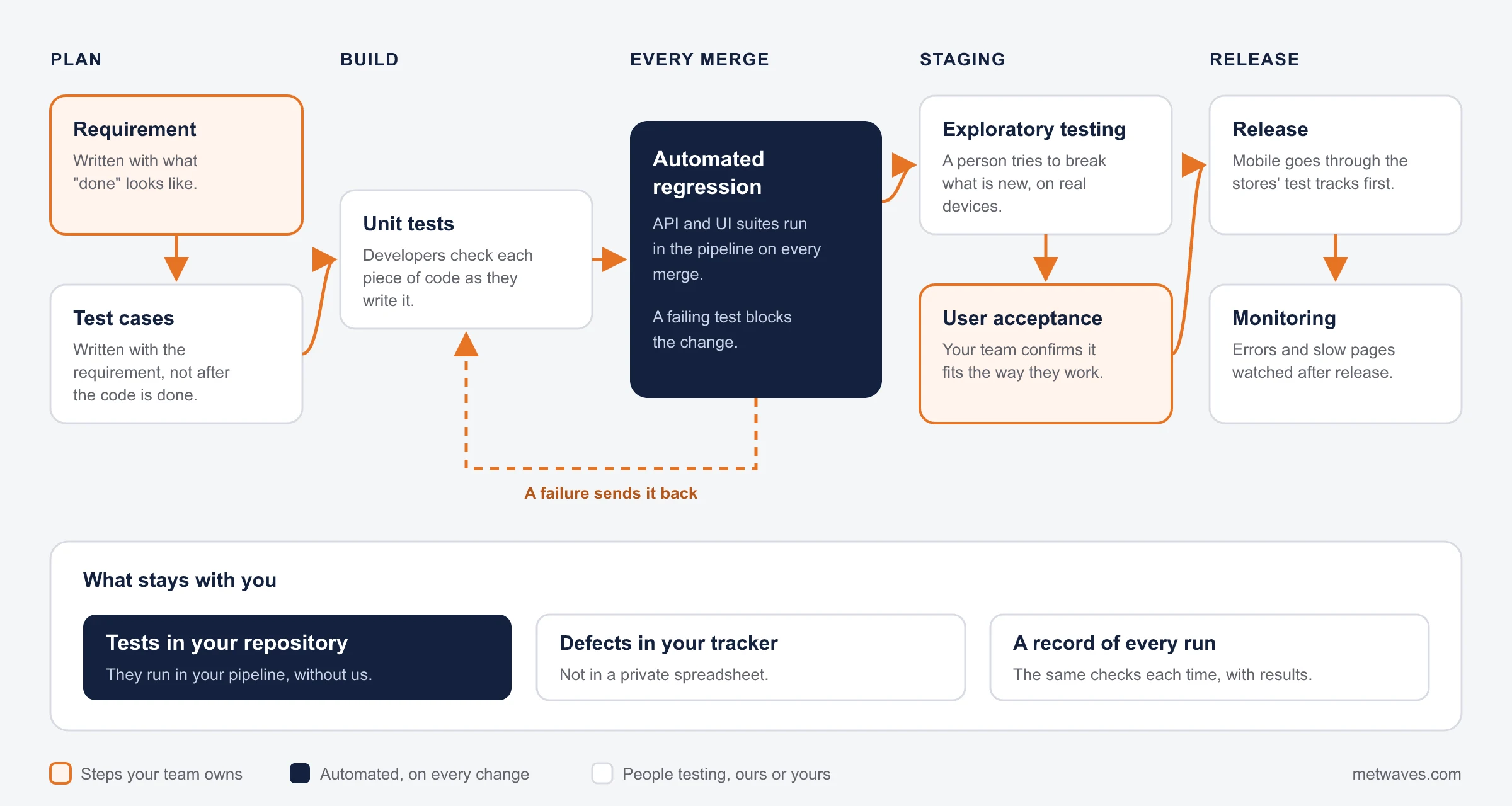
Where testing sits in a release
Testing starts when the requirement is written, not when the code is done. Automated checks run on every merge; people test what is new on staging; your team signs off.
QA, testing or test automation?
Buyers often use these words for the same thing. They are not, and the difference changes what you buy.
| Term | What it means |
|---|---|
| Quality assurance (QA) | The process that stops defects getting in: requirements review, test plans, release criteria |
| Testing | Checking the software does what it should, by hand or with code |
| Test automation | Tests written as code that run on every change; pays off for flows that rarely change and run often |
| Manual and exploratory testing | A person trying to break it; still the best way to test new features and usability |
| QA as a service | A tester or team working on software someone else builds |
WHAT WE TEST
Testing types at a glance
Every testing type answers one question. Pay for the ones whose question matters to you now.
Functional
Each feature does what the requirement says.
Worth it whenAlways, for anything new.
Regression
What worked last release still works.
Worth it whenYou release often and old features break.
Integration and API
Systems pass the right data to each other.
Worth it whenYour app talks to an ERP, CRM or payments.
Performance and load
Speed and stability at expected and peak traffic.
Worth it whenA launch, a campaign or a busy season is coming.
Usability
Real people can finish tasks without help.
Worth it whenSign-ups or bookings drop at one step.
Accessibility
People using keyboards, screen readers or zoom can use it.
Worth it whenPublic-facing apps, and before an audit.
Compatibility
Browsers, phones, tablets and OS versions.
Worth it whenUsers report it works on one phone, not another.
User acceptance
Your team confirms it fits the way they work.
Worth it whenBefore every significant release.
AI evaluation
AI answers or decisions stay right as models and content change.
Worth it whenYour app uses a language model.
Which kind of testing fits your situation
Start from what goes wrong today, not from a list of testing types.
| If you | What usually fits |
|---|---|
| Change the app weekly and the same flows keep breaking | Automated regression on those flows |
| Have a new product whose features still move | Manual and exploratory testing; automate later |
| Release rarely, but each release is high-risk | A release checklist and a regression pass before each |
| Have a mobile app used on many devices | Testing on real devices, chosen from your analytics |
| Ship AI answers or decisions | An evaluation set with a pass threshold, run every release |
| Have no tester and a small budget | Part-time QA, not a full team |
MANUAL OR AUTOMATED
Manual vs automated regression testing
Automated regression checks what used to work, in minutes, on every change. It does not replace a person testing what is new.
Days of clicking through the same screens before every release.
Stable, high-traffic flows such as login and checkout checked on every change, in minutes.
Releases wait for a tester to be free.
Testers spend their time on new features and exploratory testing.
Checks get skipped when a deadline is close.
The same checks every time, with a record of each run.
Results depend on who ran the test and how tired they were.
A failing test blocks the release before a customer sees it.
Customers find what used to work and now does not.
Tests live in your repository and run without us.
Our ruleDo not automate everything. Automate the stable, high-traffic flows such as login, checkout and your main workflow, and test new features by hand until they settle.
AUTOMATION PAYBACK
When test automation pays for itself
Automation pays when the same checks run often and the screens rarely change. Put in your own numbers: nothing here is filled in for you.
The sum: manual hours per release × releases per month × hourly cost is what manual regression costs each month. Take away the monthly upkeep of the suite (hours × hourly cost). Divide the build cost by what is left to get the months to break even.
- Manual regression each month
- -
- Suite upkeep each month
- -
- Saving each month
- -
- Break-even
- -
Fill in all five numbers to see the result. Amounts are in whatever currency you use.
HOW WE TEST
How testing was done on our live projects
We have not published a standalone testing engagement. These are systems we built, tested and now run in production, and the method each one needed.
- Parallel runCase study →
BIM to estimate integration
Run alongside manual takeoff on live projects before it became the standard. Elements it cannot map are listed in an exception report, never dropped.
- Checks firstCase study →
Invoice processing agent
The checks were built before the automation; anything doubtful goes to a review queue with the reason, and the agent ran alongside the manual process first.
- AI evaluationCase study →
Copilot Studio helpdesk agent
Measured against the questions staff really asked, with a pilot group, before anyone else used it.
- Network conditionsCase study →
Custom VoIP apps
Call quality tested under varied network conditions, and integration tests in a controlled environment before rollout.
- Load and securityCase study →
TradeAlert trading platform
Built for up to 10,000 concurrent users, with testing for functionality and security before deployment.
- AccessibilityCase study →
Urgent care clinic website
Functionality and compatibility testing and an ADA accessibility check before launch.
Security testing for fintech and healthcare apps
Apps that hold money or health data need a penetration test by a specialist firm, against a published standard, before launch and after major changes. Our part is to prepare the app, fix what the testers find and retest before release.
| Standard or check | What it covers | Who does it |
|---|---|---|
| Penetration test | An attempt to break in, by a specialist firm, before launch and after major changes | The specialist firm; we prepare the app and test accounts |
| OWASP ASVS | The Application Security Verification Standard: what a secure web app must do | Checked by the testers; we fix what they find |
| OWASP MASVS | The Mobile Application Security Verification Standard, for iOS and Android apps | Checked by the testers; we fix what they find |
| PCI DSS | Requirements wherever card data is stored, processed or sent | Your organisation, through a self-assessment or a qualified assessor |
| Patient data safeguards | Encryption, access controls and audit trails, as we built into Telemeds+ | Built into the app; retested before release |
How a testing engagement starts
The first result is a written audit you can use with or without us.
- 1
A call about what breaks
The app, its platforms, how often you release, and the last bugs your customers found before you did.
- 2
A test audit
Your current tests, the gaps and the riskiest flows, written up so you can act on it with or without us.
- 3
A test plan and the first suite
Automated regression on the one flow that breaks most, running in your pipeline.
- 4
Testing every release
Exploratory testing of what is new, regression on what is not, defects logged in your own tracker.
- 5
Hand over or keep running
The suite, the plan and the notes are yours. Keep us on, or run it yourselves.
What QA and testing cost
A test audit is a fixed price; ongoing testing is priced by the month. Three things move the price, plus whether security testing is in scope.
Platforms and devices
Web only, or web plus iOS and Android on the devices your users have.
Share automated
Automation costs more up front and less on every release after it.
Release frequency
Weekly releases need a regression pass every week; quarterly ones do not.
Ways to work with us
Pick the model by how often you release and who builds the software.

Test audit
A fixed price after the first call: your current tests, the gaps and the riskiest flows, written up so you can act with or without us.

QA engineers by the month
For teams that release often and need testing in every sprint, through IT staff augmentation.

Testing as you need it
Release testing or a one-off regression pass, billed for the time used.

Testing inside a Metwaves build
Part of the build estimate for software we build for you, not an extra.
CHOOSING A PARTNER
How to choose a QA and testing company
Signs that separate a testing partner from a test-case counter, including where we are not the right fit.
Good signs
- They show a sample bug report and test plan before you sign.
- Test code lives in your repository and runs without them.
- They can explain which flows they would automate, and which they would not.
- They test mobile apps on real devices, not only emulators.
- They log defects in your tracker, not a private spreadsheet.
Warning signs
- They promise to automate everything.
- Reports count test cases run, not risks found.
- Nobody can say who will test your app, or whether they are on staff.
- AI features are tested once, by hand, and never again.
- You need hundreds of devices and certified testers in a regulated domain: a large testing house may fit better than us.
Related services
Testing sits inside every build. These pages cover the builds and the people.
QUESTIONS & ANSWERS
Application testing and QA: frequently asked questions
Straight answers on cost, automation, mobile, AI features and ownership of the tests. If you don't see an answer to your question, you can send us a message from our contact form.
It depends on the platforms and devices, how much is automated, how often you release, and whether security testing is included. A test audit is a fixed price; ongoing QA is priced by the month. Use the payback calculator on this page before you pay for automation.
Automate the stable, high-traffic flows such as login, checkout and your main workflow, and test new features by hand until they settle. Automating screens that change every sprint costs more than it saves.
Tell us about it. Our published testing work is on software we built and run, so we will say on the first call whether a test audit from us fits. We need access to the code, a test environment and your tracker.
Testing on real phones and tablets chosen from your own analytics, across OS versions and network conditions, and through the App Store's and Google Play's pre-release tracks before a public release.
With an evaluation set: real questions or inputs, the answer each should get, and a pass rate tracked on every release. Our Teams helpdesk agent was measured this way against real staff questions before launch.
You do. They live in your repository, run in your pipeline, and work without us.
QA is the process that stops defects getting in, such as reviewing requirements and setting release criteria. Testing checks whether the software does what it should.
A penetration test by a specialist firm before launch and after major changes, checked against OWASP ASVS for web or MASVS for mobile, plus PCI DSS where card data is handled. We prepare the app and fix the findings.
INSIGHTS & NEWS
Discover IT Industry Insights and Technology Trends
 Nikit Nandan
November 17, 2026
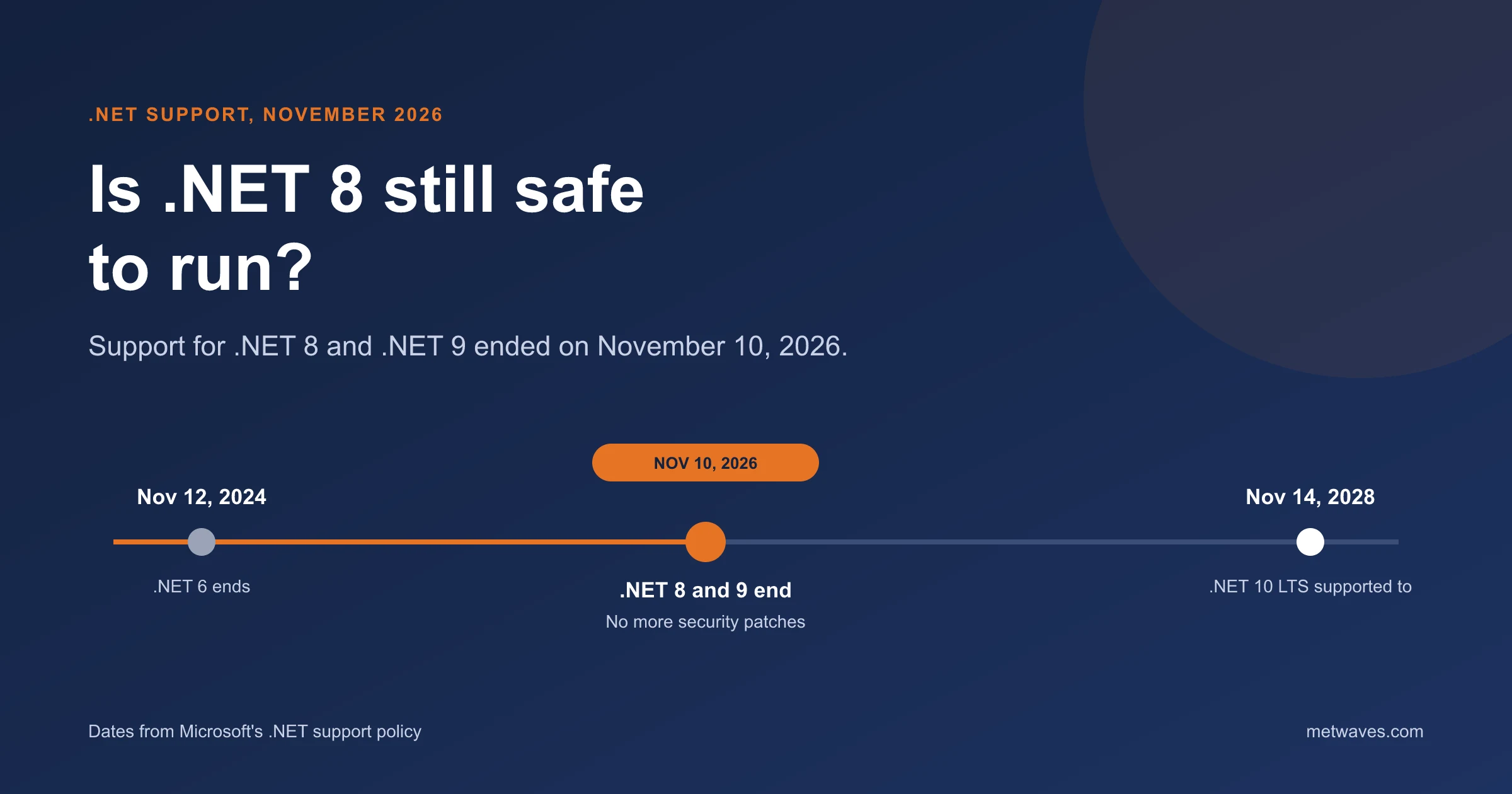
Is .NET 8 Still Safe to Run After November 2026?
Support for .NET 8 and .NET 9 ended on November 10, 2026. What that means for apps still on them, how risky it is, and how to plan the move to .NET 10.
Learn More >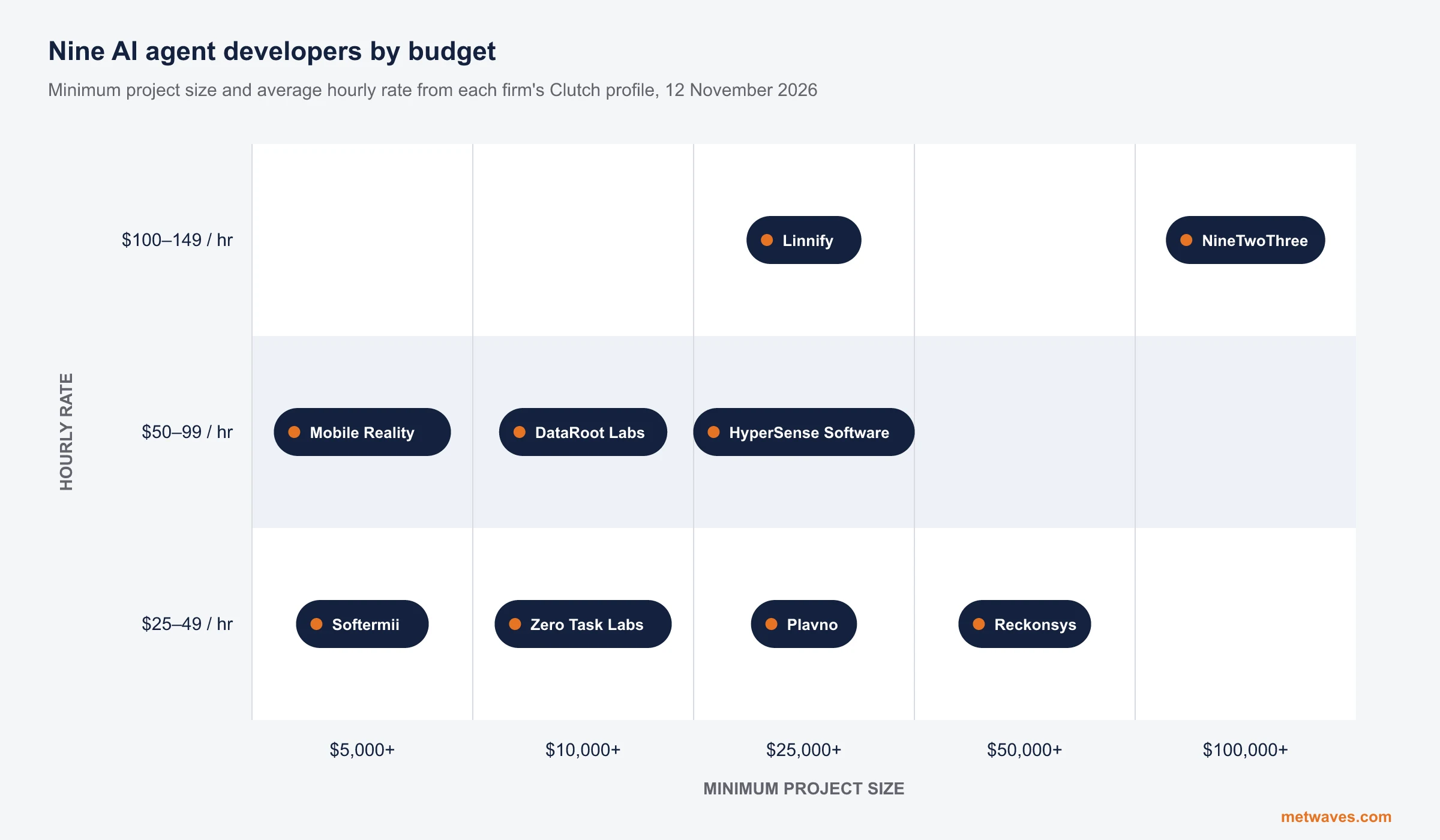 Nikit Nandan
November 12, 2026
Top AI agent development companies for small and mid-sized businesses (2026)
Nine AI agent development firms a small or mid-sized business can shortlist, with Clutch figures, minimum budgets and the weaknesses their own clients name. Published by Metwaves, which is not ranked.
Learn More >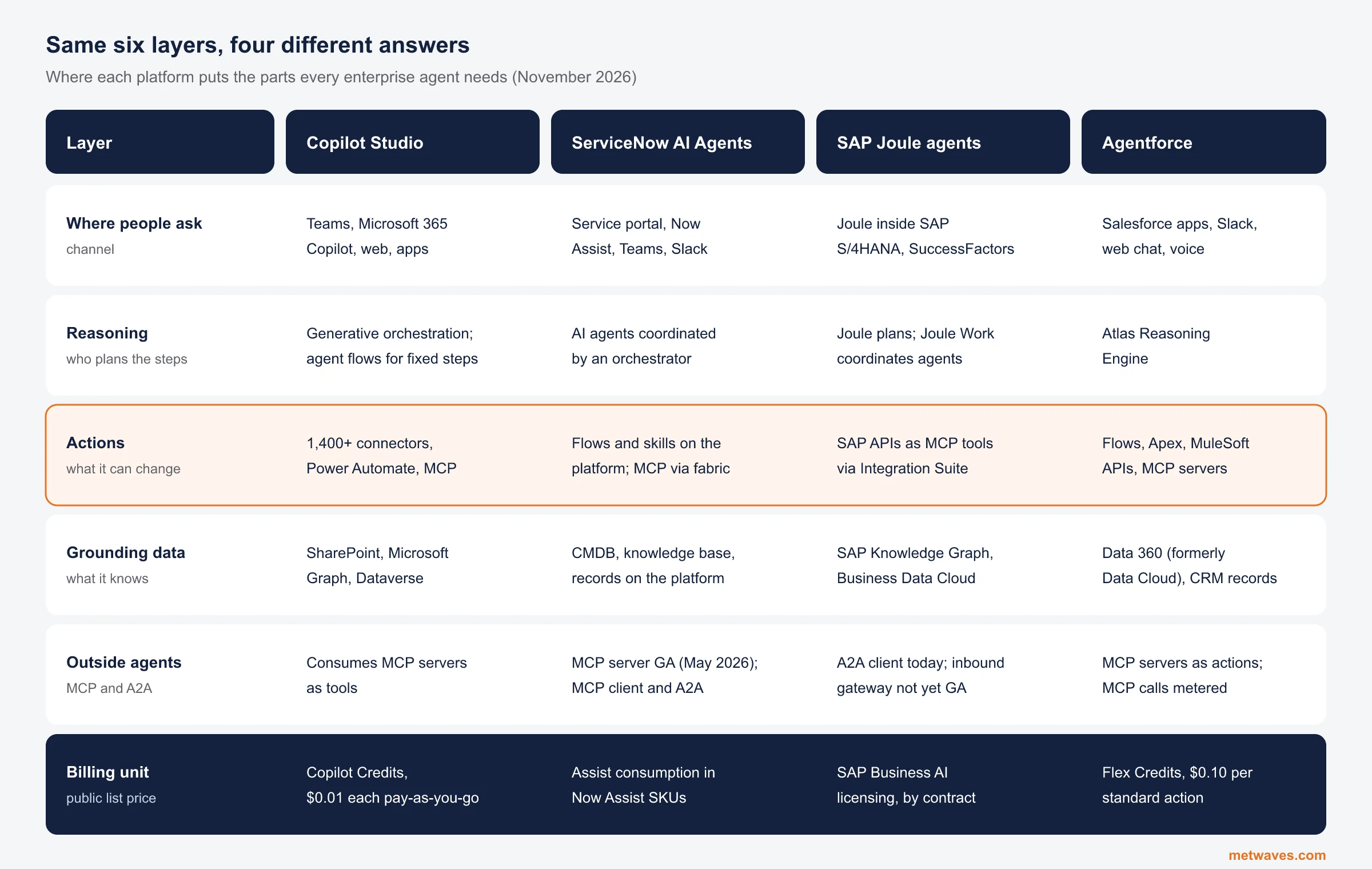 Nikit Nandan
November 12, 2026
Enterprise AI Agent Platforms Compared (2026)
An architecture review of the four big enterprise AI agent platforms: where each one reasons, acts, finds its data and connects to outside agents, what it costs, and when a custom build is the better choice.
Learn More >Let’s build your idea!
Let us help you with free analysis & estimate.
Our product expert will contact you within 12 hours.