
Machine learning development services
Machine learning development services for businesses in the US, UK, Canada and Australia that want one decision made faster: a ranking, a forecast or a flag on records that look wrong. We pilot it, measure it before and after, and you keep the code, the model and the pipeline in your own cloud account.

BioBuild material recommendation engine, live since January 2025 · 4.5 of 5 in a verified Clutch review
WHAT IT IS
What machine learning development services are
Machine learning development services build models that learn from your historical data to make one business decision faster or better: ranking options, predicting a number, or flagging records that look wrong. The work covers scoping, data preparation, training, integration into your software and retraining. Our shipped example is a material recommendation engine for BioBuild in Sweden.
It is not generative AI. A model predicts a number or a ranking from your own history; generative AI writes text or answers from documents. They need different data, testing and budgets.
Rank options
Put the best few choices in front of a person, in order, with the reason.
Materials, products, suppliers, next actionsPredict a number
Estimate demand, cost, time or risk from your history, with the likely error shown beside it.
Stock to order, delivery dates, project costFlag what looks wrong
Sort records into groups and pick out the ones that do not fit, before someone acts on them.
Payments, claims, sensor readings, data entryWHEN TO CALL US
Signs you need machine learning
If two or more of these sound like your business, one decision is probably worth a feasibility study.
A decision we make every week takes days of spreadsheet work.
The answer is out of date by the time it is ready.
Our forecasts are guesses, and we know what being wrong costs.
That cost of being wrong is the ceiling on what a model is worth.
A vendor says AI, and nobody can tell us if our data is enough.
You need a yes or no on feasibility before a build quote, not after it.
Someone built a model once, and nobody has retrained it.
It was right on launch day, and nobody has measured it since.
Our product needs ranking or recommendations.
Search results or a shortlist that should get better with use.
Our experts are the bottleneck, and they are hard to hire.
A model can do the first pass, so the expert reviews a shortlist.
Is machine learning the right tool for your problem?
Machine learning fits when you need a number or a ranking learned from history. For many problems something simpler works better, and costs less to run.
| If you | What usually fits | Example |
|---|---|---|
| Can write the rule down | Rules in code, no machine learning | Tax and approval rules, routing by fixed criteria |
| Need text read from documents, speech or images | A prebuilt service | Invoice agent on Azure Document Intelligence |
| Need answers or drafts from your documents | Generative AI | AI chatbots and generative AI |
| Need a number or a ranking learned from history | Machine learning | BioBuild material ranking |
| Have data spread across spreadsheets and systems | Data engineering first | Data engineering consulting |
| Are not sure it will pay | A feasibility study | The scoping steps below, with a go or no-go at the end |
WHAT WE DELIVER
Machine learning development services we provide
Six kinds of work. Each card says whether a published Metwaves case study backs it.
Recommendation and ranking
Models that rank options for a person to choose from, such as materials, products or next actions, with the trade-off shown.
BioBuild material engine →Prediction and forecasting
Demand, cost, time or risk predicted from your history, with the error range shown next to the number.
Classification and anomaly detection
Sorting records into categories and flagging the ones that look wrong before a person acts on them.
Document and image models
Prebuilt services first, such as Azure Document Intelligence, and custom training only where they fall short.
Invoice agent →Feasibility study and pilot
One decision, one metric and your own data, ending in a written go or no-go before you fund a full build.
How BioBuild was scoped →MLOps: deploy, monitor, retrain
The model served as an API, watched for drift and retrained on a schedule.
BioBuild, retrained quarterly →What you keep in every case: the code, the trained model, the training pipeline and the data, in your own cloud account.
SCOPING
How to scope a first machine learning project (what ML consulting should give you)
Pick one decision, one metric and one pilot, and agree what good enough means before anyone trains a model. These are the five steps we used to scope BioBuild.
- 1
Name the decision and who makes it
One frequent decision, such as which supplier, price or material.
At BioBuildWhich material to use for each building element, chosen by architects and engineers. - 2
Measure today's baseline
Time, cost or error rate today, measured the way you will measure the model.
At BioBuildSelection time per element, timed on the same tasks before go-live. - 3
List the data that exists
What history you have, where it lives and whether outcomes were recorded.
At BioBuildSupplier prices with history, carbon indexes and BIM models of past projects. - 4
Agree what good enough means
The result that justifies a production build, written down before any modelling starts.
At BioBuildA ranked shortlist experts would accept, with the trade-off shown. - 5
Run a pilot, then decide
One project or one team, with experts reviewing every output. Then go, change course or stop.
At BioBuildOne live project, with every correction fed back into the model.
DATA READINESS
Is your data ready for machine learning?
Most first machine learning projects are data projects. Tick what is already true for you; the panel says where to start.
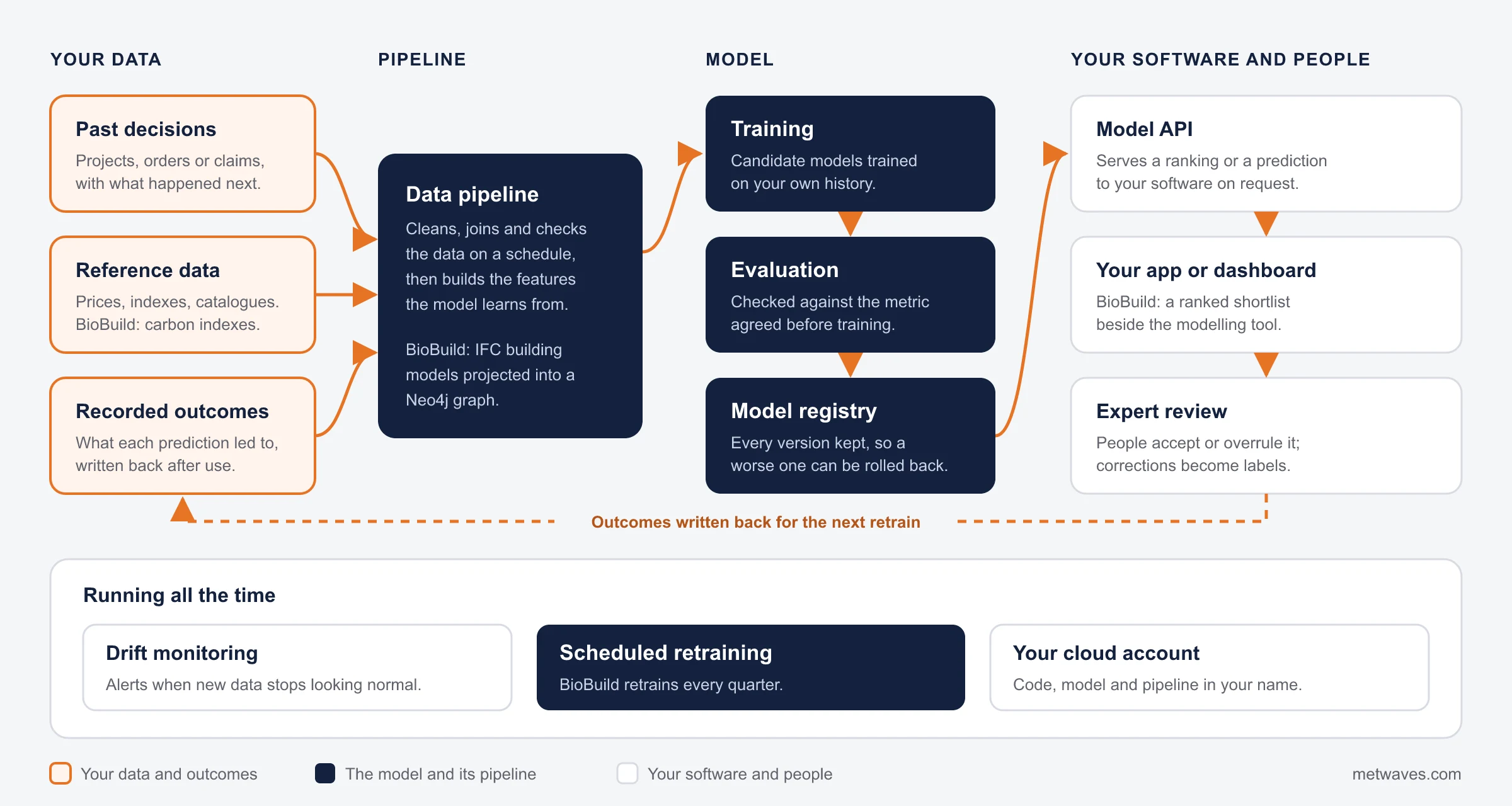
How a machine learning system runs in production
A model is one box in a longer chain. Data is shaped, the model is trained and checked against the agreed metric, served to your software, and retrained on the outcomes it records.
MLOPS
Keeping machine learning models accurate after launch
A model is accurate on the day it ships; your data drifts after that. These six practices run around every model we keep live.
Watch the inputs
Alert when new data stops looking like the training data: new suppliers, odd prices, missing fields.
Check outputs against outcomes
Compare predictions with what happened, using the metric agreed at scoping.
Retrain on a schedule
BioBuild writes back actual cost and material performance after each project and retrains every quarter.
Version and roll back
Every model version is kept with the data it was trained on, so a worse model can be replaced by the last good one.
Keep a person in the loop
Experts can overrule a recommendation, and their corrections become training data.
Report cost to run
Hosting, retraining and monitoring are reported each month, separate from the build.
How we build a machine learning model with you
Six steps, each ending in something you can check. BioBuild went from the start of work in August 2024 to go-live in January 2025, pilot included.
- 1
Feasibility
The decision, the metric, the baseline and a data check. Ends in go or no-go.
- 2
Data and labels
Pipelines from your systems, and labels built where none exist.
- 3
Pilot with experts
One project or team, every output reviewed, every correction kept. BioBuild's pilot was running two months after work began.
- 4
Into your workflow
An API and a dashboard or screen beside the tool your team already uses.
- 5
Monitor and retrain
Drift checks, scheduled retraining and a monthly report.
- 6
Hand over
Code, model and pipeline documented in your account. Keep us for retraining, or run it yourselves.
CASE STUDY
A material recommendation engine inside a BIM workflow
BioBuild, a Swedish construction firm, chose materials by hand in spreadsheets, checking prices, structural ratings and carbon data separately. Every design change restarted the loop.
We projected its IFC models into Neo4j, trained Random Forests and k-means on its past projects, and used a genetic algorithm to balance cost, carbon and structural fit, with the weighting set by the firm. A ranked shortlist updates beside the modelling tool whenever the design changes, and actual cost and material performance are written back after each project for the quarterly retrain.
- ClientBioBuild, construction, Sweden
- Built withPython, TensorFlow, Neo4j, BIMserver, Azure
- MeasuredSelection time down 40%, timed before and after go-live. Material cost down 20% against previous estimates. Project timelines 20% shorter.
- In useLive since January 2025 on more than six projects, used daily by more than ten architects and engineers
Machine learning use cases by industry
One decision per use case. Only the first row is Metwaves work; the others show the same method on other decisions.
| Industry | Decision | Model type | Status |
|---|---|---|---|
| Construction | Which material to use per element | Recommendation: Random Forests, k-means, genetic algorithm | Shipped: BioBuild |
| Healthcare | Which appointments are likely to be missed | Classification | Example, not a Metwaves project |
| Fintech | Which transactions need a second look | Anomaly detection | Example, not a Metwaves project |
| Logistics | When a delivery will arrive | Prediction | Example, not a Metwaves project |
| Retail and eCommerce | How much stock to order | Forecasting | Example, not a Metwaves project |
COST
What a machine learning project costs
You pay by phase and can stop after any of them. The monthly running cost is shown apart from the build.
- Phase 1
Feasibility study
- You pay for
- The decision, the baseline and a data check.
- What moves the price
- How many data sources we must read and how clean they are.
Ends withA written go or no-go - Phase 2
Pilot
- You pay for
- Data preparation, labels, a first model and expert review on one project or team.
- What moves the price
- Whether labels exist or must be built, and the accuracy target.
Ends withA model measured against the baseline - Phase 3
Production build
- You pay for
- Serving the model, integration into your software and monitoring.
- What moves the price
- How deep the integration goes: a dashboard beside the tool, or inside it.
Ends withThe model in daily use - Every month
Running and retraining
- You pay for
- Hosting, compute for retraining, monitoring and review.
- What moves the price
- Retraining frequency, data volume and how many people review outputs.
Ends withA monthly accuracy and cost report
We do not publish prices: data work drives most of the cost and differs for every firm.
Ways to work with us
The feasibility study is a fixed quote. What follows depends on what the study finds.

Fixed cost per phase
The feasibility study, the pilot and each production phase are quoted once the one before has answered its question.

Time and material
For model support and retraining after go-live, billed monthly for the work done.

Dedicated resource
Our engineers working inside your team, billed monthly, when you run several models and want the work close at hand.

Hybrid
Time and material while the data is explored, then a fixed price once the build is clear.
Technology in our machine learning work
The BioBuild engine also uses Neo4j, BIMserver and IFC models, and the invoice agent uses Azure Document Intelligence. We add tools such as PyTorch or scikit-learn when a project needs them, and say so in the proposal.


How to choose among machine learning consulting firms and development companies
Ask these five questions of anyone you shortlist, us included. The last one is where we lose.
| Question to ask | A good answer | A warning sign |
|---|---|---|
| Can we see a model in production, and how is it retrained? | A live system with a retraining schedule. | A list of algorithms and a demo notebook. |
| How did you measure the result? | A baseline taken before go-live and the same measure after it. | Accuracy on a test set, and nothing about the business. |
| Who owns the model, the code and the training data? | You do, in your cloud account, with the pipeline. | The model is hosted on their platform, under their account. |
| Will you tell us when machine learning is not needed? | Yes, and point you to a rule or a prebuilt service. | Every problem gets a custom model. |
| How many custom ML systems have you published? | A number you can check, with each one described. | Dozens of logos and no detail. We publish one, in full; if you need many references, we are not that firm. |
Related services
Machine learning rarely stands alone: the data has to arrive, and the result has to land somewhere.
QUESTIONS & ANSWERS
Machine learning development: frequently asked questions
Straight answers on cost, time, data, ownership and what happens after launch. If you don't see an answer to your question, you can send us a message from our contact form.
It is priced by phase: feasibility study, pilot, production build, then a monthly running cost. Data work, labels, integration depth and the accuracy target move the price most. Each phase is quoted separately, so you can stop at any point.
BioBuild went from the start of work in August 2024 to go-live in January 2025, including a pilot on one live project. A feasibility study is much shorter, because it ends in a decision, not a system.
Enough history for the one decision you want to improve, plus a record of outcomes. Coverage matters more than volume. BioBuild had no labelled dataset; we built one from its past projects.
Machine learning predicts or ranks from your historical data. Generative AI writes text or answers questions from documents. See our generative AI page for the second.
It is monitored for drift and retrained on recorded outcomes. The BioBuild model is retrained every quarter.
You do: the code, the trained model, the training pipeline and the data, in your own cloud account.
The pilot has a threshold agreed before modelling starts. If the model misses it, you stop with a written finding on why, not a half-built system.
INSIGHTS & NEWS
Discover IT Industry Insights and Technology Trends
 Nikit Nandan
November 17, 2026
Is .NET 8 Still Safe to Run After November 2026?
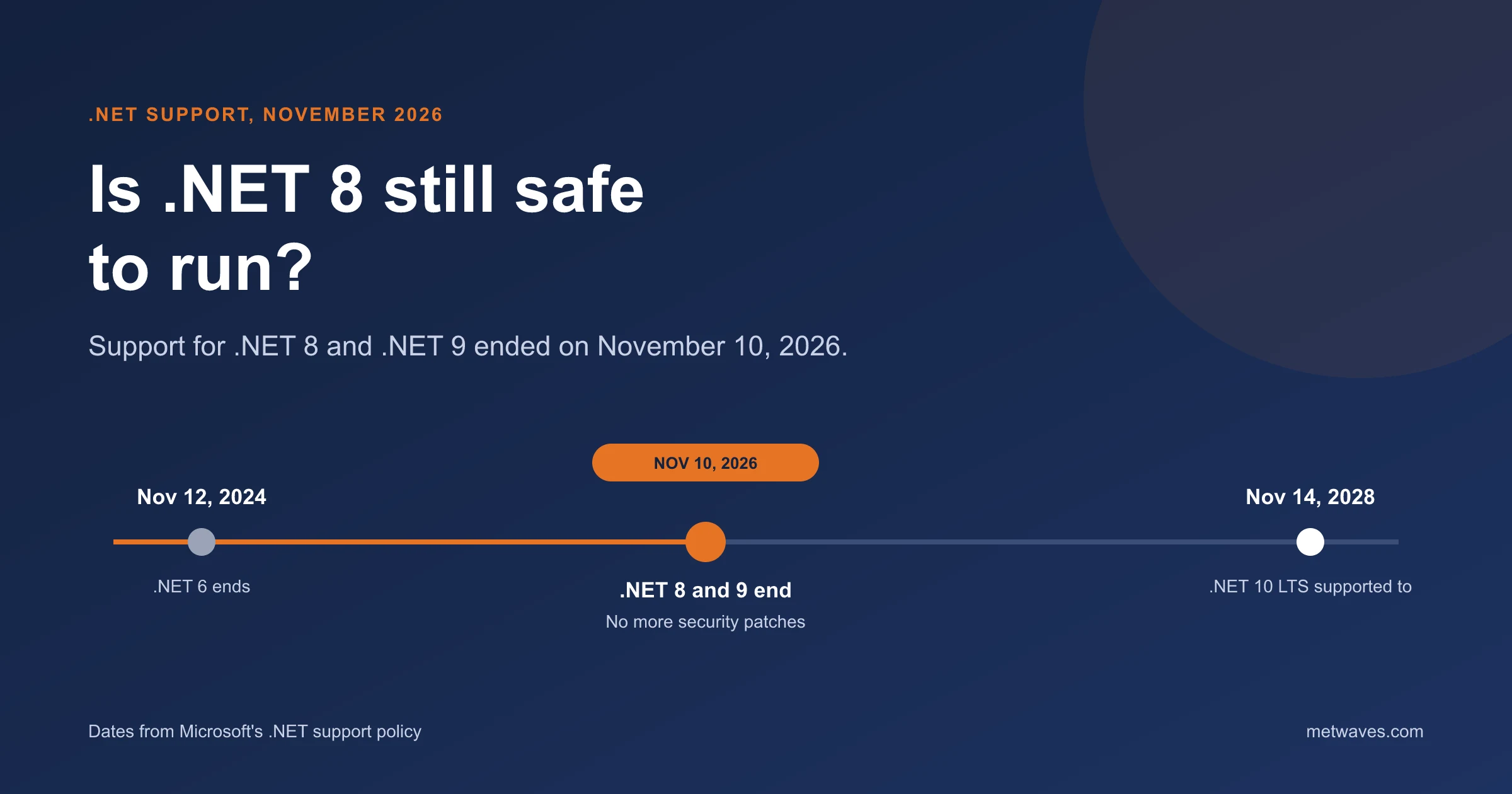
Support for .NET 8 and .NET 9 ended on November 10, 2026. What that means for apps still on them, how risky it is, and how to plan the move to .NET 10.
Learn More >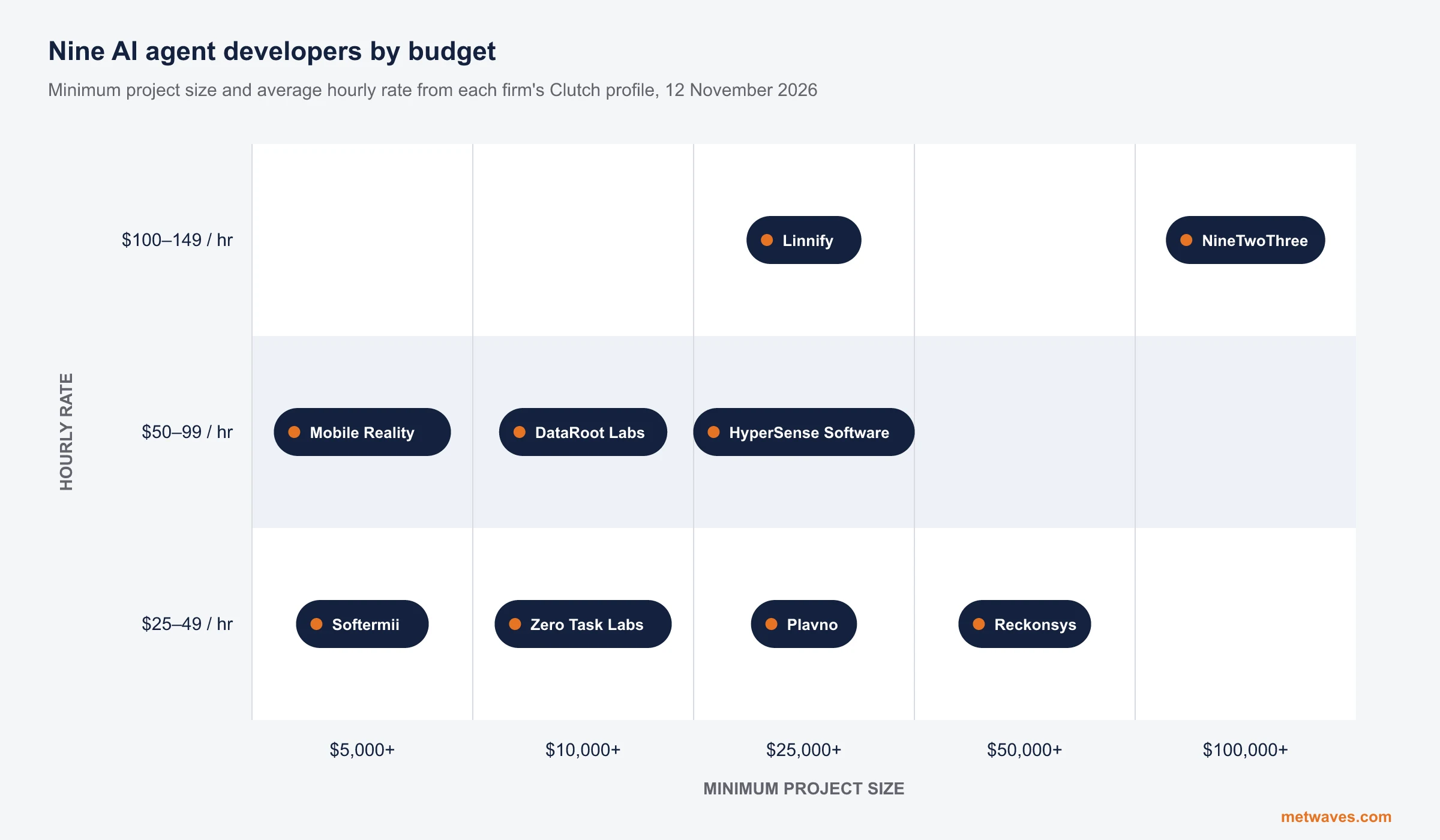 Nikit Nandan
November 12, 2026
Top AI agent development companies for small and mid-sized businesses (2026)
Nine AI agent development firms a small or mid-sized business can shortlist, with Clutch figures, minimum budgets and the weaknesses their own clients name. Published by Metwaves, which is not ranked.
Learn More >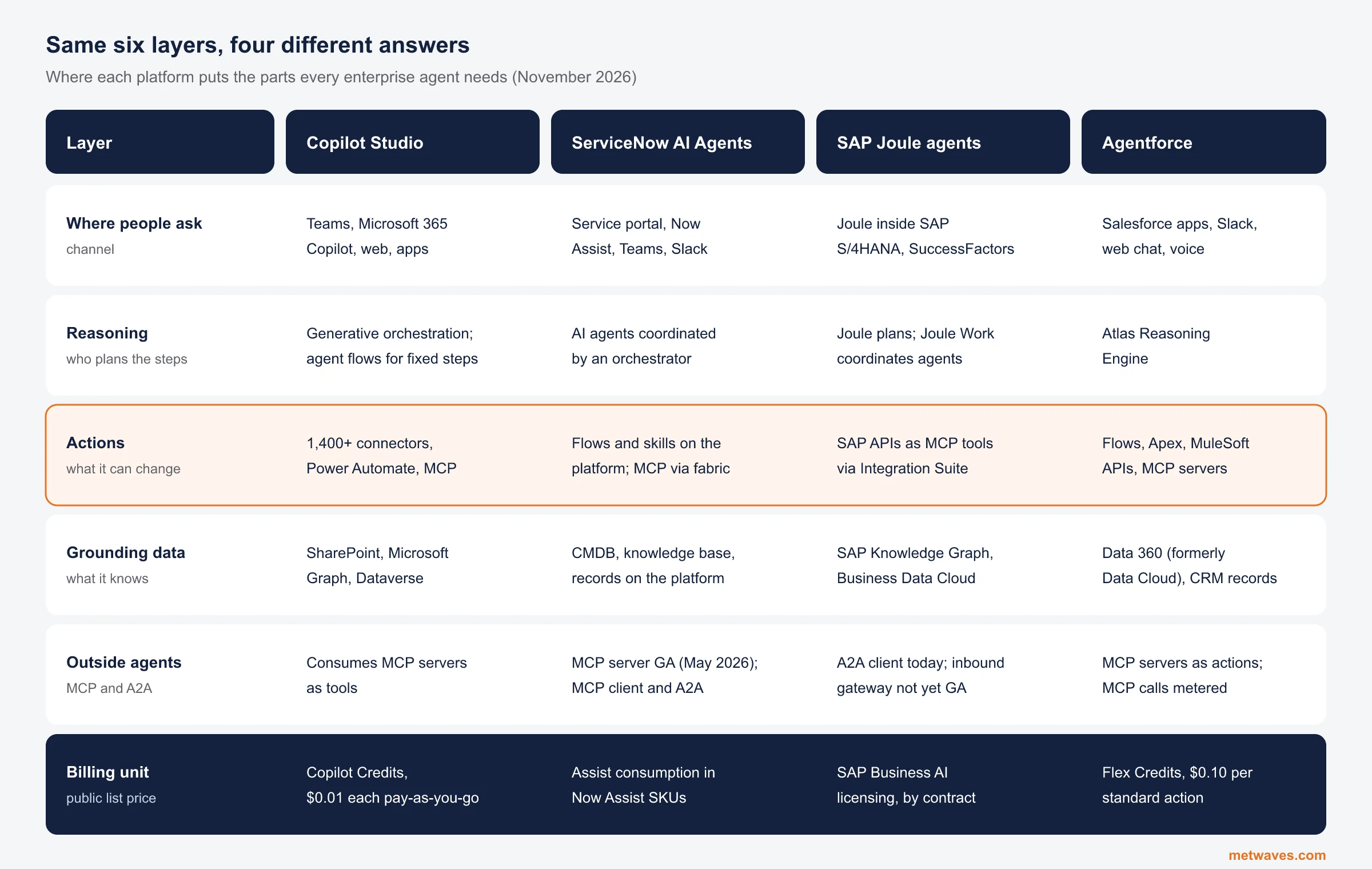 Nikit Nandan
November 12, 2026
Enterprise AI Agent Platforms Compared (2026)
An architecture review of the four big enterprise AI agent platforms: where each one reasons, acts, finds its data and connects to outside agents, what it costs, and when a custom build is the better choice.
Learn More >Let’s build your idea!
Let us help you with free analysis & estimate.
Our product expert will contact you within 12 hours.