Sports App Development

A sports app development company for clubs, leagues, academies and fitness businesses in the US, UK, Canada and Australia: registration, fixtures, scores and member apps, joined to the payment and data services you already use. We have not shipped a sports app yet; we bring live alerts, booking and multi-role apps from other industries.

Work that transfers: live alerts at 10,000 concurrent users · online booking for an urgent care clinic · three apps, one record for a telemedicine platform

THE SPORTS INDUSTRY

What the sports industry is, and how it runs on the season

The sports industry runs from the school field to the stadium: community clubs and academies, leagues and governing bodies, gyms and fitness studios, event organisers and venues, professional teams, and the sports-tech companies that sell software and devices to all of them. Most of it, by number of organisations, is small and run by volunteers.

Money comes in a few ways. Clubs and academies earn from registration fees, memberships and programmes. Leagues earn from team entry fees and sanctioning. Fitness businesses earn from memberships and classes. Venues and professional teams add tickets, sponsorship and media rights. The season sets the rhythm: a registration rush, weeks of fixtures with match-day peaks, then a quiet off-season.

That is why sports app development is mostly about people and timing: registering hundreds of players in a few weeks, changing a fixture and telling every family in minutes, and keeping children's data safe all year. A sports app development company should start by asking whether a club-management product already does the job.

250 millionAmericans aged six and over took part in at least one sport, fitness or leisure activity in 2025Sports & Fitness Industry Association, 2026 Topline Report
90 million+people played team sports in the US in 2025, the first time above 90 millionSports & Fitness Industry Association, 2026
38%of Australian children aged 0 to 14 played organised sport outside school at least weeklyAustralian Sports Commission, AusPlay 2025

Clubs and academies

Community clubs, youth academies, private coaching

  • Registration
  • Payments
  • Team messaging

Leagues and federations

Local leagues, state and national bodies

  • Competitions
  • Fixtures
  • Results

Fitness businesses

Gyms, studios, personal trainers

  • Class booking
  • Memberships
  • Coaching apps

Events and venues

Tournaments, races, stadiums and arenas

  • Entries
  • Ticketing
  • Check-in

Sports-tech

Start-ups building apps and devices

  • Performance data
  • Wearables
  • Fan apps

ONE SEASON

A season is the real specification

Load on sports software is not flat. It comes in a registration rush and in match-day peaks, and the quiet months are when changes are safe.

  1. Before

    Off-season

    Rules, prices, age groups and venues for next season are set.

    Software: set-up screens admins can change without a developer.

  2. The rush

    Registration

    Hundreds of families register and pay in a few weeks, often on the same evenings.

    Software: payments, waivers and age checks that hold up under the rush.

  3. Before round one

    Pre-season

    Teams formed, coaches assigned and checked, the draw published.

    Software: team builder, coach checks recorded, fixture generator.

  4. Every weekend

    Season

    Fixtures every weekend, changes on the day, scores and messages to families.

    Software: match-day scoring, live results and alerts at Saturday-morning peaks.

  5. End of season

    Finals

    Standings decided, finals scheduled, awards.

    Software: standings and stats people trust, because they settle who plays in the final.

  6. After

    Review

    Board and sponsor reports, renewals, lessons for next year.

    Software: reports from data already collected, not rebuilt by hand.

We pilot changes in the off-season, never in registration week.

CHALLENGES

The challenges sports organisations face

Six problems club admins, league managers and fitness owners describe, with where software helps.

01

“Registration, payments and waivers run on forms and spreadsheets.”

Where software helps: one online registration with payment and consent, age checks and a record admins can search.

02

“Fixtures change and parents find out too late.”

Where software helps: a change made once in the fixture list goes to every affected family as a notification, in minutes.

03

“Volunteers enter scores in three places.”

Where software helps: scores entered once on a phone at the ground feed results, standings and the website.

04

“Our competition format does not fit the product we bought.”

Where software helps: custom competition rules, draws and standings, integrated with the product you keep for payments and membership.

05

“Members pay in one tool and book in another.”

Where software helps: one account for membership, booking and payment, with the tools you keep connected behind it.

06

“Sponsors want audience numbers we cannot produce.”

Where software helps: reporting on members, attendance and app use from data you already collect, with consent recorded.

WHO USES IT

Six kinds of user, one app

The number of user types drives cost more than the number of screens. Each needs its own view and its own care.

PL

Players

Does
Register, see fixtures and results, track their own progress.
Sees
Their own team and stats.

Often children: see the data rules below.

PG

Parents and guardians

Does
Register and pay, consent for their child, get changes and messages.
Sees
Their children's teams and messages.

Are copied on adult messages to minors.

CO

Coaches and volunteers

Does
Pick teams, take attendance, enter scores, message the team.
Sees
Their teams' players and contacts.

Background checks recorded; no private one-to-one chat with minors.

OF

Officials and referees

Does
Accept appointments, submit match reports and scores.
Sees
Their appointments and match details.

Reports may be disputed, so keep an audit trail.

AD

Admins

Does
Set up the season, run competitions, chase payments, report to the board.
Sees
Everything for their club or league.

Access by role, and every change logged.

FA

Fans and sponsors

Does
Follow scores and news, buy tickets and merchandise.
Sees
Public results and content.

Marketing consent kept separate from membership.

Fans and sponsors can often wait until after launch.

AI IN SPORTS

How AI can help sports organisations, and where it needs care

AI helps most with admin and scheduling. Anything touching children's data, health data or medical advice needs consent and a person in charge.

01

Member and parent assistant

Answer questions about fees, fixtures, kit and venues from your own content, any time.

Who decides

admins handle complaints, refunds and anything about a child's welfare.

Light rules

Tell users it is an assistant. Do not let it collect children's data.

02

Fixture and venue scheduling

Suggest a draw that respects venue availability, travel and team requests.

Who decides

the competition manager approves the draw.

Light rules

No AI-specific rules; the risk is fairness complaints, so keep the rules visible.

03

Match reports and highlights text

Draft a short report from the score, scorers and key moments for the website.

Who decides

an admin publishes or edits every report.

Consent needed

Naming children in public content needs their parents' consent.

04

Coaching insights from wearables

Spot trends in training load or performance data and suggest what a coach should look at.

Who decides

the coach decides; the athlete owns the data.

Consent needed

Health data rules apply; in the US the FTC's Health Breach Notification Rule covers many health apps.

05

Video analysis

Tag events in match video so coaches find moments faster.

Who decides

coaches confirm tags before they are shared.

Consent needed

Video of minors is personal data, and usually needs consent to share.

06

Injury risk or medical advice

Predict injury risk or suggest treatment.

Who decides

a qualified professional makes every decision.

Health rules

This can be health advice or a medical device in some markets. It needs a regulatory route first.

Before AI touches member data

  • No children's data sent to an AI model without a parent's consent and a reason
  • A person approves anything published or sent to members
  • Health and wearable data kept separate, with its own consent
  • Every AI output logged with who approved it

COMPLIANCE

Children's data, payments and health data: the rules sports apps meet

The more sensitive the data, the more rules apply. Any app used by young players sits on the third rung or higher.

Adult member details

Names, contacts, membership and attendance.

  • Privacy law in each market: state laws, UK GDPR, PIPEDA, the Privacy Act 1988
  • Marketing consent kept separate from membership
Build in

Consent records, preferences and a way to export or delete a member's data.

Card payments

Registration fees, memberships, tickets and merchandise.

  • PCI DSS v4.0.1: requirements dated for the future became mandatory on March 31, 2025
  • They include controls on scripts running on payment pages (6.4.3 and 11.6.1)
Build in

A payment provider's hosted fields, so card numbers never touch your servers.

Children's data

Registrations, team sheets, photos and results for players under 18.

  • COPPA (US): verifiable parental consent before collecting data from under-13s; the rule was amended in April 2025
  • UK Children's code: 15 standards, including high privacy by default and geolocation off, for services likely to be used by under-18s; conformance expected since September 2, 2021
  • Canada: the OPC expects parental consent for children under 13
  • Australia: a Children's Online Privacy Code must be registered by December 10, 2026
Build in

Parent accounts that own child profiles, privacy-first defaults and no public profiles for minors.

Messages with minors

Team chats and one-to-one messages between coaches and young players.

  • US Olympic movement (USOPC MAAPP, January 2025): a parent or another adult copied on every one-to-one message, and only platforms that allow this used
  • Team messages to minors also copy another adult or the parents
Build in

Group messaging with guardians included by design, and no private adult-to-minor chat.

Health and wearable data

Heart rate, training load, injuries and fitness tests.

  • US: the FTC's Health Breach Notification Rule covers many non-HIPAA health and fitness apps since its July 2024 amendments; breaches reported within 60 days
  • UK: health data is special category data under UK GDPR
  • Australia: health information is sensitive information under the Privacy Act 1988
Build in

Separate consent, the least data that does the job, encryption and a breach plan.

Statuses as of November 2026. Check the source before you rely on a date.

FOUR MARKETS

The same questions in the US, UK, Canada and Australia

Children's data, health data, accessibility, payments and betting, side by side.

RequirementUSUnited StatesUKUnited KingdomCACanadaAUAustralia
Children onlineCOPPA: verifiable parental consent under 13Children's code: 15 standards for under-18sOPC: parental consent under 13Children's Online Privacy Code due by December 10, 2026
Health and fitness dataFTC Health Breach Notification Rule for non-HIPAA health appsSpecial category data under UK GDPRPersonal information under PIPEDASensitive information under the Privacy Act 1988
Accessible booking and ticketsADA, including selling accessible seats online on the same terms as other seatsEquality Act 2010AODA in Ontario: public websites at WCAG 2.0 AA for organisations with 50 or more staff since 2021Disability Discrimination Act 1992
Card paymentsPCI DSS v4.0.1PCI DSS v4.0.1PCI DSS v4.0.1PCI DSS v4.0.1
Betting and paid fantasyGambling law applies; we do not build itGambling Commission licence; we do not build itGambling law applies; we do not build itGambling law applies; we do not build it

A summary for planning, not legal advice. Confirm the details for your organisation with your adviser.

That is the industry. Here is where Metwaves fits: clubs, leagues and fitness businesses whose format or member experience a standard product cannot handle.

Sports software we build

Six kinds of system, each linked to the service page that explains how we build it. None is shown as shipped for a sports organisation.

Registration, memberships and payments

One online registration for players, parents and members: forms, waivers, age checks, payment plans and a record admins can search, built for the rush in the first weeks of a season.

Usually bought by
Clubs, academies and leagues
  • Online forms
  • Waivers
  • Payment plans
  • Age checks

Web application development >

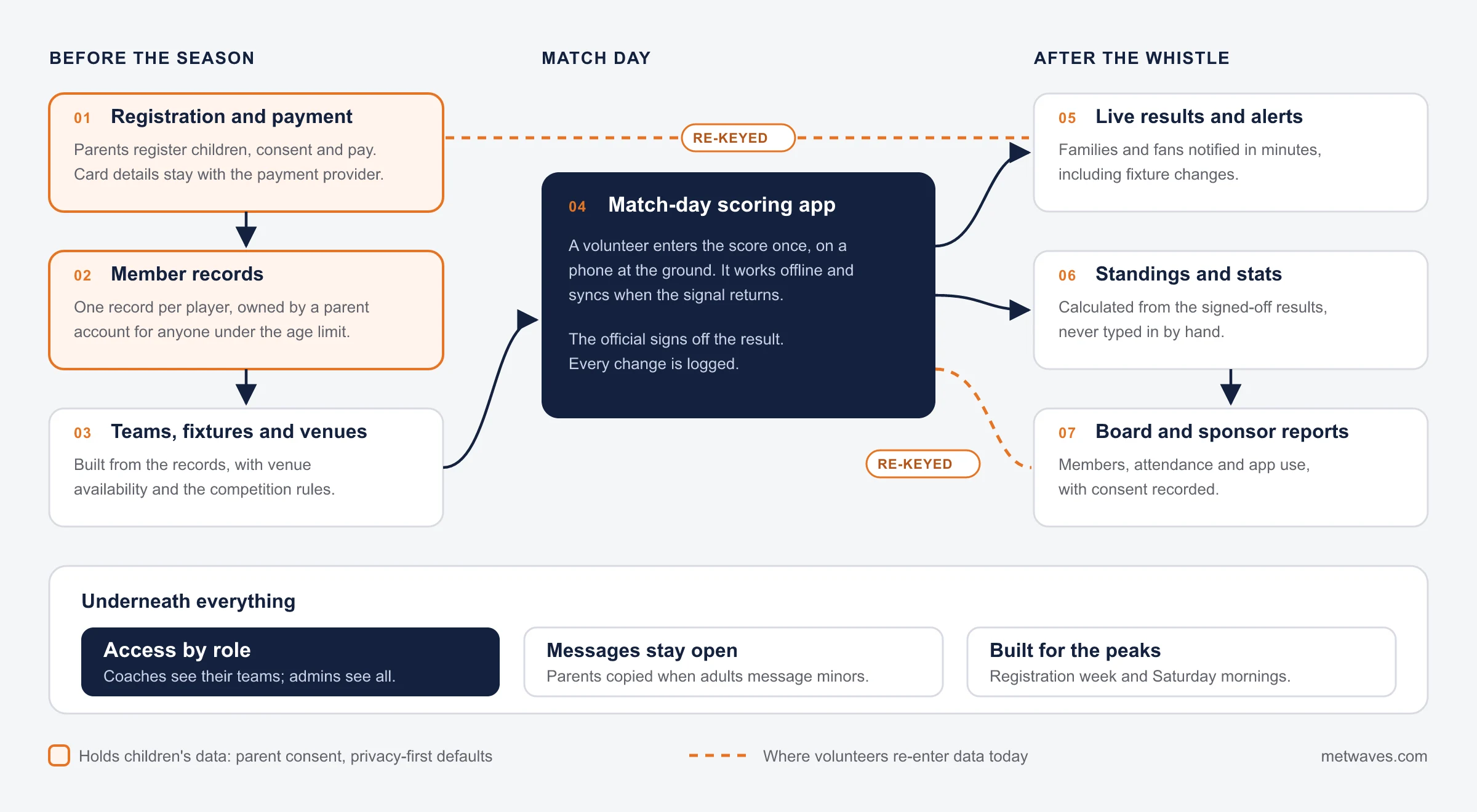
How a season's data moves

Entered once, at the right moment, by the right person. Most of the work is removing the places volunteers type the same thing twice.

How a season's data moves: registration and payment create member records; teams and fixtures are built from them with venues; a match-day scoring app records results once; live results and notifications go to families and fans; standings, stats and board reports are produced from the same data; the steps volunteers re-enter today are marked
    Dashed orange marks where volunteers re-enter the same data today. Entered once, it feeds everything after it.

    WORK THAT TRANSFERS

    Built for other industries, and what carries over

    We have no sports client to show you. These projects are from fintech and healthcare, labelled as such.

    Built for a stock trader's fintech platform

    TradeAlert: live alerts at match-day scale

    A web platform that sends stock and crypto alerts by email, SMS and app notification the moment a trigger fires, handling up to 10,000 concurrent users.

    • 10,000concurrent users
    • 85%positive beta feedback
    What transfers to sport

    Live scores, fixture changes and results alerts are the same problem: many people, one moment.

    Read the TradeAlert case study >

    Built for an urgent care clinic in Illinois

    Online booking people actually used

    A responsive clinic website with one-click booking and a notices area staff edit themselves, kept running and ranking for six years.

    • 25%more online appointment requests
    • 6years of support
    What transfers to sport

    Class, session and court booking for fitness businesses and academies works the same way.

    Read the urgent care case study >

    Built for an urgent care owner in Virginia

    Telemeds+: three apps, one record

    Patient, doctor and admin apps built on .NET, Azure and SQL Server, each role seeing its own part of one shared record.

    • 3apps sharing one record
    • 7features for patients
    What transfers to sport

    Players, parents, coaches and admins need the same pattern: one record, a view per role.

    Read the Telemeds+ case study >

    Results are the clients' own, in their industries. We do not present them as sports results.

    Build, buy or extend: what fits your organisation

    Most clubs and leagues are well served by a club-management product. Custom pays off when your format or your app is the product.

    If you areWhat usually fitsWhy
    A club with standard registration and fixturesA club-management product (TeamSnap, SportsEngine, Spond and PlayHQ are examples)Cheaper and proven. We will say so.
    A fitness studioA booking productCustom only if the app is your product.
    A league or federation with its own rulesCustom competition software, joined to a bought payment and membership toolYour format in software; the commodity parts bought.
    You want live scores for fansA licensed data feed plus a notifications appOfficial data for professional fixtures is licensed; local leagues score their own.
    A sports-tech ideaA prototype or MVP firstTest with real users before you build the platform.

    What drives the cost of a sports app

    Live data and the number of user types drive the cost more than the screens do. We price after discovery.

    high impact

    User roles

    Players, parents, coaches, officials, admins and fans each need screens and permissions.

    high impact

    Live data

    Licensed feeds cost money and come with terms; a volunteer scoring app needs offline care.

    high impact

    Children's data

    Parent accounts, consent and privacy-first defaults add design and testing.

    medium impact

    Payments and memberships

    Plans, refunds, discounts and sibling rules add states to handle.

    medium impact

    Season peaks

    Registration week and Saturday mornings set the load the system must carry.

    medium impact

    Wearables and video

    Device APIs, health-data consent and video storage each add scope.

    Running costs such as hosting, data feed licences and payment fees are listed separately.

    How we would start

    One season walked end to end, then a pilot before the rush.

    1. 1

      Discovery call

      Thirty minutes on where your season's admin work piles up.

    2. 2

      Walk one season

      Registration to final standings with your admins.

    3. 3

      List the tools

      What you use today and who re-keys what.

    4. 4

      Plan

      A costed first release and what to buy instead of build.

    5. 5

      Pilot off-season

      One division or age group, before the rush.

    6. 6

      Launch and support

      Live for the season, with support through it.

    How to choose a sports app development company

    Ask these questions of anyone you shortlist, us included. Where we do not win: sports history.

    Question to askA good answerA warning sign
    Which club, payment and data systems have you integrated?Named systems and projects.Vague answers. (Ours: none in sport yet. We say so first.)
    How do you protect children's data?Parent accounts, consent, privacy-first defaults, and no private adult chat with minors.“We'll add a privacy policy.”
    How will it handle match-day peaks?Load tested for your busiest Saturday.No answer.
    Who owns member data and the app store listings?You do.The vendor's account.
    Would you tell us to buy instead?Yes, when a club-management product fits.Every answer is a build.

    Related services

    Each page covers engagement models and the technology we use.

    Mobile app developmentMember, fan and coaching apps.
    Cross-platform appsOne codebase for iOS and Android.
    Web application developmentRegistration, fixtures and admin.
    Software prototypingTest a sports-tech idea first.
    Data engineeringReports for boards and sponsors.

    QUESTIONS & ANSWERS

    Sports app development: frequently asked questions

    Straight answers on cost, products, live scores, betting, experience and children's data. If you don't see an answer to your question, you can send us a message from our contact form.

    It depends most on the number of user roles, live data, children's data and payments, then on wearables, video and whether you need iOS, Android and web. We price after a short discovery.

    Usually use a product. Build when your competition format, programme model or member experience is what sets you apart, and keep the product for payments and membership if it fits.

    Yes, from a scoring app your volunteers use at the ground, or from a licensed data feed for professional fixtures. We have not integrated a named sports data feed yet.

    No. Betting and paid-entry fantasy contests are licensed gambling in many places, and we do not build them.

    Not yet, and we say so. What transfers is real-time alerting at up to 10,000 concurrent users (TradeAlert, fintech) and online booking and multi-role apps from our healthcare work.

    If your app collects personal information from children under 13 in the US, you need verifiable parental consent first, a stronger method if the data goes to third parties, and data kept only as long as needed. The rule was amended in April 2025.

    By testing for your busiest Saturday morning and registration week, and by sending changes as notifications rather than making everyone refresh the app.

    INSIGHTS & NEWS

    Discover IT Industry Insights and Technology Trends

    Nikit Nandan    Nikit Nandan November 17, 2026
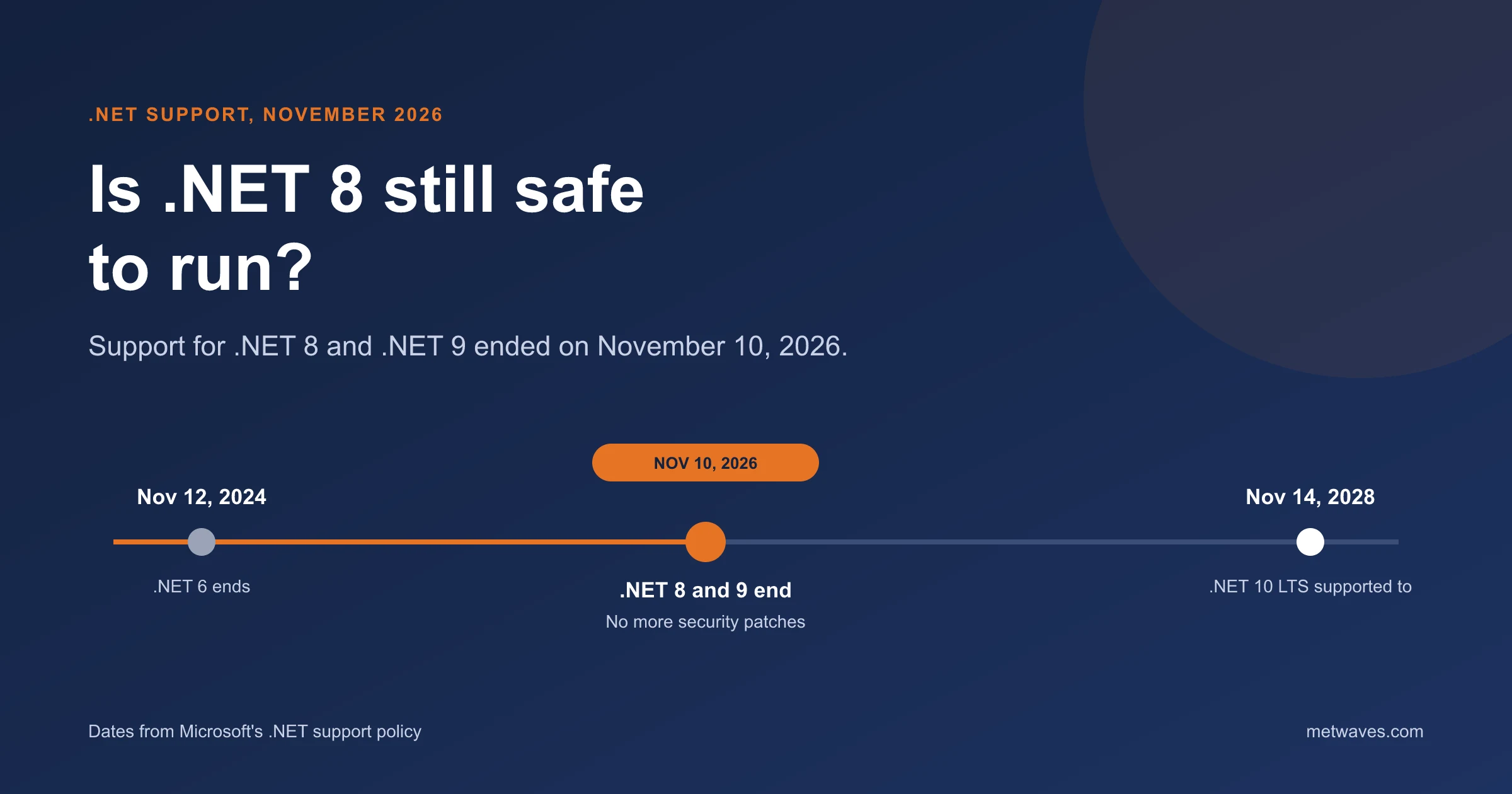
    Is .NET 8 Still Safe to Run After November 2026?

    Support for .NET 8 and .NET 9 ended on November 10, 2026. What that means for apps still on them, how risky it is, and how to plan the move to .NET 10.

    Learn More >
    Microsoft Technologies 5 min read
    Nikit Nandan    Nikit Nandan November 12, 2026
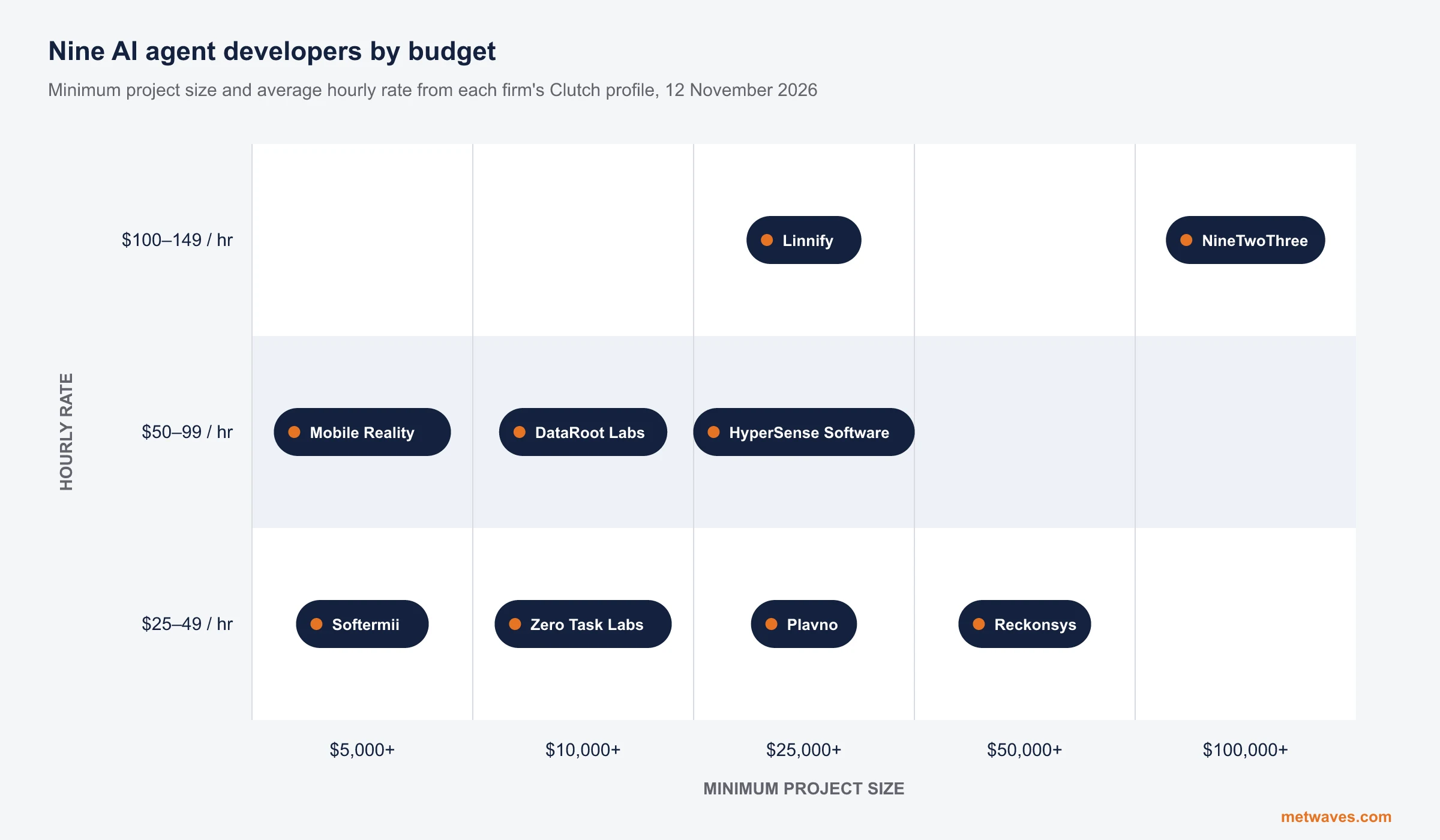
    Top AI agent development companies for small and mid-sized businesses (2026)

    Nine AI agent development firms a small or mid-sized business can shortlist, with Clutch figures, minimum budgets and the weaknesses their own clients name. Published by Metwaves, which is not ranked.

    Learn More >
    AI Development 9 min read
    Nikit Nandan    Nikit Nandan November 12, 2026
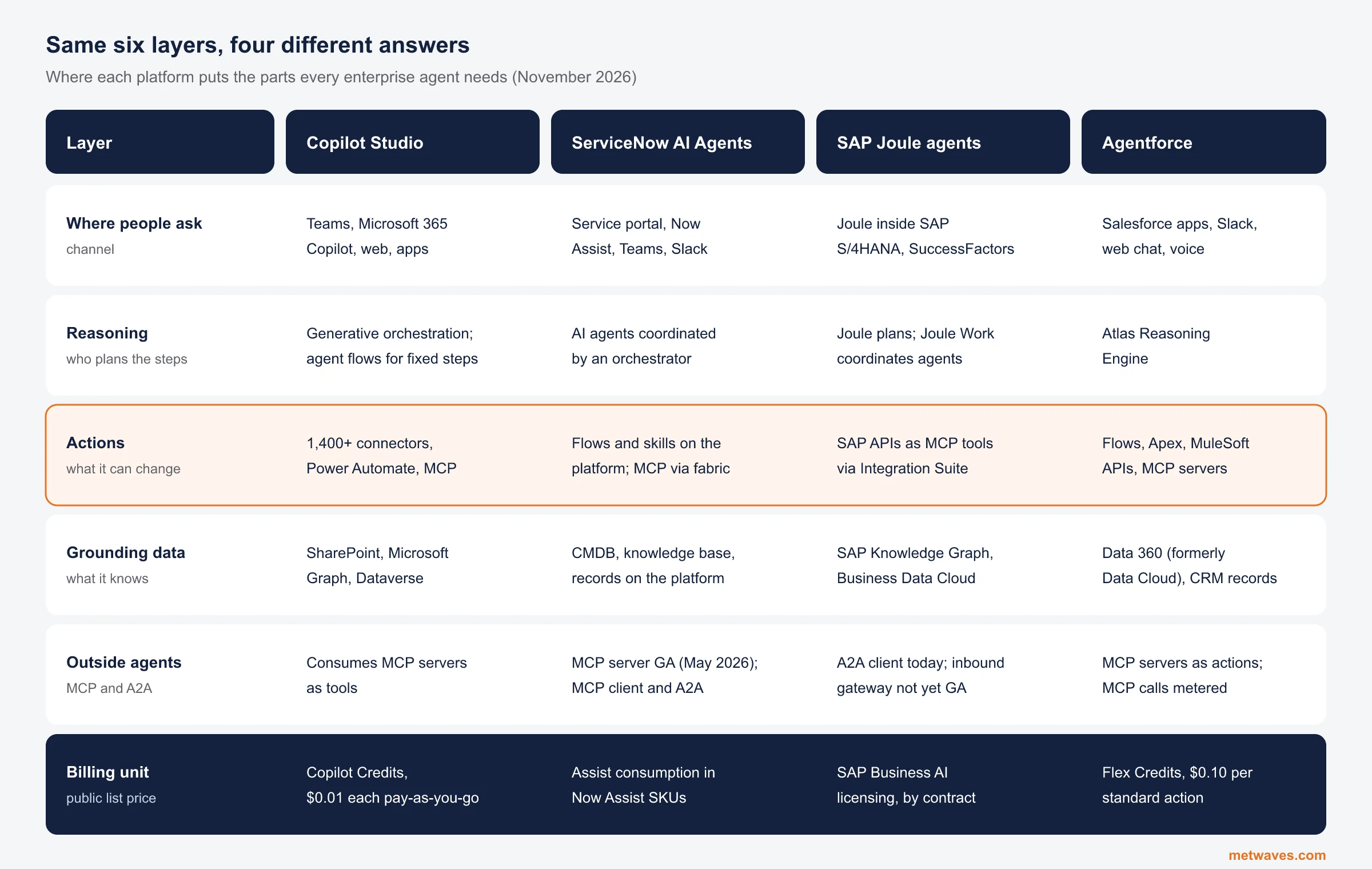
    Enterprise AI Agent Platforms Compared (2026)

    An architecture review of the four big enterprise AI agent platforms: where each one reasons, acts, finds its data and connects to outside agents, what it costs, and when a custom build is the better choice.

    Learn More >
    AI Development 9 min read

    Let’s build your idea!

    Let us help you with free analysis & estimate. Our product expert will contact you within 12 hours.

     All your information is kept confidential and protected by NDA.