
Ecommerce and Retail Software Development
Ecommerce software development services for retailers, brands and B2B sellers in the US, UK, Canada and Australia: storefronts, B2B portals, store systems and the integrations that keep every channel showing the same numbers. We have not built a store for a client yet, so this page starts as a buyer's guide: how the industry works, the rules a store must follow, and where custom software pays off.

Integration work for finance teams, not yet for a store: SAP Business One invoice agent · real-time alerts at 10,000 concurrent users
THE RETAIL INDUSTRY
What retail and ecommerce are, and how they make money
Retail is every business that sells goods to the people who use them: shops, online stores, brands selling direct, grocery chains and marketplaces. Ecommerce is the part of retail that sells online, and in most businesses it no longer sits beside the shops but runs through them: the same customer browses on a phone, collects in store and returns by post.
A retailer earns the gap between what goods cost and what they sell for, minus the cost of getting them to the customer: payment fees, shipping, returns and the advertising that brought the order in. Online, a sale usually starts on a commerce platform such as Shopify, Adobe Commerce, BigCommerce, WooCommerce or a custom build, passes through a payment provider, lands in an ERP or accounting system and leaves through a warehouse or a third-party logistics (3PL) partner. B2B sellers add account pricing, quotes and credit terms.
Ecommerce software development fills the gaps between those systems, where stock is updated by hand, orders are re-keyed and every channel shows a slightly different price.
D2C brands
Brands selling their own products online
- Storefront
- Subscriptions
- Reviews
Multi-store retailers
Shops with tills and a website
- POS
- Stock across stores
- Click and collect
B2B and wholesale
Manufacturers and distributors selling to trade buyers
- Account pricing
- Quotes
- Reorder portals
Marketplace sellers
Selling on marketplaces beside their own site
- Listing sync
- Order import
- Channel stock
Grocery and fast-moving goods
Short shelf life, delivery slots, big baskets
- Slot booking
- Substitutions
- Picking apps
CHALLENGES
The challenges retailers and online stores face
Six problems that cost stores money every week, from stock to checkout to the law, and where software makes a real difference.
Stock that does not match
The website says 3 in stock, the shop sold the last one an hour ago and the marketplace listing still takes orders. Stock syncs once a night, so busy days end in cancellations.
One owner for every stock figure, updates pushed within minutes, and safety buffers per channel for the items that sell fastest.
Orders keyed in twice
Staff copy web and marketplace orders into the ERP or accounting system by hand, and every typo becomes a wrong invoice, a wrong shipment or a refund.
Integration that posts each order once, checks it against the ERP's rules and sends anything that fails to a person with the reason.
Slow mobile checkout
Most traffic is on phones, and slow product and checkout pages cost sales. Themes slow down as apps and scripts pile up.
A leaner front end, fewer third-party scripts, image and search work, and checkout steps cut to the minimum the payment provider allows.
Too many apps and scripts
Each new app adds a monthly fee and another script. On the payment page, every script is now a PCI DSS question, and nobody can say what half of them do.
A script inventory, removal of what is not used, and custom code for the few features worth owning.
Returns and service load
Where is my order, how do I return this, can I change my size: the same questions fill the inbox, and refunds wait for someone to check stock back in.
Self-service order tracking and returns, an assistant for routine questions, and refunds tied to the warehouse check-in.
Consumer rules that keep moving
Fake reviews, hidden fees and hard-to-cancel subscriptions are now targeted by specific rules in the US, UK and Australia, and the dates keep changing.
Prices shown in full from the first screen, review systems that cannot hide negative reviews, and cancellation built as carefully as sign-up.
AI IN RETAIL
How AI can help retail and ecommerce, and where it needs a person
Most AI uses in retail touch products, not people, which makes it an easy place to start. The ones that face customers are where the rules are.
Product content
Low exposureDraft product titles, descriptions and attributes from supplier data, so new lines go live faster.
Person in chargeA merchandiser approves every listing before it publishes.
RulesClaims about materials or origin must be true. The AI cannot know that; your buyer can.
Search and recommendations
Check consumer lawUnderstand what shoppers mean, fix typos and suggest related products from browsing and order history.
Person in chargeMerchandisers set the rules and exclusions the model works within.
RulesIt uses personal data and often cookies, so privacy notices and cookie consent apply.
Customer service assistant
Check consumer lawAnswer where-is-my-order, returns and sizing questions from your own policies and live order data.
Person in chargeStaff take over refunds outside policy, complaints and anything the assistant cannot answer.
RulesIt must state refund and cancellation rights correctly. A wrong answer is still your business's answer.
Demand forecasting
Low exposureForecast sales by item and location so buyers reorder before stock runs out and markdowns shrink.
Person in chargeBuyers approve every purchase order.
RulesLittle direct regulation. The risk is commercial: a bad forecast ties up cash.
Fraud screening
Check consumer lawScore orders for fraud risk before they ship, from order, device and payment signals.
Person in chargeA person reviews held orders before any customer is refused.
RulesAutomated decisions about customers can fall under privacy law, and false declines lose good customers.
Review summaries and moderation
A rule applies directlySummarise reviews on product pages and flag abusive or off-topic ones.
Person in chargeA person decides what is removed, by a written policy.
RulesThe FTC rule and the UK's DMCC Act ban fake and AI-written reviews and the hiding of honest negative ones.
Before AI talks to your customers
- It answers from your own policies and links to them
- Refund and cancellation rights are stated as the law sets them
- No AI-written reviews, and no filtering of honest negative ones
- Prices and stock come from the source system, never the model
- Customers are told when they are talking to an assistant
- Every change to an order is logged with who approved it
PCI DSS
PCI DSS v4.0.1 for ecommerce: what changed at checkout
PCI DSS is the card industry's security standard, set by the PCI Security Standards Council and enforced through your contract with your acquirer, not by a government. Version 4.0.1 has been the only active version since v4.0 retired on December 31, 2024, and its payment page requirements took effect on March 31, 2025. How much of it lands on you depends on one design choice: how much of the payment page you build yourself.
- 1Usually SAQ A
Redirect to the provider's payment page
The customer leaves your site to pay on the payment provider's hosted page, then comes back.
Keep the redirect itself safe. PCI SSC's FAQ 1588 says the 2025 script criterion does not apply to full redirects.
- 2SAQ A, with a condition
Embedded payment form
Your checkout page shows the provider's card fields inside an iframe.
Since March 31, 2025 you must confirm the page is not open to script attacks: use controls like Requirements 6.4.3 and 11.6.1, or get confirmation from your provider that its iframe protects the page.
- 3Usually SAQ A-EP
Your page builds or posts the form
Your own JavaScript or form collects card details and sends them straight to the provider.
Requirements 6.4.3 and 11.6.1 apply in full, along with the rest of the questionnaire for the web server that serves the page.
- 4SAQ D or an assessment
Card numbers reach your servers
Your own systems receive, process or store card data.
The whole standard applies to every system that touches card data. Very few online stores need this.
What 6.4.3 asks
Every script that runs on a payment page is authorised, checked for integrity and kept in an inventory with a written reason. Tag managers, chat widgets and analytics count.
What 11.6.1 asks
A mechanism that detects unauthorised changes to the payment page and its security-relevant HTTP headers as the customer's browser receives them, and alerts your team.
Who decides your SAQ
Your acquirer or payment provider decides which questionnaire you file. Ask before you design checkout, not after.
What a developer can promise
We can build a checkout that keeps card data off your servers and document every payment page script. Nobody makes a store “PCI compliant” by building it; the merchant validates every year.
A summary of PCI SSC guidance as of November 2026, not legal or assessment advice. Confirm your SAQ with your acquirer.
Consumer rules for online stores: what changed and what is next
Ecommerce is regulated less by one law than by a stream of consumer rules on prices, reviews, subscriptions and cookies. These are the dates that change what a store's software has to do.
- Oct 2024
US: fake reviews banned
The FTC's Consumer Reviews and Testimonials Rule bans fake and AI-generated reviews, bought reviews and the suppression of negative ones, with civil penalties for knowing violations.
- Apr 2025
UK: the CMA fines directly
Under the Digital Markets, Competition and Consumers Act 2024 the CMA can fine up to 10% of global turnover. Fake reviews and drip pricing are banned.
- Jun 2025
EU: accessibility law applies
The European Accessibility Act covers ecommerce services sold to EU consumers from June 28, 2025. Microenterprises providing services are exempt.
- Jul 2025
US: click-to-cancel vacated
A federal appeals court vacated the FTC's click-to-cancel rule. The FTC reopened the rulemaking in March 2026. No replacement is in force; ROSCA and state laws still apply.
- Jan 2027
UK: subscription rules start
The government says new subscription contract rules start in January 2027: clearer upfront information, reminders, easy exit and a cooling-off period after renewals.
- Jul 2027
Australia: unfair practices banned
A law passed in July 2026 bans unfair trading practices and subscription traps from July 1, 2027 and targets fees revealed only at checkout.
FOUR MARKETS
Ecommerce rules in the US, UK, Canada and Australia, side by side
The laws differ, but they ask a store for the same things: show the real price, keep reviews honest, make cancelling as easy as signing up, ask before marketing, and protect the customer's data and card.
| Requirement | USUnited States | UKUnited Kingdom | CACanada | AUAustralia |
|---|---|---|---|---|
| Consumer law | FTC Act and ROSCA, enforced by the FTC, plus state consumer and automatic-renewal laws | Consumer Rights Act 2015 and the DMCC Act 2024, enforced by the CMA and Trading Standards | Competition Act (Competition Bureau) plus each province's consumer protection law | Australian Consumer Law, enforced by the ACCC and state fair trading agencies |
| Prices and fees | Misleading prices are deceptive under the FTC Act; a total-price rule covers hotel stays and event tickets only | Drip pricing is banned under the DMCC Act | A price made unattainable by fixed mandatory fees is misleading (since June 2022) | Show the single total price; new rules on checkout fees from July 1, 2027 |
| Subscriptions | No federal click-to-cancel rule in force; ROSCA and state laws apply | New subscription contract rules from January 2027 | No federal subscription rule; provincial consumer laws apply | Subscription traps banned from July 1, 2027 |
| Privacy law | No single federal law; state privacy laws such as California's | UK GDPR and the Data Protection Act 2018, regulated by the ICO | PIPEDA; Alberta, British Columbia and Quebec have their own private-sector laws | Privacy Act 1988 and 13 Australian Privacy Principles, for businesses over $3 million turnover and some others |
| Cookies and tracking | No federal consent rule; check state privacy laws | PECR: consent for non-essential cookies; analytics exception since February 2026 | PIPEDA's consent principles cover tracking that collects personal information | Privacy Act applies where tracking collects personal information |
| Marketing email and SMS | CAN-SPAM for email; marketing texts sent by automated tools need prior express written consent (TCPA) | PECR: consent, or the soft opt-in for existing customers | CASL: consent, sender identification, and opt-outs honoured within 10 business days | Spam Act 2003: consent, and opt-outs honoured within 5 working days; branded SMS sender IDs must be registered |
| Accessibility | ADA Title III; the DOJ points to WCAG but has no web rule for businesses | Equality Act 2010 | Ontario's AODA: WCAG 2.0 AA for organisations with 50 or more employees | Disability Discrimination Act 1992 |
| Card payments | PCI DSS v4.0.1, through your acquirer | PCI DSS v4.0.1, through your acquirer | PCI DSS v4.0.1, through your acquirer | PCI DSS v4.0.1, through your acquirer |
A summary for planning, not legal advice. Confirm the details for your business with your adviser.

That is the industry. Here is where Metwaves fits: retailers and brands whose stock, orders and prices have to agree across every channel, with these rules built in from the first release.
Ecommerce and retail software development services
Six kinds of system, each linked to the service page that explains how we build it. Pick one to see what it does and who usually buys it.
Custom and headless storefronts
A storefront on a commerce platform's theme, or a custom front end over its APIs when the theme cannot do what you need: speed on mobile, a product configurator, or several brands on one back end. We start with the platform you have and replace only what holds you back.
- Usually bought by
- D2C brands and growing retailers
- Product pages
- Search
- Checkout
- Content
- Core Web Vitals
B2B ordering portals
Portals where trade buyers see their own prices, raise quotes, get approvals, reorder in two clicks and pay on account. They read prices and credit limits from the ERP rather than keeping their own.
- Usually bought by
- Manufacturers and distributors selling to trade
- Account pricing
- Quotes
- Approvals
- Reorders
- Credit terms
ERP, stock and order integration
Orders, customers, products, prices and stock moving between the store, the ERP or accounting system, the warehouse and the marketplaces, with retries, mapping and an alert when something fails. We agree which system owns each record before any code is written.
- Usually bought by
- Sellers with an ERP and a warehouse
- Order posting
- Stock sync
- Price sync
- Marketplace orders
- Error queue
Retail software for stores
Retail software development for businesses with shops: one stock figure across tills and the website, click and collect, store-to-store transfers and staff tablets that can order what the shelf does not have. Usually built on the POS vendor's API rather than replacing the POS.
- Usually bought by
- Retailers with physical stores
- POS integration
- Click and collect
- Store stock
- Staff tablets
- Transfers
Shopping apps
Native or cross-platform apps for customers who buy often enough to install one: fast reorders, loyalty, saved sizes and push messages they agreed to receive.
- Usually bought by
- Brands and grocers with repeat customers
- Reorders
- Loyalty
- Push messages
- Wallet payments
Search, recommendations and service agents
Search that understands what shoppers mean, recommendations from real order history, and agents that answer order and returns questions from live data, handing over to staff when they should.
- Usually bought by
- Stores with enough catalogue and history to use it
- Search
- Recommendations
- Order status
- Returns
- Staff handover
BEFORE ANY CODE
One owner for every record
Most ecommerce problems are two systems both believing they own the same number. This is the map we agree with you before building; yours will differ, but every row needs exactly one answer.
| Record | Commerce platform | ERP or accounting | PIM | POS | Warehouse or 3PL | Marketplaces | Rule of thumb |
|---|---|---|---|---|---|---|---|
| Product content | Edited once in the PIM, or in the platform if you have no PIM. | ||||||
| SKU, cost and tax code | Finance owns what an item costs and how it is taxed. | ||||||
| Selling price | Pick one owner. Two systems both editing prices is how channels drift apart. | ||||||
| Warehouse stock | The warehouse counts it; every channel reads the same number. | ||||||
| Store stock | The till knows what sold in the shop a minute ago. | ||||||
| Orders | Each channel owns the orders it takes; the ERP keeps the one list finance works from. | ||||||
| Customer and consent | Marketing consent travels with the customer record, or the next email may break the law. | ||||||
| Refunds | Refund where the payment was taken; restock only when the warehouse checks the item in. |
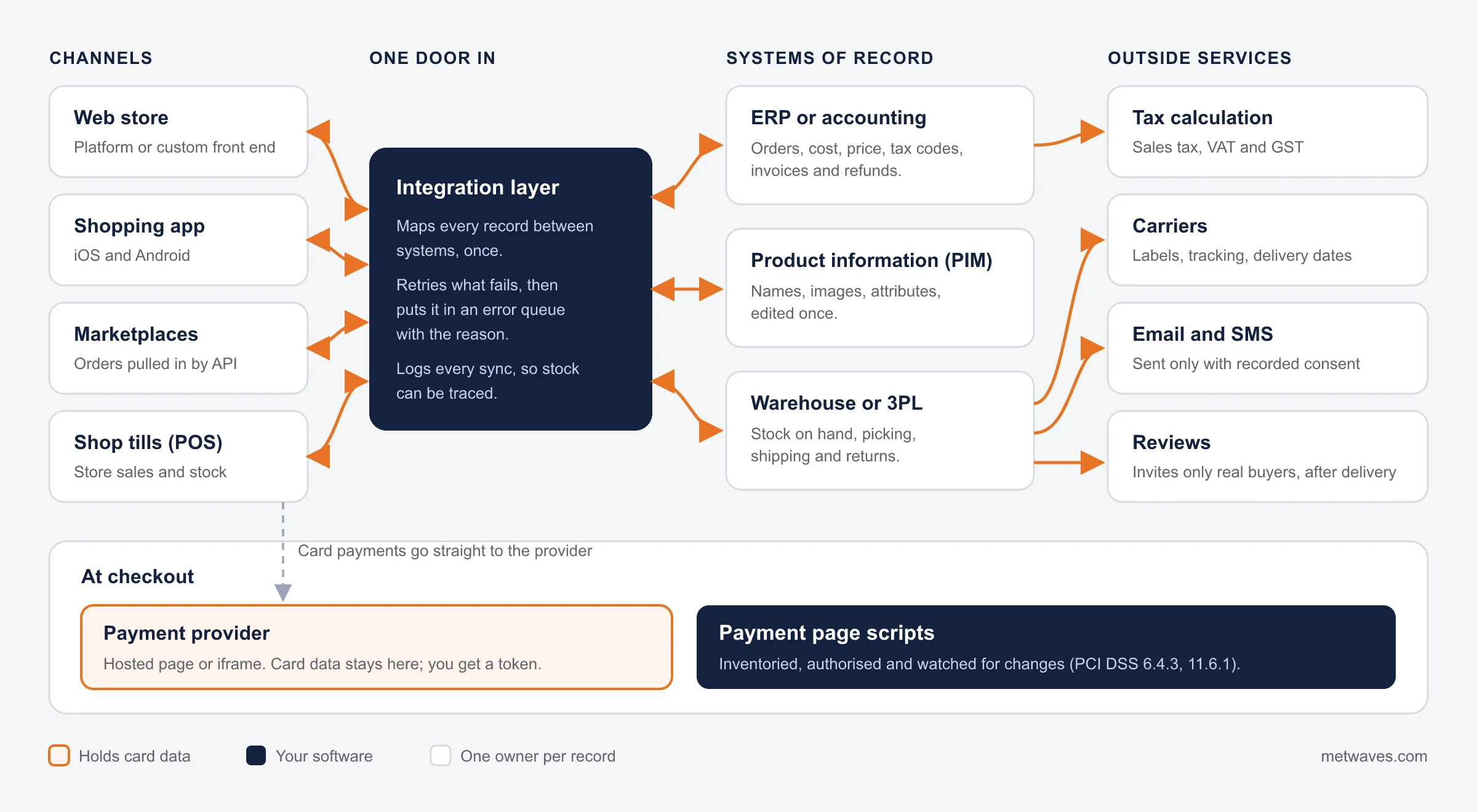
How an order moves through the system
One integration layer between the channels and the systems of record, so an order is entered once and stock is counted once.
OUR WORK
No ecommerce client yet. Here is the work that transfers.
We have not yet built a store for a client, and we will not show you one we did not build. The closest work is an invoice agent we built for an Australian business's accounts payable team: it reads about 1,000 supplier documents a month, checks each against SAP Business One and posts clean entries through its API, with exceptions sent to a person with the reason.
A store's order-to-ERP integration is the same shape of work: map, validate, post, and send what fails to someone who can fix it. On the storefront side, our posts on brand consistency in headless commerce and personalised search set out how we think about both.
- Built forFinance operations, not retail
- VolumeAbout 1,000 supplier documents a month
- SystemSAP Business One, through its API
- ResultRoughly 80% less manual data entry
- Live in8 to 12 weeks
Platform, headless or custom: what usually fits
Most stores should not start with custom software. This is the advice we give on the first call, including when the answer is a subscription and not us.
| If you... | What usually fits | Why |
|---|---|---|
| Sell direct to consumers and want to move fast with a small team | A hosted platform such as Shopify | Hosting, security and checkout are handled for you. We will tell you so on the first call. |
| Need deep catalogue, B2B and multi-store control, and have developers | Adobe Commerce or BigCommerce | More control over catalogue and pricing rules, at the cost of more to run. |
| Need a front end the theme cannot deliver, or several brands on one back end | Headless, on any of the above | Full control of design and speed, with a front end of your own to maintain. |
| Sell through quoting, configuration or contract pricing no platform supports | Custom software beside a platform | Build what sets you apart; let the platform handle catalogue and checkout. |
| Re-key orders or stock between systems every day | Integration before any rebuild | Connecting what you have often removes the work without replacing anything. |
What drives the cost of ecommerce software
Integrations and business rules set the price far more than the number of pages. We quote after discovery.
Number of integrations
Each ERP, warehouse, marketplace or POS connection needs mapping, error handling and testing with real data.
B2B rules
Account pricing, approvals, quotes and credit terms add logic on every screen.
Custom front end
A headless storefront is a second application to build and maintain.
Catalogue and data quality
Thousands of items with messy attributes take cleaning before they sync.
Markets, currencies and tax
Each new country brings tax, currency, shipping and consumer law work.
Mobile apps
Native apps add store listings, releases and two platforms to support.
Running costs such as platform plans, apps, payment fees and hosting are listed separately in every quote.
How we work with retailers
The first weeks are spent on orders and records, not screens, because that is where a store's money leaks and where a rebuild most often goes wrong.
- 1
Discovery call
Thirty minutes on your channels, your systems and where staff lose the most time.
- 2
Follow one order
From click to accounting, with everyone who touches it. We mark every re-keyed step.
- 3
Agree record owners
Which system owns stock, price, orders and customers, written down before build.
- 4
Integrations first
Orders and stock flow before new screens, because that is where money leaks.
- 5
Test the busy day
Orders, refunds and peak traffic tested end to end; redirects checked for a replatform.
- 6
Launch and support
Go live, watch the error queue, then hand over or keep improving it monthly.
How to choose an ecommerce software development company
Ask these five questions of anyone you shortlist, us included. One we do not win on today: ecommerce history. If a portfolio of live stores matters most, choose a specialist agency.
| Question to ask | A good answer | A warning sign |
|---|---|---|
| Which live stores have you built that we can visit? | A list of live stores and a client you can call. | Theme demos and mock-ups only. |
| Which system owns stock, price and orders after launch? | A written answer for each record, before build. | “We'll sync everything both ways.” |
| How will card data stay off our servers? | A hosted page or iframe, and a list of every payment page script. | Card fields built into your own form with no reason given. |
| Who owns the code, the platform account and the app subscriptions? | You do, from day one. | Accounts in the agency's name. |
| What happens to our search rankings if we replatform? | A redirect for every old URL, checked after launch. | No plan for old URLs. |
Related services
How we can work together is on each service page and on our engagement models page.
QUESTIONS & ANSWERS
Ecommerce and retail software: frequently asked questions
Straight answers on platforms, PCI DSS, accessibility, consumer rules, integration and cost. If you don't see an answer to your question, you can send us a message from our contact form.
Storefront design and build, platform customisation, custom features such as B2B portals or product configurators, and the integrations with ERP, stock, payments, tax, shipping and marketplaces. For retailers with shops, it also covers POS integration, click and collect and store stock.
Start with a platform when it covers your catalogue and checkout: it handles hosting, security and payments for you. Build custom software for the parts that set you apart, such as pricing, quoting or configuration, and connect them to the platform rather than replacing it.
Two requirements now cover payment pages: 6.4.3 (every script authorised, integrity checked and listed with a reason) and 11.6.1 (detecting unauthorised changes to the page), both effective since March 31, 2025. Stores that embed a provider's iframe can still file SAQ A, but must confirm the page is not open to script attacks. Your acquirer decides which questionnaire applies.
US courts have applied Title III of the ADA to websites and apps of businesses open to the public, and the Department of Justice says the ADA covers goods and services offered on the web, pointing to WCAG as guidance. If you are in the UK or Australia and sell to consumers in the EU, the European Accessibility Act may also reach you; whether it does depends on how you target EU shoppers, so ask your adviser. Building to WCAG 2.2 AA covers most of what each market asks.
In the US, the FTC's rule bans fake, bought and suppressed reviews, and subscriptions fall under ROSCA and state laws while the FTC's click-to-cancel rule stays vacated. In the UK, fake reviews and drip pricing have been banned since April 2025 and new subscription rules are due in January 2027. Australia bans subscription traps from July 1, 2027.
Through the platform's and the ERP's APIs, with an integration layer that handles mapping, retries and error alerts. We agree which system owns each record (products, prices, stock, customers, orders) before building, because two systems editing the same record is the usual cause of drift.
Not for a client yet, and we say so. What transfers is integration work: an invoice agent that checks about 1,000 supplier documents a month against SAP Business One and posts them through its API. If a portfolio of live stores matters most to you, a specialist ecommerce agency is the safer choice.
It depends most on the number of integrations, B2B rules, whether the front end is custom and how many markets you sell in. We price after a short discovery, with running costs such as platform plans, apps and payment fees listed separately.
INSIGHTS & NEWS
Discover IT Industry Insights and Technology Trends
 Nikit Nandan
November 17, 2026
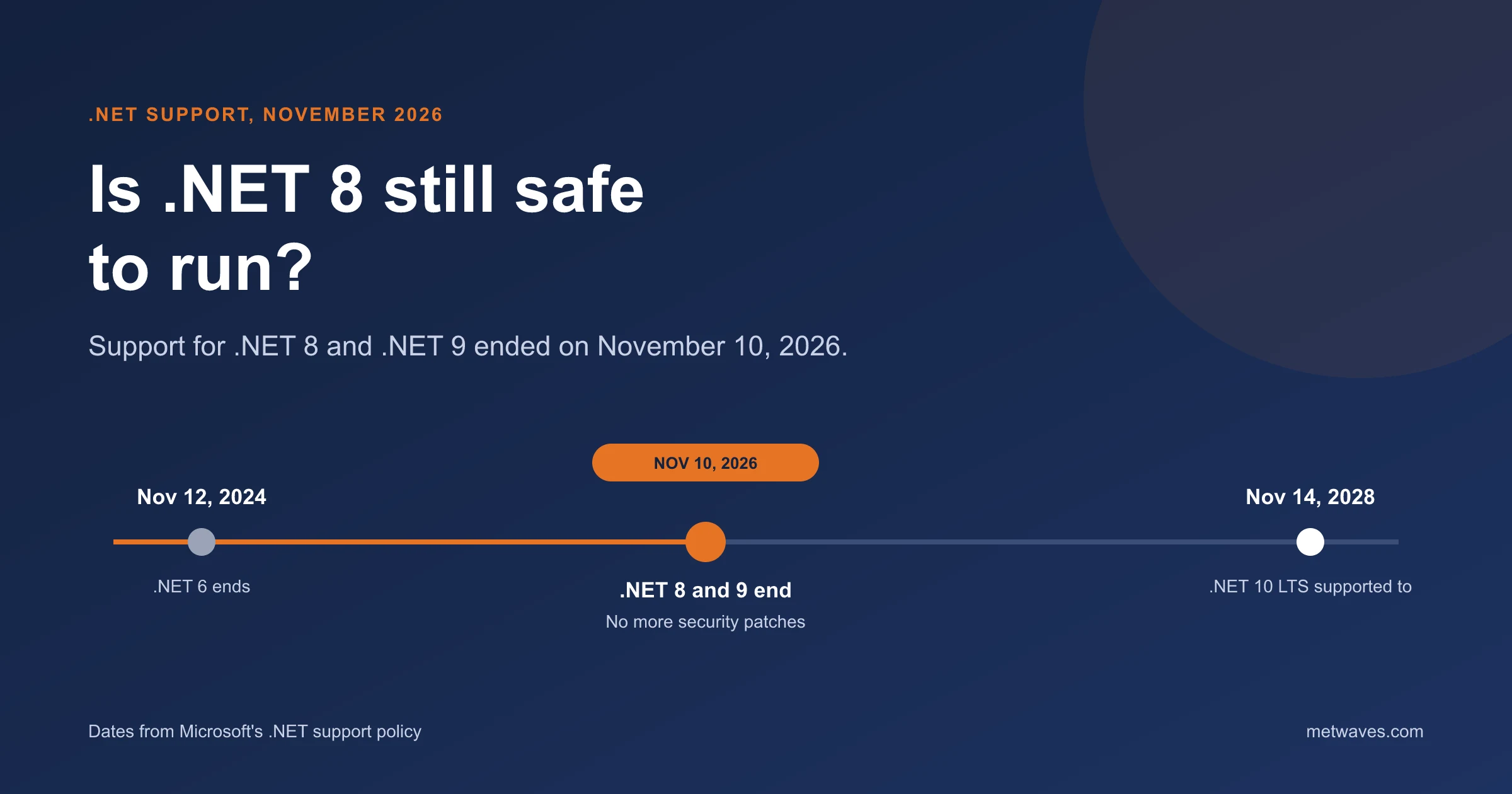
Is .NET 8 Still Safe to Run After November 2026?
Support for .NET 8 and .NET 9 ended on November 10, 2026. What that means for apps still on them, how risky it is, and how to plan the move to .NET 10.
Learn More >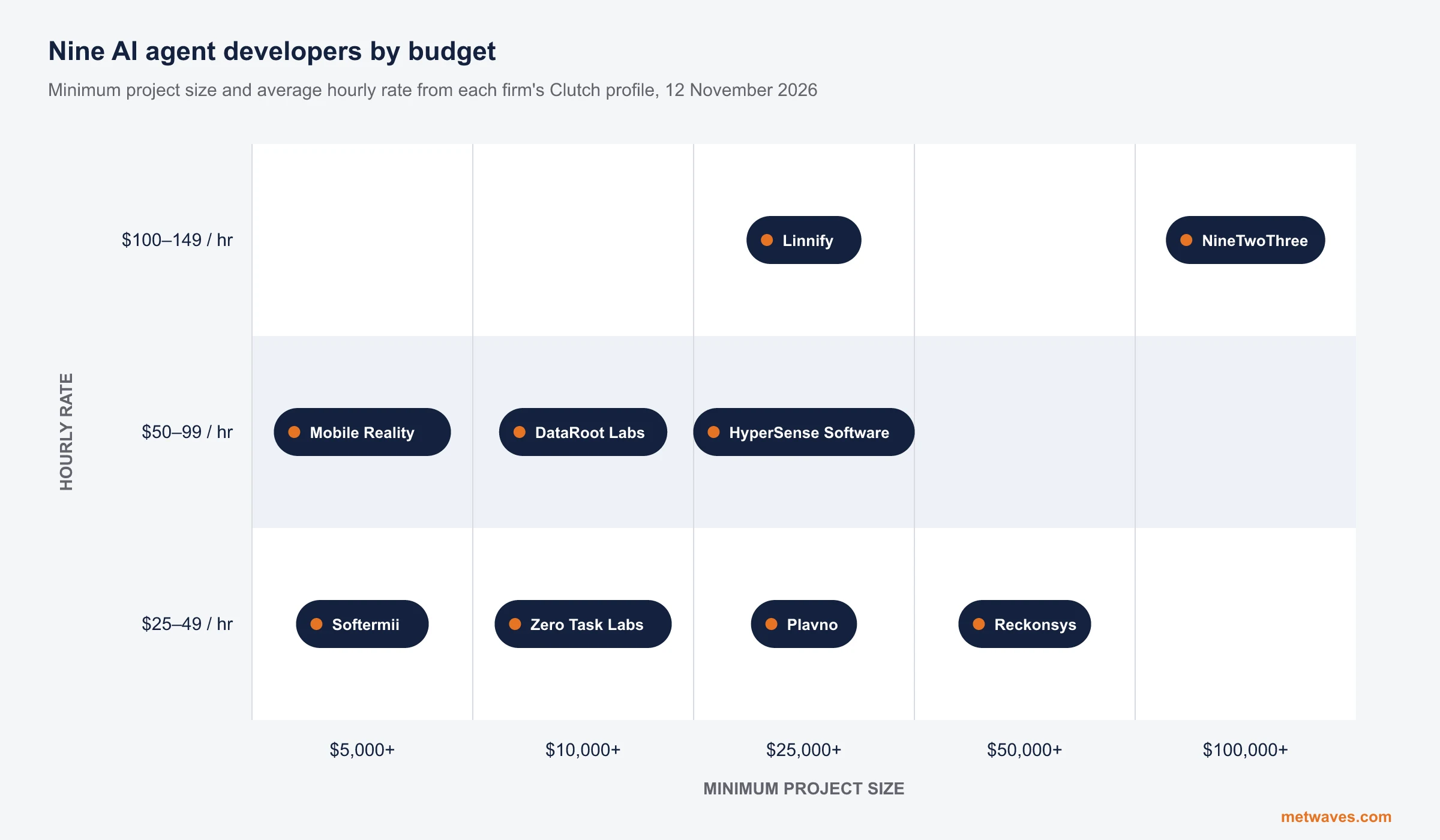 Nikit Nandan
November 12, 2026
Top AI agent development companies for small and mid-sized businesses (2026)
Nine AI agent development firms a small or mid-sized business can shortlist, with Clutch figures, minimum budgets and the weaknesses their own clients name. Published by Metwaves, which is not ranked.
Learn More >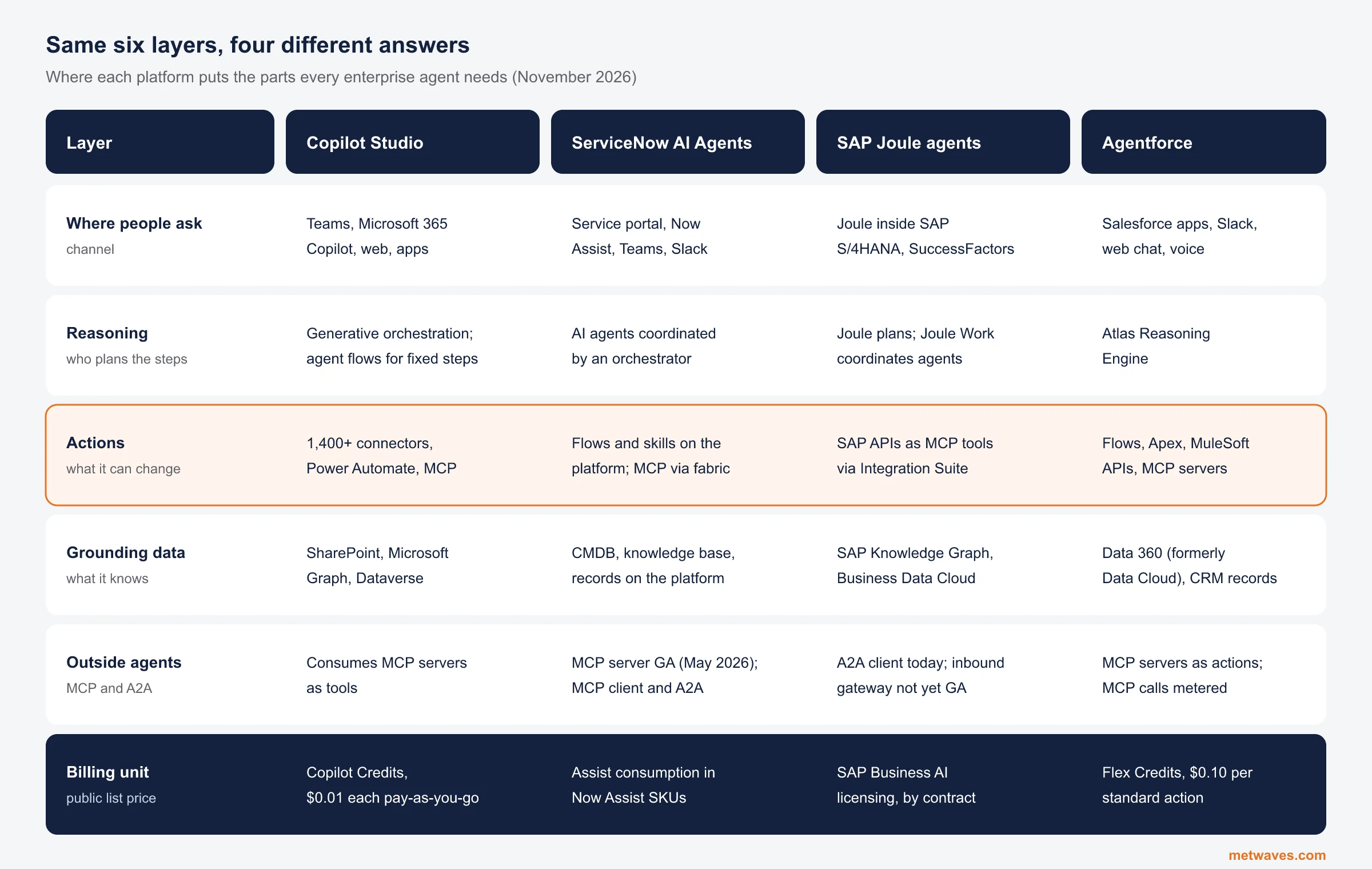 Nikit Nandan
November 12, 2026
Enterprise AI Agent Platforms Compared (2026)
An architecture review of the four big enterprise AI agent platforms: where each one reasons, acts, finds its data and connects to outside agents, what it costs, and when a custom build is the better choice.
Learn More >Let’s build your idea!
Let us help you with free analysis & estimate.
Our product expert will contact you within 12 hours.