Updated 12 November 2026. Prices and availability are from each vendor's own pages on that date; sources are listed at the end.
Short answer. Put the agent where the work already happens. If your staff live in Microsoft 365, start with Copilot Studio. If the job is an IT or HR ticket, ServiceNow. If it is a purchase order, invoice or employee record in SAP, Joule. If it is a sales or service case, Agentforce. Build a custom agent when the job crosses several of these systems, or when per-action pricing gets expensive at your volume.
We build AI agents for clients on Copilot Studio and on custom stacks such as LangGraph, Semantic Kernel and n8n, and we connect them to ServiceNow, SAP and Salesforce. None of these vendors pays us, and this review does not rank them. It compares how each platform is put together, because that decides what an agent on it can and cannot do.
The six layers every enterprise agent needs
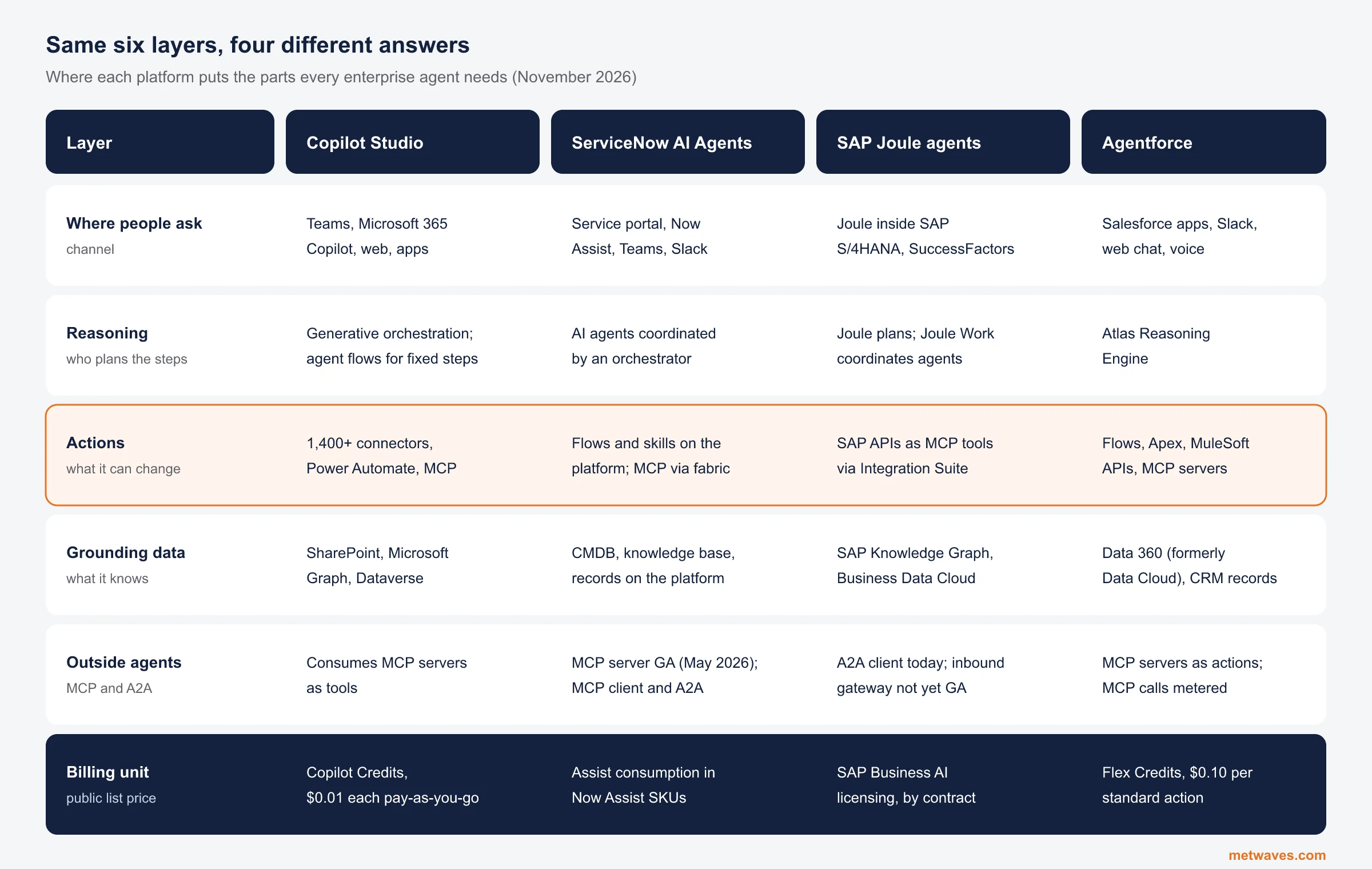
Strip away the branding and every agent platform has to answer the same six questions: where people ask, what plans the steps, what the agent is allowed to change, what data it can see, how it talks to agents and tools outside the platform, and how you pay for it. The four platforms answer them differently.
Microsoft Copilot Studio
Architecture. Copilot Studio agents run inside the Microsoft 365 and Power Platform world. Generative orchestration lets the model choose topics, knowledge and actions; agent flows handle fixed sequences without asking the model at every step. Knowledge comes from SharePoint, Dataverse and, optionally, tenant-wide grounding over Microsoft Graph. Actions use the Power Platform connector library (more than 1,400 connectors), Power Automate and MCP servers added as tools.
What it costs. Usage is measured in Copilot Credits: a prepaid pack of 25,000 credits costs $200 a month, or pay-as-you-go is $0.01 per credit through Azure. Microsoft's rate card charges 2 credits for a generative answer, 5 for an agent action, 10 for tenant graph grounding and 13 per 100 agent flow actions. Reasoning models add 10 credits per 1,000 billed tokens on top. Employee-facing agents used by people with a Microsoft 365 Copilot licence, under their own identity, are not charged; autonomous agents triggered by events are.
Watch for. Once a tenant passes 125% of its prepaid capacity, agents are blocked mid-conversation unless pay-as-you-go is switched on. Set a monthly limit per agent and link a pay-as-you-go plan before launch, not after the first outage.
Best fit. Internal helpdesk and knowledge agents in Teams, where the answers live in SharePoint. Our Copilot Studio helpdesk agent for a UK professional services firm resolves 30–50% of staff requests without a human.
ServiceNow AI Agents
Architecture. ServiceNow's agents live on the Now Platform, next to the incidents, requests, configuration items (CMDB) and knowledge articles they work on. Agents use skills built with the Now Assist Skill Kit and the platform's flows, and an orchestrator coordinates several agents on one task. AI Control Tower governs them: every action is identity-checked, permission-scoped and audited.
Opening up. In May 2026 ServiceNow announced Action Fabric, which lets outside agents, including Microsoft Copilot, Claude and custom agents, run governed actions on the platform without its user interface. The MCP server is generally available and included in every Now Assist and AI Native SKU; ServiceNow also offers an MCP client and A2A for working with external agents. Headless actions consume the same Assist allowance as Now Assist.
Best fit. IT, HR and customer service workflows that already run in ServiceNow: triage, routing, resolution drafts and fulfilment. If your helpdesk agent lives in Teams, it can hand tickets to ServiceNow rather than replace it.
SAP Joule agents
Architecture. Joule is SAP's assistant across S/4HANA, SuccessFactors and other SAP cloud applications. Joule agents are built in Joule Studio, with no-code and pro-code options, and draw on the SAP Knowledge Graph and Business Data Cloud for context. SAP and non-SAP APIs become governed MCP tools through an MCP gateway in SAP Integration Suite.
Outside agents. Joule acts as an A2A client: a custom agent you host exposes an A2A endpoint, and Joule sends it tasks. SAP's reference architecture (updated 26 October 2026) sets limits worth knowing before you design around it: only text messages are supported, synchronous answers are expected within 60 seconds, and the inbound Agent Gateway that would let outside agents call Joule agents was not yet generally available. SAP announced inbound A2A at TechEd in October 2026; check its status before relying on it.
What it costs. SAP licenses Joule and its agents through SAP Business AI agreements, and does not publish a per-action list price. Ask your account team how agent usage is counted before you size a rollout.
Best fit. Finance, procurement and HR tasks on SAP data, where the agent needs SAP's business context and authorisations. Smaller SAP estates, such as SAP Business One, are usually better served by a custom agent that calls SAP's API, as in our invoice agent for SAP Business One.
Salesforce Agentforce
Architecture. Agentforce plans with the Atlas Reasoning Engine and grounds its answers in CRM records and Data 360, the product formerly called Data Cloud. Actions come from Flows, Apex, MuleSoft APIs, External Services and MCP servers. Agents run in Salesforce apps, Slack, web chat and voice.
What it costs. Salesforce's pricing page lists Flex Credits at $500 per 100,000; a standard action uses 20 credits (about $0.10) and a voice action 30. Per-user Agentforce add-ons are $125 a month ($150 for Industries), and the Max Edition starts at $550 per user a month with 2.75 million Flex Credits per org per year. Customer-facing agents can instead be priced at $2 per conversation, but not in the same org as Flex Credits. Salesforce has also said it will start charging Flex Credits for MCP and API calls made by agents; the rate had not been published when we checked.
Best fit. Sales and service work on Salesforce data: case deflection, lead qualification and service replies, where the agent needs the full customer record.
What a request costs on the two platforms with public prices
To make the list prices concrete, take an agent that answers 1,000 requests a day, about 30,000 a month. Each request uses one generative answer and two actions on Copilot Studio, or three standard actions on Agentforce.
| Copilot Studio (pay-as-you-go) | Agentforce (Flex Credits) | |
|---|---|---|
| Credits per request | 2 + 5 + 5 = 12 credits | 3 × 20 = 60 credits |
| Cost per request | $0.12 | $0.30 |
| Cost per month (30,000 requests) | $3,600 | $9,000 |
| If users are internal | $0 for staff with a Microsoft 365 Copilot licence | Same Flex Credit cost |
This is an illustration, not a quote. Reasoning models, tenant graph grounding, voice and long conversations all change the numbers, and both vendors offer commitment discounts. The point is that per-action pricing adds up: at high volume it is worth comparing against a custom agent where you pay the model provider directly.
MCP and A2A: how open is each platform?
| Uses MCP tools | Exposes its own actions to outside agents | A2A | |
|---|---|---|---|
| Copilot Studio | Yes | Through connectors and APIs | Not the main integration route |
| ServiceNow | Yes (MCP client) | Yes, MCP server generally available since May 2026 | Yes |
| SAP Joule | Yes, via Integration Suite MCP gateway | Inbound gateway not yet generally available | Joule calls external agents |
| Agentforce | Yes, MCP servers as actions | Through APIs; agent MCP and API calls to be metered | Not the main integration route |
MCP connects an agent to tools; A2A connects agents to each other. If you expect one agent to work across several of these platforms, check both columns for each system it must touch.
When a custom agent is the better choice
- The job crosses vendors. An agent that reads an email, checks SAP, updates Salesforce and opens a ServiceNow ticket fits awkwardly inside any one of them.
- You need exact control. Frameworks such as LangGraph and Semantic Kernel let you define every step, check and hand-off, and test them against a fixed set of examples.
- You want to choose the model. A custom agent can use Azure OpenAI, Claude, Gemini or AWS Bedrock and switch between them.
- Volume makes per-action pricing expensive. Paying the model provider directly is often cheaper at thousands of actions a day.
A custom agent does not have to replace the platforms. It can call each one through its API or MCP server, and leave the users in the tools they already know. See our AI agent development services for how we build them.
How to choose
| If the work mainly happens in… | Start with | Consider custom when… |
|---|---|---|
| Microsoft 365, Teams and SharePoint | Copilot Studio | Volumes are high or the agent acts mostly outside Microsoft |
| IT, HR or customer service tickets | ServiceNow AI Agents | The work starts outside ServiceNow |
| SAP S/4HANA or SuccessFactors | SAP Joule agents | You run SAP Business One or need inbound A2A today |
| Salesforce sales or service | Agentforce | The agent spends most of its time outside Salesforce |
| Several of the above | A custom agent that calls each platform | — |
FAQ
Which is better, Copilot Studio or Agentforce?
Neither is better in general. Copilot Studio is the natural choice when your people work in Microsoft 365 and the knowledge lives in SharePoint. Agentforce is the natural choice when the work and the customer data live in Salesforce. Each is weakest when it has to act mainly in the other vendor's systems.
Do these platforms support MCP and A2A?
All four have moved toward the Model Context Protocol (MCP). Copilot Studio and Agentforce can use MCP servers as tools, ServiceNow made its MCP server generally available in May 2026, and SAP exposes APIs as MCP tools through Integration Suite. A2A support is less even: SAP's Joule can call external agents over A2A, but its inbound gateway was not generally available when we checked.
How much does an enterprise AI agent cost to run?
Copilot Studio and Agentforce publish list prices. At those prices, a request that uses one generative answer and two actions costs about $0.12 on Copilot Studio pay-as-you-go and a request with three standard actions costs about $0.30 on Agentforce Flex Credits. Internal Copilot Studio agents used by staff with a Microsoft 365 Copilot licence are included. ServiceNow and SAP price agent usage through their own contracts.
When should we build a custom AI agent instead?
When the work crosses several vendors' systems, when you need exact control over each step, when you want to choose or switch the model, or when per-action pricing would be expensive at your volume. A custom agent on LangGraph or Semantic Kernel in your own cloud can still call each platform through its APIs or MCP.
Sources
- Microsoft Learn: Copilot Studio billing rates and management (updated 30 October 2026)
- ServiceNow: Action Fabric announcement (5 May 2026)
- ServiceNow Community: Action Fabric MCP server, MCP client and A2A explained
- SAP Architecture Center: A2A and MCP for AI agent interoperability (updated 26 October 2026)
- SAP TechEd 2026 coverage: Joule Studio, A2A and MCP
- Salesforce: Agentforce pricing
- Salesforce Ben: Flex Credits for agentic MCP and API calls (24 September 2026)
Technical review by Roy Shah, Director, Software Engineering at Metwaves. Found something out of date? Write to info@metwaves.com and we will correct it.

Nikit Nandan
Strategy Director
Nikit is experienced in conducting in-depth research to stay abreast of industry trends and emerging technologies.