
Background

Our client is a construction-technology company in the United States whose estimators priced projects from building information models (BIM) produced by design teams.

Before every estimate, an estimator measured walls, slabs, doors and windows from the model or drawings and typed the quantities into the estimating system. On a large project this took days, and it had to be repeated whenever the design changed.

Challenge

Building models describe what a designer drew, not what an estimator prices. The integration had to translate one into the other.

1
Model quality varies

Models from different design teams classify and name components differently.

2
Mapping to cost codes

IFC element types had to be mapped to the estimating system's items and cost codes.

3
Units and quantities

Areas, volumes, lengths and counts had to be taken from the right properties, in the right units.

4
Design changes

A revised model had to be re-run without the estimator rebuilding the estimate from scratch.

Our Approach

We worked from real models and real estimates, so the mapping matched how the client's estimators actually price work.

01
Model and estimate review

We compared sample IFC models with the estimates priced from them, line by line.

02
Mapping rules

With the estimators we defined how each IFC element type maps to an item and cost code.

03
Extraction

Services that read the IFC file and calculate quantities from its geometry and properties.

04
Loading

Quantities are loaded into the estimating system, and on to the ERP, through their APIs.

05
Exception report

Elements that do not map cleanly are listed for the estimator instead of being guessed.

06
Rollout

Run alongside manual take-off on live projects, then adopted as the standard starting point.

From model to estimate

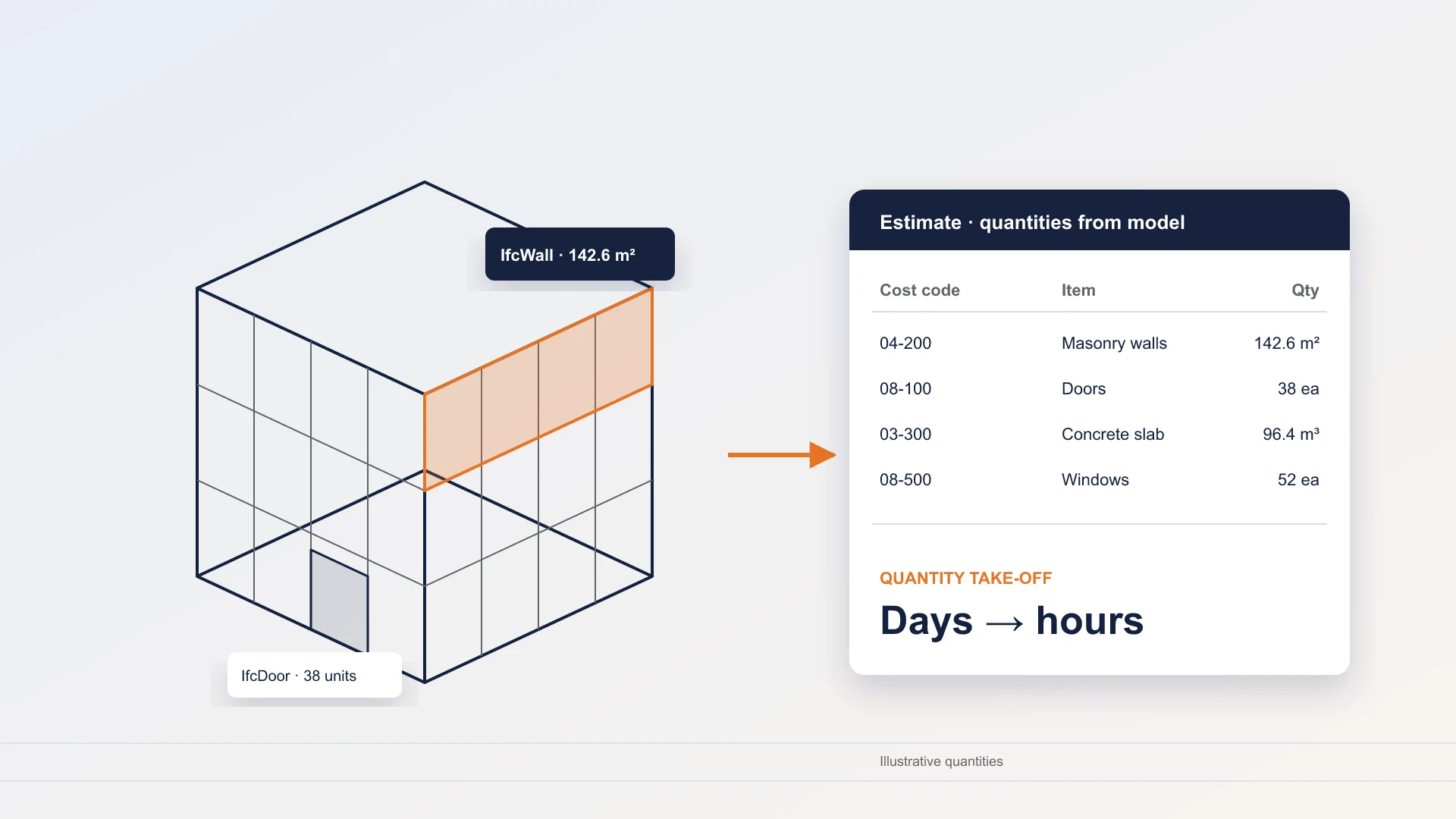
The estimator exports the IFC model and starts the run; the quantities arrive in the estimating system in the structure they already use.

  • Read the model: The IFC file is parsed into elements with their type, location and properties.
  • Calculate quantities: Areas, volumes, lengths and counts are taken from each element's properties and geometry.
  • Map to cost codes: Each element type is mapped to an estimating item and cost code using the agreed rules.
  • Load: Quantities flow into the estimating system and on to the ERP for job costing.
Illustration of an IFC building model with highlighted walls and doors feeding an estimate table of cost codes and quantities
Illustrative quantities: elements from the model arrive as estimate lines with cost codes.

Estimators stay in charge

The integration does the counting; estimators still own the estimate.

  • Exceptions listed: Elements with missing properties or no mapping are reported, not silently dropped.
  • Re-run on revisions: When the design changes, the new model is run again and the estimator reviews the result.
  • Rules they can change: Mapping rules are kept as configuration the client's team can update.

The Results

Take-off from days to hours

Estimators start from quantities taken from the model instead of measuring by hand.

Time back for pricing

Estimators spend their time on pricing, risk and exceptions rather than counting.

Fewer missed items

Every modelled element is either mapped or listed as an exception, so nothing disappears quietly.

Live in 8 to 12 weeks

From the first model review to use on live projects.

Client name withheld. Details that could identify the company have been left out.

Schedule a free consultation with our experts to discuss your Project!


Get Started Today
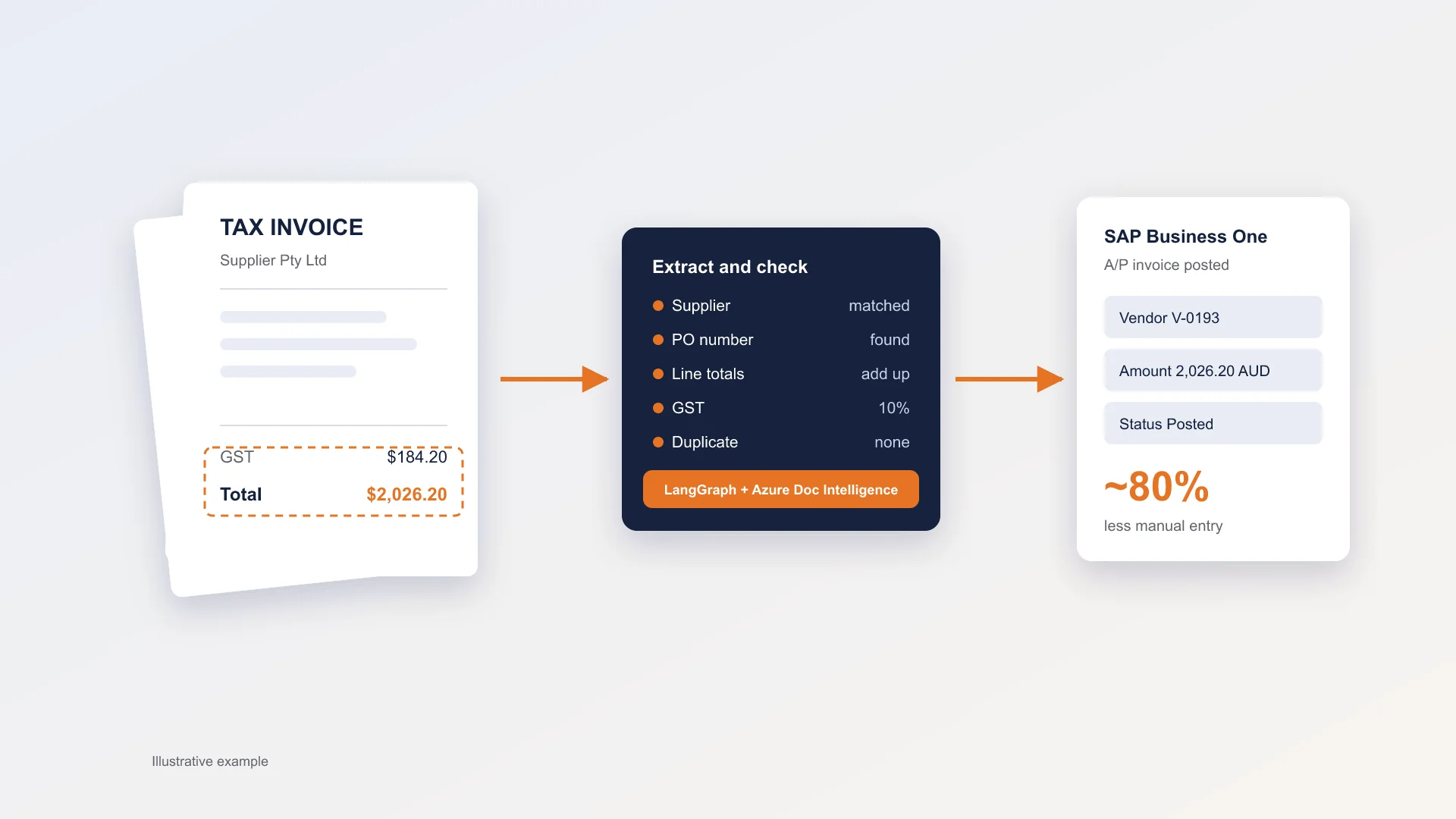
AI Invoice Processing Agent for SAP Business One

Metwaves built a LangGraph agent that reads around 1,000 supplier documents a month with Azure Document Intelligence and posts them to SAP Business One, cutting manual data entry by about 80%.

Learn More >

Copilot Studio Helpdesk Agent for a Professional Services Firm

Metwaves built a Copilot Studio agent in Microsoft Teams that answers staff IT, HR and policy questions from SharePoint and resolves 30–50% of requests without a human.

Learn More >
AI Material Recommendation System for BIM

Metwaves built and deployed an AI recommendation engine inside BioBuild's BIM workflow that scores materials on cost, carbon and structural fit. Live since January 2025: selection time down 40%, material cost down 20%.

Learn More >
INSIGHTS & NEWS

Discover IT Industry Insights and Technology Trends

Nikit Nandan    Nikit Nandan November 12, 2026
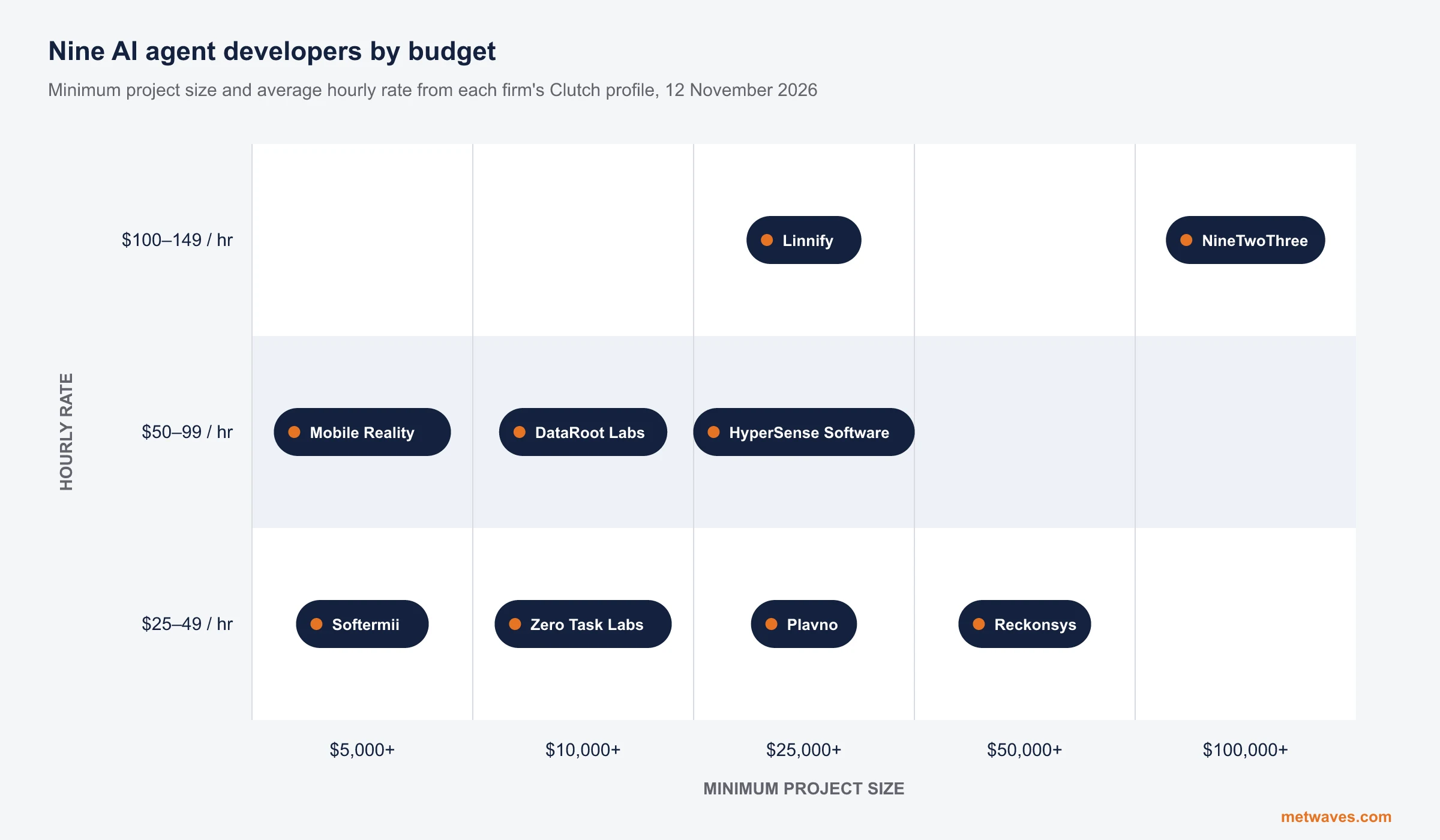
Top AI agent development companies for small and mid-sized businesses (2026)

Nine AI agent development firms a small or mid-sized business can shortlist, with Clutch figures, minimum budgets and the weaknesses their own clients name. Published by Metwaves, which is not ranked.

Learn More >
AI Development 9 min read
Nikit Nandan    Nikit Nandan November 12, 2026
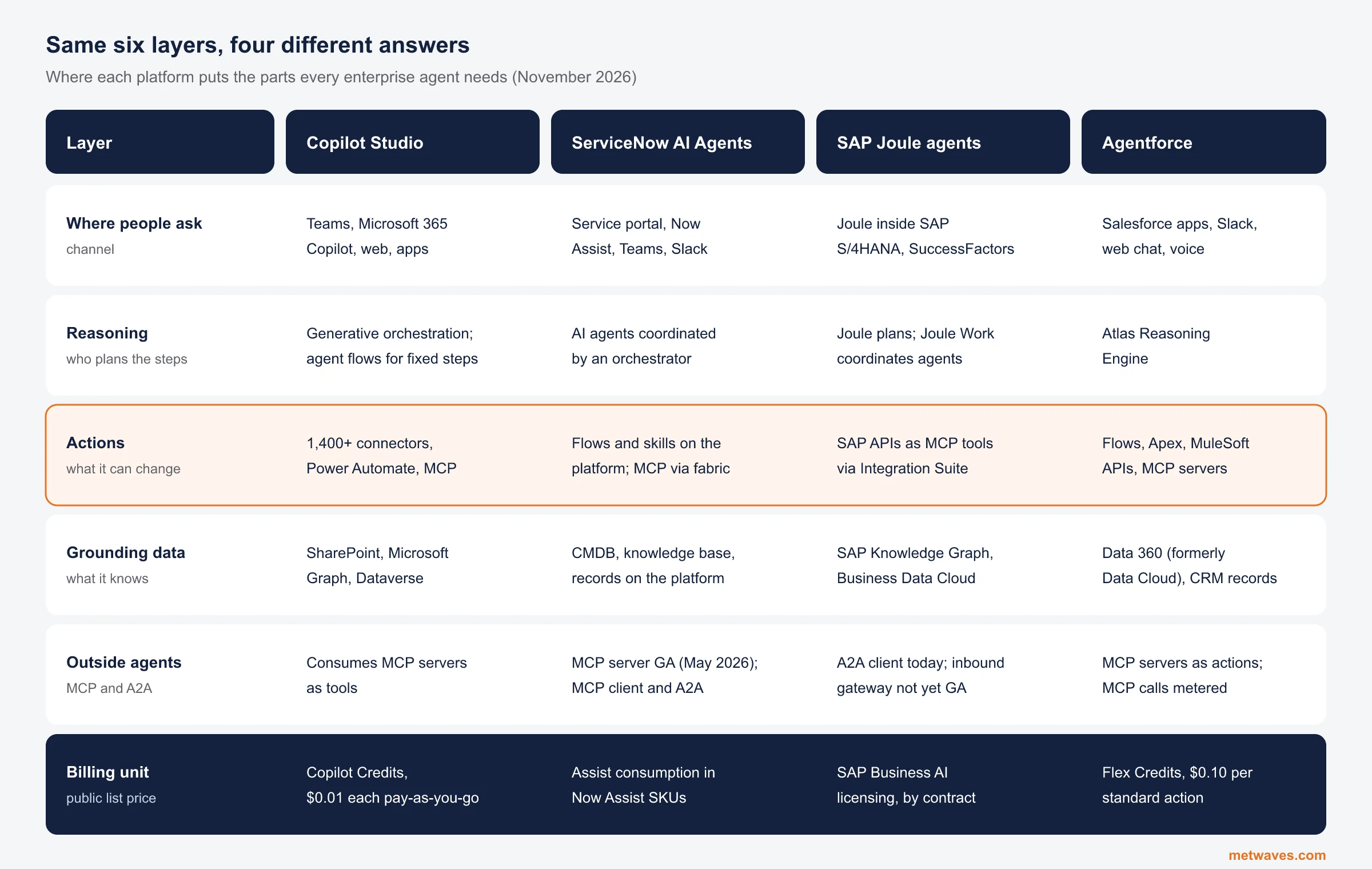
Copilot Studio vs ServiceNow vs SAP Joule vs Agentforce: An Architecture Review (2026)

An architecture review of the four big enterprise agent platforms: where each one reasons, acts, finds its data and connects to outside agents, what it costs, and when a custom build is the better choice.

Learn More >
AI Development 9 min read
Nikit Nandan    Nikit Nandan November 01, 2026
Top custom software development companies for small and mid-sized businesses (2026)

Ten custom software firms a small or mid-sized business can shortlist, with Clutch figures, minimum budgets and the weaknesses their own clients name. Published by Metwaves, which is not ranked.

Learn More >
Software Development 8 min read

Let’s build your idea!

Let us help you with free analysis & estimate. Our product expert will contact you within 12 hours.

 All your information is kept confidential and protected by NDA.