
WHEN TO CALL US
Signs your systems need integrating
Each of these costs hours every week and causes errors that surface at the worst time.
- Staff copy customers, orders or invoices from one system into another every day.
- The CRM and the accounting system disagree about who has paid.
- An integration someone wrote years ago fails silently, and nobody notices until month-end.
- Adding a new tool means another fragile script, because each connection was built differently.
- Reports need data from five systems, so someone stitches spreadsheets together every week.
WHAT WE DO
Software integration services we provide

Integration review
We list your systems, the records that move between them, who owns each field and where errors happen today, and return an integration plan with a fixed quote. One to two weeks.

API and webhook integrations
Direct connections through each system's official API and webhooks, with authentication, rate limits and pagination handled properly.

Data mapping and synchronisation
Field-by-field mapping, validation and de-duplication, with a single owning system for each field so two systems never overwrite each other.

Monitoring and recovery
A queue that retries failed records and lets us replay them, plus alerts that name the record and the reason, sent to the person who can fix it.

Legacy and custom systems
Connectors for in-house and older systems without a modern API, using database access, files or a small API we build in front of them.

Takeover and support
We take over integrations another team built, document them, add monitoring and keep them working when a vendor changes its API.
ARCHITECTURE
One integration layer, one owner for every field
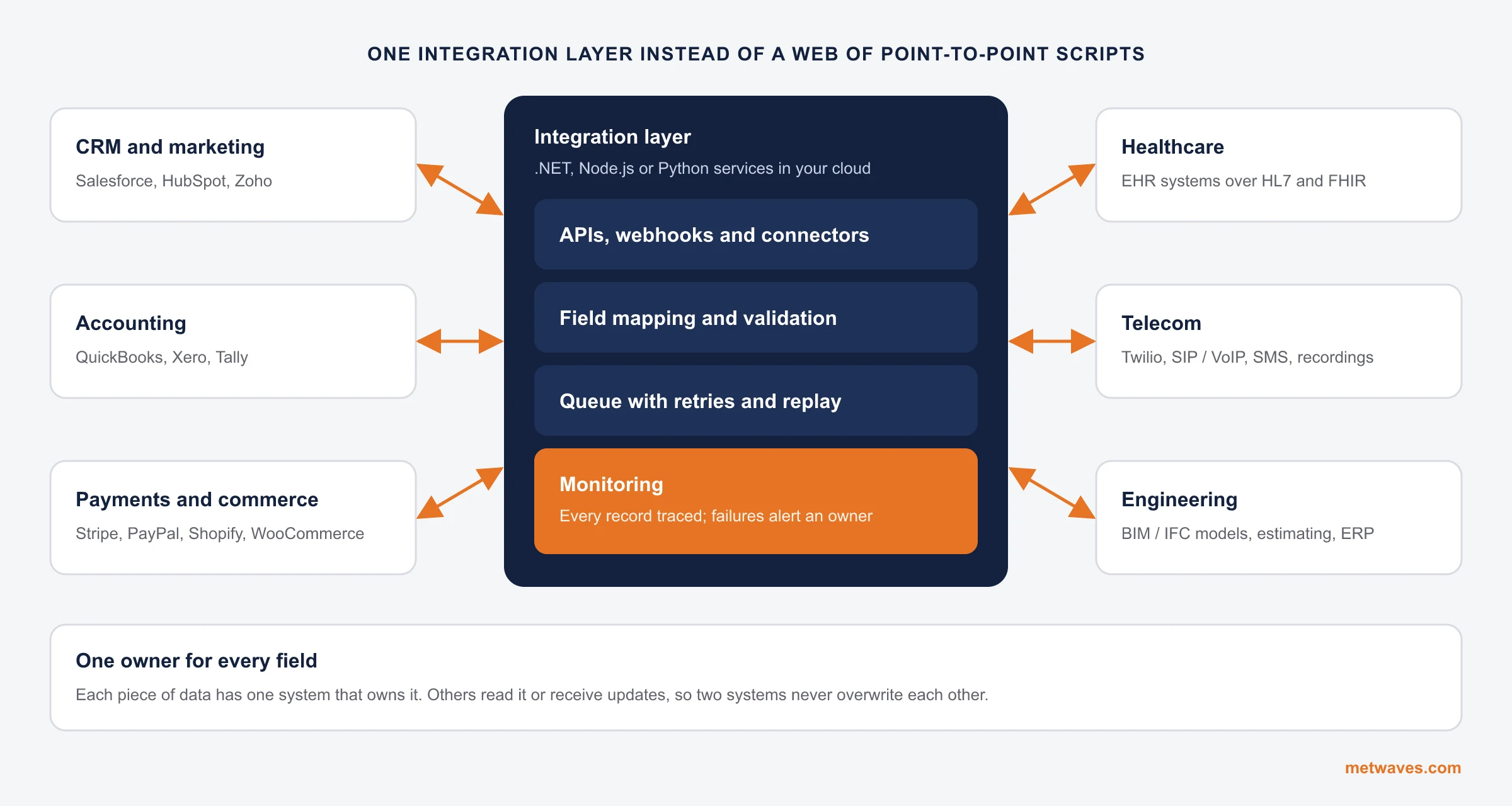
Instead of a script for every pair of systems, we put one integration layer in the middle. It knows which system owns each field, retries what fails and records what happened to every record.
SYSTEMS
Systems we have connected in production
Grouped by the kind of system. If yours is not listed, it almost certainly has an API or a database we can work with.
| Area | Systems | What the integration does |
|---|---|---|
| CRM and marketing | Salesforce, HubSpot, Zoho | Leads, contacts, deals and activity kept in step with billing and support |
| Accounting | QuickBooks, Xero, Tally | Customers, invoices and payments created once and reconciled automatically |
| Payments and commerce | Stripe, PayPal, Shopify, WooCommerce | Orders, refunds and payouts posted to the books and the CRM |
| Healthcare | EHR systems over HL7 and FHIR | Appointments, patient records and results shared with clinic and telehealth apps |
| Telecom | Twilio, SIP / VoIP | Calls, SMS and recordings logged against the right customer record |
| Engineering | BIM / IFC models, estimating, ERP | Quantities and components flowing from design models into estimates |
CASE STUDY
BIM models to cost estimates: quantity take-off from days to hours
A US construction-technology company's estimators were measuring quantities from building models by hand before every estimate. We built an integration that reads the IFC model exported from the design tools, extracts components and quantities, and loads them into the estimating and ERP systems in the structure the estimators already use.
Estimators now start from quantities taken from the model and spend their time on pricing and exceptions instead of counting.
- Client Construction-technology company, United States
- Connected BIM / IFC models → estimating → ERP
- Result Quantity take-off cut from days to hours
- Time to production 8–12 weeks
CRM AND ACCOUNTING
Who owns what in a CRM–accounting integration
The most common integration we build connects a CRM such as Salesforce, HubSpot or Zoho with QuickBooks or Xero. Deciding ownership first is what stops duplicate customers and conflicting invoices.
| Record | Owner and direction |
|---|---|
| Customer | CRM creates it; accounting receives it when the first deal closes |
| Product and price | Accounting or ERP owns it; the CRM reads it |
| Invoice | Created in accounting from the closed deal, never typed twice |
| Payment status | Accounting owns it; the CRM shows it to sales and support |
| Tax and currency | Accounting owns it, set per country |
HOW WE WORK
From mapping to a monitored integration
The old process keeps running until the integration has proved it produces the same results.
Map the systems
Which records move, in which direction, how often, and which system is the source of truth for each field.Integration review (1–2 weeks)
API checks, a field-by-field mapping, error handling rules and a fixed quote for the build.Build and test with real data
Connections built against sandbox accounts, then tested with a copy of real records, including the awkward ones: duplicates, missing fields and refunds.Go live alongside the old process
Both run in parallel for a short period and the results are compared before the manual step is switched off. Six to twelve weeks in total.Monitor and maintain
Alerts, a replay tool and runbooks for your team, or monthly support from us when vendors change their APIs.
TECHNOLOGY STACK
We build integrations as small services in your cloud account, using each system's official API.
Languages and runtimes

.NET

Node.js

Python
Cloud

Microsoft Azure

AWS
Systems we connect
Salesforce · HubSpot · Zoho · QuickBooks · Xero · Stripe · Shopify · Twilio · HL7 / FHIR · IFC / BIM
Data

SQL Server / Azure SQL

MongoDB

Redis
BEFORE YOU HIRE ANYONE
How to choose a software integration company
Four questions that reveal whether an integration will survive its first vendor update.
- Ask which system will own each field. If the answer is vague, two systems will end up overwriting each other.
- Ask what happens to a record that fails at 2 a.m., who is told and how it is replayed.
- Check that the integration uses the vendors' official APIs, not screen scraping that breaks on the next update.
- Make sure the code, credentials and logs live in your accounts, not the integrator's.
Tired of retyping data between systems?
Tell us which systems you use and what gets copied between them. On the first call we will tell you what can be connected and what it involves.
Discuss Your IntegrationQUESTIONS & ANSWERS
If you don't see an answer to your question, you can send us a message from our contact form.
Software integration services connect separate applications so that data entered in one appears, checked and in the right format, in the others. That covers API and webhook connections, data mapping, error handling, monitoring and ongoing maintenance when vendors change their APIs.
A ready-made connector or iPaaS tool is often enough for two popular SaaS tools with simple, one-way data. A custom integration pays off when you have several systems, two-way sync, complex rules, legacy or industry systems such as HL7 or IFC, or volumes where per-task pricing becomes expensive.
The integration review takes one to two weeks. Most integrations are then live within six to twelve weeks, including a period where the old process runs in parallel so results can be compared.
We do not publish a price list. Cost depends on the number of systems, the direction of the data, the volume and the quality of each system's API. The integration review ends with a fixed quote.
Yes. We usually make the CRM own customers and deals and the accounting system own invoices, payments and tax, so each record is created once and the payment status flows back to the CRM for sales and support.
Monitoring flags failing calls immediately, the queue holds the affected records, and we update the connector and replay them. Clients on monthly support do not need to do anything.
Reviewed by Roy Shah, Director, Software Engineering at Metwaves. Roy has more than 14 years of experience engineering enterprise applications and has led more than 15 enterprise projects. Last reviewed 12 November 2026.
INSIGHTS & NEWS
Discover IT Industry Insights and Technology Trends
 Nikit Nandan
November 12, 2026
Top AI agent development companies for small and mid-sized businesses (2026)
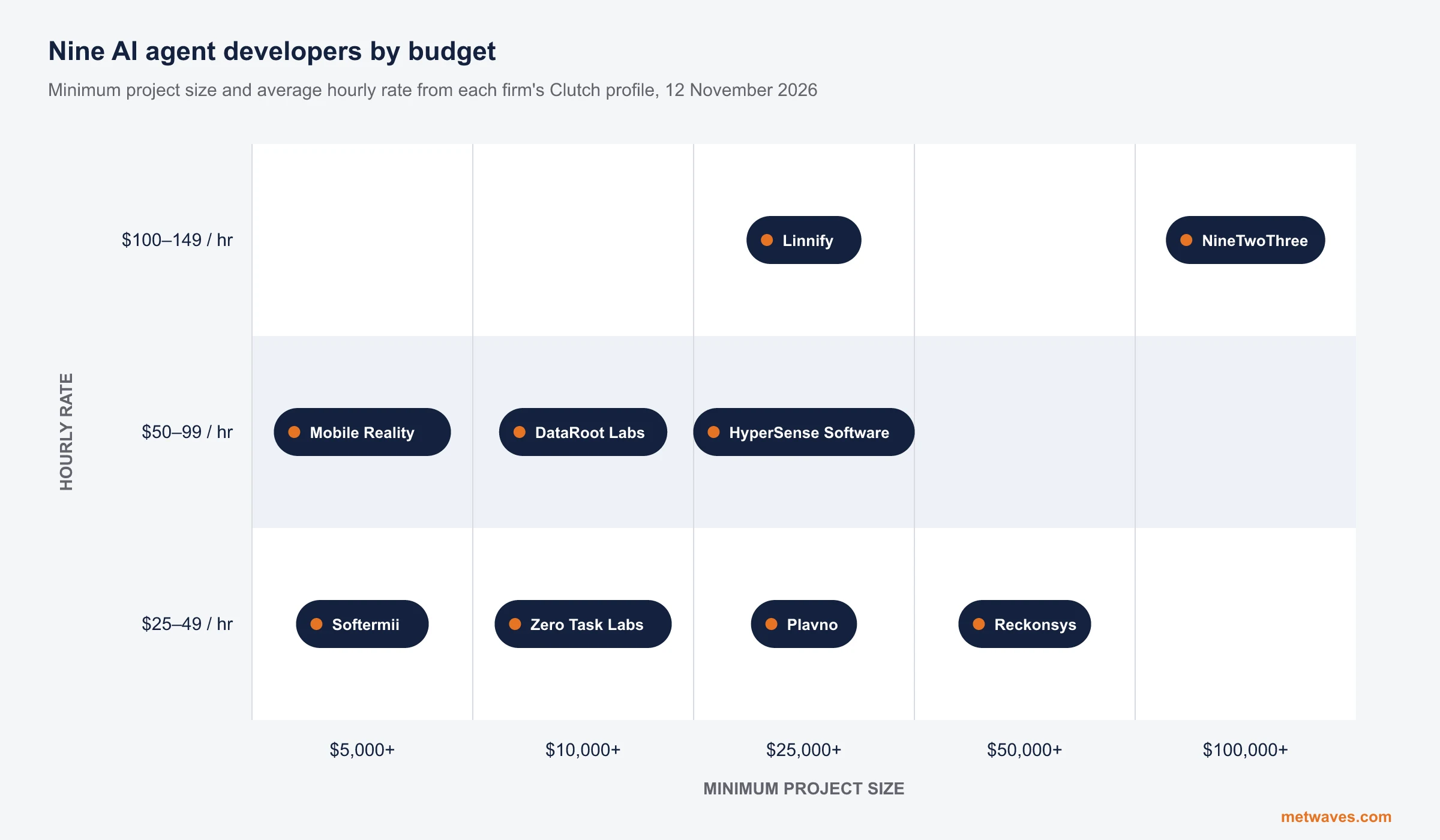
Nine AI agent development firms a small or mid-sized business can shortlist, with Clutch figures, minimum budgets and the weaknesses their own clients name. Published by Metwaves, which is not ranked.
Learn More >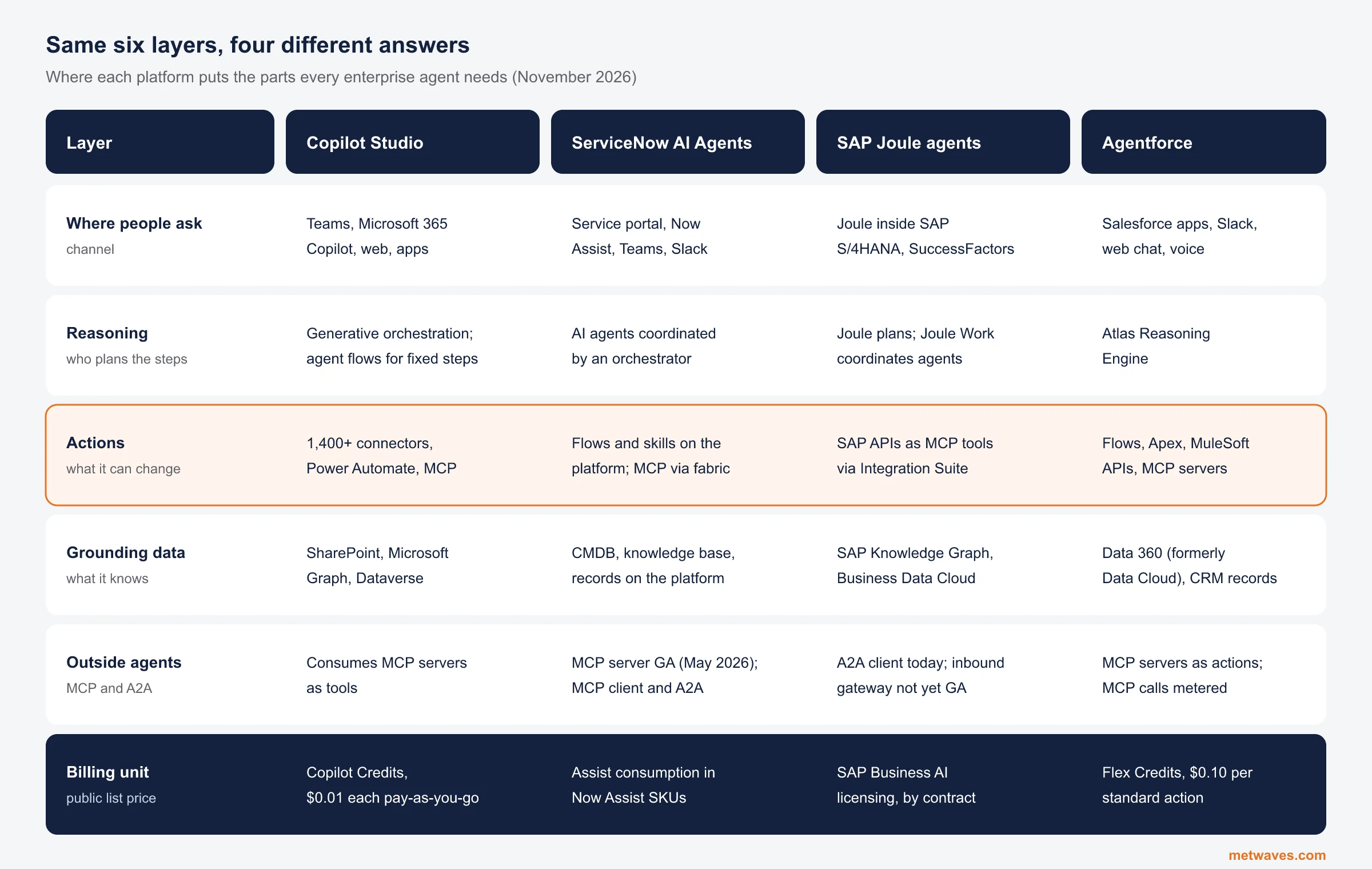 Nikit Nandan
November 12, 2026
Copilot Studio vs ServiceNow vs SAP Joule vs Agentforce: An Architecture Review (2026)
An architecture review of the four big enterprise agent platforms: where each one reasons, acts, finds its data and connects to outside agents, what it costs, and when a custom build is the better choice.
Learn More > Nikit Nandan
November 01, 2026
Top custom software development companies for small and mid-sized businesses (2026)
Ten custom software firms a small or mid-sized business can shortlist, with Clutch figures, minimum budgets and the weaknesses their own clients name. Published by Metwaves, which is not ranked.
Learn More >Let’s build your idea!
Let us help you with free analysis & estimate.
Our product expert will contact you within 12 hours.