WHEN TO CALL US
Signs your data needs engineering, not more dashboards
If two or more of these sound familiar, the problem is usually underneath the reports, in how the data is collected, cleaned and published.
- A pipeline fails overnight and someone finds out from a broken dashboard the next morning.
- Analysts spend more time cleaning and joining exports than answering the question they were asked.
- Finance and sales report different revenue numbers because each team calculates it its own way.
- Every new data source takes weeks, because each pipeline was hand-written differently.
- You want to put AI on your company data, but nobody trusts the data enough to train or ground a model on it.
- One engineer built the whole thing and is the only person who knows how it works.
WHAT WE DO
Data engineering services we provide

Data platform assessment
We map your sources, the reports and models that depend on them and what breaks today, then recommend an architecture and a phased plan. One to two weeks; you keep the plan whether or not you hire us.

Batch and streaming pipelines
Ingestion from databases, REST APIs, SaaS tools, files and event streams, with retries, schema-change alerts and run logs built in rather than added after the first outage.

Warehouse and lakehouse modelling
Raw, cleaned and business-ready layers modelled in dbt or SQL, so every metric has one definition and one owner, and the tables are documented where people look for them.

Data quality and monitoring
Tests on every run for freshness, volume, duplicates and broken joins. Failures alert the team that owns the data before a dashboard shows a wrong number.

Data for AI and machine learning
Training datasets, feature tables and the document and vector pipelines that retrieval-augmented generation (RAG) assistants need to answer from your own data.

Takeover and managed pipelines
We review pipelines another team built, fix what causes the most pain, add tests and monitoring, and then run and extend them on a monthly basis if you want us to.
ARCHITECTURE
How a well-run data platform fits together
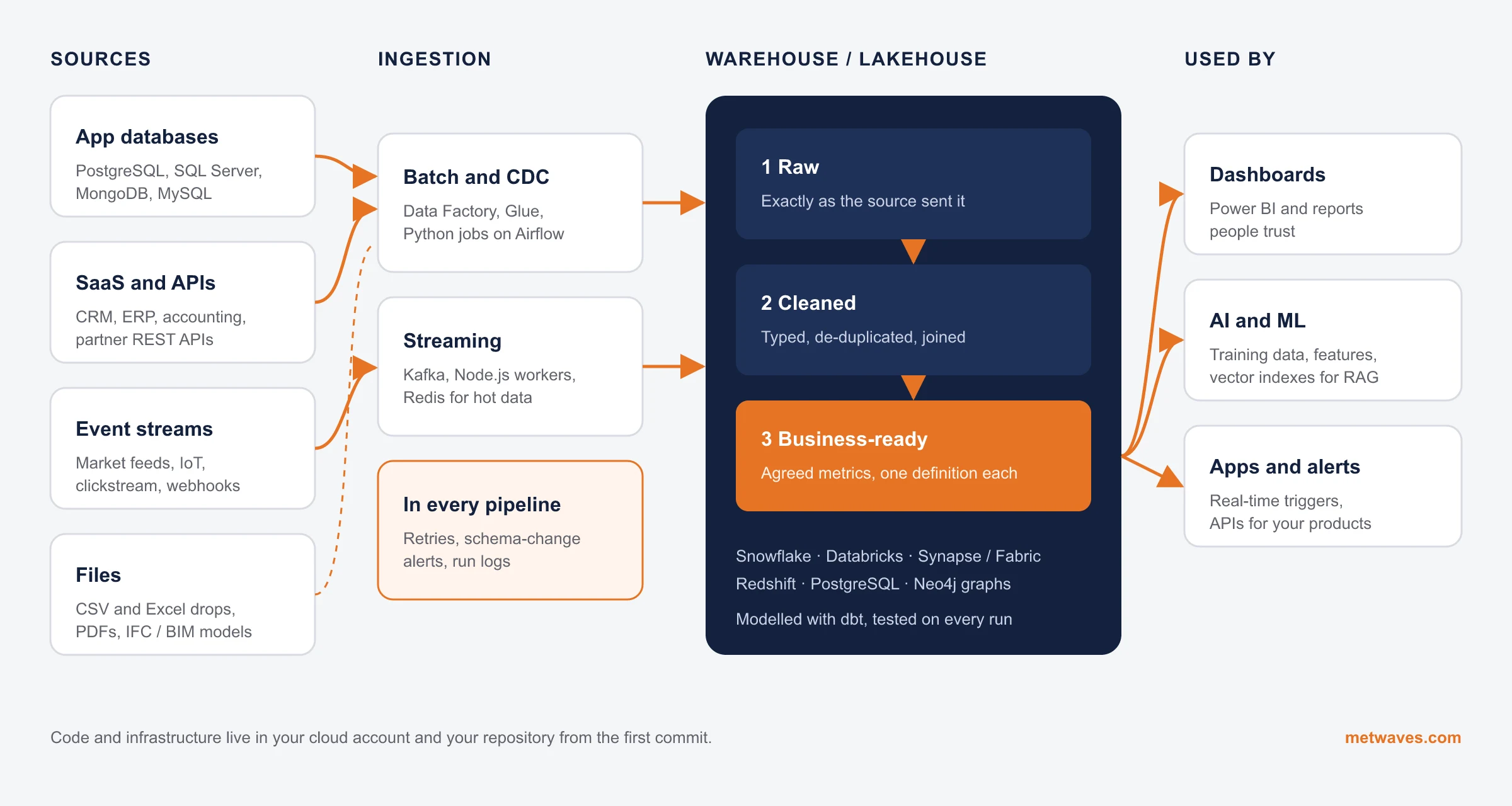
Every source lands in a raw layer exactly as it arrived, is cleaned once, and is published as business-ready tables. Dashboards, AI models and applications all read the same tables, so a number means the same thing everywhere.
BATCH OR STREAMING
Choose the pipeline your decisions need
Streaming costs more to build and run than batch. We recommend it only where a decision has to happen while the data is still fresh.
| If you… | What usually fits |
|---|---|
| Report daily or weekly, and sources change slowly | Batch loads every hour or night, modelled with dbt |
| Need dashboards a few minutes behind the source system | Change data capture (CDC) or micro-batches |
| Act on events as they happen: price moves, fraud, sensor alerts | Streaming with Kafka or Node.js workers, Redis for hot data |
| Mix BI with data science and machine learning | A lakehouse on Databricks or Snowflake |
| Have a small team and mostly SaaS sources | Managed connectors plus dbt, with little custom code to maintain |
OUR WORK
Real-time market data for 10,000 concurrent users
For an experienced trader turned founder, we built the data side of a stock and crypto alert platform. Market data streams in from exchange APIs such as IEX Cloud and Binance, Node.js workers process it asynchronously, and an alerts engine checks every user's price and volume triggers as each update arrives.
Redis caching keeps frequently requested prices close to the application and cuts load on the upstream APIs. The platform runs on AWS with load balancing and auto-scaling monitored through CloudWatch.
- Scale Up to 10,000 concurrent users without degradation
- Pipeline Exchange APIs → Node.js stream workers → Redis → MongoDB
- Platform AWS with load balancing, auto-scaling and CloudWatch
- Outcome 85% positive feedback from beta testers
HOW WE WORK
From first call to pipelines in production
One source-to-report path goes live before the rest are built, so you see working, tested data early and the pattern is proven before it is repeated.
Discovery call
Thirty minutes on your sources, the reports and models that depend on them, and what fails today.Assessment (1–2 weeks)
Source inventory, target architecture, tool choices with the reasons for each, and a phased plan with a fixed quote for the build.First domain, end to end
One source-to-report path goes live first, with tests and alerting, so the pattern is proven before it is repeated. Typically six to twelve weeks.Scale out
The remaining sources follow the same template: one ingestion pattern, one modelling standard, one deployment pipeline.Hand over or run it
Runbooks, documentation and a walkthrough for your team, or a monthly arrangement where we monitor, fix and extend the pipelines.
TECHNOLOGY STACK
We use the platforms below on client projects and choose between them per project. If you already run one of them, we usually extend it rather than replace it.
Cloud

Microsoft Azure

AWS
Warehouse and lakehouse

Azure SQL
Snowflake · Databricks · Azure Synapse / Fabric · Amazon Redshift
Ingestion and orchestration

Python

Node.js
Azure Data Factory · AWS Glue · Apache Airflow · Apache Kafka
Transformation

SQL
dbt · Spark / PySpark
Databases and caches

MongoDB

Redis
PostgreSQL · Neo4j
Reporting
Power BI
ENGAGEMENT MODELS
Ways to work with us
Every engagement starts with the assessment, which ends with a fixed quote.
| Model | Best for | How it is priced |
|---|---|---|
| Fixed scope | The assessment, or a build with a clear list of sources and outputs | Quoted after the assessment |
| Dedicated team | A data platform built over several months, with a roadmap that changes | Monthly, by team size |
| Monthly support | Running, monitoring and extending pipelines that are already live | Monthly, by scope |
BEFORE YOU HIRE ANYONE
How to choose a data engineering company
Five questions that separate a team that has run pipelines in production from one that has only drawn them.
- Ask to see a pipeline they built, including its tests, alerts and deployment, not just the architecture diagram.
- Check that the code and infrastructure will live in your cloud account and repository from day one.
- Ask what happens when a source system changes its schema without warning. A good answer names the alert and who receives it.
- Ask who will do the work, and whether the same engineers stay on the project after the sales call.
- Prefer a team that recommends batch when batch is enough. Streaming costs more to build and to run.
Not sure where your data problems start?
Tell us which report or model you cannot trust. We will tell you on the first call whether the fix is in the pipeline, the model or the source system.
Book a Data AssessmentQUESTIONS & ANSWERS
If you don't see an answer to your question, you can send us a message from our contact form.
A data engineering consultant designs and builds the pipelines that move data out of source systems, cleans and models it, and loads it into a warehouse or lakehouse. They also add the tests, monitoring and documentation that keep reports and machine learning models correct after the project ends.
Data engineers build and run the pipelines and tables. Data scientists and analysts use those tables to answer questions and build models. Without reliable data engineering, data scientists spend most of their time cleaning data instead of analysing it.
It depends on the number of sources, data volume, how fresh the data needs to be and how much already exists. We do not publish a price list. The one-to-two-week assessment ends with a fixed quote for the build, so you know the cost before committing to it.
A single well-understood source can be in production within days. A first complete domain, from source to report with tests and alerting, typically takes six to twelve weeks after the assessment.
Yes. We build in your Azure or AWS account and your repository, and we extend the tools you already use where they fit rather than replacing them by default.
Yes. We start by reviewing what exists, fix the failures that cause the most pain, and add tests and monitoring before building anything new.
Most reporting needs are met by hourly or nightly batches. Streaming is worth its extra cost when a decision has to happen within seconds, such as a price alert or a fraud check. The assessment checks which applies to each of your sources.
Reviewed by Roy Shah, Director, Software Engineering at Metwaves. Roy has more than 14 years of experience engineering enterprise applications and has led more than 15 enterprise projects. Last reviewed 12 November 2026.
INSIGHTS & NEWS
Discover IT Industry Insights and Technology Trends
 Nikit Nandan
November 12, 2026
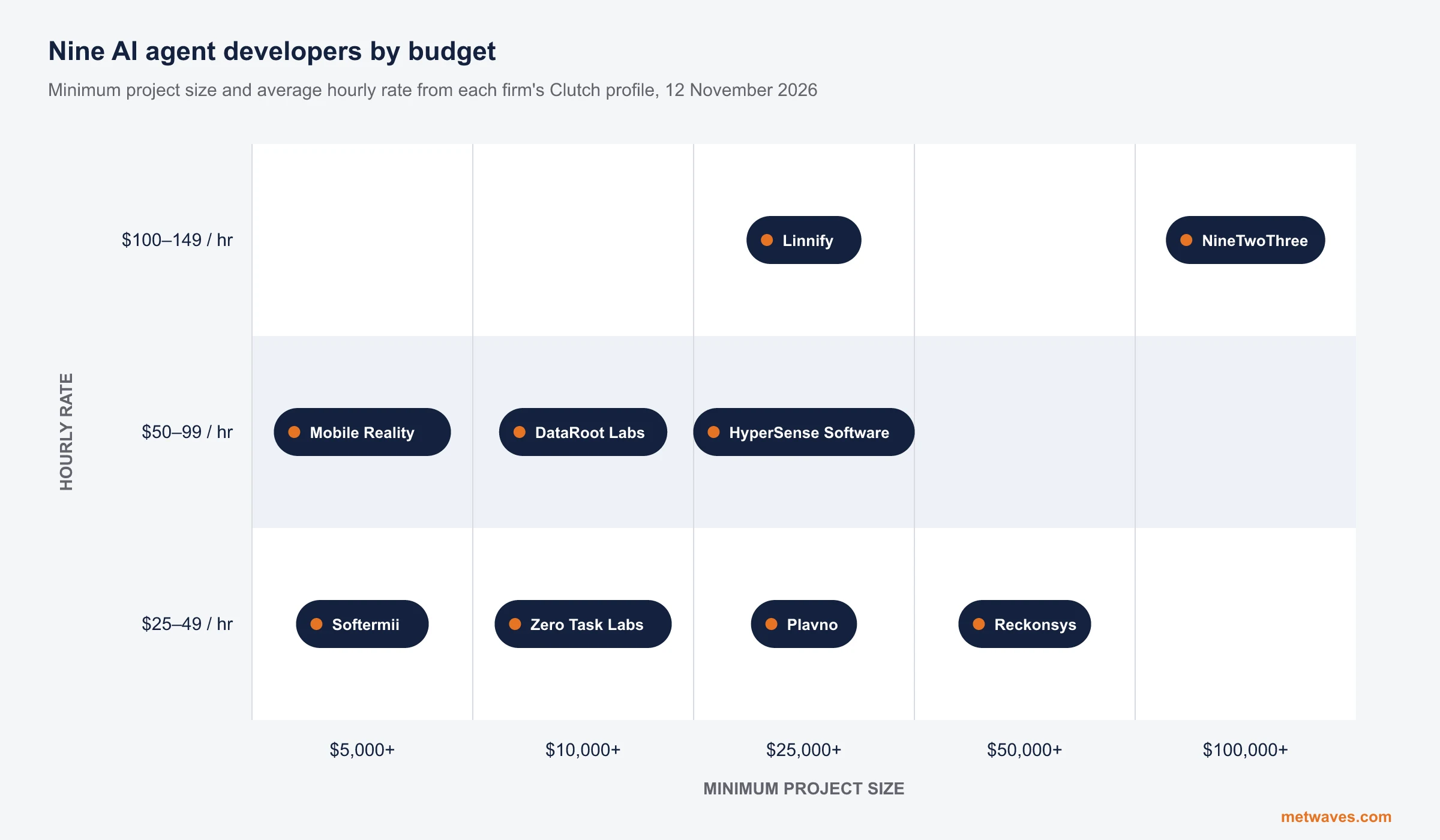
Top AI agent development companies for small and mid-sized businesses (2026)
Nine AI agent development firms a small or mid-sized business can shortlist, with Clutch figures, minimum budgets and the weaknesses their own clients name. Published by Metwaves, which is not ranked.
Learn More >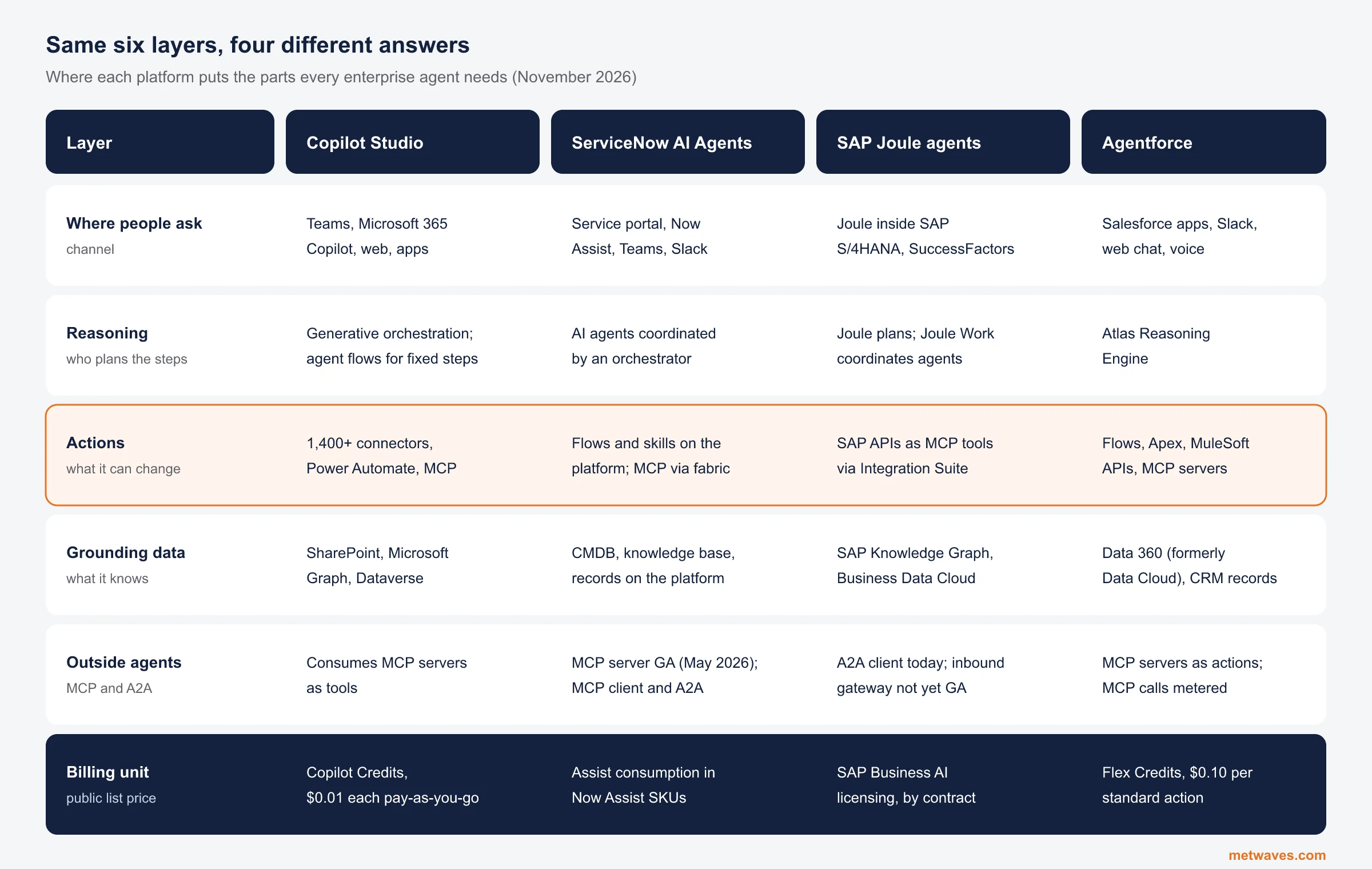 Nikit Nandan
November 12, 2026
Copilot Studio vs ServiceNow vs SAP Joule vs Agentforce: An Architecture Review (2026)
An architecture review of the four big enterprise agent platforms: where each one reasons, acts, finds its data and connects to outside agents, what it costs, and when a custom build is the better choice.
Learn More > Nikit Nandan
November 01, 2026
Top custom software development companies for small and mid-sized businesses (2026)
Ten custom software firms a small or mid-sized business can shortlist, with Clutch figures, minimum budgets and the weaknesses their own clients name. Published by Metwaves, which is not ranked.
Learn More >Let’s build your idea!
Let us help you with free analysis & estimate.
Our product expert will contact you within 12 hours.