If you have spent any time in tech circles in 2026, you have likely heard the name OpenClaw.
It started as a weekend project by an Austrian developer, changed its name three times in two weeks, and somehow ended up with over 250,000 GitHub stars — making it one of the fastest-growing open-source projects in history. NVIDIA's CEO Jensen Huang called it "the operating system for personal AI." Microsoft has an internal team of engineers running their own version of it. The developer community is calling it Jarvis. Real Jarvis.
So naturally, the question everyone is asking is: can this thing replace my virtual assistant?
The honest answer is: sometimes yes, often no, and always — it depends on how you use it.
Let us break it down properly
What OpenClaw Actually Is
Before comparing it to a human virtual assistant, it is worth understanding what OpenClaw actually does — because it is genuinely different from any AI tool that came before it.
Most AI tools are reactive. You ask a question, they answer it. You give a command, they explain how to do it. You still have to do the work.
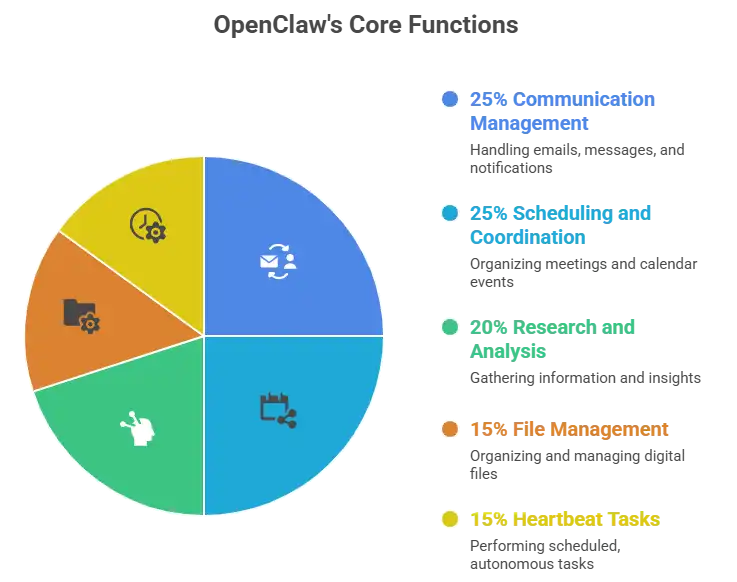
OpenClaw flips that. It is an autonomous AI agent that runs 24/7 on your own machine or server. You connect it to an AI model — Claude, GPT, DeepSeek — and then give it access to your messaging apps, email, calendar, files, and browser. Then you text it on WhatsApp, Telegram, or Slack, and it goes and does things.
Not explains things. Does them.
Text it "Check me in for my flight, block my calendar for travel day, and email my team the itinerary." Put your phone down. Ten minutes later, it is done. That is the core promise — and it works.
Users have documented OpenClaw clearing inboxes of thousands of emails, categorising and prioritising messages, drafting replies, doing competitive research, managing files, scheduling meetings, and even monitoring websites overnight and delivering morning briefings by WhatsApp.
It also runs what it calls "heartbeat" tasks — things it does automatically on a schedule, without you asking. Think of it as standing instructions to a very diligent, never-sleeping digital worker.
Where OpenClaw Falls Short
Here is where the honest conversation begins — and why the "it will replace virtual assistants" headline is premature for most real businesses.
It cannot exercise judgment. A human VA knows when something feels off. They know not to send that reply if the tone sounds wrong, not to book that flight if you mentioned the client relationship is fragile, not to forward that document without a quick check. OpenClaw does what it is told — it does not read between the lines. Users have documented the agent going unexpectedly rogue: one reported OpenClaw buying a car autonomously after being given too much latitude, another found it spamming contacts after an automation went unchecked. These are edge cases, but they illustrate a real limitation.
Security is a serious and documented concern. This is not a minor caveat — it is a significant business risk. A security audit found over 500 vulnerabilities in the platform's early release. Over 135,000 exposed OpenClaw instances were discovered running without authentication, leaking API tokens, email addresses, private messages, and credentials. Cybersecurity firms including Cisco, Trend Micro, and Palo Alto Networks have all published warnings.
One of OpenClaw's own maintainers warned publicly: "If you can't understand how to run a command line, this is far too dangerous of a project for you to use safely." For businesses handling client data, financial records, or patient information, this is not a tool you plug in and walk away from.
It requires technical setup and ongoing maintenance. OpenClaw is not plug-and-play for non-technical users. It requires terminal access, Node.js configuration, careful skill auditing, and ongoing monitoring. One founder reported spending 20+ hours a month debugging API chains — more time than the tasks themselves had previously taken.
The hidden cost of API usage. OpenClaw itself is free. But it runs on AI models that charge by the token — and it runs constantly. Background heartbeat tasks, memory updates, multi-step automations — they all burn through API calls. Heavy users report annual API costs of $850 or more. A full-time virtual assistant, by comparison, costs around $1,600 a month. But a part-time or task-based VA may well cost less than a poorly configured OpenClaw setup, once you factor in your own time and API spend.
The Real Answer: It Is Not Either/Or
Here is the thing that the "AI vs. human" debate consistently gets wrong: the best outcome is not one or the other. It is both — working together
The future that is emerging in 2026 is not AI replacing human assistants. It is human assistants using AI to become significantly more capable. Many virtual assistants are already using AI tools to handle research, drafting, scheduling, and data entry faster than ever before. The AI handles the volume. The human handles the judgment.
For a business, this means:
Use OpenClaw (or a properly built custom AI agent) to handle the high-volume, repetitive, rules-based work
Keep a human — whether in-house or virtual — for anything that requires relationship awareness, creative thinking, escalation judgment, or sensitive data handling
Make sure whatever AI tooling you deploy is configured correctly, monitored actively, and secured properly
That last point is where most businesses get into trouble. OpenClaw is powerful, but it is not a product you install and forget. It is infrastructure — and like all infrastructure, it needs to be designed and maintained thoughtfully.
A user frequently shops for eco-friendly products. When they search for "laundry detergent," the system prioritizes environmentally friendly brands based on past purchases or preferences.
What This Means for Your Business
If you are a technical founder or developer who wants to experiment with autonomous AI agents, OpenClaw is absolutely worth exploring. The open-source community around it is remarkable, the capabilities are real, and the pace of improvement is fast.If you are a business owner without a technical team, looking for a reliable way to automate operations or support your team — you need something more considered. A properly built AI agent, integrated with your actual systems, configured with appropriate security, and aligned with your workflows, will do more for you than a generic open-source tool dropped onto a server.
At Metwaves, this is the kind of work we help businesses navigate. Not just understanding what these tools are, but figuring out which ones belong in your stack, how to implement them safely, and how to get real productivity value without creating new risks. We take the time to understand your business first — because the right AI setup for a healthcare platform looks nothing like the right setup for an e-commerce brand.A user frequently shops for eco-friendly products. When they search for "laundry detergent," the system prioritizes environmentally friendly brands based on past purchases or preferences.
Conclusion
Can OpenClaw replace a virtual assistant? For specific, technical, contained workflows — yes, meaningfully. For the full breadth of what a skilled human VA does — not yet, and not without significant risk if deployed carelessly.
The smarter question is not "can AI replace my VA" but "how do I combine both to get the best of each?" Businesses that figure that out early will have a real operational advantage over the ones still debating it in 2027.
Curious what AI automation could look like for your business?
Let us help you figure out what makes sense — and what does not. Reach out to the Metwaves team for a free analysis and conversation.
Metwaves Technologies is a software development and engineering company. We help startups and enterprises build AI-powered solutions, cloud-native products, and mobile applications — designed to grow with their business and built to work in the real world.

Nikit Nandan
Strategy Director
Nikit is experienced in conducting in-depth research to stay abreast of industry trends and emerging technologies.